


China Increases Scrutiny of Rare Earth Magnets with New Tracking System

FILE PHOTO: US President Donald Trump attends a bilateral meeting with China's President Xi Jinping during the G20 leaders summit in Osaka, Japan, June 29, 2019. REUTERS/Kevin Lamarque/File Photo
TT

China Increases Scrutiny of Rare Earth Magnets with New Tracking System

FILE PHOTO: US President Donald Trump attends a bilateral meeting with China's President Xi Jinping during the G20 leaders summit in Osaka, Japan, June 29, 2019. REUTERS/Kevin Lamarque/File Photo

China has introduced a tracking system for its rare earth magnet sector, three sources said, as its export restrictions on them begin to cut off customers around the world.

The national tracking system, which went into effect last week, requires producers to submit extra information online including trading volumes and client names, said two sources familiar with the matter and another briefed by those involved.

The world's largest rare earth magnet supplier and exporter, China in early April imposed export restrictions on seven medium to heavy rare earth elements and several magnets, requiring exporters to obtain licenses, Reuters said.

Delays getting approvals have upended supply chains for automakers, semiconductor companies and others, with global automakers already beginning to stop some production lines as reserves run out.

Beijing unveiled high-level plans to establish an information tracing system for rare earth products last June, but there had been no implementation until last week, according to the source briefed on the matter.

The added level of scrutiny suggests that China's export controls on rare earths and the associated magnets - where it has a near-monopoly on production - could become a permanent feature for the products.

There have been hopes in the US and elsewhere that this would be removed as part of a trade truce agreed in Geneva last month.

In previous cases where China has imposed export curbs on metals, exports have tended to slowly rebound after the imposition of restrictions as exporters apply and receive licenses.

"Our current hypothesis is that China would continue its export control mechanism on rare earths, as its an ace card for China to hold," said Tim Zhang, founder of Singapore-based Edge Research.

Beijing's long-term target is to track the whole rare earth production chain, not just magnets, strengthen its control over the sector, and crackdown on smuggling, illegal mining and tax evasion, according to a fourth source who was also briefed on the matter.



EU, US Reportedly Near Critical Minerals Deal to Combat Chinese Control

FILE PHOTO: A block with the symbol, atomic number and mass number of Dysprosium (Dy), a heavy rare earth, in this illustration taken January 21, 2026. REUTERS/Dado Ruvic/Illustration/File Photo
TT

EU, US Reportedly Near Critical Minerals Deal to Combat Chinese Control

FILE PHOTO: A block with the symbol, atomic number and mass number of Dysprosium (Dy), a heavy rare earth, in this illustration taken January 21, 2026. REUTERS/Dado Ruvic/Illustration/File Photo

The European Union and Washington are closing in on an agreement to coordinate on producing and securing critical minerals, Bloomberg News reported on Friday.

The potential deal would include incentives such as minimum price guarantees that could favor non-Chinese suppliers, the report said, citing an "action plan".

The EU and US would also ⁠cooperate on standards, investments ⁠and joint projects, along with increased coordination on any supply disruptions by countries like China, the report added.

The European Commission declined to comment on the report. The office of the ⁠US Trade Representative did not immediately respond to Reuters' requests for comment.

EU trade commissioner Maros Sefcovic said in March he had a "very positive" meeting with US Trade Representative Jamieson Greer on the sidelines of a World Trade Organization ministerial meeting in Cameroon, where the two sides agreed to further advance work on ⁠critical ⁠minerals and also discussed tariffs.

The EU-US deal would cover “critical minerals along the entire value chain and life-cycle management, including exploration, extraction, processing, refining, recycling and recovery,” Bloomberg reported, citing a non-binding memorandum of understanding.

The US has been scrambling to get access to critical mineral reserves, especially rare earth supply chains currently dominated by Chinese players.


Gold Set for Third Weekly Gain as US Rate Outlook Offsets Dollar Strength

FILE PHOTO: Customers crowd around a jewelry showroom during Akshaya Tritiya, a major gold-buying festival, in Kochi, India April 28, 2017. REUTERS/Sivaram V/File Photo
TT

Gold Set for Third Weekly Gain as US Rate Outlook Offsets Dollar Strength

FILE PHOTO: Customers crowd around a jewelry showroom during Akshaya Tritiya, a major gold-buying festival, in Kochi, India April 28, 2017. REUTERS/Sivaram V/File Photo

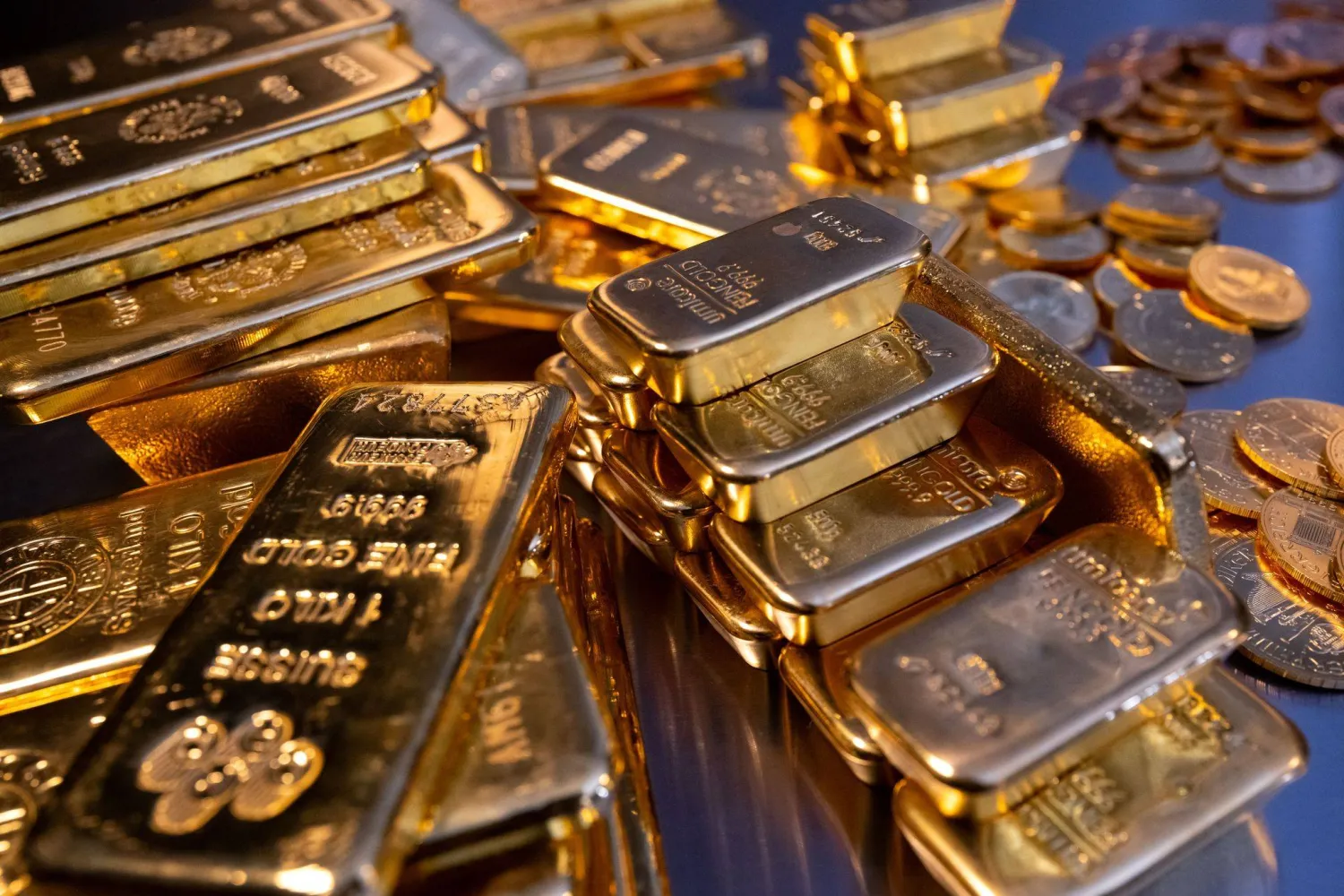
Gold steadied on Friday as US-Iran ceasefire uncertainty lingered, but the metal stayed on course for a third consecutive weekly climb as investors priced in earlier and deeper US rate cuts, supporting non-yielding bullion.

Spot gold held its ground at $4,764.54 per ounce by 0532 GMT. The metal, however, has gained 1.8% so far this week.

US gold futures for June delivery fell 0.6% to $4,787.80.

The ‌dollar index strengthened, ‌making greenback-priced bullion more expensive for holders of other currencies, Reuters said.

"There's ‌a ⁠lack of clarity ⁠about the way that the ceasefire is evolving in the Middle East and what that means to energy markets... so we're in sort of a little bit of a holding pattern (with gold) going into the final session of the week," said Kyle Rodda, senior financial market analyst at Capital.com.

Spot gold has fallen about 10% since the US-Israel conflict with Iran ⁠erupted on February 28, with elevated energy prices sparking ‌inflation concerns and the prospect of ‌higher US interest rates.

The fragile two-week ceasefire between the US and Iran showed further ‌strain on Friday, as Washington accused Tehran of breaching promises on ‌the Strait of Hormuz.

Brent crude, however, has slid more than 11% this week on optimism that the ceasefire could reopen the Strait of Hormuz, through which about 20% of the world's oil and liquefied natural gas passes.

"If things break down, (gold) ‌could end up back in mid-$4,000's pretty quickly. But if the ceasefire holds and the peace deal starts ⁠to look more ⁠likely, then we could push through $5,000," Rodda added.

On the data front, the US Personal Consumption Expenditures index, the Federal Reserve's preferred inflation gauge, advanced 2.8% in the 12 months through February, in line with estimates, and likely rose further in March.

Investors are now looking out for March's US Consumer Price Index data, due later in the day, for further clues on Fed's monetary policy direction.

Markets are pricing in a 31% chance for a US rate cut of at least 25 basis points at the Fed's December meeting, according to CME's FedWatch Tool, up from 20% in the prior session.

Among other metals, spot silver rose 1.3% to $76.03 per ounce, platinum lost 2% to $2,061.10, and palladium fell 0.2% to $1,553.92.


Saudi Business Confidence Index Remains Optimistic

A street in the Saudi capital, Riyadh (Reuters)
TT

Saudi Business Confidence Index Remains Optimistic

A street in the Saudi capital, Riyadh (Reuters)

Saudi Arabia’s Business Confidence Index remained in optimistic territory at 52.1 points in March, underscoring private sector resilience despite geopolitical challenges.

The index fell from 60.7 in February but stayed above the neutral 50 threshold, reflecting continued confidence in stable economic activity and sustained growth across key sectors, according to the General Authority for Statistics (GASTAT).

A statement released by GASTAT said that the BCI for the industrial sector recorded 50.8 points, maintaining an optimistic level despite a decline of 15.8 percent compared to February.

The BCI for the services sector recorded 52.0 points, maintaining an optimistic level despite a decline of 14.9 percent compared to February, it said.

Regarding the BCI in the construction sector, the data revealed that in March, it recorded an optimistic level at 53 points, confirming the continued positive confidence among establishments in the sector, the statement added.