


White House Says Iran Could Produce a Nuclear Weapon in 'a Couple of Weeks'

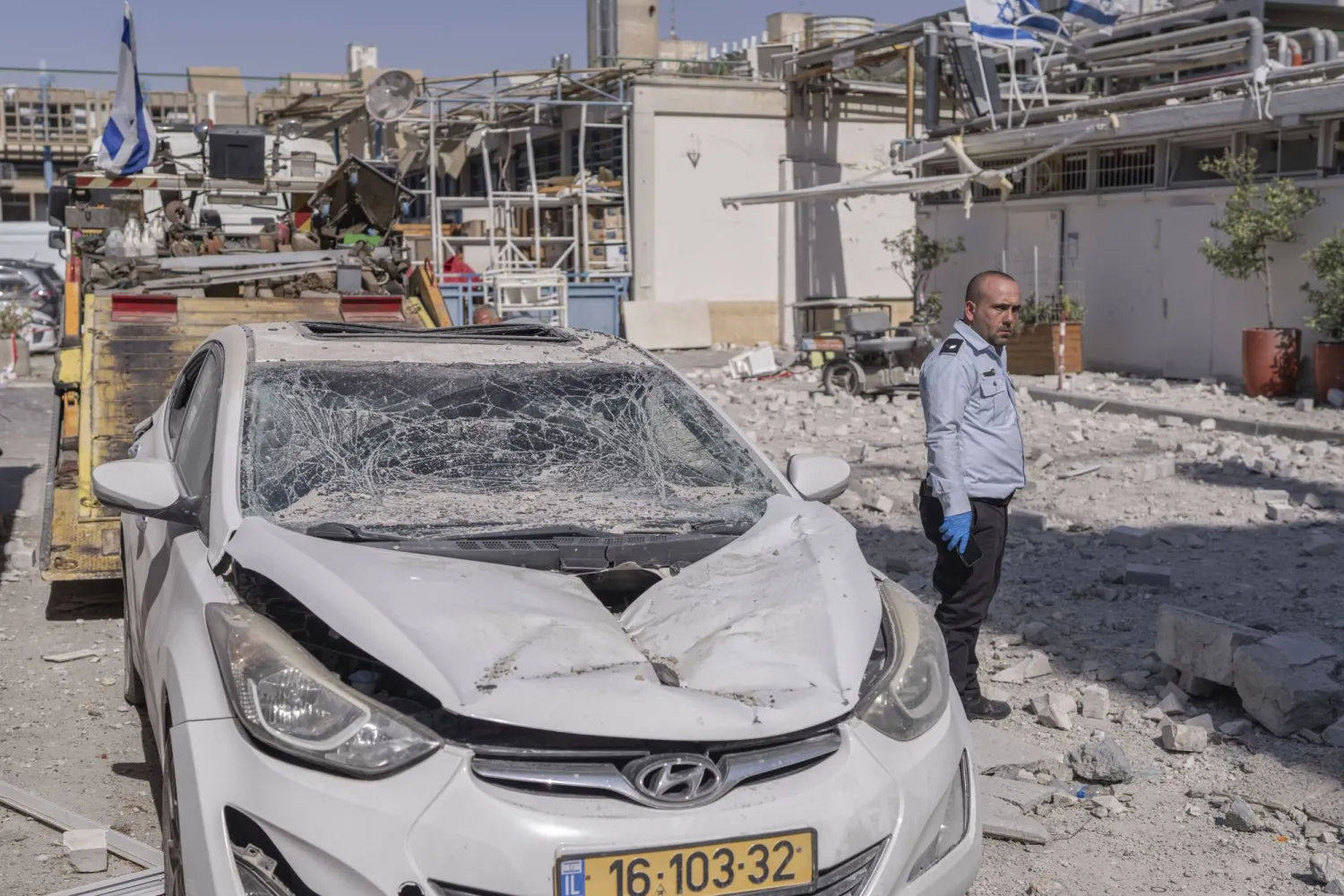
19 June 2025, Israel, Be'er Sheva: A view of the damage at the Soroka hospital premises after it was hit by an Iranian missile in Be'er Shiva. Photo: Ilia Yefimovich/dpa
TT

White House Says Iran Could Produce a Nuclear Weapon in 'a Couple of Weeks'

19 June 2025, Israel, Be'er Sheva: A view of the damage at the Soroka hospital premises after it was hit by an Iranian missile in Be'er Shiva. Photo: Ilia Yefimovich/dpa

The White House stated on Thursday that Iran can produce a nuclear weapon in a matter of two weeks once its supreme leader, Ali Khamenei, gives the green light.

"Let's be very clear, Iran has all that it needs to achieve a nuclear weapon," White House press secretary Karoline Leavitt said at her briefing. "All they need is a decision from the supreme leader to do that."

"And it would take a couple of weeks to complete the production of that weapon, which would, of course, pose an existential threat not just to Israel but to the United States and to the entire world," she added.

Israel and Iran's air war entered a second week on Friday and European officials sought to draw Tehran back to the negotiating table after President Donald Trump said any decision on potential US involvement would be made within two weeks.

Israel began attacking Iran last Friday, saying it aimed to prevent its longtime enemy from developing nuclear weapons. Iran retaliated with missile and drone strikes on Israel. It says its nuclear program is peaceful.

Israeli air attacks have killed 639 people in Iran, the Human Rights Activists News Agency said. Those killed include the military's top echelon and nuclear scientists. Israel has said at least two dozen Israeli civilians have died in Iranian missile attacks.

Israel has targeted nuclear sites and missile capabilities, and sought to shatter the government of Supreme Leader Ali Khamenei, according to Western and regional officials.

Iran has said it is targeting military and defence-related sites in Israel, although it has also hit a hospital and other civilian sites.
Israel accused Iran on Thursday of deliberately targeting civilians through the use of cluster munitions, which disperse small bombs over a wide area. Iran's mission to the United Nations did not immediately respond to a request for comment.



US War Against Iran Enters a New Phase

The US deploys two aircraft carriers and more than 20 US Navy warships across the Middle East (CENTCOM)
TT

US War Against Iran Enters a New Phase

The US deploys two aircraft carriers and more than 20 US Navy warships across the Middle East (CENTCOM)

By: Julian E. BarnesEric Schmitt and David E. Sanger


The Trump administration has lurched back into a war against Iran that had never really ended.

When the war started more than four months ago, US forces targeted Iranian military bases, missile launchers, ships and naval facilities. Israel, fighting alongside the United States, hit leadership targets, hoping to bring down Iran’s hard-line government.

Their record of success has been mixed, at best. Israel killed the supreme leader, Ali Khamenei, but the leaders who succeeded him were even more hard-line. US forces struck thousands of targets, but did not destroy Iran’s ability to control the Strait of Hormuz, the waterway through which about 20% of the world’s oil typically flows.

For roughly 90 days beginning in April, an on-again-off-again cease-fire prevailed. And then it was over.

The United States now appears to be entering Round 2 of its military campaign. This round has a new focus — but not necessarily a clearer strategy.

Iran’s ability to control the strait, despite the pummeling its navy took, is by far the most important lesson of the first phase of the war. So it is no surprise that the Trump administration is focused on trying to loosen Iran’s grip on it.

Last Tuesday, in retaliation for attacks on tankers, Trump ordered airstrikes on dozens of targets in Iran, including coastal radars, anti-ship missile launchers and a fleet of small Iranian attack boats.

After a short lull, the United States hit 140 military targets in the first of three consecutive days of heavy bombing this week.

US forces carried out new rounds of attacks on Iran throughout Tuesday and resumed a naval blockade of Iranian ports, a strategy that showed some success in the earlier phase.

The strikes are intended to open the waterway to shipping. The purpose of the naval blockade is to put economic pressure on Iran by choking off its trade and to flex American military might.

Trump was quick to declare success.

“The Strait of Hormuz is open to ALL Ship traffic except for Iran — and that is because of their lying, violent, malicious leadership, which is taking them down the path of TOTAL DESTRUCTION,” Trump wrote on Truth Social on Tuesday morning.

But exactly what the US military will do to enforce the blockade, and how far it will go to exert control of the strait, is not clear.

Round 1 of the war came at a high cost. Tehran has estimated that at least 3,500 Iranians have died in the war, including 175 at an elementary school.

Thirteen US service members have been killed. And the war has cost tens of billions of dollars already, and the new round could drive those financial costs up substantially.

A critical question for the next phase is whether Trump will consider an operation to take Kharg Island, a key export hub for Iran’s oil in the northern Arabian Gulf.

Trump publicly mused about ordering the Marines to take control of the island during the first phase of the war, but ultimately abandoned those plans for fear of high US casualties.

Such an operation would be a far bigger escalation than Trump has undertaken so far. But it would be difficult, and lives could be lost in either taking or holding the island.

The United States continues to have a fearsome arsenal in the region, including two aircraft carriers, and dozens of carrier- and land-based attack and surveillance planes.

“There are currently more than 20 US Navy warships and hundreds of military aircraft operating across the Middle East,” Central Command said in a statement announcing the resumption of the blockade. “American forces remain vigilant, lethal, and ready.”

In the strikes last week, US forces hit more than 170 Iranian military targets. In three consecutive days of heavy bombing this week, the United States has hit 140 military targets.

Analysts said the Trump administration was sending a pointed message to the government in Tehran that the United States was willing to broaden its mission again and hit sites that have both military and civilian uses.

But senior US officials said the real focus of the current phase is undoubtedly the strait.

So far, Trump had not ordered resumption of such an all-out conflict, in part because that could prompt Iran to target not only US military bases in the region, but also energy infrastructure in those nations.

Attacks on those facilities could send oil and natural gas prices skyrocketing even higher.

Senior officials said the goal of the new military campaign is to force Iran to allow tankers and other commercial cargo ships to pass freely through the strait, and ultimately to return to the bargaining table to resume nascent talks on more difficult, long-term issues like the fate of Iran’s highly enriched uranium.

Administration officials acknowledge that the military strategy is not without risks. Iran has shown it has an asymmetric advantage. Iranian forces do not have to hit every ship passing through the strait, or sink any of them. They only have to cause enough damage and issue enough threats to scare shipping companies and insurers.

This week, Iranian missiles struck two crude oil carriers that were transiting the southern part of the strait. The attack killed an Indian crew member. Another tanker, carrying liquefied natural gas, was also hit and caught fire near the Omani coast.

Senior US officials said time remains on the American side as Iran’s economy collapses.

During the uneasy peace, Iran was able to get many of its tankers out, and to empty storage tanks that were overflowing with oil.

The resumed blockade will cause that oil to back up once more, and the money Iran has made from its oil exports will begin to dry up.

But the real question is: Can Iran’s hard-line leadership outlast Trump’s anxiety over rising oil prices?


*The New York Times


Why Greater Tunb Matters Near the Strait of Hormuz

An aerial view of Iran’s Qeshm Island near the Strait of Hormuz (Reuters)
TT

Why Greater Tunb Matters Near the Strait of Hormuz

An aerial view of Iran’s Qeshm Island near the Strait of Hormuz (Reuters)

US strikes on Greater Tunb on Wednesday thrust one of the most sensitive points at the entrance to the Strait of Hormuz back into the center of the confrontation, after US Central Command said it hit coastal defense systems, storage sites and cruise missile launchers in a 90-minute assault.

CENTCOM said the strikes were aimed at reducing Iran’s ability to attack commercial vessels in the strait.

Greater Tunb, one of three Emirati islands occupied by Iran since 1971, hosts a military airfield, Iranian Revolutionary Guard Corps Navy bases, garrisons and missile assets used to monitor nearby shipping lanes.

Former IRGC Navy commander Alireza Tangsiri had called the island vital to Iran’s control of the strait because it sits between the main inbound and outbound shipping routes.

Tangsiri, who was killed in an airstrike in Bandar Abbas on March 26, said in an earlier state television interview that losing Greater Tunb would mean losing control of transit routes through the Strait of Hormuz.

Its location, he said, gave Iranian forces the ability to monitor maritime traffic and shape its movement.

Tangsiri also tied Abu Musa and Sirri islands to Iran’s gas fields and Gulf trade, warning that the loss of Abu Musa could lead to the loss of Sirri and its military positions, gas fields and trade routes.

He had overseen the expansion of IRGC bases across the islands, including the military airfield on Greater Tunb and facilities on Sirri.

Islands and shipping lanes

Greater Tunb is part of a chain that includes Abu Musa, Lesser Tunb, Qeshm, Larak, Hormuz and Sirri. Studies have described the islands as forming Iran’s “defensive arc” around the strait.

Iranian officials have likened them to “unsinkable aircraft carriers” because they host anti-ship missiles, surveillance posts and naval bases.

Greater Tunb’s importance also lies in its proximity to the two main shipping lanes.

Tehran says vessels must follow routes and schedules set by Iranian authorities and secure prior approval. Washington is pressing for a southern route along the Omani coast that would fall outside Iranian control.

The routes have become a central point of dispute since the Islamabad memorandum of understanding on June 17.

Iran interprets its fifth provision as granting Tehran a role in regulating passage. The United States says the Strait of Hormuz is an international waterway that cannot be subjected to unilateral permits or fees.

Greater Tunb is a forward military outpost in Iran’s network of control over the strait.

The strikes were aimed at disabling coastal defense and missile sites that could be used against vessels and weakening Iran’s ability to impose its rules on shipping.


US Strikes Expand into Northern Iran as it Disables Ship Trying to Run Blockade

TOPSHOT - This frame grab taken from AFPTV video footage on July 12, 2026 shows cargo ships anchoring near the Strait of Hormuz off the eastern coast of the United Arab Emirates at Khor Fakkan. (Photo by AFPTV / AFP)
TT

US Strikes Expand into Northern Iran as it Disables Ship Trying to Run Blockade

TOPSHOT - This frame grab taken from AFPTV video footage on July 12, 2026 shows cargo ships anchoring near the Strait of Hormuz off the eastern coast of the United Arab Emirates at Khor Fakkan. (Photo by AFPTV / AFP)

The United States intensified its strikes targeting Iran early Thursday, hitting targets further north as American forces also fired into a ship it accused of trying to break its naval blockade on Iran.

Iran retaliated with missile and drone fire targeting Bahrain, Jordan and Kuwait before dawn.

Days of back-and-forth strikes by the US and Iran across the Middle East — and renewed threats to the Strait of Hormuz — have shredded the interim deal to end the Iran war and could tip the region back into all-out war. Already, Iranian officials say US strikes have killed more than 35 people and wounded over 300 others. Strikes also reached into areas around Iran’s capital, Tehran, for the first time of this latest round of violence, The Associated Press said.

When the US and Israel launched the war on Iran on Feb. 28, Tehran effectively closed the strait to shipping traffic, a move that sent the price of oil, fertilizer and many other goods soaring far beyond the region and gave Iran major leverage in negotiations.

US and Iran trade threats as attacks intensify

Those rising prices pose a particular challenge to US President Donald Trump and his Republican Party, which hopes to retain control of Congress in elections in November. But Washington has struggled to successfully reopen the waterway, leading to Trump reimposing the naval blockade Wednesday.

Iran’s parliament speaker and lead negotiator, Mohammad Bagher Qalibaf, said Iran was prepared for a fuller military confrontation if the US does not live up to the terms of the interim deal, and Iran’s paramilitary Revolutionary Guard threatened to halt all energy exports from the Middle East over the blockade.

“The export of oil and gas from the region will be either for everyone or for no one,” the Guard said.

Trump again insisted Iran was ready to strike a peace deal, but he did not elaborate.

“They don’t like what we’re doing, and they do want to settle. We’ll find out whether or not we settle with them, or we just finish it off,” he said Wednesday at the US Army War College in Pennsylvania.

Trump separately said on social media that Tehran made a goodwill gesture by releasing an American citizen wrongly detained in Iran since 2024. He didn’t release further details. Human rights lawyer Jared Genser released a statement identifying the detainee as his client Dena Karari, a US-Iranian citizen who runs a nonprofit and was charged with espionage.

Iran did not immediately acknowledge the release and her case was not publicly known, as is sometimes the case with detentions in Iran.

Both the US and Iran launch attacks as blockade is reimposed

The US strikes early Thursday hit around Tehran, state media reported. It also reported that American attacks targeted Semnan province, home to Iran’s ballistic missile production and space program.

On Wednesday, the US resumed striking Iran during daylight, further showing the increasing tempo of the attacks. An attack on Greater Tunb Island, a strategic point in the Strait of Hormuz, targeted Iranian defense and missile sites, Central Command said.

Meanwhile, the US military said it opened fire on the Curacao-flagged oil tanker Belma sailing toward Kharg Island, Iran’s main oil export terminal in the Arabian Gulf. After the ship “ignored multiple warnings,” a US aircraft disabled the merchant vessel by firing a missile into the ship’s smokestack.

Another American strike Wednesday targeted a barracks for Iran’s 388th Mechanized Infantry Brigade, which operates tanks and armored vehicles, in Sistan and Baluchestan province, Iranian state television reported. The report said Americans fired at least 13 missiles in the attack and the seven dead included conscripts and career soldiers. A number of troops were wounded.

Iran retaliated Thursday with missile and drone attacks on Bahrain, Jordan and Kuwait, authorities in those countries home to US forces said. There was no immediate acknowledgment of damage or casualties from the attacks.

The Strait of Hormuz remains at the heart of the fighting

The latest round of fighting is focused on the Strait of Hormuz. How to reopen the strait has bedeviled the US since Iran choked it off in the early days of the war.

During the interim deal, some ships began moving through the passage using a route near Oman overseen by the US military that is outside Tehran’s control.

In recent days, Iran attacked ships using that route — and back-and-forth attacks ensued. The US has threatened to reopen the strait by force — but experts say that would require a much bigger armada if not tens of thousands of ground troops. Imposing the blockade is another way to put pressure on Iran.

But in the meantime, oil prices are rising. The price for Brent crude oil, the international standard, traded above $85 a barrel on Thursday — more than 15% higher than the price before the war, but still well below the nearly $120 reached at the height of the conflict.