World Leaders Express Solidarity with Qatar Following Iranian Attack

Remnants of an Iranian missile intercepted over Qatar (AFP)
TT

World Leaders Express Solidarity with Qatar Following Iranian Attack

Remnants of an Iranian missile intercepted over Qatar (AFP)

In the wake of Iran’s missile strike on Al-Udeid Air Base in Qatar, Arab and world leaders have expressed firm solidarity with the Qatari leadership, condemning the attack as a flagrant violation of the country’s sovereignty and international law.

Saudi Crown Prince Mohammed bin Salman called Qatari Emir Sheikh Tamim bin Hamad Al Thani to convey the Kingdom’s strong condemnation of the Iranian assault, reiterating Saudi Arabia’s full support for Qatar. He described the strike as a “blatant breach of Qatari airspace and sovereignty” and a serious threat to regional stability.

The Crown Prince stressed the need for restraint and a return to diplomatic channels.

Oman’s Sultan Haitham bin Tariq also spoke with Sheikh Tamim, voicing full support for Qatar and praising its calm and measured response to the regional escalation. He reaffirmed Oman’s rejection of any act that undermines the sovereignty or stability of Gulf nations and called for dialogue and peaceful conflict resolution.

US President Donald Trump joined the growing list of leaders condemning the attack. In a phone call with the Qatari Emir, Trump reaffirmed America’s commitment to Qatar’s security and condemned Iran’s actions as a “grave violation of international law and the UN Charter.”

Qatar also received expressions of support from Iraq’s Prime Minister Mohammed Shia Al-Sudani, who labeled the attack a “dangerous violation” and affirmed Baghdad’s solidarity with Doha. Al-Sudani stressed Iraq’s rejection of any aggression threatening the security of regional nations and urged all parties to exercise restraint and seek diplomatic solutions.

Egyptian President Abdel Fattah El-Sisi echoed similar sentiments in a phone call with Sheikh Tamim, voicing Cairo’s strong condemnation of the Iranian strike and declaring unwavering support for Qatar. He underscored the importance of maintaining regional stability and avoiding escalation.

Meanwhile, Lebanese Prime Minister Nawaf Salam, who visited Doha on Tuesday, met with the Qatari Emir and reaffirmed Lebanon’s support for Qatar’s sovereignty. Salam condemned the attack as a serious threat to regional peace and extended his appreciation for Qatar’s consistent support to Lebanon during challenging times.

Malaysia’s Prime Minister Anwar Ibrahim and Sudan’s Transitional Sovereignty Council Chairman General Abdel Fattah al-Burhan also joined in condemning the Iranian strike in separate phone calls with Sheikh Tamim. Both leaders expressed their nations’ solidarity with Qatar and stressed the need for diplomatic resolution and de-escalation.

In response, the Emir expressed deep gratitude for the broad regional and international solidarity, describing it as a testament to the strength of Qatar’s partnerships and the shared commitment to peace and stability in the Gulf.

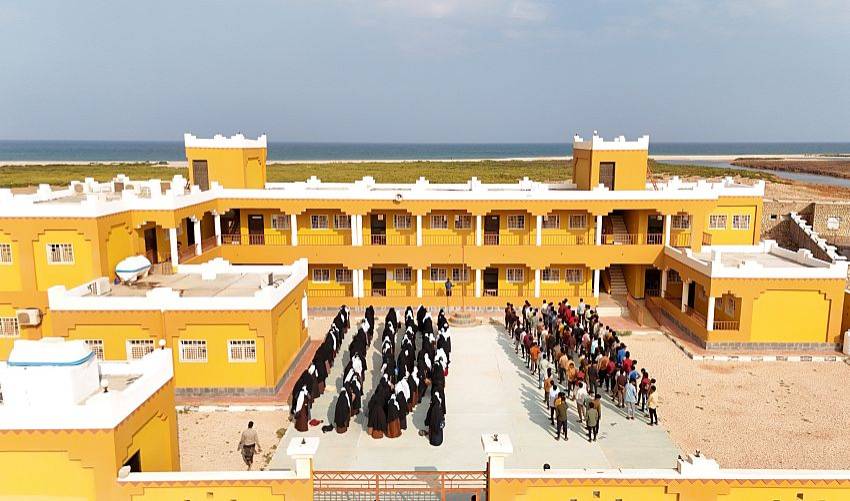

300 Saudi Projects to Strengthen Essential Services in Yemen

Hundreds of Saudi projects support the education and health sectors in Yemen. (SDRPY)
TT

300 Saudi Projects to Strengthen Essential Services in Yemen

Hundreds of Saudi projects support the education and health sectors in Yemen. (SDRPY)

Saudi Arabia is stepping up development and humanitarian efforts in Yemen, expanding healthcare and education services, improving access to water and delivering food and shelter to displaced families across the country.

The Saudi Development and Reconstruction Program for Yemen (SDRPY) has carried out 300 projects and initiatives across 16 governorates, spanning eight key areas: education, healthcare, energy, water, transportation, agriculture and fisheries, development programs, and support for the Yemeni government's institutional capacity.

In healthcare, the program has delivered more than 40 projects and initiatives and supported 30 medical facilities across 13 governorates, building, equipping and operating hospitals and healthcare centers while training medical personnel and strengthening their specialized skills.

Among its flagship projects is the 270-bed Prince Mohammed bin Salman Hospital in Aden, equipped with 14 specialized clinics, a cardiac center and more than 2,000 medical devices and pieces of equipment.

Since opening in January 2023, the hospital has provided nearly five million medical services through October 2026, including 31,000 surgical procedures and more than 11,000 cardiac surgeries and catheterization procedures, according to published figures.

Other major projects include the King Salman Medical and Educational City in Al-Mahra governorate, home to a 110-bed hospital, and support for the governorate's dialysis center, which has delivered more than 100,000 specialized medical services, including over 22,000 dialysis sessions.

The program has also rehabilitated healthcare centers in Socotra, supplied medical equipment to hospitals in Marib and operated healthcare facilities in Socotra and Shabwa.

Education is another major focus, with around 60 projects and initiatives across 11 governorates. These include building and equipping more than 40 model schools, upgrading university infrastructure and laboratories, expanding technical and vocational education, and improving teacher training and access to schooling in rural areas.

At the University of Aden, projects include equipping 28 laboratories at the Faculty of Pharmacy and establishing a forensic research laboratory at the Faculty of Law.

Saudi Arabia has been keen on supporting the education sector in Yemen. (SDRPY)

In Marib, the program has supported the development of the University of Saba Region with two new buildings housing 16 classrooms, an administrative building and university transportation.

Efforts to expand girls' education in rural areas have also gained ground. The first phase of the Rural Education Access Project trained 150 young women for teaching diplomas, while the second aims to train 450 female secondary school graduates across six rural governorates.

Another initiative is training 200 male and female teachers under the International Professional Certifications in Teaching Project.

Humanitarian response

Alongside long-term development efforts, the King Salman Humanitarian Aid and Relief Center (KSrelief) is delivering emergency water, food and shelter assistance to displaced families across several Yemeni governorates.

In Taiz and Lahj, emergency water and sanitation agreements provide for daily water supplies over 90 days, alongside distribution points, storage containers and water quality testing.

The Taiz project is expected to reach 3,500 people directly and another 700 indirectly. In Lahj, the figures stand at 2,163 direct beneficiaries and 1,050 indirect beneficiaries.

Food assistance has also reached displaced communities in Abyan, Aden and Shabwa.

The center distributed 510 food baskets in the Khanfar district in Abyan, 350 in the Mansoura district in Aden and 1,100 in the Nisab district in Shabwa, benefiting 7,700 people.

In the Hajjah governorate, 564 people in the Haradh and Midi districts received shelter assistance, including 94 tents and 94 shelter kits.

Together, the initiatives reflect Saudi Arabia's efforts to combine long-term investment in Yemen's essential services, education and institutional capacity with immediate humanitarian assistance for displaced people and local communities.


GCC Secretary-General Meets with Turkish Foreign Minister in Istanbul

Secretary-General of the Gulf Cooperation Council (GCC) Jasem Mohamed Albudaiwi
TT

GCC Secretary-General Meets with Turkish Foreign Minister in Istanbul

Secretary-General of the Gulf Cooperation Council (GCC) Jasem Mohamed Albudaiwi

Gulf Cooperation Council (GCC) Secretary-General Jasem Albudaiwi met on Friday with Minister of Foreign Affairs of the Republic of Türkiye Hakan Fidan, on the sidelines of the 9th Istanbul Mediation Conference held under the theme "Partnerships and New Perspectives for Peace: Mediation in a Changing World."

The two sides reviewed GCC-Turkish relations and explored avenues to broaden cooperation across various fields, reflecting the growing partnership between the GCC and Türkiye to serve mutual interests, SPA reported.

Both officials expressed their shared anticipation for convening the seventh Joint Ministerial Meeting of the Strategic Dialogue between the GCC and Türkiye in the coming period, emphasizing its role in advancing joint initiatives and opening new horizons for cooperation.

The meeting also addressed the latest regional developments, with both sides exchanging views on efforts to de-escalate tensions and bolster regional security and stability.


UAE: Oil Spill from Tanker Affects Beaches in Umm Al Quwain

An image published by the UAE Ministry of Climate Change and Environment of one of the country's beaches. (UAE Ministry of Climate Change and Environment)
TT

UAE: Oil Spill from Tanker Affects Beaches in Umm Al Quwain

An image published by the UAE Ministry of Climate Change and Environment of one of the country's beaches. (UAE Ministry of Climate Change and Environment)

The UAE Ministry of Climate Change and Environment said on Friday that its monitoring and environmental assessment systems had detected marine pollution caused by an oil leak from a tanker.

The spill had affected beaches in the emirate of Umm Al Quwain, the ministry said.

It said in a statement that the leak had caused odors reported by residents of Sharjah, Ajman and Umm Al Quwain, adding that it posed no health concerns or risks to residents.

All beaches and coastal areas in Umm Al Quwain had been temporarily closed as a precautionary measure to ensure the safety of the marine environment while survey operations were completed, added the ministry.

Specialist teams had begun coordinating with the relevant authorities to contain the pollution, cordon off affected areas and launch cleanup and remediation operations to limit its environmental impact, the statement added.