


Iran's Judiciary Says at Least 71 Killed in Israel's Attack on Tehran's Notorious Evin Prison

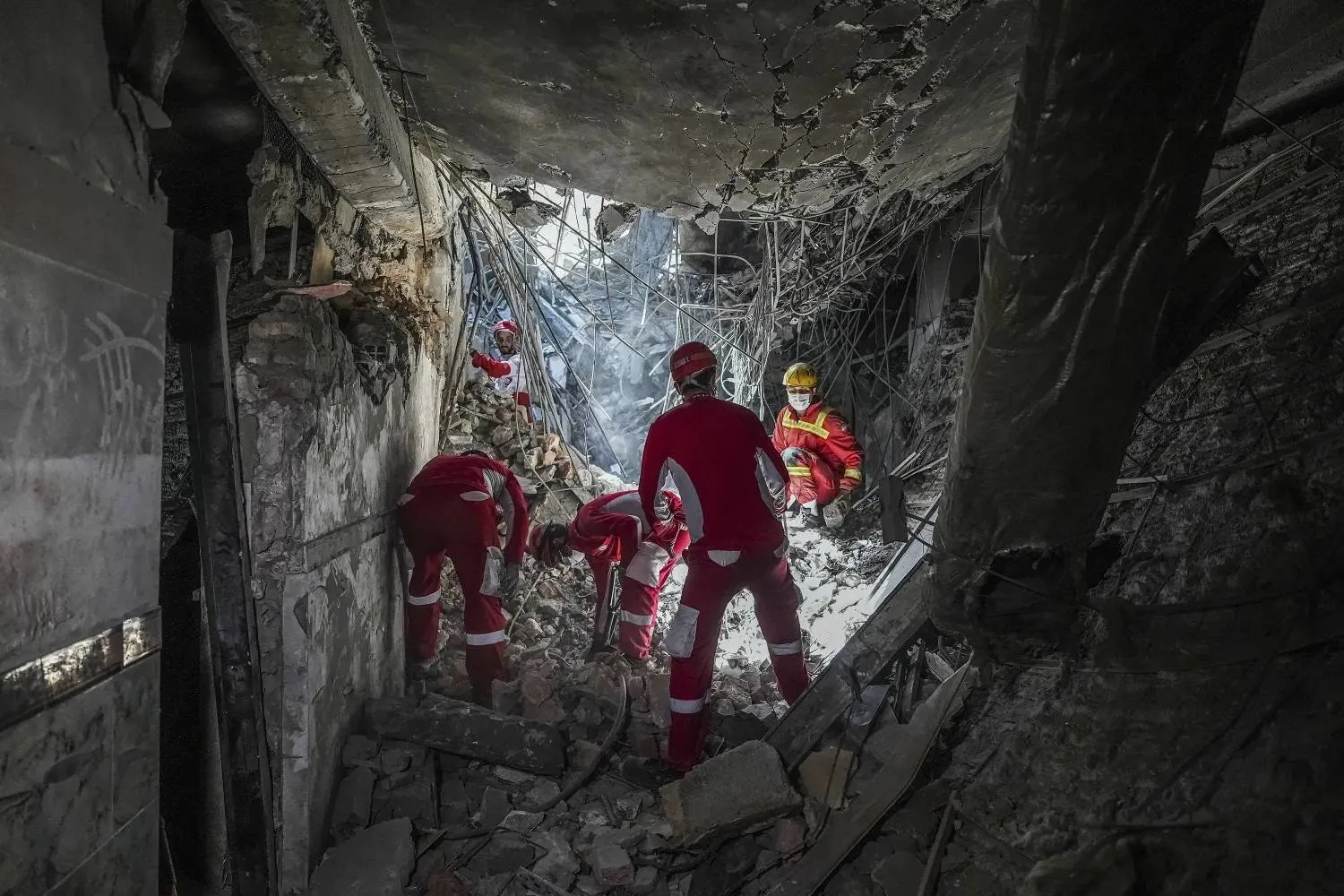
In this picture obtained from the Iranian judiciary's news agency Mizan Online on June 25, 2025, rescuers sift through the rubble inside the Evin prison complex in Tehran that was hit days ago by an Israeli strike. (Mostafa Roudaki/mizanonline/AFP via Getty Images) 
TT

Iran's Judiciary Says at Least 71 Killed in Israel's Attack on Tehran's Notorious Evin Prison

In this picture obtained from the Iranian judiciary's news agency Mizan Online on June 25, 2025, rescuers sift through the rubble inside the Evin prison complex in Tehran that was hit days ago by an Israeli strike. (Mostafa Roudaki/mizanonline/AFP via Getty Images) 

At least 71 people were killed in Israel’s attack on Tehran’s Evin prison, a notorious facility where many political prisoners and dissidents have been held, Iran's judiciary said on Sunday.

Judiciary spokesperson Asghar Jahangir posted on the office’s official Mizan news agency website that those killed on Monday included staff, soldiers, prisoners and members of visiting families. It was not possible to independently verify the claim.

The June 23 attack, the day before the ceasefire between Israel and Iran took hold, hit several prison buildings and prompted concerns from rights groups about the safety of the inmates.

Jahangir did not break down the casualty figures but said the attack had hit the prison's infirmary, engineering building, judicial affairs and visitation hall, where visiting family members were killed and injured.

On the day of the attack, New York-based Center for Human Rights in Iran criticized Israel for striking the prison, seen as a symbol of the Iranian regime's repression of any opposition, saying it violated the principle of distinction between civilian and military targets.

At the same time, the group said Iran was legally obligated to protect the prisoners held in Evin, and slammed authorities in Tehran for their “failure to evacuate, provide medical assistance or inform families” following the attack.

Jahangir said some of those injured were treated on site, while others were sent to hospitals.

Iran had not previously announced any death figures, though on Saturday confirmed that top prosecutor Ali Ghanaatkar — whose prosecution of dissidents, including Nobel Peace Prize winner Narges Mohammadi, led to widespread criticism by human rights groups — had been killed in the attack.

He was one of about 60 people for whom a massive public funeral procession was held on Saturday in Tehran, and he was to be buried at a shrine in Qom on Sunday.

Israel attacked Iran on June 13 in a bid to destroy the country's nuclear program.

Over 12 days before a ceasefire was declared, Israel claimed it killed around 30 Iranian commanders and 11 nuclear scientists, while hitting eight nuclear-related facilities and more than 720 military infrastructure sites. More than 1,000 people were killed, including at least 417 civilians, according to the Washington-based Human Rights Activists group.

In retaliation, Iran fired more than 550 ballistic missiles at Israel, most of which were intercepted, but those that got through caused damage in many areas and killed 28 people.



Strikes Near Iran, Israel Nuclear Sites Risk ‘Unmitigated Catastrophe’, Says UN

 A drone view shows a damage in a residential neighborhood, following a night of Iranian missile strikes which injured dozens of Israelis, amid the US-Israel conflict with Iran, in Dimona, southern Israel March 22, 2026. (Reuters)
A drone view shows a damage in a residential neighborhood, following a night of Iranian missile strikes which injured dozens of Israelis, amid the US-Israel conflict with Iran, in Dimona, southern Israel March 22, 2026. (Reuters)
TT

Strikes Near Iran, Israel Nuclear Sites Risk ‘Unmitigated Catastrophe’, Says UN

 A drone view shows a damage in a residential neighborhood, following a night of Iranian missile strikes which injured dozens of Israelis, amid the US-Israel conflict with Iran, in Dimona, southern Israel March 22, 2026. (Reuters)
A drone view shows a damage in a residential neighborhood, following a night of Iranian missile strikes which injured dozens of Israelis, amid the US-Israel conflict with Iran, in Dimona, southern Israel March 22, 2026. (Reuters)

Strikes around Iran and Israel's nuclear sites risk unleashing an "unmitigated catastrophe", the United Nations rights chief said Wednesday, warning that the Middle East war had created an "extremely dangerous" situation.

Speaking before the UN Human Rights Council, where countries were holding an urgent debate on Tehran's attacks across the Gulf, Volker Turk warned that many of the strikes in the weeks-long war "raise serious concerns under international law".

In particular, Turk cautioned that "recent missile strikes near nuclear sites in both Israel and Iran underscore the immense danger of further escalation".

"States are flirting with unmitigated catastrophe."

His comments came after the UN nuclear watchdog said Iran had informed it that "another projectile hit the premises" of the Bushehr nuclear power plant on Tuesday, without damaging it.

Over the weekend, an Iranian strike hit the southern Israeli town of Dimona, home to a nuclear facility, in what Tehran said was in response to an earlier attack on its nuclear site at Natanz.

"The situation is extremely dangerous and unpredictable, and has created chaos across the region," Turk said, insisting that "we cannot go back to war as a tool of international relations".

The UN rights chief also warned that "this conflict has an unprecedented power to ensnare countries across borders and around the world".

"The complex dynamics could ignite further national, regional or global crises at any moment, with an appalling impact on civilians and people everywhere."


Hungary Says Will ‘Progressively’ Stop Gas Deliveries to Ukraine

Hungarian Prime Minister Viktor Orban speaks during an assembly of European far-right parties with Orban’s Patriots for Europe group, in Budapest, Hungary, Monday, March 23, 2026. (AP)
TT

Hungary Says Will ‘Progressively’ Stop Gas Deliveries to Ukraine

Hungarian Prime Minister Viktor Orban speaks during an assembly of European far-right parties with Orban’s Patriots for Europe group, in Budapest, Hungary, Monday, March 23, 2026. (AP)

Hungary's prime minister said on Wednesday that Budapest would phase out gas deliveries to Ukraine, the latest salvo in a feud between the two countries over a damaged oil pipeline.

"To break the oil blockade and guarantee the security of Hungary's energy supply, new measures are now necessary," Viktor Orban said in a video posted on Facebook.

Hungary has locked horns with Ukraine over damage to the Druzhba (Friendship) pipeline through Ukraine, which has choked the flow of cheap Russian oil to Hungary and Slovakia.


Iran Speaker Warns US Not to Test 'Resolve to Defend Our Land'

FILED - 12 October 2024, Lebanon, Beirut: Iranian Parliament speaker Mohammad Bagher Ghalibaf speaks during a press conference in Beirut. Photo: Hassan Ibrahim/Lebanese Parliament/dpa
TT

Iran Speaker Warns US Not to Test 'Resolve to Defend Our Land'

FILED - 12 October 2024, Lebanon, Beirut: Iranian Parliament speaker Mohammad Bagher Ghalibaf speaks during a press conference in Beirut. Photo: Hassan Ibrahim/Lebanese Parliament/dpa

Iran's parliament speaker on Wednesday warned Washington not to test Tehran’s determination to defend its territory after the United States was reported to be sending more troops to the Middle East.

"We are closely monitoring all US movements in the region, especially troop deployments.

What the generals have broke, the soldiers can't fix; instead, they will fall victim to (Israeli Prime Minister Benjamin) Netanyahu's delusions," said Mohammad Bagher Ghalibaf in an X post in English.

"Do not test our resolve to defend our land."

At least 1,000 troops from the 82nd Airborne Division will be sent to the Mideast in the coming days, three people with knowledge of the plans told The Associated Press. They spoke on condition of anonymity to discuss sensitive military plans.

The Pentagon is also in the process of deploying two Marine units that will add about 5,000 Marines and thousands of sailors to the region.