


Trump Complains about US-Japan Trade Talks as Bessent Warns of Higher Tariffs

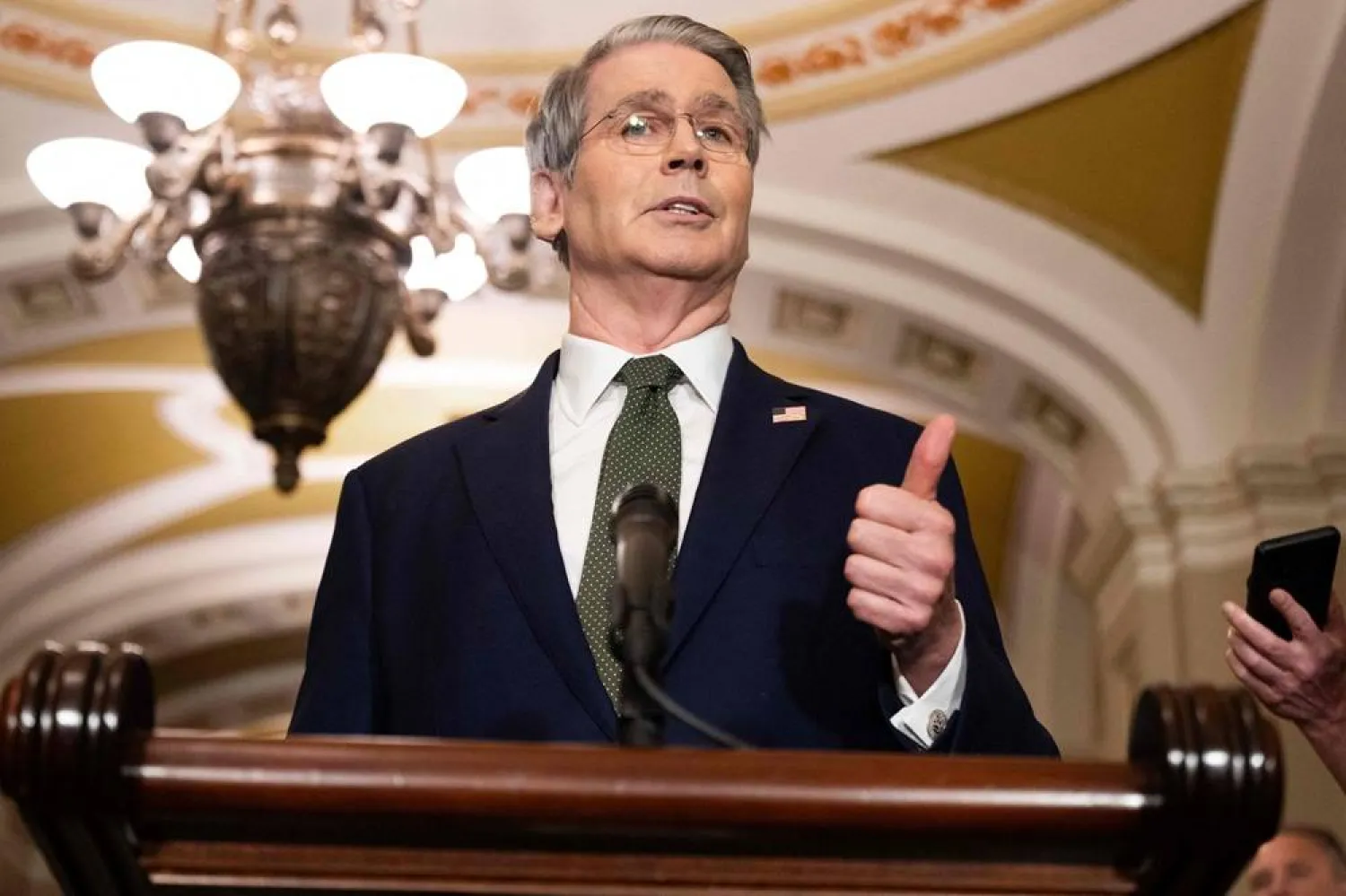
 US Treasury Secretary Scott Bessent speaks to reporters after meeting with Senate Republicans at the US Capitol in Washington, DC, on June 24, 2025. (AFP)
US Treasury Secretary Scott Bessent speaks to reporters after meeting with Senate Republicans at the US Capitol in Washington, DC, on June 24, 2025. (AFP)
TT

Trump Complains about US-Japan Trade Talks as Bessent Warns of Higher Tariffs

 US Treasury Secretary Scott Bessent speaks to reporters after meeting with Senate Republicans at the US Capitol in Washington, DC, on June 24, 2025. (AFP)
US Treasury Secretary Scott Bessent speaks to reporters after meeting with Senate Republicans at the US Capitol in Washington, DC, on June 24, 2025. (AFP)

President Donald Trump expressed frustration with US-Japan trade negotiations on Monday as Treasury Secretary Scott Bessent warned that countries could be notified of sharply higher tariffs as a July 9 deadline approaches despite good-faith negotiations.

Trump wrote in a social media post that Japan's reluctance to import American-grown rice was a sign that countries have become "spoiled with respect to the United States of America."

"I have great respect for Japan, they won't take our RICE, and yet they have a massive rice shortage," Trump wrote on Truth Social. "We'll just be sending them a letter, and we love having them as a Trading Partner for many years to come."

Trump said last week that his administration would send letters to a number of countries notifying them of their higher tariff rates before July 9, when tariff rates are scheduled to revert from a temporary 10% level to his suspended rates of 11% to 50% announced on April 2.

Trump's Monday complaint about US-Japan rice trade follows his comments broadcast on Sunday that Japan engages in "unfair" autos trade with the US.

White House spokesperson Karoline Leavitt said on Monday that Trump would meet with his trade team to set tariff rates for countries "if they don't come to the table to negotiate in good faith."

Bessent, who earlier this month floated the idea of extending the deadline for countries that were negotiating trade deals with the US in good faith, told Bloomberg Television that only Trump would decide on such extensions. He added that he expects "a flurry" of deals ahead of the July 9 deadline and wanted to keep up pressure on trading partners.

"We have countries that are negotiating in good faith, but they should be aware that if we can't get across the line because they are being recalcitrant, then we could spring back to the April 2 levels. I hope that won't have to happen," Bessent said.

Japan's main tariff negotiator, Ryosei Akazawa, on Monday said that Japan would continue working with the US to reach a trade agreement while defending Japan's national interest.

Akazawa said he was aware of Trump's comments on autos, adding that a continuation of Trump's 25% on autos imported from Japan would cause significant damage to its economy.

Another key trading partner, the European Union, is open to a trade agreement that maintains a 10% US tariff on EU goods, but wants US commitments to reduce its tariffs in key sectors such as pharmaceuticals, semiconductors and commercial aircraft, Bloomberg News reported, citing people familiar with the matter.

Reuters reported earlier this month that European officials are increasingly resigned to a 10% rate of "reciprocal" tariffs being the baseline in any trade deal between the US and the EU. Britain negotiated a trade deal on similar terms, accepting a 10% US tariff on many goods, including autos, in exchange for special access for aircraft engines and British beef.



Saudi PIF Backs Multibillion-Dollar Projects to Boost Sustainability

A solar power project in Saudi Arabia (SPA)
TT

Saudi PIF Backs Multibillion-Dollar Projects to Boost Sustainability

A solar power project in Saudi Arabia (SPA)

Saudi Arabia’s Public Investment Fund has fully allocated the proceeds of its green bond issuance, directing $9 billion to eligible projects, in a move that highlights the sovereign wealth fund’s growing role in shaping a more sustainable future and delivering lasting positive impact worldwide.

According to a recent report issued by the Public Investment Fund, reviewed by Asharq Al-Awsat, the expected impact of the fund’s eligible green projects includes generating 427 megawatts of renewable energy, avoiding emissions equivalent to 5.1 million tons of carbon dioxide, and treating 4 million cubic meters of wastewater.

The Public Investment Fund aims to establish itself as an active participant in global debt markets, while also fostering the development of a dynamic domestic market. This would enable the fund to access short- or long-term liquidity through a diverse range of financing instruments.

Financing strategy

The fund’s capital markets program aims to further strengthen its financing strategy and execution capabilities, both at the level of the Saudi sovereign wealth fund and across its portfolio companies, while enabling deeper engagement with global and local debt markets.

The program will also support expanding the fund’s capacity to raise debt and deploy it as a source of investment financing, in line with its overall funding strategy. This approach is designed to instill greater discipline in cash flow management and enhance returns on equity for the fund and its portfolio companies.

The green bond issuance will provide the fund with access to a broader pool of investors who prioritize environmental, social, and governance considerations in their investment decisions. It will also allow investors to diversify their portfolios through green assets, a step expected to help accelerate the pace of green investment globally.

Climate change

The fund has taken concrete steps to advance governance and policy, focusing on sustainability, and is a founding member of the One Planet Sovereign Wealth Funds initiative. This international platform aims to accelerate the integration of climate change considerations into asset management decisions and investment opportunities.

As an investment vehicle, the Public Investment Fund operates through acquiring stakes in companies aligned with its mandate, including ACWA Power and Lucid.

It has also established the Saudi Investment Recycling Company, a leader in waste management and recycling, manages the National Energy Services Company, Tarshid, and supports the creation of a voluntary carbon market in the Middle East and North Africa.

These efforts aim to strengthen Saudi Arabia’s position as one of the world’s most energy-efficient countries.

The green bond issuance will finance tangible projects on the ground, helping to accelerate the green transition and advance the Kingdom’s core targets of achieving net zero emissions by 2060 and generating 50 percent of electricity consumption from renewable energy sources by 2030.

This forms a key pillar of the renewable energy program implemented by the fund, which involves developing 70 percent of renewable power generation capacity.


Saudi E-Commerce Hits Record Monthly Sales over SAR30.7 Billion in October

A view of Riyadh, Saudi Arabia. (SPA file)
TT

Saudi E-Commerce Hits Record Monthly Sales over SAR30.7 Billion in October

A view of Riyadh, Saudi Arabia. (SPA file)

E-commerce sales in Saudi Arabia via "mada" cards soared to an all-time monthly high in October 2025, surpassing SAR30.7 billion.

The surge in sales represents a 68% year-on-year increase, totaling about SAR12.4 billion more than the SAR18.3 billion recorded in October 2024, according to the Saudi Central Bank (SAMA) statistical bulletin on Wednesday.

E-commerce sales for the third quarter (Q3) of 2025 hit SAR88.3 billion, up 15.2% from the previous quarter, representing an increase of about SAR11.6 billion over the SAR76.6 billion recorded in Q2.

On a monthly basis, e-commerce sales in October rose 6%, gaining approximately SAR1.6 billion over September’s total of SAR29.1 billion.

From January to October, "mada" data showed e-commerce sales grew 47.3%, rising by around SAR9.9 billion over the SAR20.9 billion recorded in January.

These figures cover transactions made via "mada" cards on e-commerce websites, apps, and digital wallets, and do not include credit-card payments.


Jeddah's King Abdulaziz Airport Launches First Direct Flight to Moscow

The expansion supports Jeddah Airports Company’s goal of broadening travel options and increasing air traffic revenue, leveraging the Kingdom's strategic location. (SPA)
TT

Jeddah's King Abdulaziz Airport Launches First Direct Flight to Moscow

The expansion supports Jeddah Airports Company’s goal of broadening travel options and increasing air traffic revenue, leveraging the Kingdom's strategic location. (SPA)

Jeddah's King Abdulaziz International Airport (KAIA) celebrated the launch of its first direct flynas flight to Moscow, operating three weekly flights between Jeddah and Vnukovo International Airport.

This initiative, in partnership with the Saudi Tourism Authority and the Air Connectivity Program, boosts air links between Saudi Arabia and Russia.

It marks KAIA's third direct Russian destination, following Makhachkala and Mineralnye Vody, which were inaugurated earlier this month by Azimuth Airlines.

The expansion supports Jeddah Airports Company’s goal of broadening travel options and increasing air traffic revenue, leveraging the Kingdom's strategic location.