



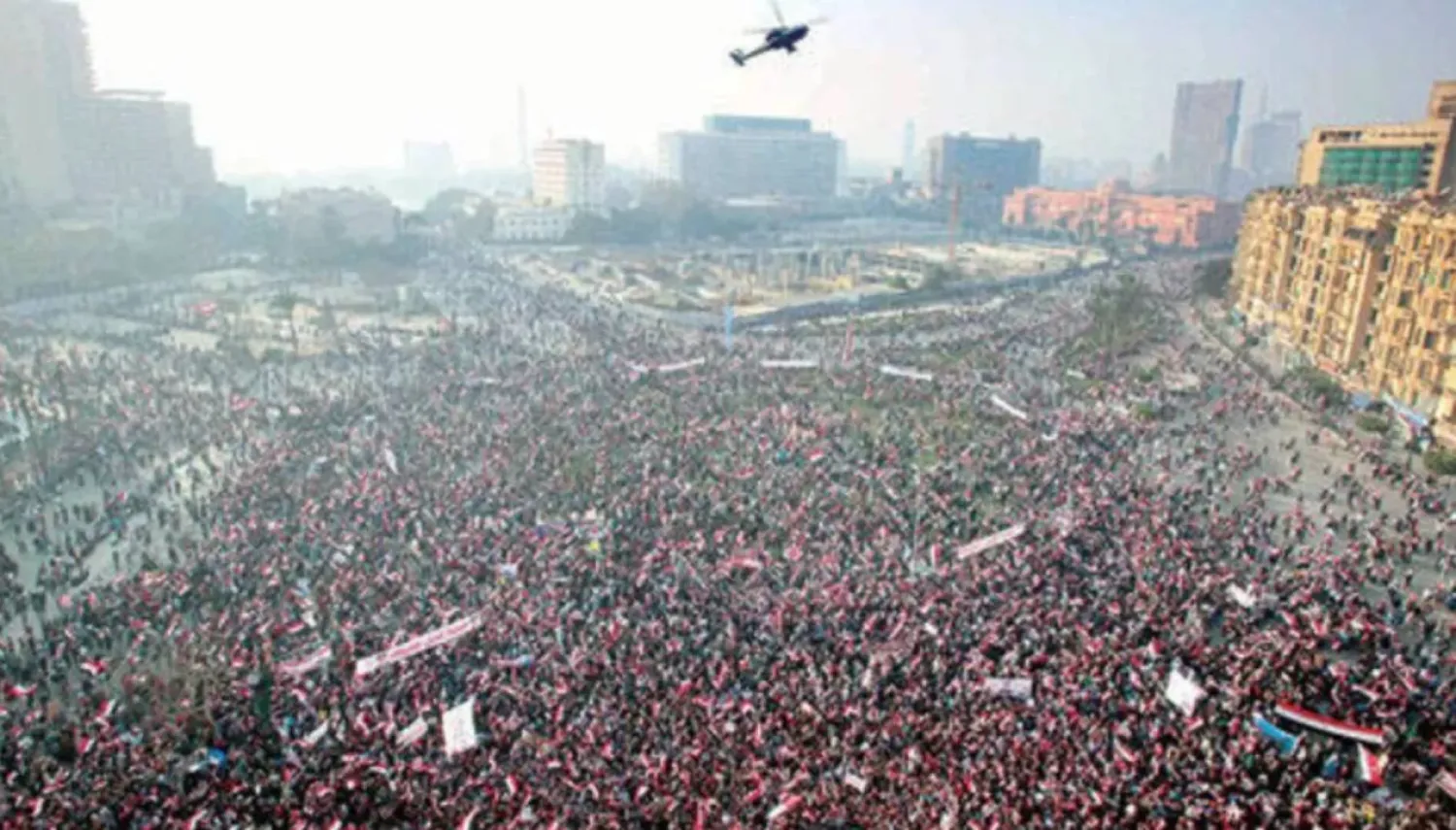

Egypt marked the 12th anniversary of the June 30 uprising on Monday with President Abdel Fattah el-Sisi vowing to press ahead with national development despite deepening economic strains and regional instability.
In a televised address, el-Sisi said the 2013 uprising, which ousted the Muslim Brotherhood from power, had thwarted chaos and terrorism, steering the country back onto what he called the “right path.”
“The revolution was a national epic that confronted terrorism and conspiracies, broke the waves of chaos, and foiled attempts at blackmail and abduction,” el-Sisi said. “It marked the beginning of our journey toward the New Republic.”
Egypt, he said, had “defeated terrorism, faced internal and external challenges, and embarked on comprehensive development to build a modern nation.”
But the president acknowledged that the road ahead remains difficult, citing “heavy burdens and enormous challenges” as the country grapples with high inflation, a weakening currency and the impact of global conflicts.
“The strength of Egypt lies not only in its weaponry, but in your awareness, your unity, and your rejection of division, despair and hatred,” Sisi told Egyptians. “You are the true shield and beating heart of this nation.”
El-Sisi also warned that this year’s anniversary comes at a time of escalating regional violence. “The entire region is burning—from Gaza to Sudan, Libya, Syria, Yemen and Somalia,” he said, urging warring parties and the international community to “heed the voice of reason” and work toward peace.
“Egypt has always been a supporter of peace,” el-Sisi added. “Peace is not born of bombing, nor imposed by force, nor achieved through normalization rejected by peoples.” He cited the Egypt-Israel peace deal of the 1970s, brokered by the United States, as a model for difficult but possible reconciliation.
Analysts speaking to Asharq Al-Awsat said Egypt faced “existential threats” in the aftermath of the 2013 events, and now confronts a new wave of challenges requiring bold reforms and swift action.
El-Sisi pledged to prioritize easing the burden on ordinary Egyptians, especially in the face of rising regional volatility.
“We do not bow, and we will not turn away from our aspirations,” he said. “This is Egypt—resilient in the face of challenges, built by the will of its people, and kept alive by their devotion.”
Twelve years after the mass protests that toppled the Muslim Brotherhood-backed government, Egypt is grappling with fresh economic and geopolitical headwinds that are testing the country's resilience and reform agenda.
The June 30, 2013 uprising ended the presidency of Mohamed Morsi - Egypt’s first elected Islamist leader - after just one year in power. Millions took to the streets demanding his removal, accusing the Brotherhood of consolidating power and mismanaging the country.
Morsi and senior Brotherhood leaders were later jailed on charges including espionage, incitement and violence. The group was outlawed and designated a terrorist organization by Egyptian authorities.
The aftermath of the Brotherhood’s fall brought a raft of challenges. Egypt faced international criticism, deteriorating ties with several countries, and a suspension of its African Union membership. Domestically, the country was rocked by a wave of militant attacks, particularly in the restive North Sinai region.
But over time, Egypt managed to stabilize both its security and foreign relations. Ties with regional rivals such as Türkiye and Qatar were restored, and strategic partnerships were expanded with the European Union, the United States, Russia, and China. At home, authorities declared terrorism in Sinai had been defeated and launched long-term development projects in the peninsula.
Still, new challenges are emerging. The ongoing Gaza war and its fallout have heightened regional instability, triggering tensions in the Red Sea that have severely hit Suez Canal revenues, a vital source of hard currency. According to government figures, canal earnings have dropped by 61% in recent months, exacerbating Egypt’s economic crisis, marked by soaring inflation and a weakened currency.
“Over the past 12 years, Egypt has overcome the post-June 30 turmoil, most notably terrorism, and maintained its stability in an increasingly volatile region,” said Abdel Moneim Said, a member of Egypt’s Senate. “The Brotherhood has lost ground in Egyptian society. Their presence is now largely confined to online voices with no political influence.”
Egypt’s years-long military campaign in North Sinai was described by el-Sisi in 2022 as “the first line of defense” for the nation. In 2023, Sisi announced the state had succeeded in preventing the region from becoming a permanent hub for terrorism, and pledged continued investment in its development.
Amr El-Shobaki, a senior political analyst at Al-Ahram Center for Political and Strategic Studies, said Egypt had faced “existential threats” in the immediate aftermath of the uprising. “Cairo successfully contained the threat of terrorism, which at one point endangered the capital and other key cities,” he said.
However, El-Shobaki warned of a shifting landscape. “The country is now facing pressing economic challenges - rising prices, inflation, and lack of clear priorities,” he said, referencing public backlash over a recent high-profile incident in Monufia involving teenage girls, which sparked widespread criticism of government performance, weak political opposition, and state media’s limited crisis coverage.
Still, Senator Said described such scrutiny as “normal and healthy,” saying criticism of government oversight and parliamentary accountability was a sign of a functioning public discourse.
As Egypt looks ahead, analysts say the country must balance its security gains with urgent reforms to restore economic confidence and manage public expectations in a turbulent region.
Egypt’s government came under fire following a deadly road crash that killed 19 schoolgirls and injured three others in Monufia province, north of Cairo, just days ahead of the June 30 anniversary. The incident sparked public outrage and renewed parliamentary calls for accountability, further highlighting concerns over government performance, priorities, and political opposition.
The accident, which took place on the Regional Ring Road last Friday, prompted several members of parliament to demand the dismissal of officials. The criticism underscored what lawmakers and analysts say is a deeper issue of weak governance, bureaucratic inefficiency, and lack of clear national priorities.
Senator Said said Egypt’s current challenge lies in “harnessing talent, encouraging investment, completing economic reforms, and dismantling bureaucracy.” He expressed cautious optimism, pointing to positive indicators such as declining birth rates and rising remittances from Egyptians abroad.
El-Shobaki said Egypt had already overcome existential threats in the past, but now faces a different kind of test: institutional reform and political renewal.
“Today’s challenge is reforming the institutions that were once under threat,” he said. “Addressing the economic crisis requires serious reform at both institutional and political levels.”
In response to mounting economic pressures - worsened by global crises and regional instability - Egypt has pursued a series of policy shifts aimed at attracting foreign investment and boosting private sector participation. The Egyptian pound has fallen steeply in recent months, trading above 50 to the dollar in unofficial markets. Officially, the rate stands at 49.6 pounds per dollar.
Cairo also secured an $8 billion loan agreement with the International Monetary Fund (IMF), tied to a sweeping economic reform plan that includes reducing the state's role in the economy and divesting from certain sectors.
But experts warn that reforms must go deeper to yield tangible results.
“The main challenge today is economic,” said economist Mostafa Badra. “With inflation rising and prices soaring, Egypt must improve the pound’s value by attracting investment, increasing exports, and building a stronger industrial base.”
He cautioned that relying on the sale of state assets without building a sustainable industrial sector “will not solve the crisis.”
Former Deputy Prime Minister and political economist Ziad Bahaa-Eldin has repeatedly urged the government to adopt a long-term economic strategy. He has also highlighted the unresolved question of the state’s role in the economy, which continues to fuel debate among economists and policymakers.
As Egypt marks over a decade since the Brotherhood's fall, analysts say the focus must now shift from security victories to structural reforms if the country is to regain economic stability and rebuild public trust.


