

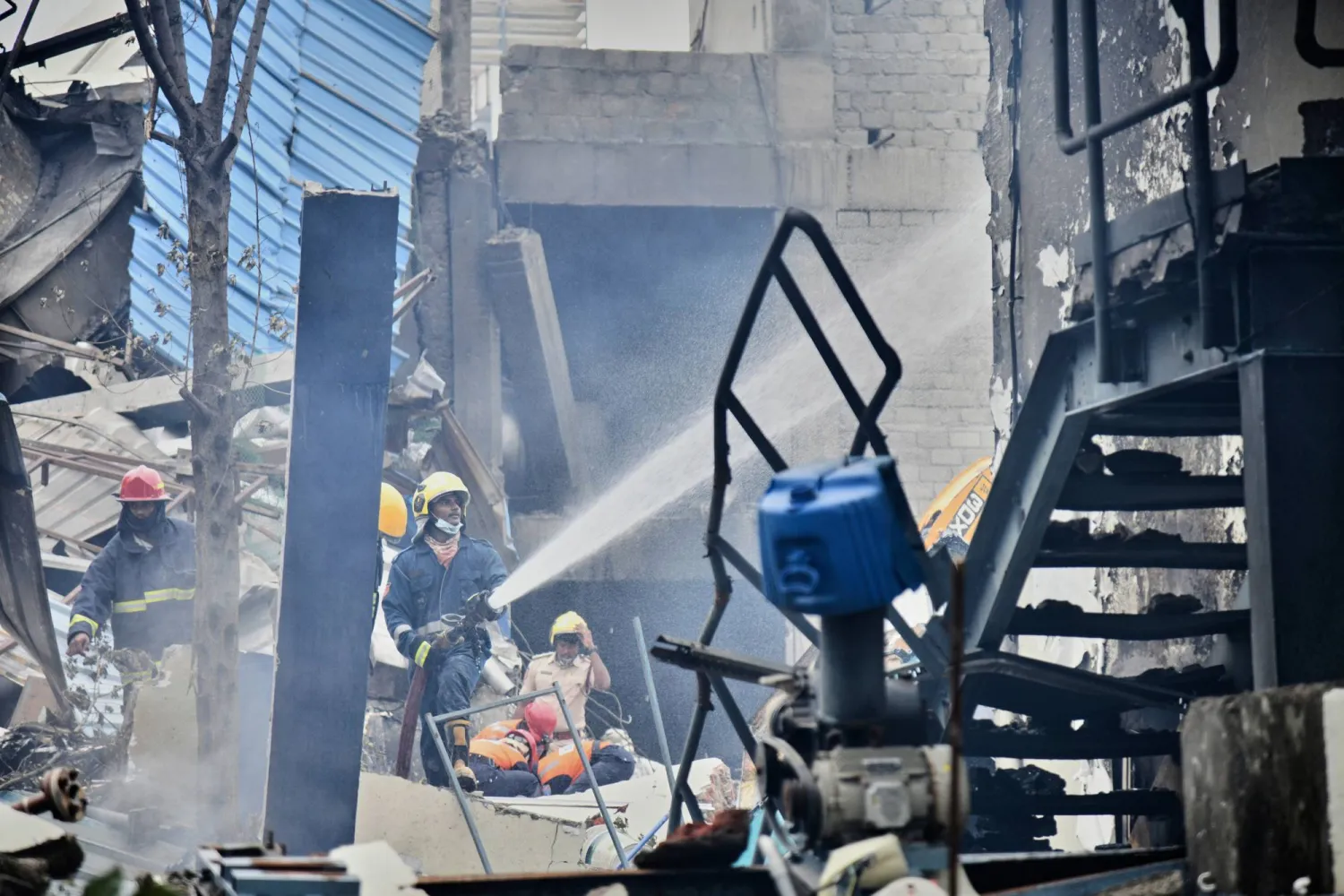

Death Toll Rises to 36 after Explosion at India Pharmaceutical Factory

Firefighters extinguish a fire after an explosion at a pharmaceutical factory in an industrial area in Sangareddy some 50 kilometers (31 miles) from Hyderabad, India, Monday, June 30, 2025. (AP Photo)
TT

Death Toll Rises to 36 after Explosion at India Pharmaceutical Factory

Firefighters extinguish a fire after an explosion at a pharmaceutical factory in an industrial area in Sangareddy some 50 kilometers (31 miles) from Hyderabad, India, Monday, June 30, 2025. (AP Photo)

The death toll from Monday's massive explosion and fire at a pharmaceutical factory in India’s southern state of Telangana has risen to at least 36 while about three dozen were left injured, authorities said Tuesday.

The fire department recovered the charred bodies of 34 workers from the accident site in an industrial area about 50 kilometers (31 miles) from the state capital Hyderabad, the state’s fire services director G.V. Narayana Rao told The Associated Press.

Two other workers succumbed to burns and were pronounced dead in hospital, Rao said, adding that debris of the gutted pharmaceutical unit of Sigachi Industries was still being removed to find out if any more workers were trapped.

Nearly three dozen injured workers were admitted to hospitals, he said.

“The whole structure of the factory has collapsed. Fire has been doused, and we hope to finish removing the debris in the next few hours,” Rao said.

Sigachi Industries did not disclose what led to the explosion and fire, but said the plant's core manufacturing infrastructure was damaged and facility operations would be halted for 90 days. The plant produces microcrystalline cellulose, a chemical compound commonly used in making drugs, the company said.

The explosion and subsequent fire was reported on Monday in the factory’s spray dryer unit, which is used to process raw material into fine powder for making drugs, Rao said.

The state’s Health Minister Damodar Raja Narasimha said there were 108 workers inside the factory at the time of the explosion.

“As bodies were badly burnt and mutilated, a special medical team has been deployed to conduct DNA tests”, said Narasimha, adding the state government has set up a panel to investigate the cause of the incident.

Witnesses said they heard the explosion from a couple of kilometers away from the site.

India is home to some of the world’s top pharmaceutical companies, playing a pivotal role in the global supply of generic medicines and vaccines. The country’s robust manufacturing and cost-effective production have made it a hub for pharma giants.

Industrial accidents, particularly involving chemical reactors, aren’t uncommon in such factories, underlining the need for authorities to implement stringent safety protocols and regulatory oversight in a sector critical to public health.
Sigachi Industries Limited is an Indian company dealing with active pharmaceutical ingredients, intermediates and vitamin-mineral blends, according to the company’s website. It has five manufacturing facilities across India and subsidiaries in the US and the United Arab Emirates.

Shares of Sigachi Industries tumbled 8% in intra-day trading Tuesday, extending the previous session’s plunge of nearly 10%.

In a disclosure to the Bombay Stock Exchange on Monday, the company called the incident “unfortunate” and announced that a thorough site assessment was underway. The factory where the fire occurred contributes a little more than a fourth of the company’s annual capacity.



Officials: Torrential Rains in Kenya Kill 81 in March

Officials: Torrential Rains in Kenya Kill 81 in March
TT

Officials: Torrential Rains in Kenya Kill 81 in March

Officials: Torrential Rains in Kenya Kill 81 in March

Torrential storms that have triggered flash floods in Kenya have killed at least 81 people this month, authorities said Sunday, as rain continued to pound much of the country.

"The cumulative number of fatalities has unfortunately risen to 81," national police spokesman Muchiri Nyaga said in a statement.

"Additionally, flash floods have swept through several areas, displacing approximately 2,690 families and causing widespread destruction of infrastructure and property."

The capital Nairobi is the hardest-hit region, with 37 people killed, he said.

On Friday night, authorities called on residents to evacuate several slum neighborhoods downstream from the Nairobi dam, warning of an imminent risk of flooding as rising water levels threatened to breach the dam embankment, according to local media.

The dam has held so far.

Two people drowned overnight in floods in the town of Kiambu, just outside the capital, police told AFP.

Two also died as landslides hit the western village of Kasaka, burying numerous homes, reported private broadcaster Citizen TV.

The rain is forecast to continue until Tuesday.

Authorities called for "extreme caution".

The March rains have repeatedly turned Nairobi streets to raging rivers, flooding thousands of homes and businesses.

Critics have called for the resignation of Nairobi Governor Johnson Sakaja, who had vowed to improve the capital's drainage and road infrastructure when he took office in 2022.

Scientists say human-caused climate change is increasing the probability, length and severity of extreme weather events.

Studies indicate east Africa has been hit by more extreme rains and droughts over the past two decades.


1 Dead in Istanbul after Gas Explosion Collapses 2 Buildings

Police secure the way to a site where two residential buildings collapsed in Istanbul, Sunday, March 22, 2026. (AP Photo/Khalil Hamra)
TT

1 Dead in Istanbul after Gas Explosion Collapses 2 Buildings

Police secure the way to a site where two residential buildings collapsed in Istanbul, Sunday, March 22, 2026. (AP Photo/Khalil Hamra)

A natural gas explosion in Istanbul’s central Fatih district brought down two buildings on Sunday, killing one person.

Search and rescue personnel pulled out 10 injured who were hospitalized, including one in critical condition, according to a statement by the Istanbul Governor’s office.

The governor, Davut Gul, visited the site of the explosion and checked on survivors at the hospital.

One of the collapsed buildings had two stories, the other one.


Iran Threatens to Retaliate against Gulf Energy and Water after Trump Ultimatum

epa12835579 Liquefied natural gas (LNG) facilities in Ras Laffan Industrial City, in Ras Laffan, Qatar, 25 February 2026 (issued 20 March 2026). Qatar has said Iranian missile attacks on the Ras Laffan Industrial City have caused significant damage to the natural gas industrial complex, located approximately 80 km north-east of Doha. It is operated by Qatar Energy and employs around 115,000 people according to the company.  EPA/HANNIBAL HANSCHKE
epa12835579 Liquefied natural gas (LNG) facilities in Ras Laffan Industrial City, in Ras Laffan, Qatar, 25 February 2026 (issued 20 March 2026). Qatar has said Iranian missile attacks on the Ras Laffan Industrial City have caused significant damage to the natural gas industrial complex, located approximately 80 km north-east of Doha. It is operated by Qatar Energy and employs around 115,000 people according to the company. EPA/HANNIBAL HANSCHKE
TT

Iran Threatens to Retaliate against Gulf Energy and Water after Trump Ultimatum

epa12835579 Liquefied natural gas (LNG) facilities in Ras Laffan Industrial City, in Ras Laffan, Qatar, 25 February 2026 (issued 20 March 2026). Qatar has said Iranian missile attacks on the Ras Laffan Industrial City have caused significant damage to the natural gas industrial complex, located approximately 80 km north-east of Doha. It is operated by Qatar Energy and employs around 115,000 people according to the company.  EPA/HANNIBAL HANSCHKE
epa12835579 Liquefied natural gas (LNG) facilities in Ras Laffan Industrial City, in Ras Laffan, Qatar, 25 February 2026 (issued 20 March 2026). Qatar has said Iranian missile attacks on the Ras Laffan Industrial City have caused significant damage to the natural gas industrial complex, located approximately 80 km north-east of Doha. It is operated by Qatar Energy and employs around 115,000 people according to the company. EPA/HANNIBAL HANSCHKE

Iran said on Sunday it would strike the energy and water systems of its Gulf neighbors in retaliation if US President Donald Trump follows through with a threat to hit Iran's electricity grid in 48 hours, escalating the three-week-old war.

The prospect of tit-for-tat strikes on civilian infrastructure could deepen the regional crisis and rattle global markets when they reopen on Monday morning, Reuters reported.

Air raid sirens sounded across Israel from the early hours of Sunday, warning of incoming missiles from Iran, after scores of people were hurt overnight in two separate attacks in the southern Israeli towns of Arad and Dimona.

The Israeli military said hours later that it was striking Tehran in response.

Trump threatened overnight to "obliterate" Iran's power plants if Tehran did not fully reopen the Strait of Hormuz within 48 hours, barely a day after he talked about "winding down" the war. He made the new threat as US Marines and heavy landing craft are heading to the region.

Iran's Parliament Speaker Mohammad Baqer Qalibaf wrote on X that critical infrastructure and energy facilities in the Middle East could be "irreversibly destroyed" should Iranian power plants be attacked.

Iran's powerful Revolutionary Guards said it would also mean the shipping lane where a fifth of global oil and liquefied natural gas normally transits along Iran's southern coast would remain shut.

"The Strait of Hormuz will be completely closed and will not be opened until our destroyed power plants are rebuilt," the Guards said in a statement.

"President Trump's threat has now placed a 48-hour ticking time bomb of elevated uncertainty over markets," said IG market analyst Tony Sycamore, who expects stock markets to fall when they reopen on Monday.

Oil prices jumped on Friday, ending the day at their highest in nearly four years.

Markets already under severe strain from blockaded shipping were further rattled last week when Israel attacked a major gas field in Iran, and Tehran responded with strikes on neighbors Saudi Arabia, Qatar and Kuwait, raising the prospect of damage hindering energy output even if tankers resume sailing.

Iranian attacks have effectively closed the Strait of Hormuz, causing the worst oil crisis since the 1970s. Its near-closure sent European gas prices surging as much as 35% last week.

"If Iran doesn't FULLY OPEN, WITHOUT THREAT, the Strait of Hormuz, within 48 HOURS from this exact point in time, the United States of America will hit and obliterate their various POWER PLANTS, STARTING WITH THE BIGGEST ONE FIRST!" Trump posted on social media around 7:45 p.m. EDT (2345 GMT) on Saturday.

Iranian media quoted the country's representative to the International Maritime Organisation as saying the strait remains open to all shipping except vessels linked to "Iran's enemies".

Ali Mousavi said passage through the waterway was possible by coordinating security and safety arrangements with Tehran.

Ship-tracking data shows some vessels, such as Indian-flagged ships and a Pakistani oil tanker, have negotiated safe passage through the strait. But the vast majority of ships have remained holed up inside.

Iran's Khatam al-Anbiya military command headquarters said on Sunday if the US hit Iran's fuel and energy infrastructure, Iran would attack all US energy, information technology and desalination infrastructure in the region.

Striking major Iranian power plants could trigger blackouts, crippling everything from pumps and refineries to export terminals and military command centres.