


Thomas Barrack: Syria’s Joining Abraham Accords ‘Could Take Time’

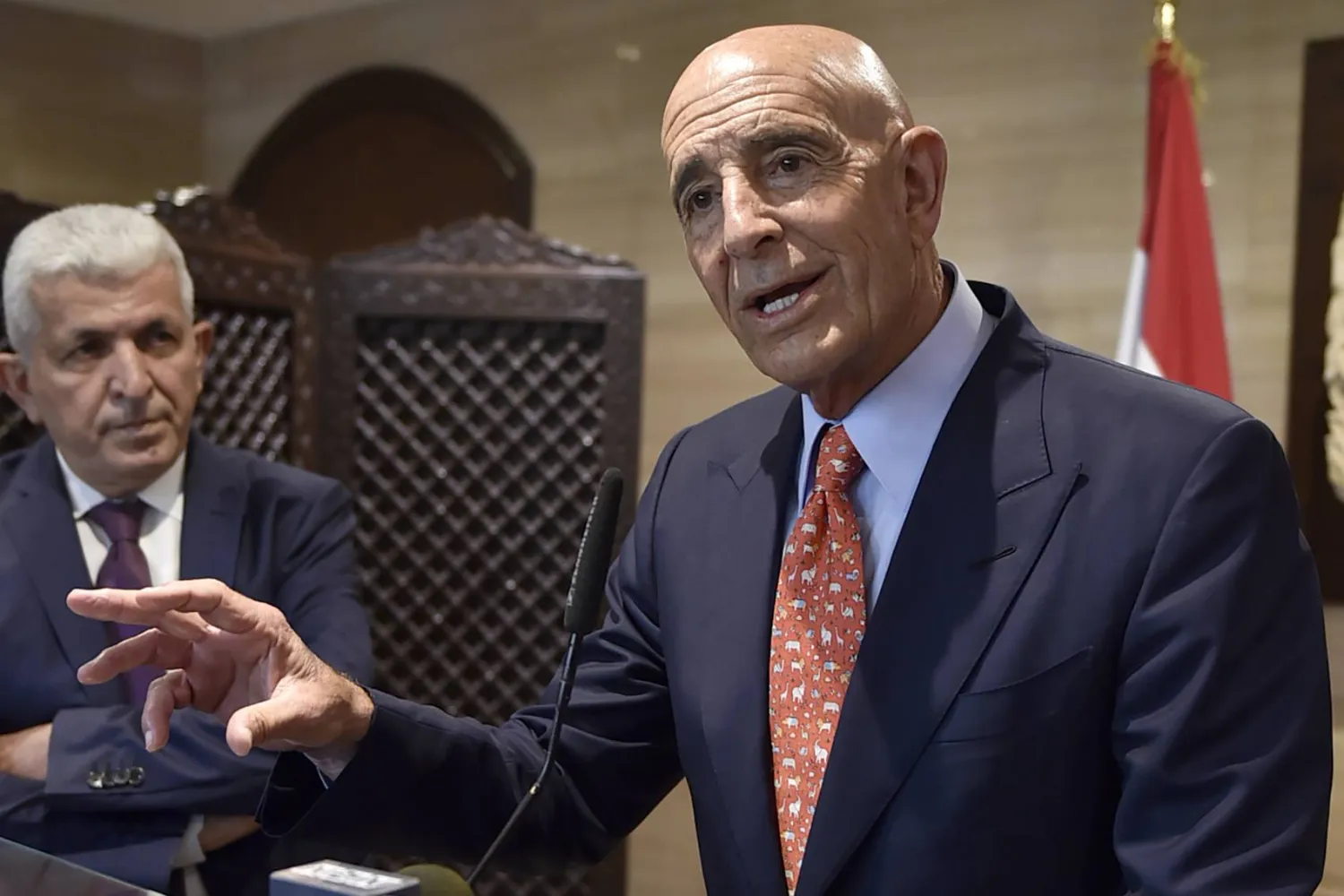
HANDOUT - 19 June 2025, Lebanon, Beirut: US Special Envoy to Syria Tom Barrack speaks during a press conference in Beirut. Photo: Hassan Ibrahim/Lebanese Parliament/dpa
TT

Thomas Barrack: Syria’s Joining Abraham Accords ‘Could Take Time’

HANDOUT - 19 June 2025, Lebanon, Beirut: US Special Envoy to Syria Tom Barrack speaks during a press conference in Beirut. Photo: Hassan Ibrahim/Lebanese Parliament/dpa

Syria and Israel are engaged in “meaningful” talks through the United States that aim to restore calm along their border, according to Thomas Barrack, US President Donald Trump’s envoy to Syria.

Barrack said in an interview with The New York Times on Thursday that the administration wanted Syria to join the Abraham Accords, but “this could take time” because Syria’s new President Ahmed al-Sharaa could face resistance at home.

“He cannot be seen by his own people to be forced or coerced into the Abraham Accords,” Barrack said. “So he has to work slowly.”

Trump tapped Barrack, an old friend and private equity investor, to help realize his vision for the Middle East, which the administration hopes will foster less conflict and more prosperity.

Trump made clear during his Mideast visit in May that lucrative business deals in sectors including arms and artificial intelligence were his priority, and his decision to bomb nuclear enrichment facilities in Iran last month showed his support for Israel and willingness to use force against American foes.

Barrack called the US administration’s approach a departure from previous “failed” American attempts at “nation building” and from past efforts to shape how other governments rule.

Much of Barrack’s work has focused on pushing Syria and Lebanon, both recovering from destructive wars, toward solving their own problems while rallying support from Qatar, Saudi Arabia, Türkiye and other regional partners.

It is unclear whether Trump’s focus on prioritizing economic development over vocal support for democracy will fare better than the efforts of previous administrations to address some of the Middle East’s most bedeviling problems, according to The New York Times.

Barrack, in his first diplomatic job at age 78, has been working his relationships with heads of state and other power brokers. He said that having a direct line to the White House and to Secretary of State Marco Rubio, and the fact that the administration had “little patience for the region’s resistance to helping itself,” had helped.

Much of Barrack’s effort has focused on Syria, where the fledgling government of al-Sharaa is trying to rebuild the country after a 13-year civil war.

Trump signed an executive order this week aimed at ending decades of US sanctions on Syria.

Barrack said that instead of making strict demands, the administration had laid out objectives for the Syrian government to work toward while Washington monitored its progress.

Those indications would include finding a peaceful accommodation with Israel; integrating the US-backed, Kurdish-led militia that controls Syria’s northeast; and investigating the fates of Americans who went missing during the war.

Progress on democratization and inclusive government will not happen quickly, Barrack said, and are not part of the US criteria.

American officials have expressed concerns about the thousands of fighters who came to Syria from abroad to take part in the war, mostly as part of militant groups.

Barrack said Washington realized that Syria could not expel those who remained and that they could pose a threat to the new government if they were excluded. So the Trump administration instead expects transparency about the roles they are given.

Lifting sanctions to encourage changes worked better than keeping them in place until Syria met specific demands, Barrack said.

“It is a brilliant way to accomplish the same thing, and these roll-on, roll-off sanctions have never worked anyway,” he said.

The new Syrian government’s relations have been tense with Israel, whose military has moved into southern Syria and often carried out operations there. The talks aim to quiet the conflict along the border while laying the groundwork for better relations.



Hezbollah Supporters Dismayed as Leaked Videos Show Assad Mocking Party

A tattered Syrian flag and Assad poster in Aleppo on Dec. 5, 2024. (AFP via Getty Images)
TT

Hezbollah Supporters Dismayed as Leaked Videos Show Assad Mocking Party

A tattered Syrian flag and Assad poster in Aleppo on Dec. 5, 2024. (AFP via Getty Images)

Hezbollah supporters in Lebanon expressed their dismay in the leaked videos of ousted Syrian President Bashar al-Assad and his late media advisor Luna al-Shibl in which they mock supporters of the regime, including the Iran-backed party, during the 14-year Syrian civil war.

Al Arabiya released the videos that showed Assad driving a vehicle in Damascus, with Shibl in the passenger seat. A third person was filming from the back seat. The videos are undated but suspected to date back to 2018 after opposition fighters were forced out of Ghouta near Damascus.

As they drive, the trio encounter gunmen, whom Assad said were Lebanese, meaning Hezbollah fighters. Shibl then started to discuss the party and its performance during the war.

Hezbollah had sent its fighters to Syria to prop up the regime during the conflict. Its intervention helped prolong the war. Russia’s eventual intervention helped tip the balance in the regime’s favor.

In the videos, Shibl said that the “Syrian army has learned and now has experience that it can share with other armies.”

“Hezbollah in the end could not back up its claims and we never heard from it,” she added.

Commenting to Asharq Al-Awsat about the videos, Hezbollah supporters in Lebanon expressed their disappointment, saying they were a “mockery of all the sacrifices and denial of the facts on the ground.”

One supporter said Assad’s silence over Shibl’s comments “is a sign of his agreement and another insult” to the party.

Assad has no loyalty and does not appreciate the sacrifices, he stressed.

Another supporter dismissed Shibl, telling Asharq Al-Awsat that she is “delusional”, a “liar” and “flatterer”.

“She and Assad both know that were it not for Hezbollah, the opposition would have captured Damascus in winter 2012,” he remarked.

Hezbollah supporters often trade stories about their fighting in Syria. The party has also released footage of its operations in Syria, most notably in the regions of Qusayr and al-Qalamoun in spring 2013, and Aleppo, al-Zabadani and Ghouta in 2016. Those operations have become part of the party’s “lore”.

One Hezbollah fighters told Asharq Al-Awsat that the regime army “did not know how to stop attacks in southern Damascus in 2012. (...) The party had to step in and draft plans.”

The offensive launched by the opposition in Daraa at the time “was repelled by the party alone and some Syrian fighters,” he went on to say.

In eastern Ghouta, he recalled how the regime forces were retreating, “leaving Hezbollah members to fight alone for two hours” before regrouping.

“Shibl should have spoken about who devised the plans to capture al-Qalamoun and al-Zabadani and who fought there” before she doubted the party’s capabilities, the fighter told Asharq Al-Awsat.

The disappointment in the videos also played out on social media, with supporters recalling that before they were allied during the war, Hezbollah and the regime had a rivalry that dates back to Lebanon’s 1975-90 civil war.

The rivalry was patched up because the regime needed the party, said one social media user.

Another said the videos were a message to those who still defended Assad.

Ties between Hezbollah and Assad were strained before his ouster in December 2024. Some Hezbollah leaders accused Assad of abandoning the party during the “support war” it had launched from Lebanon in solidarity with Hamas in Gaza in October 2023.

It has since been revealed that Assad barred Hezbollah from using Syrian territory to launch rockets at Israel during the “support war”. The regime also restricted the delivery of weapons to the party through Syria during the conflict.


Assad Curses Ghouta, Mocks Syrian Troops in Leaked Videos

Bashar al-Assad was overthrown after 24 years in power. (EPA)
TT

Assad Curses Ghouta, Mocks Syrian Troops in Leaked Videos

Bashar al-Assad was overthrown after 24 years in power. (EPA)

As Syrians gear up to mark the one-year anniversary of the ouster of President Bashar al-Assad's regime on Monday, Al Arabiya television released videos of the toppled leader recorded a few years ago showing him cursing the region of al-Ghouta and mocking his own troops even amid the civil war.

The videos released on Saturday showed Assad as he was driving his car through Damascus with his late media advisor Luna al-Shibl. The videos are undated but suspected to have been recorded around 2018 after opposition fighters were forced out of Ghouta. They were filmed by a third person in the vehicle with Assad and Shibl.

In one video, Assad is heard cursing Ghouta, saying: “To hell with it.” Other shots showed him mocking his own soldiers when they would kiss the president’s hands in a show of loyalty.

At one point, Shibl asked Assad how he feels about seeing posters of himself on the streets of Syria, to which he replied that he feels “nothing” about them.

On the situation in war-torn Syria, Assad said he was “not only ashamed but disgusted.”

Assad at one point mocks even his family name, which translates to “lion” in Arabic, saying maybe he should change it to “some other animal.”

Assad and Shibl even mocked Lebanon's Hezbollah that had sent its fighters to Syria to prop up the regime.

Commenting on the leaks, Syrians dismissed them, while other said they were further evidence of his lack of loyalty to forces that had stood by him during the war.

Journalist Wael Youssef said he did not care about the leaks, saying Assad and Shibl were now part of the past.

He added that he was disturbed even hearing their voices. “Personally, I could never listen to Bashar when he was delivering an allegedly important speech. If it was really important, I would get a copy of it to read. Today they are now behind us, thank God.”

Assad's late media advisor Luna al-Shibl.

Radwan, a resident of Damascus’ Jobar neighborhood that was destroyed by regime forces during the war, described Assad as an “idiot, which is why we rose up against him”.

“When he would bomb us with planes, we would often wonder how he could possibly call himself Syrian because he has an unnatural animosity to Syria and its people,” he said. “The videos are evidence of this.”

Lawyer Nibal Hamdoun said she was not surprised by Assad’s comments in the leaks. “We had experienced his sentiments during 14 years of killing and destruction during the war,” she remarked.

“If he believes Syria is disgusting, then it is because of his corrupt rule and the corruption of his father (late President Hafez al-Assad),” she stressed, adding that he should be ashamed of himself.

Another Syrian, Badr Rahmeh said he was curious to learn how Assad feels in his Moscow exile as he watches Syria prepare to celebrate a year since his ouster.

“Will he watch as we trample posters of his image that he allegedly didn’t like to see on the streets where we were forced to hang them?” he wondered.

“I want to know how the supporters Shibl had called on to persevere during the war now feel as they watch these videos that mock their loyalty,” he went on to say.

Shibl had died in mysterious circumstance in 2024. The official story was that she died in a car accident, while skeptics say that the accident was deliberate and staged by the regime after she had fallen afoul of it.

She had worked for years as the director of the presidency media office before being promoted to Assad’s media advisor.


Abbas Calls on Hamas to Disarm, Israel to Withdraw from Gaza

Palestinian President Mahmoud Abbas. (dpa)
TT

Abbas Calls on Hamas to Disarm, Israel to Withdraw from Gaza

Palestinian President Mahmoud Abbas. (dpa)

Palestinian President Mahmoud Abbas said on Saturday that the second phase of US President Donald Trump’s ceasefire plan in Gaza demands Israel’s withdrawal from the enclave and for Hamas and other armed groups to turn over their weapons to his Palestinian Authority.

Speaking during a telephone call with German Chancellor Friedrich Merz, Abbas added that his priority now lies in implementing Trump’s plan to end the war, stop the bloodshed and ease the suffering of the Palestinian people in Gaza and prevent their displacement.

The implementation of the second phase will pave the way for the deployment of Palestinian police and the international stabilization force in Gaza and the launch of the reconstruction phase in an organized and effective manner, he explained.

Parallel steps must be carried out in the occupied West Bank to put an end to Israeli measures that are undermining the two-state solution, Abbas continued.

He demanded an end to Israeli settler violence against the Palestinian people, an end to settlement expansion and annexation policies, and an end to Israeli policies that are harming the Palestinian economy and government’s ability to meet its commitments to the people.

Abbas reiterated his condemnation of Hamas’ October 7, 2023 attack, saying the movement “must end its rule in Gaza and hand over its weapons.”

He renewed Palestine’s commitment to recognize Israel and the two-state solution, “so that an independent Palestinian state can coexist side by side by Israel in peace and security.”

Abbas and Merz held their call hours before the German leader arrived in Israel on an official visit.