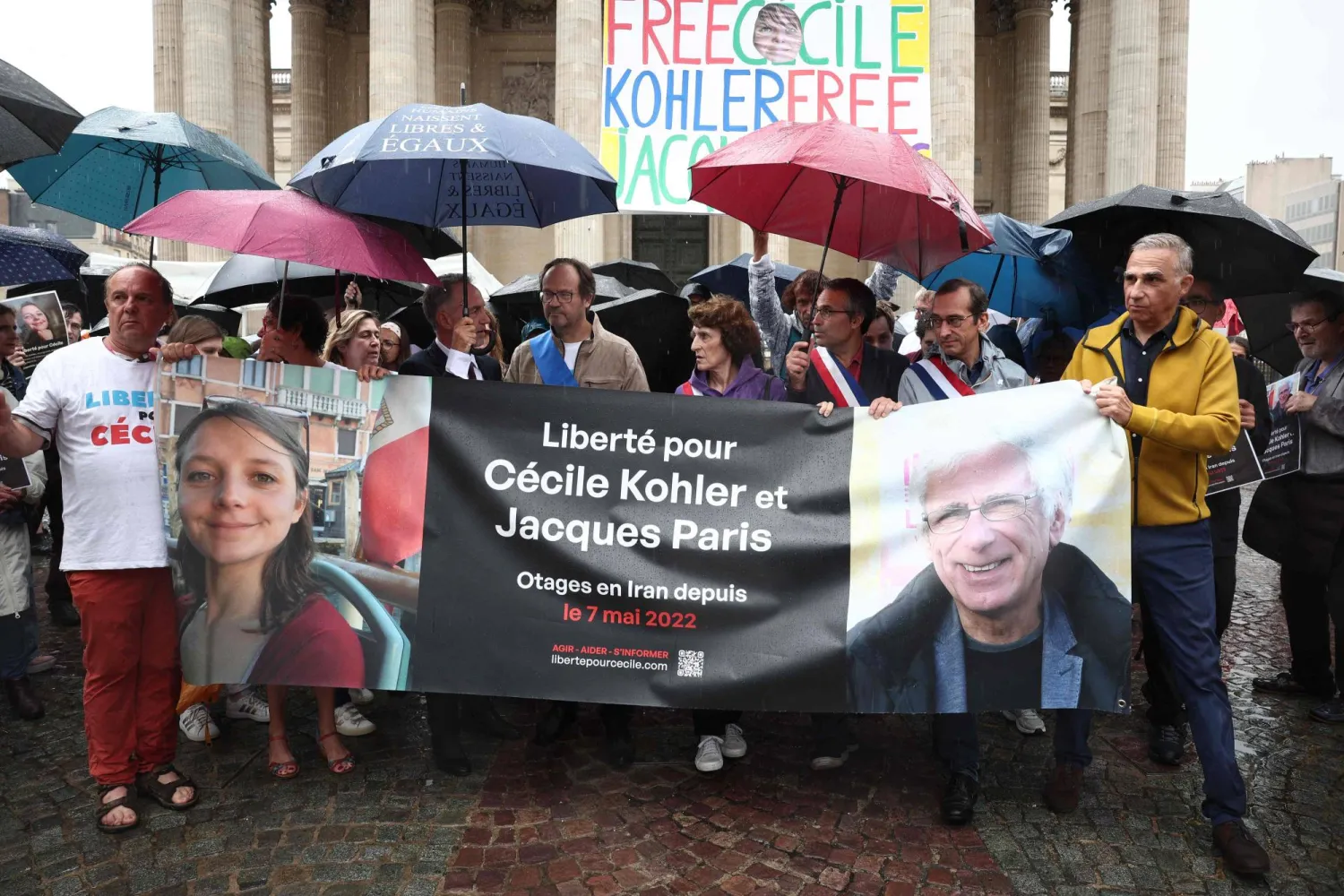
'Worrying' Disappearance of French National in Iran

Relatives and supporters pose behind a banner with the portrait of Cecile Kohler (L) and Jacaues Paris (R) who are being held in Iran since May 2022 on espionage charges, at the end of a rally in support to them at Place du Pantheon in Paris, on July 6, 2025. (Photo by Sebastien DUPUY / AFP)
TT

'Worrying' Disappearance of French National in Iran

Relatives and supporters pose behind a banner with the portrait of Cecile Kohler (L) and Jacaues Paris (R) who are being held in Iran since May 2022 on espionage charges, at the end of a rally in support to them at Place du Pantheon in Paris, on July 6, 2025. (Photo by Sebastien DUPUY / AFP)

A young Frenchman who was on a cycling trip in Iran has been missing since June 16, a French diplomatic source told AFP on Sunday.

Posts shared on Instagram identified the missing person as 18-year-old Lennart Monterlos, who allegedly also holds German nationality.

"This disappearance is worrying. We are in contact with the family about this," the source said, when asked about the missing person notices on social media.

French nationals are advised not to travel to Iran, as Tehran is implementing "a deliberate policy of taking Western hostages", the source added.

The source was unable to confirm if the young Frenchman was among the Europeans recently arrested in Iran on charges of spying for Israel.

Iran is believed to hold around 20 European nationals, many of whose cases have never been publicized, in what some Western governments including France describe as a strategy of hostage-taking aimed at extracting concessions from the West.

Three other Europeans, who have not been identified, have also been arrested in the wake of the recent conflict, two of whom are accused of spying for Israel, according to authorities.

Two French nationals Cecile Kohler, 40, and Jacques Paris, her 72-year-old partner, have been held in Iran since May 2022 on charges of espionage that their families deny.

Iran is "targeting French nationals passing through the country, accusing them of espionage and detaining them in appalling conditions -- some of which fall under the definition of torture under international law," the source said.

Iran earlier this week charged the pair with spying for Israel's intelligence agency Mossad, as well as "corruption of Earth" and "plotting to overthrow the regime", diplomatic and family sources told AFP on Wednesday.

Tehran has not confirmed the new charges, all three of which carry the death penalty.


Iran President Tells Putin Region Can Solve Problems without US

Russian President Vladimir Putin shakes hands with Iranian President Masoud Pezeshkian during the official welcoming ceremony at the Summit of Heads of State and Government of the Gas Exporting Countries Forum (GECF) in Moscow, Russia, October 27, 2026. (Reuters)
TT

Iran President Tells Putin Region Can Solve Problems without US

Russian President Vladimir Putin shakes hands with Iranian President Masoud Pezeshkian during the official welcoming ceremony at the Summit of Heads of State and Government of the Gas Exporting Countries Forum (GECF) in Moscow, Russia, October 27, 2026. (Reuters)

Iranian President Masoud Pezeshkian told his Russian counterpart Vladimir Putin on Tuesday that the Middle East can solve its problems without the involvement of the United States.

"I believe we are capable of resolving our problems in the region without relying on the United States," Pezeshkian said at a meeting with Putin on the sidelines of a summit of the Gas Exporting Countries Forum in Moscow.

"Our trade is expanding and growing day by day. US actions in the region make it easier for us to move towards greater multilateralism and strengthen our cooperation with you and other countries subject to unilateral US sanctions," he told Putin.

Putin said he discussed the war with Pezeshkian, expressing hope that the situation would improve.

"We spoke earlier, one-on-one, about the situation in the region -- a situation that, undoubtedly, cannot help but cause concern," he said, adding that he hoped it would "evolve in a positive direction".

Pezeshkian said he was confident the will existed on both sides to expand cooperation in science, industry, culture, security and military affairs.

Moscow has been looking to mediate to help end the Middle East war which broke out on February 28 with US-Israeli strikes on Iran.

Last week Russian Foreign Minister Sergei Lavrov visited Iran for the first time since the war broke out, saying Russia's efforts were "aimed at preventing the return of a large-scale war", with talks stalled between Tehran and Washington.

Iran's Foreign Minister Abbas Araghchi later said Russia and Iran have "never" worked so closely.

Negotiations between Washington and Tehran have been stalled for months, with both the US and Israel threatening to resume their strikes on Iran.


Burnham Reignites Britain’s Divisive Brexit Debate with His Push for Closer EU Ties

 Britain's Prime Minister Andy Burnham gestures as he speaks while hosting a "Rough Sleeping Summit" in Downing Street in central London on October 26, 2026, to push for further action to support people to get off the streets for good. (Reuters)
Britain's Prime Minister Andy Burnham gestures as he speaks while hosting a "Rough Sleeping Summit" in Downing Street in central London on October 26, 2026, to push for further action to support people to get off the streets for good. (Reuters)
TT

Burnham Reignites Britain’s Divisive Brexit Debate with His Push for Closer EU Ties

 Britain's Prime Minister Andy Burnham gestures as he speaks while hosting a "Rough Sleeping Summit" in Downing Street in central London on October 26, 2026, to push for further action to support people to get off the streets for good. (Reuters)
Britain's Prime Minister Andy Burnham gestures as he speaks while hosting a "Rough Sleeping Summit" in Downing Street in central London on October 26, 2026, to push for further action to support people to get off the streets for good. (Reuters)

For a decade, British governments have observed a cardinal rule: Don’t mention Brexit. In particular, don’t suggest that voters’ 2016 decision to leave the European Union should be reversed.

Prime Minister Andy Burnham, who marked his 100th day in office on Tuesday, has broken that code of silence and reignited a debate that bitterly divided the country. He says Brexit has been a failure and the UK should seek a much closer relationship with the EU, with options up to and including rejoining the 27-nation bloc.

“I am positive about closer ties with Europe and I’m not hiding that,” Burnham told the Sunday Times. “I think it will add to British GDP. I think it will give us stronger control of migration. I want to make those arguments.”

In recent interviews, Burnham has said the country should have an “evidence-based debate” about the consequences of Brexit. He gave the example of immigration. Supporters of Brexit argued that it would give the country control over its borders by ending the right of EU citizens to live and work in the UK, and of British nationals to settle across the bloc.

While Britain now sets its own immigration policy, Burnham said leaving the bloc had made it harder to control unauthorized migration because Britain has lost access to EU databases and agreements.

“The truth of the matter is we’ve lost immigration control in the way that we once had,” Burnham told broadcaster ITV on Monday.

Most economists agree that Brexit has hurt the British economy, but few politicians have wanted to reopen the painful debate.

The decision of British voters, by 52% to 48%, to leave the bloc after four decades of membership was followed by years of UK-EU wrangling over divorce terms. Britain finally left the EU in 2020 with a bare-bones trade deal that erected new barriers to doing business with the bloc of 450 million people on the UK’s doorstep.

In seeking closer ties, Burnham remains bound by the pledge of Keir Starmer, whom he replaced as Labour Party leader and prime minister, not to rejoin the bloc’s tariff-free customs union or frictionless single market for goods, services and workers.

Burnham says that could change after the next national election, which must be held by 2029.

He told the Labour Party’s annual conference last month that “Brexit has done more harm than good” and he will seek political consensus on a new relationship, with future options including rejoining the bloc.

A UK-EU summit in Brussels on Nov. 20 is set to discuss a more limited reset: a trade deal for food and drink, agreements on energy and emissions trading and a plan to let young people work for limited periods across Britain and the EU.

Around the same time as the summit, the British government says Burnham will set out options for the long-term relationship with Europe, and ask the public to weigh in.

Burnham’s office stressed that he wasn’t prejudging the outcome of that debate. But Downing Street acknowledged that UK and EU officials are already holding informal talks about the future relationship, with options including a return to the single market and freedom of movement.

The EU is welcoming but wary

The EU has welcomed Britain’s warmer tone, but its leaders are wary of UK attempts to secure some of the benefits reserved for members only.

In Britain, the return of the Brexit debate has stirred mixed feelings of hope, opposition and dread.

Anti-immigration Reform UK leader Nigel Farage, who campaigned for years to take the country out of the EU, said Burnham “has no mandate” to renegotiate Brexit.

Even within the governing center-left Labour Party, views are mixed. Labour lawmaker Melanie Onn, who represents a district that voted heavily in favor of Brexit in 2016, warned against “reopening the divisions of the past.”

“Political trust is hard won and easily lost,” she wrote on the Politics.co.uk website.

David Henig, a trade expert at the European Centre for International Political Economy, said public support for Brexit has declined over the years. But he said politicians remain reluctant to revisit an issue that caused “a nervous breakdown for UK politics,” triggering a decade in which the UK has had seven prime ministers.

He said that for Burnham, “it’s the wider political support that is not there at the moment: within Labour, within his own Cabinet.

“The biggest challenge is actually not in Brussels,” Henig said. “I don’t think it’s with the public either. It’s whether he can make this work in terms of the politics.”


Iran Says Supreme Leader Met with Security Chief Over Hormuz

 A cargo ship sails in the Arabian Gulf toward the Strait of Hormuz, as seen from Dubai, United Arab Emirates, Wednesday, Oct. 21, 2026. (AP)
A cargo ship sails in the Arabian Gulf toward the Strait of Hormuz, as seen from Dubai, United Arab Emirates, Wednesday, Oct. 21, 2026. (AP)
TT

Iran Says Supreme Leader Met with Security Chief Over Hormuz

 A cargo ship sails in the Arabian Gulf toward the Strait of Hormuz, as seen from Dubai, United Arab Emirates, Wednesday, Oct. 21, 2026. (AP)
A cargo ship sails in the Arabian Gulf toward the Strait of Hormuz, as seen from Dubai, United Arab Emirates, Wednesday, Oct. 21, 2026. (AP)

Iran's supreme leader Mojtaba Khamenei, who has yet to appear in public since he took office in March, has met with security chief Mohsen Rezaei to discuss regional security and the Strait of Hormuz, his office said Tuesday.

Mojtaba was chosen in March to succeed his father and longtime ruler Ali Khamenei, who was killed in US-Israeli strikes on February 28 in central Tehran alongside senior military commanders, and was said to have been injured in the same attack.

He has only communicated through written messages since his appointment, some of them published in handwriting attributed to him.

During the meeting, the first publicly announced encounter between Rezaei and the leader, they discussed "strengthening bilateral relations with neighboring countries" and "safeguarding national and regional security through the management of the Strait of Hormuz," Khamenei's office said in a statement.

Khamenei "emphasized the need to safeguard the rights and interests of the Iranian nation and the resistance front by adhering to the conditions set by the country's authorities, with the aim of ending the war and the state of neither war nor peace," it added.

Neither the date nor the location of the meeting was disclosed.

Iran claims control over the Hormuz strait and regularly targets vessels that attempt to cross without its authorization, while the United States has imposed a naval counter-blockade on Iranian ports.

Diplomatic efforts to resolve the crisis remain stalled, especially since the collapse of a June deal which laid out a pathway to a permanent settlement.

Several Iranian officials, including Judiciary chief Gholamhossein Mohseni Ejei and parliament speaker Mohammad Bagher Ghalibaf, have in recent days said they held rare meetings with the supreme leader.