


Axios: US, Israeli Officials Believe Highly Enriched Uranium is Sealed Off Inside Iran’s Damaged Facilities

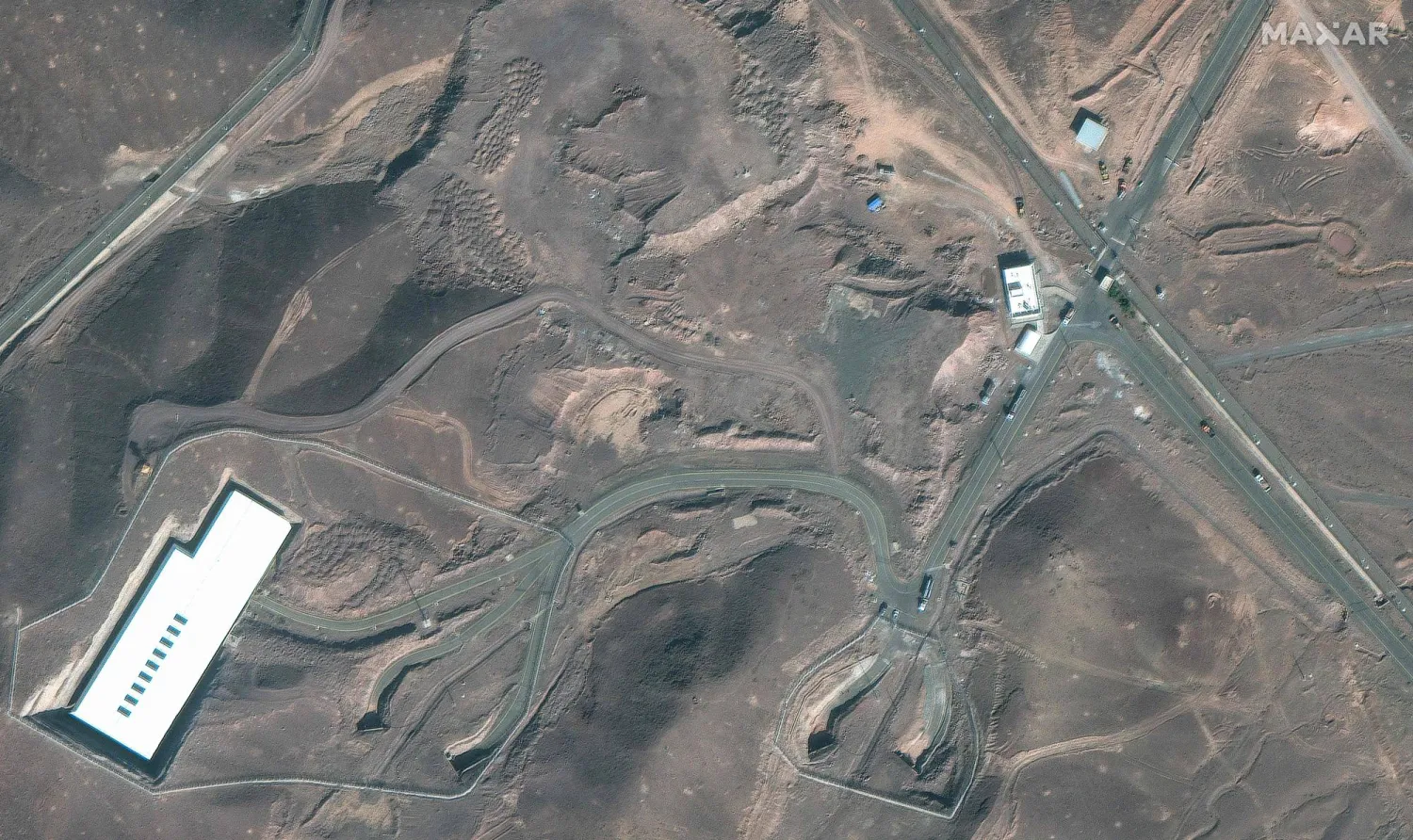
This handout satellite image courtesy of Maxar Technologies shows cargo trucks postioned near an underground entrance to Iran's Fordow Fuel Enrichment Plant (FFEP), in Fordo, Iran on June 20, 2025. (Photo by Satellite image 2025 Maxar Technologies / AFP)
TT

Axios: US, Israeli Officials Believe Highly Enriched Uranium is Sealed Off Inside Iran’s Damaged Facilities

This handout satellite image courtesy of Maxar Technologies shows cargo trucks postioned near an underground entrance to Iran's Fordow Fuel Enrichment Plant (FFEP), in Fordo, Iran on June 20, 2025. (Photo by Satellite image 2025 Maxar Technologies / AFP)

Highly enriched uranium is currently “sealed off” inside damaged facilities in Iran’s Fordow, Natanz and Isfahan, Israeli and US officials say, according to the America news website, Axios.

Iranian President Masoud Pezeshkian said in an interview that aired Monday with US journalist Tucker Carlson that the nuclear facilities were seriously damaged, but Iran doesn't currently have access to them to accurately assess the situation.

US and Israeli officials say both countries' intelligence services are monitoring Iranian actions around its nuclear facilities to detect efforts to remove material or restore operations, according to Axios.

Netanyahu's top adviser, Ron Dermer, told officials in closed briefings that he came away from a recent visit to Washington with the impression that the Trump administration would back new Israeli strikes on Iran under certain circumstances, two sources with knowledge told the website.

One scenario would be an Iranian attempt to remove the highly enriched uranium inside the damaged facilities in Fordow, Natanz and Isfahan, according to the sources.

Another would be if the Iranians start rebuilding their nuclear program, particularly enrichment facilities.

Dermer met last week with Vice President JD Vance, Secretary of State Marco Rubio and White House envoy Steve Witkoff, Israeli officials said.

Witkoff is planning to meet Iranian Foreign Minister Abbas Araghchi in Oslo in the coming days to restart nuclear talks.

According to Axios, the Iranians confirmed such a meeting is in the works but so far no final date has been set.

Dermer told Israeli officials the US remains committed to the principle of zero enrichment on Iranian soil in the nuclear talks, the website wrote.



China Says Japan-India Cooperation ‘Should Not Target’ Beijing

Indian Prime Minister Narendra Modi (R) shakes hands with Japanese Prime Minister Sanae Takaichi prior to their meeting at Hyderabad House in New Delhi, India, 02 July 2026. (EPA)
TT

China Says Japan-India Cooperation ‘Should Not Target’ Beijing

Indian Prime Minister Narendra Modi (R) shakes hands with Japanese Prime Minister Sanae Takaichi prior to their meeting at Hyderabad House in New Delhi, India, 02 July 2026. (EPA)

China said on Friday that cooperation between India and Japan "should not target" Beijing, after the leaders of the other two countries agreed to work more closely on critical minerals.

The strategic commodities, which are used in everything from electric vehicles and smartphones to jet engines and guided missiles, featured prominently during talks between Indian Prime Minister Narendra Modi and Japan's Sanae Takaichi in New Delhi on Thursday.

Asked about the meeting, China's foreign ministry said countries should work to "foster understanding and trust".

"Cooperation between nations... should not target or harm the interests of third parties, let alone serve as a pretext for forming exclusive cliques or stoking confrontation," spokesperson Guo Jiakun told a news conference.

The relationship between Beijing and Tokyo has become more turbulent since Takaichi suggested in November that a potential future attack on Taiwan -- the self-ruled island claimed by China -- could warrant Japanese military involvement.

Chinese authorities have responded in part by restricting flows to Japan of rare earths, a sector China dominates globally in both mining and processing.

Modi said after his talks with Takaichi that the countries had agreed to "strengthen supply chain resilience in strategic sectors such as semiconductors, quantum technologies and critical minerals".

Takaichi warned that Japan and India were facing challenges including "weaponization of the economy and non-market policies and practices".

This week, China's commerce ministry added 20 Japanese entities to an export blacklist on the basis that they had boosted Tokyo's military capabilities.

Japan called the latest move "unacceptable and deeply regrettable", demanding its reversal.


Researchers Say EU Lawmaker Who Investigated Surveillance Was Hacked by Israeli Spyware

Logo of Israel's NSO Group, owner of the Pegasus spyware, on a smartphone placed on a keyboard. (Reuters)
TT

Researchers Say EU Lawmaker Who Investigated Surveillance Was Hacked by Israeli Spyware

Logo of Israel's NSO Group, owner of the Pegasus spyware, on a smartphone placed on a keyboard. (Reuters)

A former member of the European Parliament who served on a committee investigating abusive surveillance was himself hacked using an Israeli-made spy tool, a Canadian tech watchdog group said on Friday.

Citizen Lab said in a report that the phone of Stelios Kouloglou, a Greek television journalist-turned-lawmaker, was hacked at least three times between October 2022 and March 2023 using Pegasus spyware, a tool distributed by the Israeli company NSO Group.

At the time of the targeting, Kouloglou was serving on the European Parliament's PEGA Committee, which was set up in 2022 to examine the use of illegal phone hacking across the European Union. The committee focused mainly on ‌the use of ‌Pegasus and similar tools, finding that governments across the EU likely used spyware, "in ‌one ⁠way or another, ⁠some legitimate, some illegitimate."

Kouloglou said he was astonished at the audacity of whoever was behind the hacking.

"I was not expecting that a PEGA member would be spied on by Pegasus," he told Reuters. "I was not expecting that they would be as reckless as that."

NSO did not return messages seeking comment.

In a statement to Reuters, the European Parliament did not directly address Kouloglou's case but said its IT security services "constantly monitor cybersecurity threats as well as potential cyberattacks against its working environment."

It said spyware screening tools ⁠had been available to all lawmakers since 2022 and that a report ‌adopted last month called for their extension to all devices ‌used for parliamentary business.

The European Commission, the European Union's executive branch, did not immediately return messages seeking comment.

NSO has ‌said its spy tools are used to police serious crime and to protect national security, ‌but the company has repeatedly been accused of facilitating intrusive surveillance of journalists, political opponents, civil rights activists and religious figures around the world. NSO was blacklisted by the US government in 2021 over human rights and national security concerns.

Last year, WhatsApp owner Meta Platforms won a $168 million damages award against NSO for unlawfully hacking the ‌platform, although the award was significantly reduced. Last month, Meta accused NSO of violating the court's injunction on targeting its services and filed for ⁠a contempt order.

Citizen Lab ⁠said it believed that Kouloglou had been hacked through a vulnerability in Apple software that was not known at the time. It said Kouloglou received repeated warnings about state-sponsored hacking attempts from Apple in 2023 and 2024. Citizen Lab did not identify who actually used Pegasus to target the former lawmaker, but it linked some of the hacking activity to earlier discoveries that Pegasus was used to spy on Russian- and Belarusian-speaking journalists and activists in exile. Apple did not directly address questions about Kouloglu, but said the vulnerability referred to in the Citizen Lab report had since been patched and that it regularly issued alerts to hacking targets.

Sophie in 't Veld, a former EU lawmaker who championed the PEGA committee's creation, said the hacking of Kouloglou's phone showed how the spread of mercenary spyware had created a surveillance free-for-all.

"We're in a situation where anybody could spy on anyone and they're spying on citizens, they're spying on journalists, they're spying on NGOs, on lawyers, on politicians, and nobody knows who's behind it," she said.


Man Dies after Setting Self Ablaze Outside UN in New York

A man self-immolates outside the United Nations headquarters in New York (Reuters)
TT

Man Dies after Setting Self Ablaze Outside UN in New York

A man self-immolates outside the United Nations headquarters in New York (Reuters)

A man died after setting himself on fire outside the UN's headquarters in New York on Thursday, police said, with activists and reports identifying him as a pro-Tibet campaigner.

The New York Police Department told AFP that "at 1832 (2232 GMT) NYPD received a call... a male set himself on fire at First Avenue and 42nd Street. He was pronounced dead at Bellevue Hospital. Investigations ongoing." No motive was given.

A spokesperson for United Nations Secretary-General Antonio Guterres said in a statement to AFP: "We are saddened by this tragic and horrific incident, and offer our condolences to his family."

US media and a pro-Tibet activist said the individual was a pro-Tibet campaigner, though investigators did not confirm this claim.

Tencho Gyatso, President of the International Campaign for Tibet, named the deceased man as Lobga Rangzen.

"Lobga was a tireless advocate for Tibet who devoted himself to peacefully raising awareness of the human rights crisis in Tibet," Gyatso said in a statement to AFP.