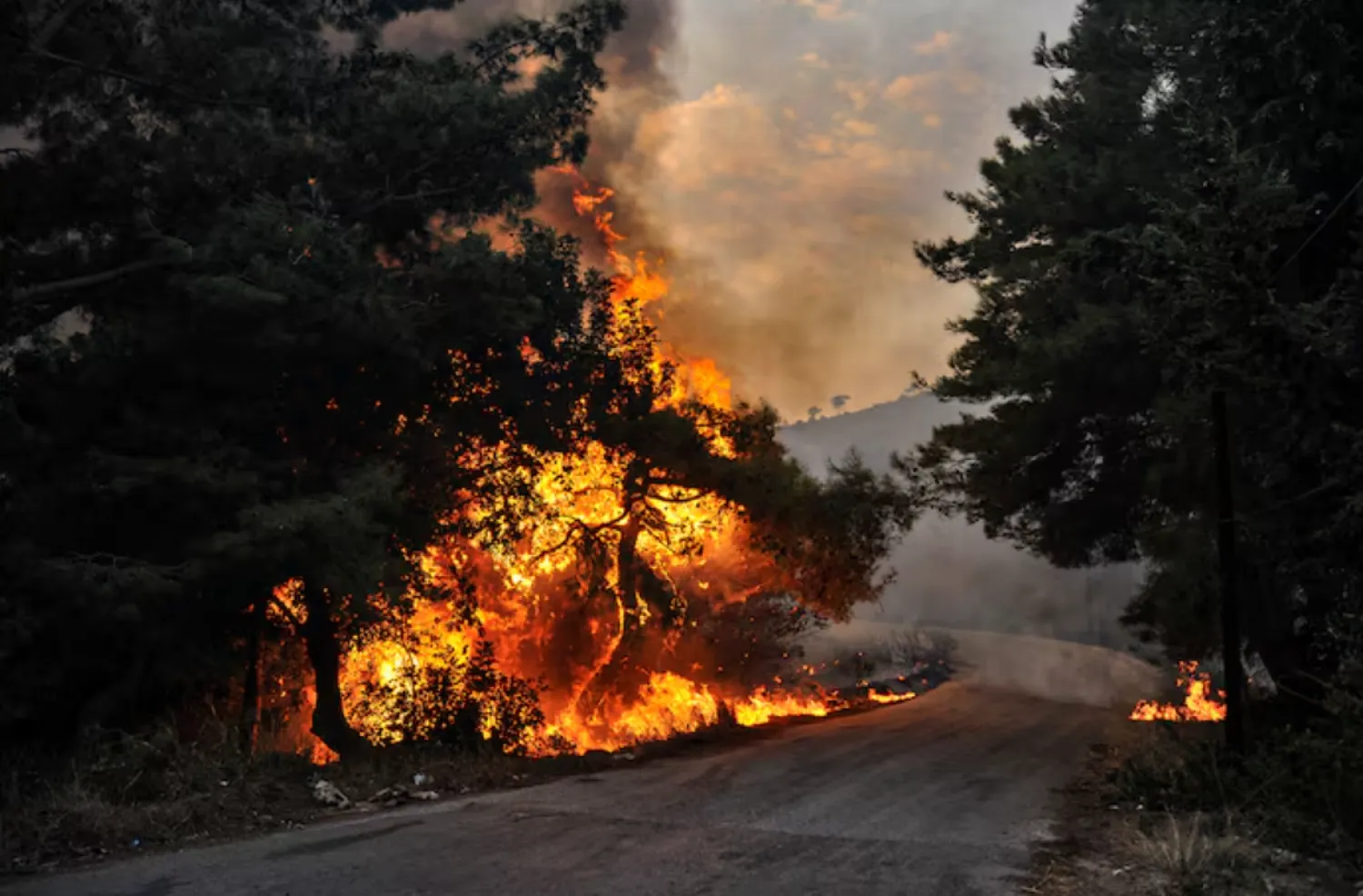
Syria Seeks EU Help to Battle Massive Wildfires

FILE : A fire burns at a forest in Latakia province, Syria in this handout released by SANA on October 9, 2020. SANA/Handout via REUTERS
TT

Syria Seeks EU Help to Battle Massive Wildfires

FILE : A fire burns at a forest in Latakia province, Syria in this handout released by SANA on October 9, 2020. SANA/Handout via REUTERS

Syria’s minister of emergencies and disaster management on Tuesday requested support from the European Union to battle wildfires that have swept through a vast stretch of forested land.

The fires have been burning for six days, with Syrian emergency crews struggling to bring them under control amid strong winds and severe drought.

Neighboring countries Jordan, Lebanon and Türkiye have already dispatched firefighting teams to assist in the response.

“We asked the European Union for help in extinguishing the fires,” minister Raed al-Saleh said on X, adding Cyprus was expected to send aid on Tuesday, AFP reported.

“Fear of the fires spreading due to strong winds last night prompted us to evacuate 25 families to ensure their safety without any human casualties,” he added.

According to the United Nations Office for the Coordination of Humanitarian Affairs (OCHA) office in Syria, the fires impacted “some 5,000 persons, including displacements, across 60 communities.”

An estimated 100 square kilometers (40 square miles) of forest and farmland -- more than three percent of Syria’s forest cover -- have burned, OCHA told AFP.

At least seven towns in Latakia province have been evacuated as a precaution.

Efforts to extinguish the fires have been hindered by “rugged terrain, the absence of firebreaks, strong winds, and the presence of mines and unexploded ordnance”, Saleh said.

With man-made climate change increasing the likelihood and intensity of droughts and wildfires worldwide, Syria has also been battered by heatwaves and low rainfall.

In June, the United Nations Food and Agriculture Organization said Syria had “not seen such bad climate conditions in 60 years.”


Whale Stranded at Baltic Sea Resort Has Swum Off Sandbank. But it Isn't Safe Yet

A humpback whale swims in the Baltic Sea, accompanied by an inflatable boat, after freeing itself the night before from being stranded off Niendorf in Timmendorfer Strand, Germany, Friday March 27, 2026. (Marcus Brandt/dpa via AP)
TT

Whale Stranded at Baltic Sea Resort Has Swum Off Sandbank. But it Isn't Safe Yet

A humpback whale swims in the Baltic Sea, accompanied by an inflatable boat, after freeing itself the night before from being stranded off Niendorf in Timmendorfer Strand, Germany, Friday March 27, 2026. (Marcus Brandt/dpa via AP)

A whale that was stranded for days in shallow water at a Baltic Sea resort in Germany has swum free from a sandbank overnight after a last-ditch rescue effort. But it isn't out of danger yet.

An excavator spent Thursday digging an escape channel. The whale then swam through it overnight, marine biologist Robert Marc Lehmann said Friday, German news agency dpa reported.

But he cautioned that it was only a small step in the right direction for the marine mammal, which is 12-15 meters (39-49 feet) long, and that it will only really be at home again if it reaches the Atlantic Ocean.

The whale was spotted stuck on an underwater sandbank in Timmendorfer Strand, a popular resort town, on Monday morning. Initial efforts to free it and coax it back toward deeper water, including using coast guard and fire department boats to create large waves, were unsuccessful. The Baltic Sea lacks strong tides that could have freed the whale.

On Thursday morning, rescuers brought in excavators to dig a trench in front of the whale's head, while Lehmann approached the animal and guided the digging. They worked until well after sunset, but hadn't quite been able to get the whale out by the time they had to stop work for the night.

Early on Friday morning, the whale was on its way out of Lübeck Bay, where Timmendorfer Strand is located, said Stephanie Gross of the Institute of Terrestrial and Aquatic Wildlife Research. She said the massive mammal, which was about 300 meters (nearly 1,000 feet) off the coast, was being accompanied by a coast guard ship and several boats.

Experts assume that the whale is a young male, as males, unlike females, tend to migrate. It also appeared to be the same whale that was spotted several times in the port of Wismar, east of Timmendorfer Strand, in recent weeks.

It was not immediately clear why the whale was in the area and got stranded.

Humpback whales aren't native to the Baltic. This one faces a journey of several hundred kilometers (miles) through German and Danish waters if it is to reach the North Sea.


Singapore Seizes Record Asian Pangolin Scales Disguised as 'Dried Fish Skin'

This undated handout received on March 28, 2026 from Singapore's National Parks Board and Immigration and Checkpoints Authority shows pangolin scales being examined following their seizure in Singapore on December 29, 2025. (Photo by Handout / Singapore's National Parks Board and Immigration & Checkpoints Authority / AFP)
TT

Singapore Seizes Record Asian Pangolin Scales Disguised as 'Dried Fish Skin'

This undated handout received on March 28, 2026 from Singapore's National Parks Board and Immigration and Checkpoints Authority shows pangolin scales being examined following their seizure in Singapore on December 29, 2025. (Photo by Handout / Singapore's National Parks Board and Immigration & Checkpoints Authority / AFP)

Singapore has seized over 830 kilograms of Asian pangolin scales hidden in a shipment bound for Cambodia, authorities said Saturday, calling it the largest haul of its kind discovered in the city-state.

Falsely declared as "dried fish skin", the scales -- estimated to be from more than 2,200 pangolins -- were found in 30 bags on December 29 after officials intercepted an inbound lorry carrying sea cargo, Singapore's National Parks Board said in a statement.

The announcement came as Singapore released a report Saturday on the nation's role in tackling illegal wildlife trade in the shipping sector.

"Based on preliminary investigations, the cargo was transiting through Singapore en route from Indonesia to Cambodia," AFP quoted the statement as saying.

"This marks the largest seizure of Asian pangolin scales in Singapore to date," it added, noting that investigations are ongoing.

The scales were identified as belonging to Sunda pangolins, a critically endangered species native to Southeast Asia, including Singapore.

Pangolins are protected under the wildlife protection treaty CITES, to which Singapore is a signatory.

"Singapore adopts a zero-tolerance stance on the illegal trade of endangered wildlife species, and their parts and derivatives," the statement read.

Pangolins are among the world's most endangered species, and their scales are prized in countries like China and Vietnam where they are used in traditional medicine as remedy for various ailments.

Their scales are similar in constitution to fingernails and provide no scientifically proven medicinal benefit.

Under Singaporean law, those found guilty of trading in protected species without a valid CITES permit face a fine of up to S$200,000 ($154,702) per specimen (not exceeding S$1 million or the market value of the items) and up to eight years in prison.


Saudi Arabia Reaffirms Commitment to Environmental Action on Saudi Green Initiative Day

One of the mountainous areas located in the south of the Kingdom of Saudi Arabia (Asharq Al-Awsat)
TT

Saudi Arabia Reaffirms Commitment to Environmental Action on Saudi Green Initiative Day

One of the mountainous areas located in the south of the Kingdom of Saudi Arabia (Asharq Al-Awsat)

The Saudi Green Initiative (SGI) Day, observed annually on March 27 following a Cabinet decision, reflects the Kingdom's commitment to establishing a culture of sustainability, enhancing national environmental efforts, and encouraging all sectors to achieve sustainable development goals in line with Vision 2030, SPA reported.

The initiative recently achieved a significant national milestone by rehabilitating one million hectares of degraded land through the National Greening Program, overseen by the National Center for Vegetation Cover Development and Combating Desertification. This objective aims to expand vegetation cover, reduce desertification, improve quality of life, and enhance the natural capacity of local environments to adapt to climate change.

The achievement is an extension of the Kingdom's broader efforts to protect natural resources, reduce emissions, promote reliance on clean energy, and preserve biodiversity, thereby strengthening Saudi Arabia's regional and international standing in environmental action.

Over the past year, the initiative has continued to make tangible progress. More than 159 million trees were planted across the Kingdom, and environmental reserves saw the birth of Arabian oryx calves for the third consecutive year. Furthermore, the National Water Efficiency and Conservation Center currently saves 120,000 cubic meters of water daily, with plans to increase this capacity to 300,000 cubic meters.

These combined efforts align with the objectives of Vision 2030 and contribute to strengthening the Kingdom’s regional and international standing in environmental sustainability.

SGI Day is observed annually to highlight the initiative’s achievements, review its future goals, and encourage broad sector participation in environmental efforts and sustainable development.

These efforts reflect the Kingdom’s approach to environmental and climate action, driven by the Saudi Green Initiative and the Middle East Green Initiative, both launched by Prince Mohammed bin Salman bin Abdulaziz Al Saud, Crown Prince and Prime Minister, underscoring its ongoing commitment to supporting the transition toward a more sustainable development model.