

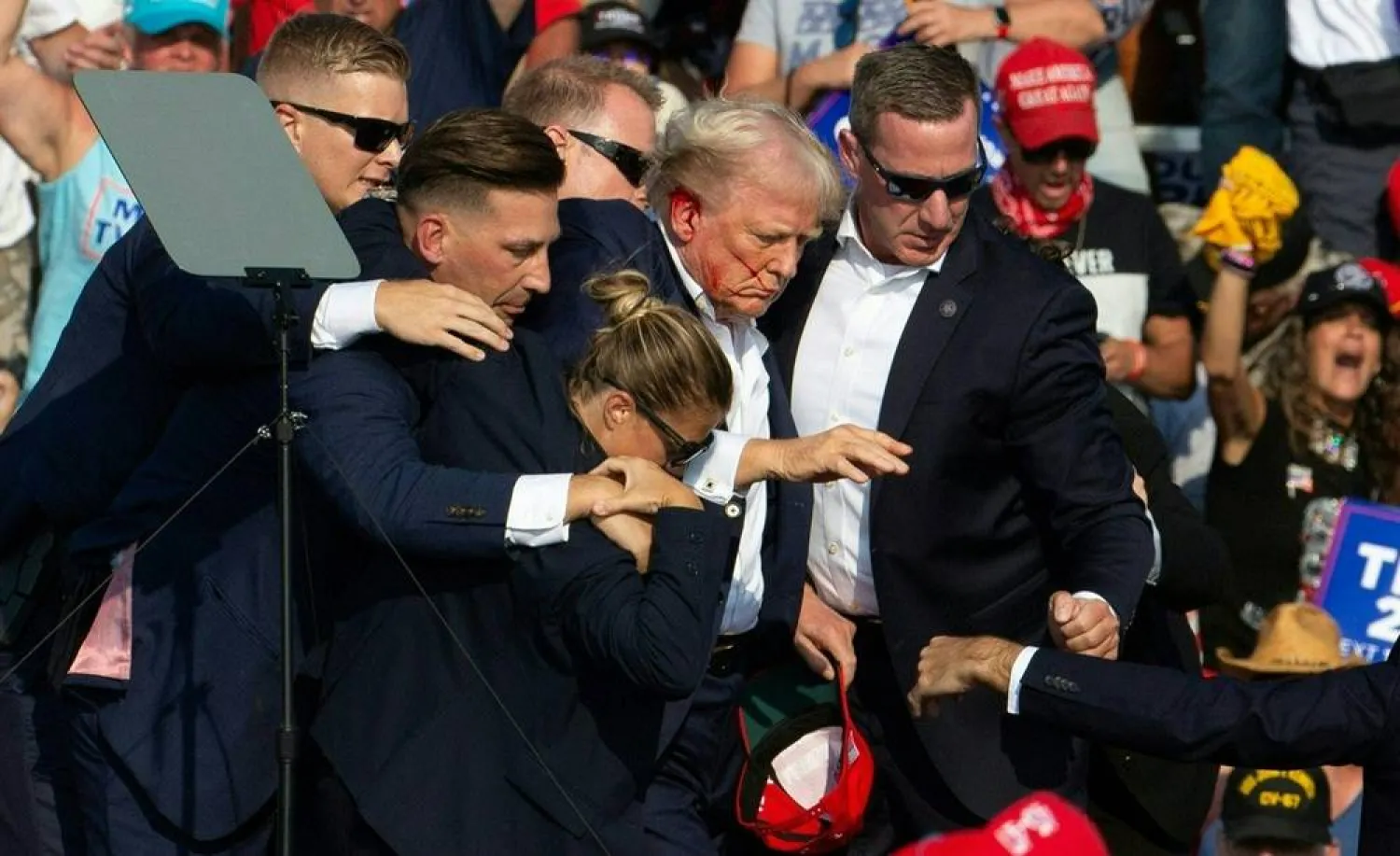

‘Bad Day:’ Trump Reflects on Assassination Bid One Year Later

Republican candidate Donald Trump is seen with blood on his face surrounded by secret service agents as he is taken off the stage at a campaign event at Butler Farm Show Inc. in Butler, Pennsylvania, July 13, 2024. (AFP)
TT

‘Bad Day:’ Trump Reflects on Assassination Bid One Year Later

Republican candidate Donald Trump is seen with blood on his face surrounded by secret service agents as he is taken off the stage at a campaign event at Butler Farm Show Inc. in Butler, Pennsylvania, July 13, 2024. (AFP)

US President Donald Trump says "mistakes were made" but he's satisfied with the investigation into his near-assassination a year ago, as the Secret Service announced disciplinary actions Thursday against six staff members.

In excerpts of an interview on Fox News' "My View with Lara Trump" show, airing Saturday, Trump, 79, said the elite close-protection service "had a bad day."

"There were mistakes made. And that shouldn't have happened," Trump said in the interview conducted by his daughter-in-law Lara Trump, who has her own show on the Trump-friendly news channel.

The Republican -- whose ear was nicked by a bullet while he addressed an election rally in Butler, Pennsylvania -- noted that the would-be assassin had access to a "prime building" overlooking the rally.

One bystander was killed and two other people in addition to Trump were wounded before a counter-sniper killed the gunman -- 20-year-old Thomas Crooks.

The sniper "was able to get him from a long distance with one shot. If he didn't do that, you would have had an even worse situation," Trump said. "His name is David and he did a fantastic job."

Speaking of the post-incident investigation and "the larger plot," Trump said "I'm satisfied with it."

"It was unforgettable," he said, recalling the drama. "I didn't know exactly what was going on. I got whacked. There's no question about that. And fortunately, I got down quickly. People were screaming."

The Secret Service said in a statement that the July 13, 2024, attack was "nothing short of a tragedy" and "an operational failure that the Secret Service will carry as a reminder of the critical importance of its zero-fail mission."

The agency cited communication, technical and human errors and said reforms were underway, including on coordination between different law enforcement bodies and establishment of a division dedicated to aerial surveillance.

Six unidentified staff have been disciplined, the Secret Service said. The punishments range from 10 to 42 days suspension without pay and all six were put into restricted or non-operational positions.

Among measures beefing up security, is an expansion of the fleet of armored golf carts to carry the president. Trump spends frequent weekends at his golf courses and in September last year was allegedly the target of a failed assassination plot while playing in Florida.

"The agency has taken many steps to ensure such an event can never be repeated in the future," Secret Service Director Sean Curran said in a statement.



SKorea Grounds Aging Attack Choppers after Fatal Training Crash

South Korean military officials secure the site where an AH-1S Cobra attack helicopter crashed in Gapyeong, South Korea, February 9, 2026. Yonhap via REUTERS
TT

SKorea Grounds Aging Attack Choppers after Fatal Training Crash

South Korean military officials secure the site where an AH-1S Cobra attack helicopter crashed in Gapyeong, South Korea, February 9, 2026. Yonhap via REUTERS

South Korea grounded an aging fleet of military helicopters on Monday after a chopper crashed during a training exercise and killed two people on board.

The AH-1S Cobra was training for emergency landings when it "crashed due to an unidentified cause" in Gapyeong county west of Seoul, the army said in a statement.

Two service members were taken to hospital and later pronounced dead, AFP reported.

Photos in local media showed the helicopter's crumpled fuselage lying on a rocky river bank.

"Following the accident, the Army has suspended operations of all aircraft of the same model" and is investigating the cause, the forces said.

The AH-1S Cobra is a US-made, single-engine anti-tank attack helicopter.

Some of those used by South Korea's military are more than 30 years old. It is not clear how many are currently in service.

The country's defense acquisition agency said in 2022 that the Army's Cobra helicopters were "scheduled to be retired" as domestically developed light-armed choppers started flying.


Japan Restarts World's Biggest Nuclear Plant Again

Participants demonstrate in front of Tokyo Electric Power Company's headquarters against the restart of the Kashiwazaki-Kariwa Nuclear Power Plant, in Tokyo on February 9, 2026. (Photo by Kazuhiro NOGI / AFP)
TT

Japan Restarts World's Biggest Nuclear Plant Again

Participants demonstrate in front of Tokyo Electric Power Company's headquarters against the restart of the Kashiwazaki-Kariwa Nuclear Power Plant, in Tokyo on February 9, 2026. (Photo by Kazuhiro NOGI / AFP)

Japan switched on the world's biggest nuclear power plant again on Monday, its operator said, after an earlier attempt was quickly suspended due to a minor glitch.

The Kashiwazaki-Kariwa plant in the Niigata region restarted at 2:00 pm (0500 GMT), AFP quoted the Tokyo Electric Power Company (TEPCO) as saying in a statement.

A glitch with an alarm in January forced the suspension of its first restart since the 2011 Fukushima disaster.

The facility had been offline since Japan pulled the plug on nuclear power after a colossal earthquake and tsunami sent three reactors at the Fukushima atomic plant into meltdown.

But now Japan is turning to atomic energy to reduce its reliance on fossil fuels, achieve carbon neutrality by 2050 and meet growing energy needs from artificial intelligence.

Conservative Prime Minister Sanae Takaichi, who pulled off a thumping election victory on Sunday, has promoted nuclear power to energize the Asian economic giant.

TEPCO initially moved to start one of seven reactors at the Kashiwazaki-Kariwa plant on January 21 but shut it off the following day after an alarm from the monitoring system sounded.

The alarm had picked up slight changes to the electrical current in one cable even though these were still within a range considered safe, TEPCO officials told a press conference last week.

The firm has changed the alarm's settings as the reactor is safe to operate.
The commercial operation will commence on or after March 18 after another comprehensive inspection, according to TEPCO officials.


Israel Threatens to Hit Iran’s Ballistic Missiles, Questions ‘Value’ of Deal

People walk past a huge anti-US billboard displayed on a building in Tehran's Valiasr Square on February 8, 2026. (Photo by ATTA KENARE / AFP)
TT

Israel Threatens to Hit Iran’s Ballistic Missiles, Questions ‘Value’ of Deal

People walk past a huge anti-US billboard displayed on a building in Tehran's Valiasr Square on February 8, 2026. (Photo by ATTA KENARE / AFP)

Israel on Sunday said it could launch military strikes on Iran's ballistic missile program, expressing deep skepticism regarding the viability of any potential nuclear deal between Washington and Tehran.

Israeli Energy Minister Eli Cohen considered a possible agreement between the US and Iran to be worthless - and a further military confrontation with Iran to be possible.

His comments came as representatives of the US government and Iran began talks in the Omani capital Muscat on Friday. A date for a possible continuation has not yet been set.

Israeli Prime Minister Benjamin Netanyahu is expected to travel to Washington on Wednesday to discuss the ongoing talks with Iran with US President Donald Trump.

“An agreement with the current regime has no value,” said Cohen, the Israeli news portal ynet reported on Sunday. “Regime change in Tehran is in the interest of all Muslim states surrounding Iran.”

“Even in the event of an agreement, if a threat against Israel develops and we are forced to act, we will act,” Cohen emphasized.

Also on Sunday, Israeli Foreign Minister Gideon Sa’ar said: “The Iranian regime spreads terror beyond the Middle East, including to Latin America and we commend Paraguay's designation of the IRGC as a terror organization.”

During a meeting with Paraguay’s Foreign Minister Ruben Ramirez Lezcano, Sa’ar said Iran’s long-range ballistic missile program poses a threat not only to Israel but also to Europe.

Israel is demanding that any agreement between the US and Iran must also include a limit on ballistic missiles and an end to support for Iran's allies in the region.

On Sunday, The Jerusalem Post reported that Israeli defense officials recently told their US counterparts that Iran’s ballistic missile program represents an existential threat, and that Jerusalem is prepared to act unilaterally if necessary.

According to security sources, Israeli intentions to dismantle Iran’s missile capabilities and production infrastructure were conveyed in recent weeks through a series of high-level exchanges. Military officials outlined operational concepts to degrade the program, including strikes on key manufacturing sites.

“We told the Americans we will strike alone if Iran crosses the red line we set on ballistic missiles,” the source said, adding that Israel is not yet at that threshold but is continuously tracking developments inside Iran.

The officials stressed that Israel reserves freedom of action and emphasized that it will not allow Iran to restore strategic weapon systems on a scale that threatens Israel’s existence.

One defense official described the current moment as a “historic opportunity” to deliver a significant blow to Iran’s missile infrastructure and neutralize active threats to Israel and neighboring states.

During recent talks, Israel also presented plans to target additional facilities connected to the missile program, according to the official.

The newspaper said concerns were raised by several officials that Trump may adopt a limited strike model - similar to recent US operations against the Houthis in Yemen - which, they fear, could leave Iran’s critical capabilities intact.

“The worry is he might choose a few targets, declare success, and leave Israel to deal with the fallout, just like with the Houthis,” another military official said, adding that partial measures won’t eliminate the core threat.