


Evidence of Ongoing 'Crimes Against Humanity' in Darfur, Says ICC Deputy Prosecutor

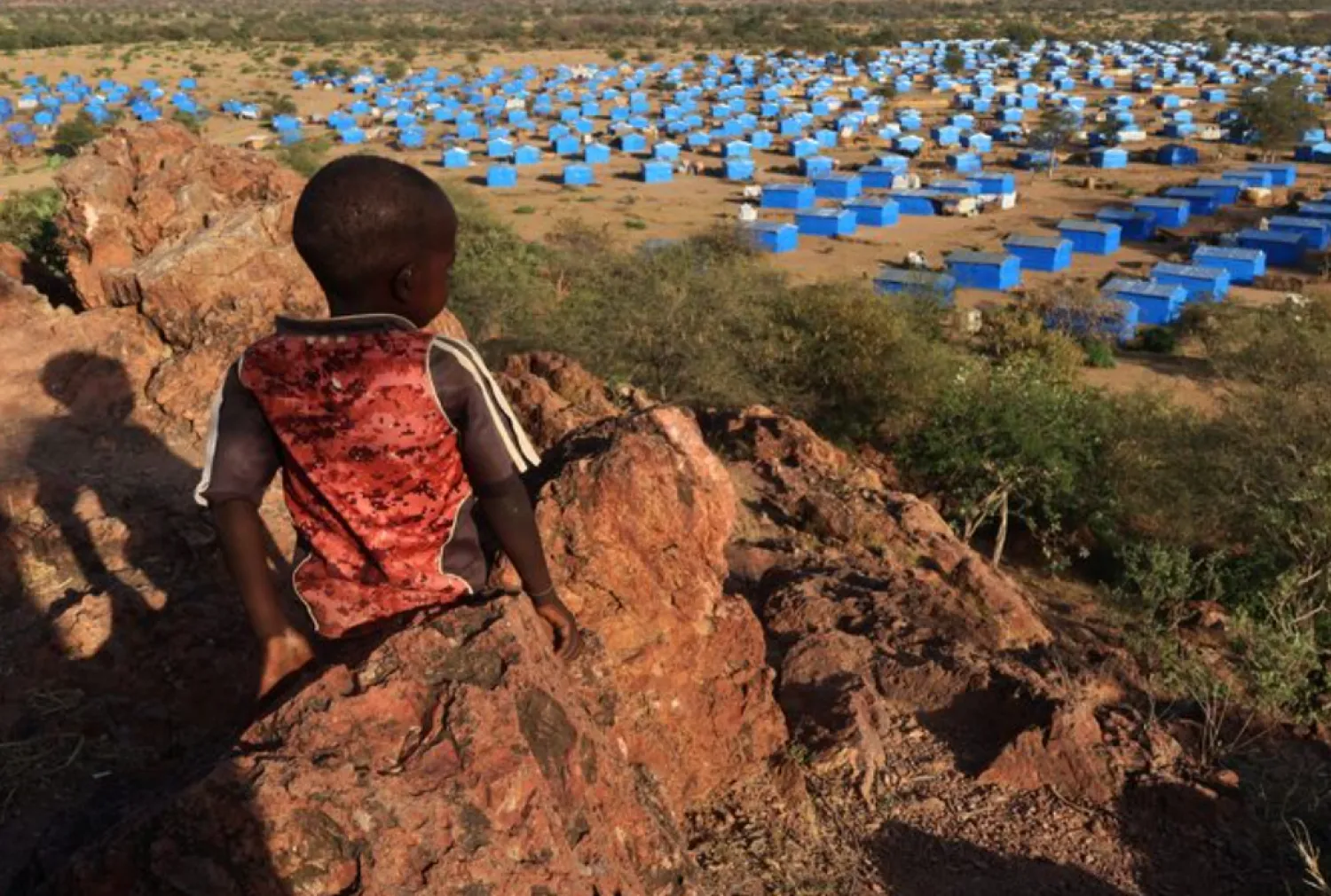
A boy sits atop a hill overlooking a refugee camp near the Chad-Sudan border, November 9, 2023. REUTERS/El Tayeb Siddig/File Photo
TT

Evidence of Ongoing 'Crimes Against Humanity' in Darfur, Says ICC Deputy Prosecutor

A boy sits atop a hill overlooking a refugee camp near the Chad-Sudan border, November 9, 2023. REUTERS/El Tayeb Siddig/File Photo

There are "reasonable grounds to believe that war crimes and crimes against humanity" are being committed in war-ravaged Sudan's western Darfur region, the deputy prosecutor of the International Criminal Court (ICC) said.

Outlining her office's probe of the devastating conflict which has raged since 2023, Nazhat Shameem Khan told the UN Security Council that it was "difficult to find appropriate words to describe the depth of suffering in Darfur," AFP reported.

"On the basis of our independent investigations, the position of our office is clear. We have reasonable grounds to believe that war crimes and crimes against humanity, have been and are continuing to be committed in Darfur," she said.

The prosecutor's office focused its probe on crimes committed in West Darfur, Khan said, interviewing victims who fled to neighboring Chad.

She detailed an "intolerable" humanitarian situation, with apparent targeting of hospitals and humanitarian convoys, while warning that "famine is escalating" as aid is unable to reach "those in dire need."

"People are being deprived of water and food. Rape and sexual violence are being weaponized," Khan said, adding that abductions for ransom had become "common practice."

"And yet we should not be under any illusion, things can still get worse."

The Security Council referred the situation in Darfur to the ICC in 2005, with some 300,000 people killed during conflict in the region in the 2000s.

In 2023, the ICC opened a fresh probe into war crimes in Darfur after a new conflict erupted between the Sudanese army and the Rapid Support Forces (RSF).

The RSF's predecessor, the Janjaweed militia, was accused of genocide two decades ago in the vast western region.

ICC judges are expected to deliver their first decision on crimes committed in Darfur two decades ago in the case of Ali Mohamed Ali Abd-Al-Rahman, known as Ali Kosheib, after the trial ended in 2024.

"I wish to be clear to those on the ground in Darfur now, to those who are inflicting unimaginable atrocities on its population -- they may feel a sense of impunity at this moment, as Ali Kosheib may have felt in the past," said Khan.

"But we are working intensively to ensure that the Ali Kosheib trial represents only the first of many in relation to this situation at the International Criminal Court," she added.



Palestinian PM to Asharq Al-Awsat: Gaza Rebuilding Delays Aid Displacement Plans

Palestinian Prime Minister Mohammad Mustafa (Asharq Al-Awsat)
TT

Palestinian PM to Asharq Al-Awsat: Gaza Rebuilding Delays Aid Displacement Plans

Palestinian Prime Minister Mohammad Mustafa (Asharq Al-Awsat)

With a fragile ceasefire holding in the Gaza Strip amid continued Israeli violations and overlapping political and security pressures, Palestinian Prime Minister Mohammad Mustafa has set out a roadmap for the next phase, beginning with urgent humanitarian needs and extending to reconstruction, institution-building, and the reunification of Gaza and the West Bank.


Speaking to Asharq Al-Awsat on the sidelines of the World Economic Forum in Davos, Mustafa tied the provision of “decent housing, even if temporary,” to the launch of reconstruction efforts, the opening of border crossings, the restoration of security, and the prevention of displacement.


Any delay in these steps, he warned, would undermine recovery prospects and advance what he described as Israel’s aim of pushing Gaza’s population to leave.


Delaying these steps, he warned, threatens recovery prospects and serves what he described as Israel’s objective of pushing Gaza’s population to leave.


Decent living basics are a top priority


Mustafa said the progress achieved so far on the Gaza ceasefire “deserves thanks to all international and Arab parties” that helped secure it and set the process toward subsequent steps.


But he stressed that the next phase still requires extensive work and that “everything must start with the basics.”


“People are still dying and suffering under these conditions,” he said. “There is indeed no famine today, but decent housing is not available, even temporarily, at least.” He said Israel “continues to impose restrictions” on this front, calling housing “an absolute priority.”


“We do not want to talk about big things. Let us simplify matters,” Mustafa added. “After food and water, the most basic need is for people to live in a dignified place. We are not asking for apartment buildings or villas, just temporary housing, a ready place, a room of 70 or 100 square meters for a family to live with dignity.”


Two conditions for economic recovery


The Palestinian prime minister said the second step after providing temporary housing was “seriously thinking about launching economic recovery and reconstruction, even in their initial stages.”


While acknowledging that arrangements are complex, he said they hinge on two essential conditions: opening the crossings and restoring security.


“Without opening the crossings, construction materials will not enter, and without security, there will be no reconstruction, no economy, nothing at all,” he said.


He added that the next step must be to allow crossings to open for the entry of construction materials and to begin repairing infrastructure to restore basic services, stressing that this “necessarily requires improving the security situation.”


Security and institution-building


Mustafa said improving security must be based on recognizing that the current situation is temporary and that, “ultimately, after around two years, full authority must return to the Palestinian Authority.”


“We want to build all institutions, including the security institution, and we are taking this into account,” he said.


In this context, he said efforts were underway to accelerate work with partners, particularly Egypt, Europeans, and Jordan, to reestablish or strengthen the Palestinian security force, especially the Palestinian police, so that it can maintain security in Gaza.


He added that an international military peace force, if deployed, could provide additional support and help preserve calm with Israel.


Unifying institutions between Gaza and the West Bank


Mustafa said the government is working to develop the performance of institutions in Gaza so they can carry out their duties in delivering services to citizens, but within unified institutional and legal frameworks linking Gaza and the West Bank.


He said the ultimate goal is the unity of Gaza and the West Bank as a step toward establishing a Palestinian state, as agreed at the New York conference led by Saudi Arabia and France, and as outlined in President Donald Trump’s plan and UN Security Council Resolution 2803.


That resolution, he said, stipulates that the process begins with a ceasefire and ends with self-determination and the establishment of a Palestinian state.


Asked whether displacement plans still pose a real threat, Mustafa said: “We hope displacement will not be real and will not succeed. But to ensure its failure, we must achieve what we talked about: reconstruction, relief, housing, and security.”


“How can people live?” he asked, warning that the absence of these fundamentals would push people to look for any opportunity to leave, which he said is what Israel wants.


Israeli Fire Kills 11, Including Journalists, Gaza Health Officials Say

 Mourners react during the funeral of Palestinians who, according to medics, were killed by Israeli strikes on Wednesday, at Al-Aqsa Martyrs Hospital, in Deir al-Balah, central Gaza Strip, January 21, 2026. REUTERS/Mahmoud Issa
Mourners react during the funeral of Palestinians who, according to medics, were killed by Israeli strikes on Wednesday, at Al-Aqsa Martyrs Hospital, in Deir al-Balah, central Gaza Strip, January 21, 2026. REUTERS/Mahmoud Issa
TT

Israeli Fire Kills 11, Including Journalists, Gaza Health Officials Say

 Mourners react during the funeral of Palestinians who, according to medics, were killed by Israeli strikes on Wednesday, at Al-Aqsa Martyrs Hospital, in Deir al-Balah, central Gaza Strip, January 21, 2026. REUTERS/Mahmoud Issa
Mourners react during the funeral of Palestinians who, according to medics, were killed by Israeli strikes on Wednesday, at Al-Aqsa Martyrs Hospital, in Deir al-Balah, central Gaza Strip, January 21, 2026. REUTERS/Mahmoud Issa

Israeli fire killed 11 Palestinians, including two boys and three journalists, in Gaza on Wednesday, local medics ​said, and the Israeli military said it had "eliminated" a Palestinian militant who posed a threat to soldiers.

In the latest violence disrupting a brittle, three-month-old ceasefire, Palestinian health officials said an Israeli airstrike killed three Palestinian journalists travelling in a car in the central Gaza Strip.

The three were on an assignment sponsored by the Egyptian Committee, which supervises Egypt's relief work in Gaza, to film tent encampments built by Egypt for displaced Palestinians, other local journalists told Reuters.

An Egyptian security source confirmed the vehicle belonged to the committee but gave no further details. The Israeli military did not immediately respond to a request ‌for comment.

Israel and Hamas ‌have traded blame for multiple breaches of the October truce after ‌two ⁠years ​of war ‌that devastated Gaza and caused a humanitarian disaster, and remain at odds over the next steps in US President Donald Trump's 20-point peace plan.

Earlier on Wednesday, Palestinian medics said three people, including a 10-year-old boy, were killed as a result of Israeli tank shelling east of Deir Al-Balah in central Gaza. Two others, a boy of 13 and a woman, were killed in two Israeli shooting incidents in eastern Khan Younis in Gaza's south, they said.

Three other Palestinians were killed in other shootings across the coastal enclave, taking Wednesday's ⁠death toll to at least 11, the health ministry of the Hamas-run Gaza said.

Residents said the two incidents occurred in Palestinian-controlled areas. The ‌ceasefire brought about a partial Israeli military withdrawal, leaving Israeli forces holding ‍about 53% of the enclave, but they ‍have been gradually expanding their presence in recent weeks, leading to further displacement of Palestinian families, residents ‍told Reuters.

There was also no immediate Israeli military comment on the two incidents.

Earlier on Wednesday, it said in a statement that Israeli forces had killed a "terrorist" who entered an area under their control, posing an imminent threat to soldiers operating there.

TRUMP PLAN STRUGGLES TO MOVE BEYOND FIRST STAGE

The US-brokered October deal has not progressed beyond ​the first-phase ceasefire, under which major fighting stopped, some Israeli forces pulled back, and Hamas freed hostages in return for Palestinian detainees and convicted prisoners.

Under future phases whose details ⁠have yet to be hammered out, Hamas is supposed to disarm, Israeli forces withdraw further and an internationally backed administration installed to rebuild the ruined, densely populated territory.

But no timetable has been set to implement the plan.

Trump was due on Thursday to preside over a ceremony celebrating the Board of Peace, a group he formed with the stated goal of redeveloping the coastal enclave.

Israel says it can only move into the second phase after Hamas hands over the remains of the last Israeli hostage.

On Wednesday, Hamas Gaza spokesperson Hazem Qassem said the Islamist group had shared all information it had on the body of the last hostage and searched for it but in vain, blaming what it called Israeli military obstruction.

More than 460 Palestinians and three Israeli soldiers have been reported killed in clashes since the ceasefire took effect.


Egyptian President Says Palestinian Cause Remains Top Priority

Egypt's President Abdel Fattah al-Sisi delivers a speech during the World Economic Forum (WEF) annual meeting in Davos on January 21, 2026.  (AFP)
Egypt's President Abdel Fattah al-Sisi delivers a speech during the World Economic Forum (WEF) annual meeting in Davos on January 21, 2026. (AFP)
TT

Egyptian President Says Palestinian Cause Remains Top Priority

Egypt's President Abdel Fattah al-Sisi delivers a speech during the World Economic Forum (WEF) annual meeting in Davos on January 21, 2026.  (AFP)
Egypt's President Abdel Fattah al-Sisi delivers a speech during the World Economic Forum (WEF) annual meeting in Davos on January 21, 2026. (AFP)

Egyptian President Abdel Fattah al-Sisi on Wednesday said the Palestinian cause is still “at the forefront of priorities” in the Middle East.

He told a panel at Davos that resolving Palestinian cause “is the core of regional stability, and a cornerstone to achieve a just and comprehensive peace.”

The Egyptian leader lauded US President Donald Trump’s efforts to help reach a ceasefire that stropped the Israel-Hamas war in Gaza in October.

The two leaders are expected to meet at Davos, said the Egyptian Presidency on Tuesday.

This ‌will be ‌the first ‌meeting ⁠between ​the ‌two leaders since the US announced it was launching the second phase of its plan to end the war in Gaza.

Sisi and ⁠Trump met in the ‌Red Sea resort ‍of Sharm ‍el-Sheikh in October during a ‍summit convened by Egypt to sign a ceasefire deal aimed at ending the ​war.