


Rubio Holds Talks with Russia’s Lavrov as Ukraine Tensions Soar

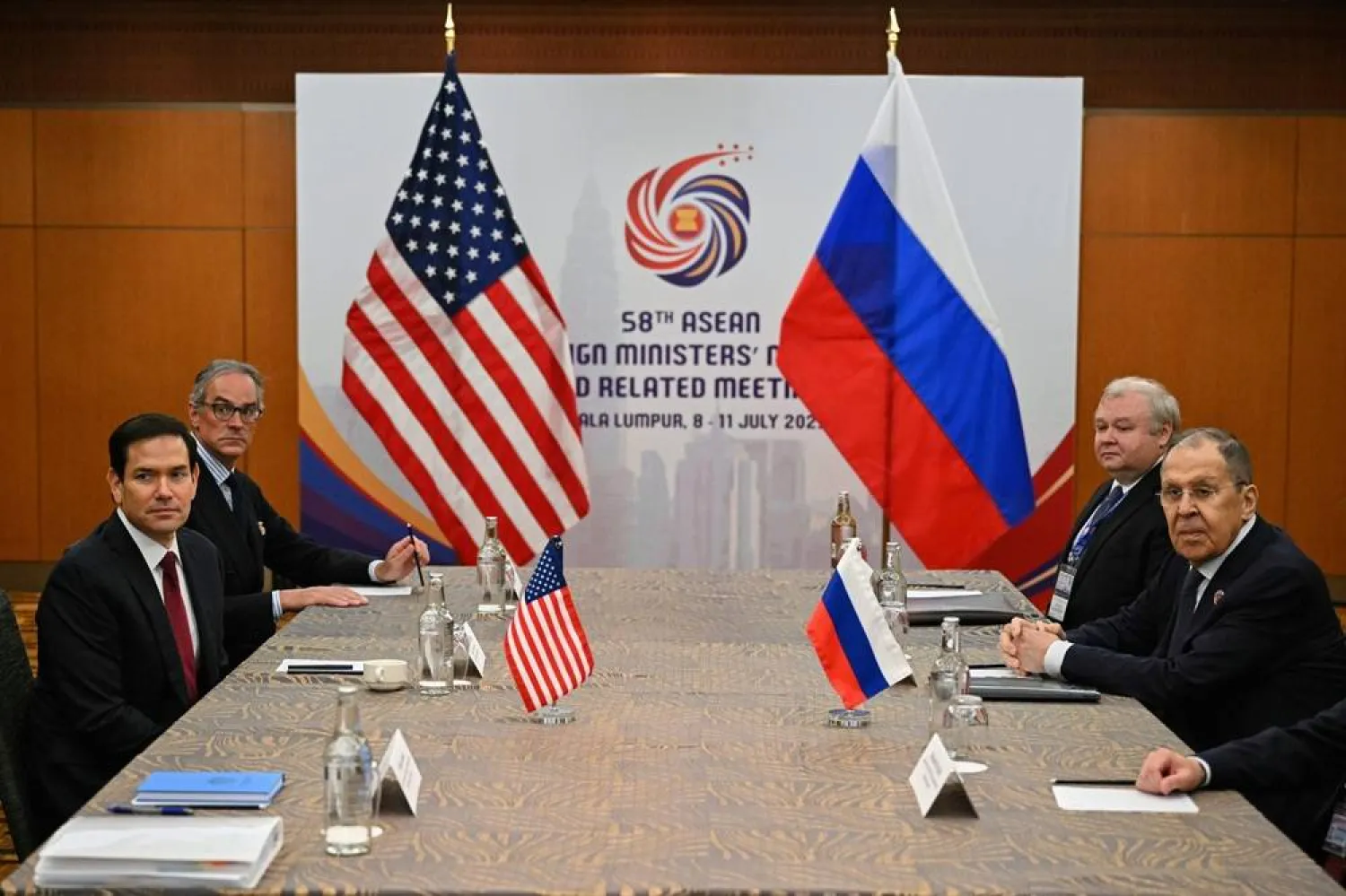
 US Secretary of State Marco Rubio, left, meets with Russia's Foreign Minister Sergei Lavrov, right, on the sidelines of the ASEAN Foreign Ministers' meeting in Kuala Lumpur, Thursday, July 10, 2025. (Mandel Ngan/Pool Photo via AP)
US Secretary of State Marco Rubio, left, meets with Russia's Foreign Minister Sergei Lavrov, right, on the sidelines of the ASEAN Foreign Ministers' meeting in Kuala Lumpur, Thursday, July 10, 2025. (Mandel Ngan/Pool Photo via AP)
TT

Rubio Holds Talks with Russia’s Lavrov as Ukraine Tensions Soar

 US Secretary of State Marco Rubio, left, meets with Russia's Foreign Minister Sergei Lavrov, right, on the sidelines of the ASEAN Foreign Ministers' meeting in Kuala Lumpur, Thursday, July 10, 2025. (Mandel Ngan/Pool Photo via AP)
US Secretary of State Marco Rubio, left, meets with Russia's Foreign Minister Sergei Lavrov, right, on the sidelines of the ASEAN Foreign Ministers' meeting in Kuala Lumpur, Thursday, July 10, 2025. (Mandel Ngan/Pool Photo via AP)

US Secretary of State Marco Rubio and his Russian counterpart met Thursday in Malaysia as tensions between the countries rise over Moscow’s increasing attacks on Ukraine and whether Russia's leader is serious about a peace deal.

Rubio and Foreign Minister Sergey Lavrov held talks in Kuala Lumpur on the sidelines of the annual Association of Southeast Asian Nations Regional Forum, which brings together 10 ASEAN members and their most important diplomatic partners including Russia, China, Japan, South Korea, European nations and the US.

The meeting lasted around 50 minutes. Rubio was seen winking at Lavrov afterward as reporters shouted questions, which they both ignored.

The meeting was their second encounter since Rubio took office, although they have spoken by phone several times. Their first meeting took place in February in Riyadh, Saudi Arabia, as the Trump administration sought to test Russia and Ukraine on their willingness to make peace.

Thursday's meeting occurred shortly after the US resumed some shipments of defensive weapons to Ukraine following a pause, ostensibly for the Pentagon to review domestic munitions stocks, that was cheered in Moscow.

The resumption comes as Russia fires escalating air attacks on Ukraine and as US President Donald Trump has become increasingly frustrated with Russian President Vladimir Putin.

"Putin is not, he’s not treating human beings right," Trump said during a Cabinet meeting Tuesday, explaining the pause’s reversal. "It’s killing too many people. So we’re sending some defensive weapons to Ukraine, and I’ve approved that."

Rubio was also seeing other foreign ministers, including many whose countries face tariffs set to be imposed Aug. 1. The tariff threat could overshadow the top diplomat’s first official trip to Asia, just as the US seeks to boost relations with Indo-Pacific nations to counter China’s growing influence in the region.

Rubio sought to assuage concerns as he held group talks with ASEAN foreign ministers.

"The Indo Pacific, the region, remains a focal point of US foreign policy," he told them. "When I hear in the news that perhaps the United States or the world might be distracted by events in other parts of the planet, I would say distraction is impossible, because it is our strong view and the reality that this century and the story of next 50 years will largely be written here in this region."

"These are relationships and partnerships that we intend to continue to build on without seeking the approval or the permission of any other actor in the region of the world," Rubio said in an apparent reference to China.

Trump notified several countries on Monday and Wednesday that they will face higher tariffs if they don’t make trade deals with the US. Among them are eight of ASEAN's 10 members.

US State Department officials said tariffs and trade won't be Rubio’s focus during the meetings, which Trump’s Republican administration hopes will prioritize maritime safety and security in the South China Sea, where China has become increasingly aggressive toward its small neighbors, as well as combating transnational crime.

But Rubio may be hard-pressed to avoid the tariff issue that has vexed some of Washington's closest allies and partners in Asia, including Japan and South Korea and most members of ASEAN, which Trump says would face 25% tariffs if there is no deal.

Rubio also met with Malaysian Prime Minister Anwar Ibrahim, who has warned global trade is being weaponized to coerce weaker nations. Anwar urged the bloc Wednesday to strengthen regional trade and reduce reliance on external powers.

Rubio’s "talking points on the China threat will not resonate with officials whose industries are being battered by 30-40% tariffs," said Danny Russel, vice president of the Asia Society Policy Institute and a former assistant secretary of state for East Asia and the Pacific during the Obama administration.

When Anwar said "ASEAN will approach challenges ‘as a united bloc’ he wasn’t talking about Chinese coercion but about US tariffs," Russel noted.

Majority of ASEAN members face major tariff hikes Among ASEAN states, Trump has announced tariffs on almost all of the bloc's 10 members.

Trump sent tariff letters to two more ASEAN members Wednesday: Brunei, whose imports would be taxed at 25%, and the Philippines at 20%. Others hit this week include Cambodia at 36%, Indonesia at 32%, Laos at 40%, Malaysia at 25%, Myanmar at 40% and Thailand at 36%.

Vietnam recently agreed to a trade deal for a 20% tariffs on its imports, while Singapore still faces a 10% tariff that was imposed in April. The Trump administration has courted most Southeast Asian nations in a bid to blunt or at least temper China’s push to dominate the region.

In Kuala Lumpur, Rubio also will likely come face-to-face with China's foreign minister during his visit of about 36 hours.

Chinese Foreign Minister Wang Yi is a veteran of such gatherings and "fluent in ASEAN principles and conventions," while Rubio "is a rookie trying to sell an ‘America First’ message to a deeply skeptical audience," Russel noted.

Issues with China remain substantial, including trade, human rights, militarization of the South China Sea and China's support for Russia in Ukraine.

US officials continue to accuse China of resupplying and revamping Russia’s military industrial sector, allowing it to produce additional weapons that can be used to attack Ukraine.

Earlier on Thursday, Rubio signed a memorandum on civilian nuclear energy with Malaysia’s foreign minister, which will pave the way for negotiations on a more formal nuclear cooperation deal, known as a 123 agreement after the section of US law allowing such programs.

Those agreements allow the US government and US companies to work with and invest in civilian energy nuclear programs in other countries under strict supervision.



Netanyahu Skeptical of an Iran Breakthrough

Israel's Prime Minister Benjamin Netanyahu leaves after a meeting with US President Donald Trump at the White House February 11, 2026, in Washington, DC. (Photo by Brendan Smialowski / AFP)
TT

Netanyahu Skeptical of an Iran Breakthrough

Israel's Prime Minister Benjamin Netanyahu leaves after a meeting with US President Donald Trump at the White House February 11, 2026, in Washington, DC. (Photo by Brendan Smialowski / AFP)

Israeli Prime Minister Benjamin Netanyahu said he was skeptical that US nuclear talks with Iran will lead to a breakthrough but described his meeting with US President Donald Trump at the White House as “excellent.”

Speaking to reporters Thursday in Washington before boarding a plane to return to Israel, Netanyahu said Trump’s terms and Iran’s “understanding that they made a mistake the last time when they did not reach an agreement, may lead them to agree to conditions that will enable a good agreement to be reached.”

While he said he did “not hide my general skepticism” about any deal, he stressed that any agreement must include concessions about Iran’s ballistic missiles program and support for militant proxies.

He added that the conversation Wednesday with Trump, which lasted more than two hours, included a number of other subjects, including Gaza and regional developments but focused on the negotiations with Iran.


German Court Rejects Palestinian's Claim over Weapons Exports

A view shows the front of the Reichstag building, the seat of the German parliament, the Bundestag, in Berlin, Germany March 5, 2025. REUTERS/Annegret Hilse/File Photo
TT

German Court Rejects Palestinian's Claim over Weapons Exports

A view shows the front of the Reichstag building, the seat of the German parliament, the Bundestag, in Berlin, Germany March 5, 2025. REUTERS/Annegret Hilse/File Photo

Germany's highest court on Thursday threw out a case brought by a Palestinian civilian from Gaza seeking to sue the German government over its weapons exports to Israel.

The complainant, supported by the European Center for Constitutional and Human Rights (ECCHR), had been seeking to challenge export licences for German parts used in Israeli tanks deployed in Gaza.

After his case was rejected by lower courts in 2024 and 2025, he had appealed to the Federal Constitutional Court.

But the court in Karlsruhe dismissed the case, stating that "the complainant has not sufficiently substantiated that the specialized courts misjudged or arbitrarily denied a possible duty to protect him", AFP reported.

While Germany is obliged to protect human rights and respect international humanitarian law, this does not mean the state is necessarily obliged to take specific action on behalf of individuals, the court said.

"It is fundamentally the responsibility of the state authorities themselves to decide how they fulfil their general duty of protection," it added.

The ECCHR called the decision "a setback for civilian access to justice".

"The court acknowledges the duty to protect but only in the abstract and refuses to ensure its practical enforcement," said Alexander Schwarz, co-director of the NGO's International Crimes and Legal Accountability program.

"For people whose lives are endangered by the consequences of German arms exports, access to justice remains effectively closed," he said.

The ECCHR had been hoping for a successful appeal after the Constitutional Court ruled last year that Germany had "a general duty to protect fundamental human rights and the core norms of international humanitarian law, even in cases involving foreign countries".

In that case, two Yemenis had been seeking to sue Berlin over the role of the US Ramstein airbase in a 2012 drone attack.

The complainant was one of five Palestinians who initially brought their case against the German government in 2024.


2 Israelis Charged with Using Classified Military Information to Place Bets

The Israeli Iron Dome air defense system intercepts missiles during an Iranian attack on Tel Aviv, Israel, June 18, 2025. (AP Photo/Leo Correa, File)
TT

2 Israelis Charged with Using Classified Military Information to Place Bets

The Israeli Iron Dome air defense system intercepts missiles during an Iranian attack on Tel Aviv, Israel, June 18, 2025. (AP Photo/Leo Correa, File)

Two Israelis have been charged with using classified military information to place bets on how future events will unfold, Israeli authorities said Thursday, accusing the individuals of “serious security offenses.”

A joint statement by the Israeli Ministry of Defense, domestic security service Shin Bet and police said that a civilian and a reservist are suspected of placing bets on the US-based prediction market Polymarket on future military operations based on information that the reservist had access to, The AP news reported.

Israel’s Attorney General’s Office decided to prosecute the two individuals following a joint investigation by police, military intelligence and other security agencies that resulted in several arrests. The two face charges including bribery and obstruction of justice.

Authorities offered no details on the identity of the two individuals or the reservist's rank or position in the Israeli military but warned that such actions posed a “real security risk” for the military and the Israeli state.

Israel’s public broadcaster Kan had reported earlier that the bets were placed in June ahead of Israel’s war with Iran and that the winnings were roughly $150,000.

Israel's military and security services “view the acts attributed to the defendants very seriously and will act resolutely to thwart and bring to justice any person involved in the activity of using classified information illegally,” the statement said.

The accused will remain in custody until the end of legal proceedings against them, the Prosecutor's Office said.

Prediction markets are comprised of typically yes-or-no questions called event contracts, with the prices connected to what traders are willing to pay, which theoretically indicates the perceived probability of an event occurring.

Their use has skyrocketed in recent years, but despite some eye-catching windfalls, traders still lose money everyday. In the US, the trades are categorized differently than traditional forms of gambling, raising questions about transparency and risk.