


Putin Urges Iran to Take ‘Zero Enrichment’ Nuclear Deal with US

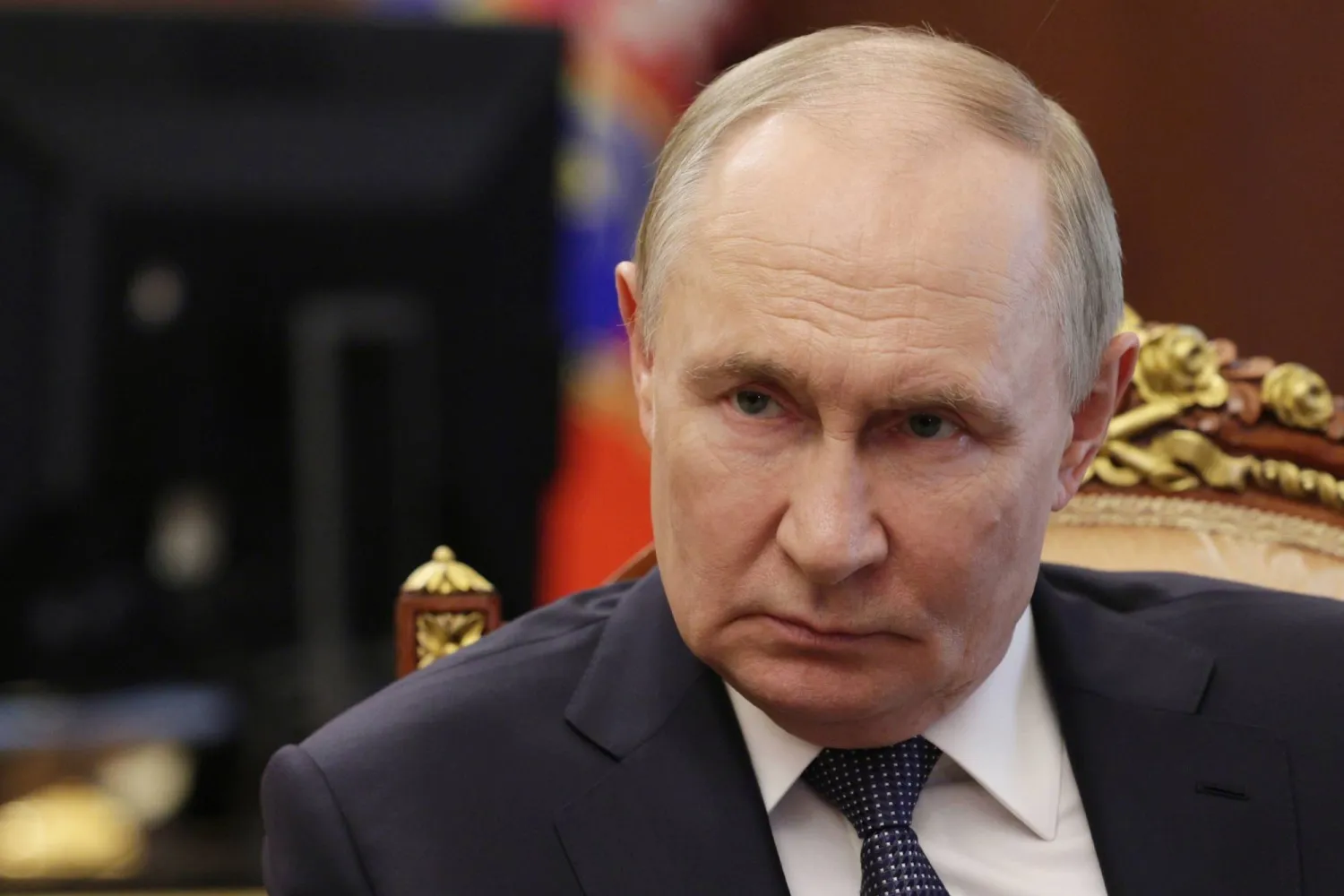
Russian President Vladimir Putin listens to Belgorod Region Governor Vyacheslav Gladkov during their meeting at the Kremlin in Moscow, Russia, Friday, July 11, 2025. (Mikhail Metzel, Sputnik, Kremlin Pool Photo via AP)
TT

Putin Urges Iran to Take ‘Zero Enrichment’ Nuclear Deal with US

Russian President Vladimir Putin listens to Belgorod Region Governor Vyacheslav Gladkov during their meeting at the Kremlin in Moscow, Russia, Friday, July 11, 2025. (Mikhail Metzel, Sputnik, Kremlin Pool Photo via AP)

The stalled indirect talks between Washington and Tehran were activated on Saturday after reports said Russian President Vladimir Putin stepped in, urging the Iranians to accept a nuclear deal that would not allow uranium enrichment.

Putin has told both US President Donald Trump and Iranian officials that he supports the idea of a nuclear deal in which Iran is unable to enrich uranium, sources familiar with those discussions told Axios.

The website said Russia has been Iran's main diplomatic backer on the nuclear issue for years, while Moscow publicly advocates for Iran's right to enrich.

But, it added, Putin has taken a tougher position in private in the wake of the 12-day war between Israel and Iran.

Two sources said the Russians briefed the Israeli government about Putin's position regarding Iran's uranium enrichment.

Iran has long insisted that it must retain the ability to enrich under any deal.

Putin and other Russian officials have conveyed their support for a “zero enrichment” deal to the Iranians several times of the last few weeks, sources told Axios.

“Putin would support zero enrichment. He encouraged the Iranians to work towards that in order to make negotiations with the Americans more favorable.

The Iranians said they won't consider it,” one European official with direct knowledge of the issue said.

The Russians have made clear in public and private that if a deal is reached, they are willing to remove Iran's highly enriched uranium.

“Russia has said it would then supply Iran with 3.67% uranium for nuclear power and small quantities of 20% enriched uranium for the Tehran research reactor and the production of nuclear isotopes,” the sources told Axios.

But an informed Iranian source dismissed the Axios report. Speaking to Tasnim on Saturday, the source said Iran has not received any message from Putin regarding a zero enrichment nuclear deal with the US.

In Tehran, Foreign Minister Abbas Araghchi said cooperation with the International Atomic Energy Agency will “take a new form to ensure the security of its nuclear facilities.”

He reiterated Iran’s commitment to the Non-Proliferation Treaty (NPT), saying: “Iran’s nuclear program has always been peaceful and will remain so,” stressing that Tehran “will continue to be a member of the NPT.”

On its missile program, the minister said Iran will not abandon its military and defense capabilities while it is under constant threats from Israel and the United States.

Khamenei Threatens Washington

In a related development, Iranian Supreme Leader Ali Khamenei issued a fresh threat to the US, saying American military bases in the region could be struck again at any moment.

“Striking Al Udeid Air Base is not a small incident but a major one that can be repeated,” Khamenei said.

“We are capable of reaching important American sites in the region,” he wrote in a post on X.

Khamenei also enclosed a caricature of Trump in the form of the Statue of Liberty, and title it, “A strong punch... A remarkable event that can be repeated.”

The supreme leader’s statements came while the Pentagon has acknowledged that a ballistic missile Iran fired toward Qatar late last month, in response to the American attack on Iranian nuclear facilities, directly hit Al Udeid base near Doha.

Pentagon spokesman Sean Parnell made the remarks after the AP news agency analyzed satellite images indicating that an Iranian attack on the air base in Qatar that’s key to the US military hit a geodesic dome housing equipment used by the Americans for secure communications.

The Iranian attack on Al Udeid Air Base on June 23 came as a response to the American bombing of three nuclear sites in Iran — and provided Iran a way to retaliate that quickly led to a ceasefire brokered by Trump ending the 12-day Iran-Israel war.

The Iranian attack otherwise did little damage - likely because of the fact that the US evacuated its aircraft from the base, which is home to the forward headquarters of the US military’s Central Command, before the attack.

Trump also has said that Iran signaled when and how it would retaliate, allowing American and Qatari air defense to be ready for the attack, which briefly disrupted air travel in the Middle East.



Air Force One Returns to Washington Area Due to Minor Electrical Issue, White House Says

Members of the media walk toward the plane which will now carry President Trump to Switzerland after Air Force One returned to Joint Base Andrews on January 20, 2026 in Joint Base Andrews, Maryland. (Getty Images/AFP)
TT

Air Force One Returns to Washington Area Due to Minor Electrical Issue, White House Says

Members of the media walk toward the plane which will now carry President Trump to Switzerland after Air Force One returned to Joint Base Andrews on January 20, 2026 in Joint Base Andrews, Maryland. (Getty Images/AFP)

President Donald Trump’s plane, Air Force One, returned to Joint Base Andrews about an hour after departing for Switzerland on Tuesday evening.

White House press secretary Karoline Leavitt said the decision to return was made after takeoff when the crew aboard Air Force One identified “a minor electrical issue” and, out of an abundance of caution, decided to turn around.

A reporter on board said the lights in the press cabin of the aircraft went out briefly after takeoff, but no explanation was immediately offered. About half an hour into the flight reporters were told the plane would be turning around.

Trump boarded another aircraft, an Air Force C-32, a modified Boeing 757 normally used by the president for domestic trips to smaller airports, and continued on with his trip to the World Economic Forum in Davos shortly after midnight.

The two planes currently used as Air Force One have been flying for nearly four decades.

Boeing has been working on replacements, but the program has faced a series of delays. The planes are heavily modified with survivability capabilities for the president for a range of contingencies, including radiation shielding and antimissile technology. They also include a variety of communications systems to allow the president to remain in contact with the military and issue orders from anywhere in the world.

Last February, an Air Force plane carrying Secretary of State Marco Rubio to Germany had to return to Washington because of a mechanical issue. In October, a military plane carrying Defense Secretary Pete Hegseth had to make an emergency landing in United Kingdom due to a crack in the windshield.


Trump on His Way to Davos, Where His Quest to Own Greenland Could Overshadow His Other Goals

US President Donald Trump speaks to the media on the South Lawn of the White House in Washington, DC, USA, 20 January 2026. (EPA)
TT

Trump on His Way to Davos, Where His Quest to Own Greenland Could Overshadow His Other Goals

US President Donald Trump speaks to the media on the South Lawn of the White House in Washington, DC, USA, 20 January 2026. (EPA)

President Donald Trump heads to the World Economic Forum in the Swiss Alps on Wednesday where his ambitions to wrest control of Greenland from NATO ally Denmark could tear relations with European allies and overshadow his original plan to use his appearance at the gathering of global elites to address affordability issues back home.

Trump arrives for the international forum at Davos on the heels of threatening tariffs on Denmark and seven other allies unless they negotiate a transfer of the semi-autonomous territory — a concession the European leaders indicated they are not willing to make. Trump said the tariffs would start at 10% next month and climb to 25% in June, rates that would be high enough to increase costs and slow growth, potentially hurting Trump’s efforts to tamp down the high cost of living.

The president in a text message that circulated among European officials this week also linked his aggressive stance on Greenland to last year’s decision not to award him the Nobel Peace Prize. In the message, he told Norway’s prime minister, Jonas Gahr Støre, that he no longer felt “an obligation to think purely of Peace.”

In the midst of an unusual stretch of testing the United States relations with longtime allies, it seems uncertain what might transpire during Trump's two days in Switzerland.

“This will be an interesting trip,” Trump told reporters as he departed the White House on Tuesday evening for his flight to Davos. “I have no idea what’s going to happen, but you are well represented.”

In fact, his trip to Davos got off to a difficult start. There was a minor electrical problem on Air Force One, leading the crew to turn around the plane about 30 minutes into the flight out of an abundance of caution and delaying the president's arrival in Switzerland.

Wall Street wobbled on Tuesday as investors weighed Trump's new tariff threats and escalating tensions with European allies. The S&P 500 fell 2.1%, its biggest drop since October. The Dow Jones Industrial Average dropped 1.8%. The Nasdaq composite slumped 2.4%.

“It’s clear that we are reaching a time of instability, of imbalances, both from the security and defense point of view, and economic point of view,” French President Emmanuel Macron said in his address to the forum. Macron made no direct mention of Trump but urged fellow leaders to reject acceptance of “the law of the strongest.”

Meanwhile, European Commission President Ursula von der Leyen warned the bloc's response, should Trump move forward with the tariffs, “will be unflinching, united and proportional." She pointedly suggested that Trump's new tariff threat could also undercut a US-EU trade framework reached this summer that the Trump administration worked hard to seal.

“The European Union and the United States have agreed to a trade deal last July,” von der Leyen said in Davos. “And in politics as in business — a deal is a deal. And when friends shake hands, it must mean something.”

Trump, ahead of the address, said he planned on using his Davos appearance to talk about making housing more attainable and other affordability issues that are top priorities for Americans.

But Trump’s Greenland tariff threat could disrupt the US economy if it blows up the trade truce reached last year between the US and the EU, said Scott Lincicome, a tariff critic and vice president on economic issues at the Cato Institute, a libertarian think tank.

“Significantly undermining investors' confidence in the US economy in the longer term would likely increase interest rates and thus make homes less affordable,” Lincicome said.

Trump also on Tuesday warned Europe against retaliatory action for the coming new tariffs.

“Anything they do with us, I’ll just meet it,” Trump said on NewsNation’s “Katie Pavlich Tonight.” “All I have to do is meet it, and it’s going to go ricocheting backward.”

Davos — a forum known for its appeal to the global elite — is an odd backdrop for a speech on affordability. But White House officials have promoted it as a moment for Trump to try to rekindle populist support back in the US, where many voters who backed him in 2024 view affordability as a major problem. About six in 10 US adults now say that Trump has hurt the cost of living, according to the latest survey by The Associated Press-NORC Center for Public Affairs Research.

US home sales are at a 30-year low with rising prices and elevated mortgage rates keeping many prospective buyers out of the market. So far, Trump has announced plans to buy $200 billion in mortgage securities to help lower interest rates on home loans, and has called for a ban on large financial companies buying houses.

Trump will promote his ‘Board of Peace’

The White House has said Trump plans to meet with leaders on the sidelines of the forum, after he gives his keynote address. There are more than 60 other heads of state attending.

On Thursday, Trump plans to have an event to talk about the “Board of Peace,” a new body meant to oversee the end of the Israel-Hamas war in Gaza, and possibly take on a broader mandate, potentially rivaling the United Nations.

Fewer than 10 leaders have accepted invitations to join the group so far. Several of America’s main European partners have declined or been noncommittal, including Britain, France and Germany.

Trump on Tuesday told reporters that his peace board “might” eventually make the UN obsolete but insisted he wants to see the international body stick around.

“I believe you got to let the UN continue, because the potential is so great," Trump said.


Iran FM Issues Most Direct Threat Yet to US as Crackdown Over Protests Squeezes Nation

Iranian Foreign Minster Abbas Araghchi speaks during a joint press conference with the Iraqi Foreign Minister in Tehran, Iran, 18 January 2026. Hussein is in Tehran to meet with Iranian officials. (EPA)
TT

Iran FM Issues Most Direct Threat Yet to US as Crackdown Over Protests Squeezes Nation

Iranian Foreign Minster Abbas Araghchi speaks during a joint press conference with the Iraqi Foreign Minister in Tehran, Iran, 18 January 2026. Hussein is in Tehran to meet with Iranian officials. (EPA)

Iran's foreign minister issued the most direct threat yet Wednesday against the United States after Tehran's bloody crackdown on protesters, warning the country will be “firing back with everything we have if we come under renewed attack."

The comments by Abbas Araghchi, who saw his invitation to the World Economic Forum in Davos rescinded over the killings, comes as an American aircraft carrier group moves westward toward the Middle East from Asia. Meanwhile, American fighter jets and other equipment appears to be moving in the Mideast after a major US military deployment in the Caribbean saw troops seize Venezuela's Nicolás Maduro.

Araghchi made the threat in an opinion article published by The Wall Street Journal. In it, the foreign minister contended “the violent phase of the unrest lasted less than 72 hours” and sought again to blame armed demonstrators for the violence. Videos that have slipped out of Iran despite an internet shutdown appear to show security forces repeatedly using live fire to target apparently unarmed protesters, something unaddressed by Araghchi.

“Unlike the restraint Iran showed in June 2025, our powerful armed forces have no qualms about firing back with everything we have if we come under renewed attack,” Araghchi wrote, referring to the 12-day war launched by Israel on Iran in June. “This isn’t a threat, but a reality I feel I need to convey explicitly, because as a diplomat and a veteran, I abhor war.”

He added: “An all-out confrontation will certainly be ferocious and drag on far, far longer than the fantasy timelines that Israel and its proxies are trying to peddle to the White House. It will certainly engulf the wider region and have an impact on ordinary people around the globe.”
Mideast nations had lobbied Trump not to attack. Last week, Iran shut its airspace, likely in anticipation of a strike.

The USS Abraham Lincoln, which had been in the South China Sea in recent days, had passed through the Strait of Malacca, a key waterway connecting the South China Sea and Indian Ocean, by Tuesday, ship-tracking data showed.

A US Navy official, speaking on condition of anonymity, said the aircraft carrier and three accompanying destroyers were heading west.

While naval and other defense officials stopped short of saying the carrier strike group was headed to the Middle East, its current heading and location in the Indian Ocean means it is only days away from moving into the region.

The death toll from the protests has reached at least 4,519 people, the US-based Human Rights Activists News Agency said. The agency has been accurate throughout the years on demonstrations and unrest in Iran, relying on a network of activists inside the country that confirms all reported fatalities. The Associated Press has been unable to independently assess the death toll.

The death toll exceeds that of any other round of protest or unrest in Iran in decades, and recalls the chaos surrounding the 1979 revolution that brought the Islamic Republic into being. Although there have been no protests for days, there are fears the death toll could increase significantly as information gradually emerges from a country still under a government-imposed shutdown of the internet since Jan. 8.

Supreme Leader Ali Khamenei said on Saturday that the protests had left “several thousand” people dead and blamed the United States. It was the first indication from an Iranian leader of the extent of the casualties.

More than 26,300 people have been arrested, according to the Human Rights Activists News Agency. Comments from officials have led to fears of some of those detained being put to death in Iran, one of the world’s top executioners. That and the killing of peaceful protesters have been two red lines laid down by Trump in the tensions.