


Trump Downplays Possibility of Sending Ukraine Long-Range Weapons as It Struggles to Repel Russia

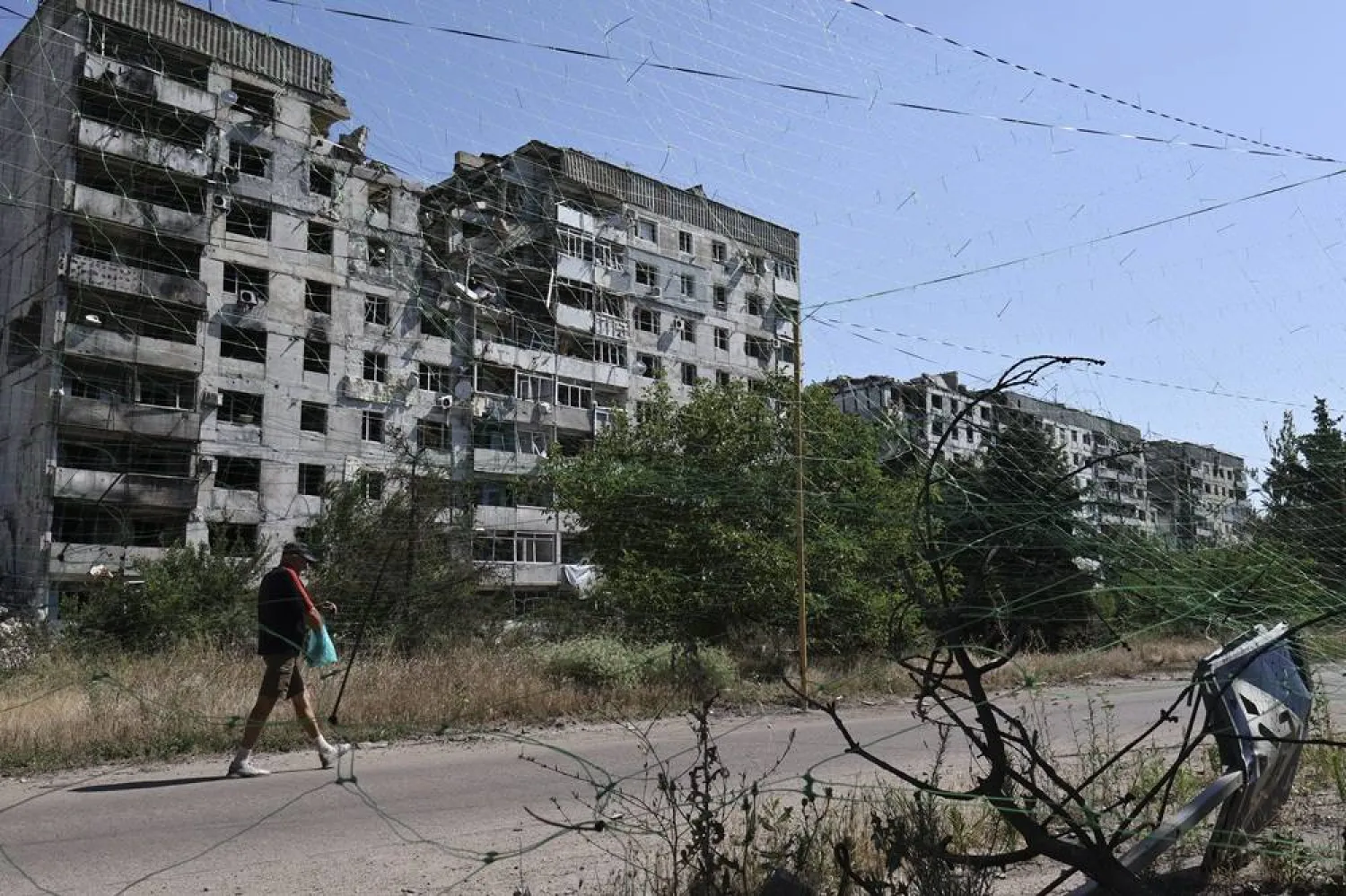
 In this photo provided by Ukraine's 65th Mechanized Brigade press service, a local resident walks along the street under an anti-drone net in Orikhiv, Zaporizhzhia region, Ukraine, Tuesday, July 15, 2025. (Andriy Andriyenko/Ukraine's 65th Mechanized Brigade via AP)
In this photo provided by Ukraine's 65th Mechanized Brigade press service, a local resident walks along the street under an anti-drone net in Orikhiv, Zaporizhzhia region, Ukraine, Tuesday, July 15, 2025. (Andriy Andriyenko/Ukraine's 65th Mechanized Brigade via AP)
TT

Trump Downplays Possibility of Sending Ukraine Long-Range Weapons as It Struggles to Repel Russia

 In this photo provided by Ukraine's 65th Mechanized Brigade press service, a local resident walks along the street under an anti-drone net in Orikhiv, Zaporizhzhia region, Ukraine, Tuesday, July 15, 2025. (Andriy Andriyenko/Ukraine's 65th Mechanized Brigade via AP)
In this photo provided by Ukraine's 65th Mechanized Brigade press service, a local resident walks along the street under an anti-drone net in Orikhiv, Zaporizhzhia region, Ukraine, Tuesday, July 15, 2025. (Andriy Andriyenko/Ukraine's 65th Mechanized Brigade via AP)

President Donald Trump on Tuesday downplayed the possibility of sending Ukraine long-range weapons as Kyiv awaits an injection of US weaponry that it hopes will help it beat back an intensifying Russian air offensive.

Trump offered a more cautious tone on what to expect after he threatened Russia a day earlier with steep tariffs if President Vladimir Putin doesn’t act within 50 days to end the three-year conflict. He also on Monday announced plans to bolster Kyiv's stockpile by selling American weapons to NATO allies who would in turn send arms to Ukraine.

Providing Ukraine with more long-range weaponry would give Kyiv the chance to strike further into Russian territory, a move that some in Ukraine and the US have said could help push Putin toward negotiations to end the fighting.

Asked if he intended to supply Ukraine with weapons that could reach deeper into Russian territory, Trump replied, "We're not looking to do that." He made the remarks to reporters before departing the White House for an energy investment event in Pittsburgh.

While Trump's threats of weapons, sanctions and tariffs mark the most substantive pressure he’s placed on Putin since returning to office nearly six months ago, some lawmakers said they remain concerned that the administration, with the 50-day deadline, is giving Putin time to grab even more Ukrainian territory.

Sens. Thom Tillis, a Republican from North Carolina, and Jeanne Shaheen, a Democrat from New Hampshire, said waiting 50 days before imposing sanctions on Russia would give Putin more time to gain an advantage in the war.

"The 50-day delay worries me that Putin would try to use the 50 days to win the war, or to be better positioned to negotiate a peace agreement after having murdered and potentially collected more ground," said Tillis, who recently announced he won’t run for reelection.

Tillis and Shaheen lead the Senate NATO Observer Group, which facilitates work between Congress and NATO, and met Tuesday with NATO Secretary General Mark Rutte on Capitol Hill.

Trump himself scoffed at the idea that 50 days is giving Putin too much time. The president suggested he may act more quickly if he does not see signs that Putin is taking steps toward ending the conflict.

"I don’t think 50 days is very long and it could be shorter than that," he said.

Ahead of Trump's announcement that he would impose a 100% tariff on Russia’s trading partners if Putin doesn't negotiate an end to the war, bipartisan legislation proscribing even tougher sanctions on Moscow was gaining steam in the Senate.

The legislation, in part, calls for a 500% tariff on goods imported from countries that continue to buy Russian oil, gas, uranium and other exports. It would have an enormous impact on the economies of Brazil, China and India, which account for the vast majority of Russia’s energy trade.

But Trump on Monday said "at a certain point it doesn’t matter" how high the tariff is set and that "100% is going to serve the same function." Senate Majority Leader John Thune said he was putting the legislation on hold following Trump's announcement.

Trump during his campaign described the conflict as a waste of US taxpayer money and vowed to quickly end it on his first day back in office. He deflected when asked by a reporter on Tuesday if his tougher tone on Putin suggests he's now on Ukraine’s side in the bloody conflict.

"I’m on nobody’s side," Trump said, adding this concern was for "humanity."

US officials say they are still sorting through Ukraine’s wish list of weaponry to determine what can be most quickly replaced after Trump announced an agreement for Europe to supply Ukraine with defensive munitions from existing stocks.

The officials, who spoke on condition of anonymity to discuss arms transfers that have not yet been approved or completed, said Ukraine’s requests for military equipment are roughly the same as they have been since the start of Russia’s invasion. Those include air defenses like Patriot missiles and Advanced Precision Kill Weapon Systems, long-range missiles known as ATACMS and short- to medium-range ground-to-air missiles known as NASAMs, and assorted artillery, according to the officials.

Under the terms of the very rough agreement sketched out by Trump and Rutte on Monday, NATO members would ship billions of dollars of these weapons to Ukraine and then purchase replacements for them from the United States.

One official said some of the larger items, such as Patriots, could take up to five years to produce to deliver to the European donors, while smaller munitions like 155mm artillery shells can be produced on a much shorter timeline.

Trump has lately changed his once friendly tune toward Putin, whom he has long admired and whom he sided with publicly over his national security team during his first term when asked whether Russia had interfered in the 2016 election.

In recent weeks, Trump has chastised Putin for continuing his brutal assault on Ukrainian cities, even noting that the Russian leader "talks nice and then he bombs everybody."

Trump has continued to blame his White House predecessors for Putin's 2022 invasion on neighboring Ukraine — a conflict he says would have never happened if he were reelected in 2020.

"He’s fooled a lot of people," Trump said Monday at the White House. "He fooled Clinton, Bush, Obama, Biden. He didn’t fool me."

In February, Trump expressed confidence that Putin "will keep his word" on any deal to end the war in Ukraine. But in an interview with the BBC published Tuesday, when asked whether he trusted Putin, Trump paused before answering.

"I trust almost nobody, to be honest with you," Trump said. "I’m disappointed in him, but I’m not done with him. But I’m disappointed in him."



8 Dead, Dozens Wounded in Russian Strike on Ukraine's Odesa Port

A firefighter works at the site of a Russian missile and drone strike, amid Russia's attack on Ukraine, in Odesa region, Ukraine in this handout picture released December 20, 2025. Press service of the State Emergency Service of Ukraine in Odesa region/Handout via REUTERS
TT

8 Dead, Dozens Wounded in Russian Strike on Ukraine's Odesa Port

A firefighter works at the site of a Russian missile and drone strike, amid Russia's attack on Ukraine, in Odesa region, Ukraine in this handout picture released December 20, 2025. Press service of the State Emergency Service of Ukraine in Odesa region/Handout via REUTERS

Eight people were killed and 27 wounded in a Russian missile strike on port infrastructure in Odesa, southern Ukraine, late on Friday, Ukraine’s Emergency Service said Saturday morning.

Some of the wounded were on a bus at the epicenter of the overnight strike, the service said in a Telegram post. Trucks caught fire in the parking lot, and cars were also damaged.

The port was struck with ballistic missiles, said Oleh Kiper, the head of the Odesa region.

Elsewhere, Ukrainian forces hit a Russian warship and other facilities with drones, Ukraine’s General Staff said in a statement Saturday.

The nighttime attack on Friday hit the Russian warship “Okhotnik,” according to the statement posted to the Telegram messaging app.

The ship was patrolling in the Caspian Sea near an oil and gas production platform, The Associated Press reported. The extent of the damage is still being clarified, the statement added.

A drilling platform at the Filanovsky oil and gas field in the Caspian Sea was also hit. The facility is operated by Russian oil giant Lukoil. Ukrainian drones also struck a radar system in the Krasnosilske area of Crimea, which Russia illegally annexed from Ukraine in 2014.


Satellite Imagery Shows ‘Recent Activity’ at Iran Nuclear Facility

An inspector of the International Atomic Energy Agency sets up surveillance equipment at a uranium conversion facility in Iran in 2005. Photograph: Mehdi Ghasemi/AP
TT

Satellite Imagery Shows ‘Recent Activity’ at Iran Nuclear Facility

An inspector of the International Atomic Energy Agency sets up surveillance equipment at a uranium conversion facility in Iran in 2005. Photograph: Mehdi Ghasemi/AP

New satellite imagery shows recent activity at the Natanz nuclear facility that was damaged during June's 12-day war with Israel, according to the US-based Institute for Science and International Security (ISIS).

During the June conflict, the IAEA confirmed Israeli strikes hit Iran's Natanz underground enrichment plant.

The think tank said the satellite imagery from December 13 show panels placed on top of the remaining anti-drone structure at the Pilot Fuel Enrichment Plant (PFEP), providing cover for the damaged facility.

It suggested the new covering allows Iran to examine or retrieve materials from the rubble while limiting external observation.

The Natanz uranium enrichment facility, located some 250 km south of the Iranian capital Tehran, is one of Iran's most important and most controversial nuclear facilities in the Middle East.

Although the facility “likely held several kilograms of highly enriched uranium,” ISIS stressed that such material is “not negligible” in the broader context of Iran’s nuclear capabilities.

While PFEP shows renewed activity, ISIS said it has not observed similar signs at other major nuclear sites, including the underground Fordow facility also damaged in June by airstrikes.

Inspections
On December 15, IAEA chief Rafael Grossi has reiterated that Iran must allow inspectors access to the three key nuclear facilities that enrich uranium and were hit by the US and Israeli airstrikes last June.

Speaking to RIA Novosti, Grossi said the agency’s activities in Iran are very limited. “We are only allowed to access sites that were not hit.”

In October, the head of the UN nuclear watchdog told AP that Iran does not appear to be actively enriching uranium but that the agency has recently detected renewed movement at the country’s nuclear sites.

Grossi said that despite being unable to fully access Iranian nuclear sites, inspectors have not seen any activity via satellite to indicate that Tehran has accelerated its production of uranium enriched beyond what it had compiled before the 12-day war with Israel in June.

“However, the nuclear material enriched at 60% is still in Iran,” Grossi said in an interview at the United Nations headquarters in New York.

“And this is one of the points we are discussing because we need to go back there and to confirm that the material is there and it’s not being diverted to any other use,” he added, “This is very, very important.”

Iran’s Foreign Minister Abbas Araghchi said on December 8 that resuming the agency’s inspections is currently not possible because “there is no protocol or guideline” for inspecting facilities he described as “peaceful.”

ISIS reported on October 3 that new satellite imagery shows that Iran is ongoing construction efforts at a mountainous area just south of the Natanz enrichment site known as Kuh-e Kolang Gaz La, or Pickaxe Mountain.

On Sept. 26, The Washington Post said according to a review of satellite imagery and independent analysis, Iran has increased construction at a mysterious underground site in the months since the US and Israel pummeled its main nuclear facilities, suggesting Tehran has not entirely ceased work on its suspected weapons program and may be cautiously rebuilding.


Rubio: Venezuela Cooperates with Iran, Hezbollah

Secretary of State Marco Rubio speaks during a news conference at the State Department, Friday, Dec. 19, 2025, in Washington. (AP Photo/Julia Demaree Nikhinson)
TT

Rubio: Venezuela Cooperates with Iran, Hezbollah

Secretary of State Marco Rubio speaks during a news conference at the State Department, Friday, Dec. 19, 2025, in Washington. (AP Photo/Julia Demaree Nikhinson)

US Secretary of State Marco Rubio has accused the illegitimate regime in Venezuela of cooperating with criminals that threaten the national security of the United States.

Rubio said Friday the regime of President Nicolas Maduro openly cooperates with Iran, Hezbollah, and drug trafficking groups.

“They (Venezuela regime) operate and cooperate with terrorist organizations against the national interest of the United States, not just cooperate, but partner with and participate in activities to threaten the national interest of the United States,” he told reporters at a news conference at the State Department.

According to Rubio, Venezuela is a country that is not just an illegitimate regime that does not cooperate with the US but also a regime that openly cooperates with criminal and terrorist elements, including Hezbollah, Iran and others.

“And clearly these narco groups cooperate openly from there,” the Secretary of State said.

“We have a regime that cooperates with Iran, that cooperates with Hezbollah; that cooperates with narcotrafficking and narcoterrorist organizations, inclusive not just protecting their shipments and allowing them to operate with impunity, but also allows some of them to control territory,” he added.

Earlier, US President Donald Trump said he was leaving the possibility of war with Venezuela on the table, according to an interview with NBC News published on Friday.

“I don't rule it out, no,” he told NBC News in a phone interview.

Trump also said there would be additional seizures of oil tankers near Venezuelan waters, according to the interview. The US seized a sanctioned oil tanker off the coast of Venezuela last week.

“If they're foolish enough to be sailing along, they'll be sailing along back into one of our harbors,” he told NBC News.

On Tuesday, Trump ordered a “blockade” of all sanctioned oil tankers entering and leaving Venezuela, in Washington's latest move to increase pressure on Nicolas Maduro's government, targeting its main source of income, following which Venezuela's government said it rejected Trump's “grotesque threat.”