


Russia May Hope to Use Trump's 50-day Window to Wear Down Ukraine, but Quick Gains Seem Unlikely

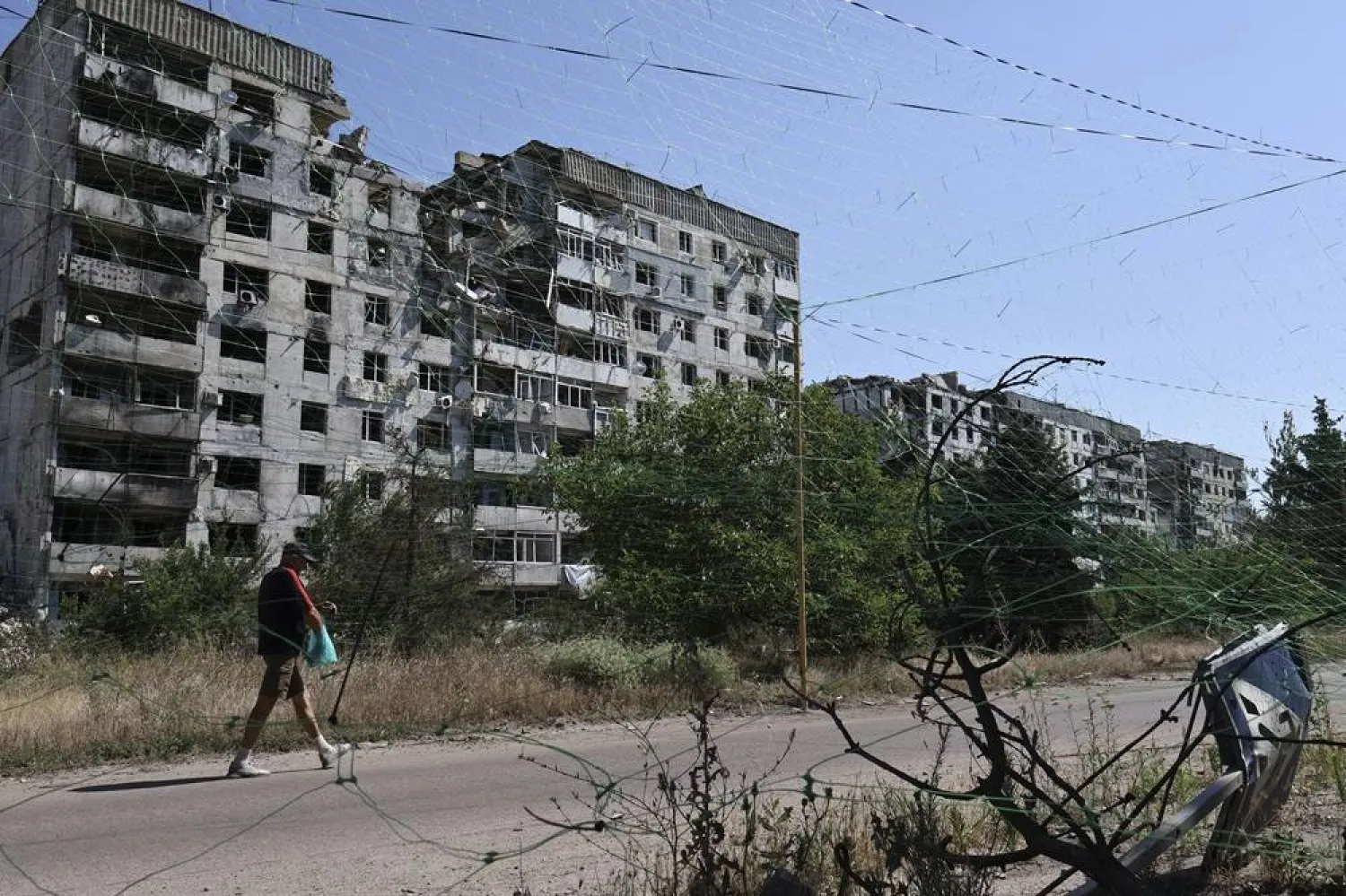
In this photo provided by Ukraine's 65th Mechanized Brigade press service, a local resident walks along the street under an anti-drone net in Orikhiv, Zaporizhzhia region, Ukraine, Tuesday, July 15, 2025. (Andriy Andriyenko/Ukraine's 65th Mechanized Brigade via AP)
TT

Russia May Hope to Use Trump's 50-day Window to Wear Down Ukraine, but Quick Gains Seem Unlikely

In this photo provided by Ukraine's 65th Mechanized Brigade press service, a local resident walks along the street under an anti-drone net in Orikhiv, Zaporizhzhia region, Ukraine, Tuesday, July 15, 2025. (Andriy Andriyenko/Ukraine's 65th Mechanized Brigade via AP)

President Donald Trump’s ultimatum to Russia to accept a peace deal in Ukraine within 50 days or face bruising sanctions on its energy exports has given the Kremlin extra time to pursue its summer offensive.

The dogged Ukrainian resistance, however, makes it unlikely that the Russian military will make any quick gains, The Associated Press said.

President Vladimir Putin has declared repeatedly that any peace deal should see Ukraine withdraw from the four regions that Russia illegally annexed in September 2022 but never fully captured. He also wants Ukraine to renounce its bid to join NATO and accept strict limits on its armed forces -– demands Kyiv and its Western allies have rejected.

A chronic shortage of manpower and ammunition has forced Ukrainian forces to focus on holding ground rather than launching counteroffensives.

But despite a renewed Russian push — and an onslaught of aerial attacks on Kyiv and other cities in recent weeks — Ukrainian officials and analysts say it remains unlikely that Moscow can achieve any territorial breakthrough significant enough in 50 days to force Ukraine into accepting the Kremlin's terms anytime soon.

Russia's main targets

Since spring, Russian troops have accelerated their land gains, capturing the most territory in eastern Ukraine since the opening stages of Moscow's full-scale invasion in 2022.

Russian forces are closing in on the eastern strongholds of Pokrovsk and Kostyantynivka in the Donetsk region, methodically capturing villages near both cities to try to cut key supply routes and envelop their defenders — a slow offensive that has unfolded for months.

Capturing those strongholds would allow Russia to push toward Slovyansk and Kramatorsk, setting the stage for the seizure of the entire Donetsk region.

If Russian troops seize those last strongholds, it would open the way for them to forge westward to the Dnipropetrovsk region. The regional capital of Dnipro, a major industrial hub of nearly 1 million, is about 150 kilometers (just over 90 miles) west of Russian positions.

The spread of fighting to Dnipropetrovsk could damage Ukrainian morale and give the Kremlin more leverage in any negotiations.

In the neighboring Luhansk region, Ukrainian troops control a small sliver of land, but Moscow has not seemed to prioritize its capture.

The other two Moscow-annexed regions — Kherson and Zaporizhzhia — seem far from being totally overtaken by Russia.

Early in the war, Russia quickly overran the Kherson region but pulled back from large swaths of it in November 2022, retreating to the eastern bank of the Dnieper River. A new attempt to cross the waterway to seize the rest of the region would involve massive challenges, and Moscow doesn’t seem to have the capability to mount such an operation.

Fully capturing the Zaporizhzhia region appears equally challenging.

Russian attempts to establish a ‘buffer zone’ Moscow’s forces captured several villages in northeastern Ukraine's Sumy region after reclaiming chunks of Russia’s Kursk region from Ukrainian troops who staged a surprise incursion in August 2024. Ukraine says its forces have stopped Russia's offensive and maintain a presence on the fringe of the Kursk region, where they are still tying down as many as 10,000 Russian troops.

Putin recently described the offensive into the Sumy region as part of efforts to carve a “buffer zone” to protect Russian territory from Ukrainian attacks.

The regional capital of Sumy, a city of 268,000, is about 30 kilometers (less than 20 miles) from the border. Putin said Moscow doesn’t plan to capture the city for now but doesn’t exclude it.

Military analysts, however, say Russian forces in the area clearly lack the strength to capture it.

Russian forces also have pushed an offensive in the neighboring Kharkiv region, but they haven't made much progress against fierce Ukrainian resistance.

Some commentators say Russia may hope to use its gains in the Sumy and Kharkiv regions as bargaining chips in negotiations, trading them for parts of the Donetsk region under Ukrainian control.

“A scenario of territorial swaps as part of the talks is quite realistic,” said Mikhail Karyagin, a Kremlin-friendly political expert, in a commentary.

Wearing down Ukraine with slow pressure Ukrainian commanders say the scale and pace of Russian operations suggest that any game-changing gains are out of reach, with Moscow’s troops advancing slowly at a tremendous cost to its own forces.

While exhausted Ukrainian forces are feeling outnumbered and outgunned, they are relying on drones to stymie Moscow's slow offensive. Significant movements of troops and weapons are easily spotted by drones that are so prolific that both sides use them to track and attack even individual soldiers within minutes.

Russian military commentators recognize that Ukraine’s drone proficiency makes any quick gains by Moscow unlikely. They say Russia aims to bleed Ukraine dry with a strategy of “a thousand cuts,” using relentless pressure on many sectors of the front and steadily increasing long-range aerial attacks against key infrastructure.

“The Russian army aims to exhaust the enemy to such an extent that it will not be able to hold the defense, and make multiple advances merge into one or several successes on a strategic scale that will determine the outcome of the war,” Moscow-based military analyst Sergei Poletayev wrote in an analysis. “It’s not that important where and at what speed to advance: the target is not the capture of this or that line; the target is the enemy army as such.”

Western supplies are essential for Ukraine

Ukrainian troops on the front express exasperation and anger about delays and uncertainty about US weapons shipments.

Delays in US military assistance have forced Kyiv's troops to ration ammunition and scale back operations as Russia intensifies its attacks, Ukrainian soldiers in eastern Ukraine told The Associated Press.

The United States will sell weapons to its NATO allies in Europe so they can provide them to Ukraine, according to Trump and US Secretary of State Marco Rubio. Included are Patriot air defense systems, a top priority for Ukraine.

Speeded-up weapons shipments from European allies are crucial to allowing Ukraine to stem the Russian attacks, according to analysts.

“The rate of Russian advance is accelerating, and Russia’s summer offensive is likely to put the armed forces of Ukraine under intense pressure,” Jack Watling of the Royal United Services Institute in London said in a commentary.

But most of the capabilities that Ukraine needs — from drones to artillery systems — can be provided by NATO allies in Europe, he said.

“In the short-term, Europe can cover most of Ukraine’s needs so long as it can purchase some critical weapons types from the US,” Watling said.



8 Dead, Dozens Wounded in Russian Strike on Ukraine's Odesa Port

A firefighter works at the site of a Russian missile and drone strike, amid Russia's attack on Ukraine, in Odesa region, Ukraine in this handout picture released December 20, 2025. Press service of the State Emergency Service of Ukraine in Odesa region/Handout via REUTERS
TT

8 Dead, Dozens Wounded in Russian Strike on Ukraine's Odesa Port

A firefighter works at the site of a Russian missile and drone strike, amid Russia's attack on Ukraine, in Odesa region, Ukraine in this handout picture released December 20, 2025. Press service of the State Emergency Service of Ukraine in Odesa region/Handout via REUTERS

Eight people were killed and 27 wounded in a Russian missile strike on port infrastructure in Odesa, southern Ukraine, late on Friday, Ukraine’s Emergency Service said Saturday morning.

Some of the wounded were on a bus at the epicenter of the overnight strike, the service said in a Telegram post. Trucks caught fire in the parking lot, and cars were also damaged.

The port was struck with ballistic missiles, said Oleh Kiper, the head of the Odesa region.

Elsewhere, Ukrainian forces hit a Russian warship and other facilities with drones, Ukraine’s General Staff said in a statement Saturday.

The nighttime attack on Friday hit the Russian warship “Okhotnik,” according to the statement posted to the Telegram messaging app.

The ship was patrolling in the Caspian Sea near an oil and gas production platform, The Associated Press reported. The extent of the damage is still being clarified, the statement added.

A drilling platform at the Filanovsky oil and gas field in the Caspian Sea was also hit. The facility is operated by Russian oil giant Lukoil. Ukrainian drones also struck a radar system in the Krasnosilske area of Crimea, which Russia illegally annexed from Ukraine in 2014.


Satellite Imagery Shows ‘Recent Activity’ at Iran Nuclear Facility

An inspector of the International Atomic Energy Agency sets up surveillance equipment at a uranium conversion facility in Iran in 2005. Photograph: Mehdi Ghasemi/AP
TT

Satellite Imagery Shows ‘Recent Activity’ at Iran Nuclear Facility

An inspector of the International Atomic Energy Agency sets up surveillance equipment at a uranium conversion facility in Iran in 2005. Photograph: Mehdi Ghasemi/AP

New satellite imagery shows recent activity at the Natanz nuclear facility that was damaged during June's 12-day war with Israel, according to the US-based Institute for Science and International Security (ISIS).

During the June conflict, the IAEA confirmed Israeli strikes hit Iran's Natanz underground enrichment plant.

The think tank said the satellite imagery from December 13 show panels placed on top of the remaining anti-drone structure at the Pilot Fuel Enrichment Plant (PFEP), providing cover for the damaged facility.

It suggested the new covering allows Iran to examine or retrieve materials from the rubble while limiting external observation.

The Natanz uranium enrichment facility, located some 250 km south of the Iranian capital Tehran, is one of Iran's most important and most controversial nuclear facilities in the Middle East.

Although the facility “likely held several kilograms of highly enriched uranium,” ISIS stressed that such material is “not negligible” in the broader context of Iran’s nuclear capabilities.

While PFEP shows renewed activity, ISIS said it has not observed similar signs at other major nuclear sites, including the underground Fordow facility also damaged in June by airstrikes.

Inspections
On December 15, IAEA chief Rafael Grossi has reiterated that Iran must allow inspectors access to the three key nuclear facilities that enrich uranium and were hit by the US and Israeli airstrikes last June.

Speaking to RIA Novosti, Grossi said the agency’s activities in Iran are very limited. “We are only allowed to access sites that were not hit.”

In October, the head of the UN nuclear watchdog told AP that Iran does not appear to be actively enriching uranium but that the agency has recently detected renewed movement at the country’s nuclear sites.

Grossi said that despite being unable to fully access Iranian nuclear sites, inspectors have not seen any activity via satellite to indicate that Tehran has accelerated its production of uranium enriched beyond what it had compiled before the 12-day war with Israel in June.

“However, the nuclear material enriched at 60% is still in Iran,” Grossi said in an interview at the United Nations headquarters in New York.

“And this is one of the points we are discussing because we need to go back there and to confirm that the material is there and it’s not being diverted to any other use,” he added, “This is very, very important.”

Iran’s Foreign Minister Abbas Araghchi said on December 8 that resuming the agency’s inspections is currently not possible because “there is no protocol or guideline” for inspecting facilities he described as “peaceful.”

ISIS reported on October 3 that new satellite imagery shows that Iran is ongoing construction efforts at a mountainous area just south of the Natanz enrichment site known as Kuh-e Kolang Gaz La, or Pickaxe Mountain.

On Sept. 26, The Washington Post said according to a review of satellite imagery and independent analysis, Iran has increased construction at a mysterious underground site in the months since the US and Israel pummeled its main nuclear facilities, suggesting Tehran has not entirely ceased work on its suspected weapons program and may be cautiously rebuilding.


Rubio: Venezuela Cooperates with Iran, Hezbollah

Secretary of State Marco Rubio speaks during a news conference at the State Department, Friday, Dec. 19, 2025, in Washington. (AP Photo/Julia Demaree Nikhinson)
TT

Rubio: Venezuela Cooperates with Iran, Hezbollah

Secretary of State Marco Rubio speaks during a news conference at the State Department, Friday, Dec. 19, 2025, in Washington. (AP Photo/Julia Demaree Nikhinson)

US Secretary of State Marco Rubio has accused the illegitimate regime in Venezuela of cooperating with criminals that threaten the national security of the United States.

Rubio said Friday the regime of President Nicolas Maduro openly cooperates with Iran, Hezbollah, and drug trafficking groups.

“They (Venezuela regime) operate and cooperate with terrorist organizations against the national interest of the United States, not just cooperate, but partner with and participate in activities to threaten the national interest of the United States,” he told reporters at a news conference at the State Department.

According to Rubio, Venezuela is a country that is not just an illegitimate regime that does not cooperate with the US but also a regime that openly cooperates with criminal and terrorist elements, including Hezbollah, Iran and others.

“And clearly these narco groups cooperate openly from there,” the Secretary of State said.

“We have a regime that cooperates with Iran, that cooperates with Hezbollah; that cooperates with narcotrafficking and narcoterrorist organizations, inclusive not just protecting their shipments and allowing them to operate with impunity, but also allows some of them to control territory,” he added.

Earlier, US President Donald Trump said he was leaving the possibility of war with Venezuela on the table, according to an interview with NBC News published on Friday.

“I don't rule it out, no,” he told NBC News in a phone interview.

Trump also said there would be additional seizures of oil tankers near Venezuelan waters, according to the interview. The US seized a sanctioned oil tanker off the coast of Venezuela last week.

“If they're foolish enough to be sailing along, they'll be sailing along back into one of our harbors,” he told NBC News.

On Tuesday, Trump ordered a “blockade” of all sanctioned oil tankers entering and leaving Venezuela, in Washington's latest move to increase pressure on Nicolas Maduro's government, targeting its main source of income, following which Venezuela's government said it rejected Trump's “grotesque threat.”