UN Food Agency Says Israeli Tanks, Snipers Opened Fire on a Crowd Seeking Aid in Gaza

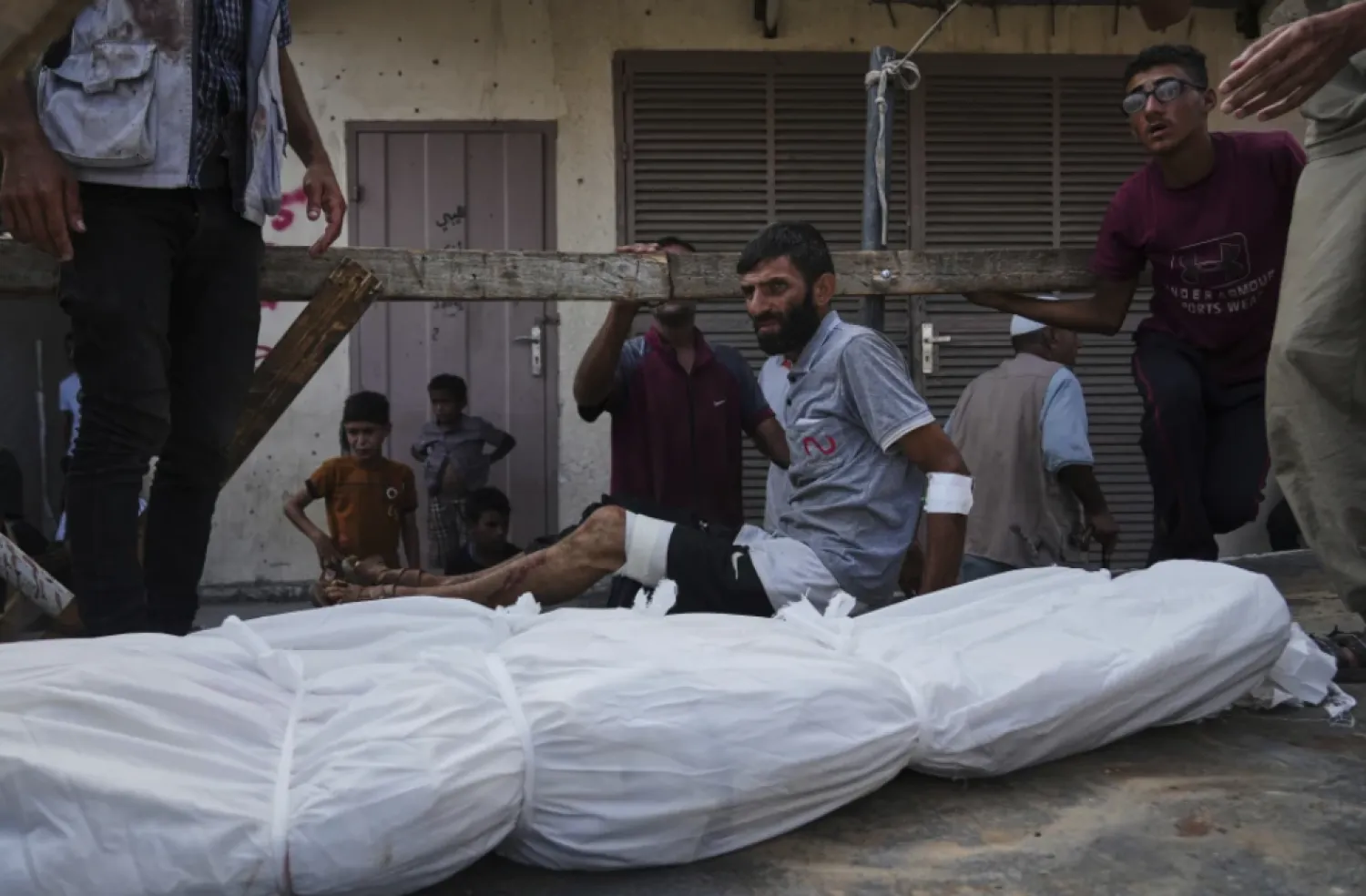
Mourners attend the funeral of their relatives killed in an Israeli bombardment, in Deir al-Balah, central Gaza Strip, Monday, July 21, 2025. (AP Photo/Abdel Kareem Hana)
TT

UN Food Agency Says Israeli Tanks, Snipers Opened Fire on a Crowd Seeking Aid in Gaza

Mourners attend the funeral of their relatives killed in an Israeli bombardment, in Deir al-Balah, central Gaza Strip, Monday, July 21, 2025. (AP Photo/Abdel Kareem Hana)

The UN food agency accused Israel of using tanks, snipers and other weapons to fire on a crowd of Palestinians seeking food aid, in what the territory's Health Ministry said was one of the deadliest days for aid-seekers in over 21 months of war.

The World Food Program in a statement Sunday condemned the violence that erupted in northern Gaza as Palestinians tried to reach a convoy of trucks carrying food. The Health Ministry in Gaza said at least 80 people were killed in the incident. The Israeli military has said it fired warning shots “to remove an immediate threat,” but has questioned the death toll reported by the Palestinians.

The accusation by a major aid agency that has had generally good working relations with Israel builds on descriptions by witnesses and others, who also said Israel opened fire on the crowd, The AP news reported.

The bloodshed surrounding aid access highlights the increasingly precarious situation for people in Gaza who have been desperately seeking out food and other assistance, as the war that has roiled the region shows no signs of ending. Israel and Hamas are still engaged in ceasefire talks, but there appears to be no breakthrough and it's not clear whether any truce would bring the war to a lasting halt.

As the talks proceed, the death toll in the war-ravaged territory has climbed to more than 59,000 Palestinians, according to Gaza’s Health Ministry. Its count doesn't distinguish between militants and civilians but the ministry says more than half of the dead are women and children. The ministry is part of the Hamas government, but the UN and other international organizations see it as the most reliable source of data on casualties.

WFP condemns violence at food distribution points In northern Gaza on Sunday, the Health Ministry, witnesses and a UN official said Israeli forces opened fire toward crowds who tried to get food from a 25-truck convoy that had entered the hard-hit area.

The WFP statement, which said the crowd surrounding its convoy “came under fire from Israeli tanks, snipers and other gunfire,” backs up those claims. The statement did not specify a death toll, saying only the incident resulted in the loss of “countless lives.”

“These people were simply trying to access food to feed themselves and their families on the brink of starvation,” it said, adding that the incident occurred despite assurances from Israeli authorities that aid delivery would improve. Part of those assurances, it said, was that armed forces would not be present nor engage along aid routes.

“Shootings near humanitarian missions, convoys and food distributions must stop immediately.”

Israel has not allowed international media to enter Gaza throughout the war, and the competing claims could not be independently verified.


Egypt FM Banks on Trump for Implementation of Gaza Deal, Blames Israel for Impasse

Egyptian Foreign Minister Badr Abdelatty (Asharq Al-Awsat)
TT

Egypt FM Banks on Trump for Implementation of Gaza Deal, Blames Israel for Impasse

Egyptian Foreign Minister Badr Abdelatty (Asharq Al-Awsat)

After Egypt’s Foreign Ministry launched a white paper outlining the principle of strategic balance in Egyptian diplomacy, Asharq Al-Awsat spoke to Foreign Minister Badr Abdelatty on a broad range of regional crises in which Cairo is engaged as a mediator, partner and diplomatic actor.

Abdelatty described relations between Egypt and Saudi Arabia as exceptionally strong and enduring, revealing that preparations are under way for the first meeting of the Egyptian-Saudi Supreme Coordination Council, to be attended by President Abdel Fattah al-Sisi and Crown Prince Mohammed bin Salman.

He said coordination between Cairo and Riyadh spans key regional files, including Gaza and Red Sea security, stressing that Egypt and Saudi Arabia are the two wings of the Arab and Islamic nations and that neither can function effectively without the other.

On Gaza, Abdelatty placed responsibility on Israel for the failure to move to the second phase of the ceasefire agreement with Hamas, linking the impasse to what he described as lack of Israeli commitment to the plan put forward by US President Donald Trump.

He said the first phase had been implemented in full except for one body of an Israeli hostage still missing beneath vast amounts of rubble and unexploded ordnance left by Israel’s assault.

Egypt, he added, is counting on Washington to ensure enforcement of the agreement and a transition to the second phase, despite ongoing Israeli violations of the ceasefire.

He stressed the need to consolidate the truce and implement all obligations of the second phase, including Israeli redeployment and withdrawal from Gaza, in line with the plan and with UN Security Council Resolution 2803.

Abdelatty said Egypt is actively engaged on the temporary transitional arrangements referenced in the resolution, adding that Cairo is ready and that sustained pressure is needed to move forward.

Abdelatty said in the interview with Asharq Al-Awsat that Egypt remains in constant contact with the US, which he described as fully invested in translating the plan into reality.

As one of eight Arab and Islamic states that met the US president in New York on the sidelines of the UN General Assembly and endorsed his vision, Egypt has presented proposals aligned with Arab and Islamic positions.

He described the dialogue with Washington as positive and ongoing at political, security and intelligence levels.

On the proposed International Stabilization Force in Gaza, Abdelatty said discussions with Washington were serious and constructive, but stressed that the force must be tasked with peacekeeping, not peace enforcement.

This means it would focus on monitoring adherence to the ceasefire and assisting with the operation of border crossings, while internal security and law enforcement should remain the responsibility of the Palestinian police.

He reiterated Egypt’s call for a technocratic committee to manage civilian affairs in Gaza, noting that Cairo has submitted a list of 15 names agreed upon by Palestinian factions.

Egypt supports the formation of an international force, Abdelatty said, and is prepared to provide logistical and technical support and participate in command and control structures.

On Hamas’ weapons, he said restricting and handing over arms is an issue that should be resolved through intra-Palestinian dialogue, potentially through a gradual handover process.

Egypt has also proposed a comprehensive plan for Gaza’s reconstruction and expressed readiness to host an international funding conference. Abdelatty said Cairo is coordinating closely with Washington and has held recent talks with Secretary of State Marco Rubio and Trump’s son-in-law Jared Kushner.

Discussions are continuing to determine the timing and venue of the conference.

As for Egypt’s efforts to end the conflict in Sudan, Abdelatty said they remain uncompromising. Cairo is driven by a commitment to preserving state institutions, unity and territorial integrity in Sudan, he told Asharq Al-Awsat.

Egypt is also working with Saudi Arabia, the UAE and the US within an international quartet, while coordinating with the UN to facilitate humanitarian access, mobilize aid and establish safe zones.

Britain and Qatar, he said, have expressed readiness to contribute.

Abdelatty also stressed that there is no military solution to the crisis in Sudan.

On Libya, he warned against entrenching the east-west split and called for unifying state institutions, particularly military and security bodies, to enable simultaneous presidential and parliamentary elections.

He reaffirmed Egypt’s rejection of the Turkish-Libyan maritime memorandum, while confirming continued dialogue with both sides. He called for foreign forces to withdraw and militias to be dismantled.

Abdelatty said relations with Türkiye are improving despite differences. In the Horn of Africa, he denied that Egypt’s support for Somalia targets Ethiopia, and said Cairo will join a peacekeeping mission to combat terrorism.

He also stressed that Red Sea governance belongs exclusively to littoral states.

On the Nile dam dispute, Abdelatty said talks with Ethiopia have reached a dead end, warning Egypt reserves its right to self-defense if its water security is harmed.

He also reaffirmed Egypt’s support for stability in Syria and Lebanon, condemning Israeli violations of Syrian sovereignty and pledging continued diplomatic efforts to shield Lebanon from escalation.


Lifting of US Sanctions on Syria Could Spur Refugee Returns, Says UN Official

People sit after receiving bread from Ecir Kapici, Turkish humanitarian NGO at Al-Yarmouk Palestinian refugee camp, after Syria's Bashar Al-Assad was ousted, in Damascus, Syria, December 20 , 2024. (Reuters)
TT

Lifting of US Sanctions on Syria Could Spur Refugee Returns, Says UN Official

People sit after receiving bread from Ecir Kapici, Turkish humanitarian NGO at Al-Yarmouk Palestinian refugee camp, after Syria's Bashar Al-Assad was ousted, in Damascus, Syria, December 20 , 2024. (Reuters)

The head of the UN refugee agency in Lebanon said Thursday that the move by the United States to lift sweeping sanctions on Syria could encourage more refugees to return to their country.

The US Senate voted Wednesday to permanently remove the so-called Caesar Act sanctions after the administration of President Donald Trump previously temporarily lifted the penalties by executive order. The vote came as part of the passage of the country's annual defense spending bill. Trump is expected to sign off on the final repeal Thursday.

An estimated 400,000 Syrian refugees have returned from Lebanon since the ouster of former Syrian President Bashar Assad in December 2024 following a nearly 14-year civil war, UNHCR Lebanon Representative Karolina Lindholm Billing said, with around 1 million remaining in the country. Of those, about 636,000 are officially registered with the refugee agency.

The UN refugee agency reports that altogether more than 1 million refugees and nearly 2 million internally displaced Syrians have returned to their homes since Assad’s fall.

Refugees returning from neighboring countries are eligible for cash payments of $600 per family upon their return, but with many coming back to destroyed houses and no work opportunities, the cash does not go far. Without jobs and reconstruction, many may leave again.

The aid provided so far by international organizations to help Syrians begin to rebuild has been on a “relatively small scale compared to the immense needs,” Billing said, but the lifting of US sanctions could “make a big difference.”

The World Bank estimates it will cost $216 billion to rebuild the homes and infrastructure damaged and destroyed in Syria's civil war.

“So what is needed now is big money in terms of reconstruction and private sector investments in Syria that will create jobs,” which the lifting of sanctions could encourage, Billing said.

Lawmakers imposed the wide-reaching Caesar Act sanctions on Syria in 2019 to punish Assad for human rights abuses during the country’s civil war.

Despite the temporary lifting of the sanctions by executive order, there has been little movement on reconstruction. Advocates of a permanent repeal argued that international companies are unlikely to invest in projects needed for the country’s rebuilding as long as there is a threat of sanctions returning.

New refugees face difficulties While there has been a steady flow of returnees over the past year, other Syrians have fled the country since Assad was ousted by Islamist-led insurgents. Many of them are members of religious minorities fearful of being targeted by the new authorities — particularly members of the Alawite sect to which Assad belonged and Shiites fearful of being targeted in revenge attacks because of the support provided to Assad during the war by Iran and the Lebanese militant group Hezbollah.

Hundreds of Alawite civilians were killed in outbreaks of sectarian violence on Syria’s coast in March.

While the situation has calmed since then, Alawites continue to report sporadic sectarian attacks, including incidents of kidnapping and sexual assault of women.

About 112,000 Syrians have fled to Lebanon since Assad’s fall, Billing said. Coming at a time of shrinking international aid, the new refugees have received very little assistance and generally do not have legal status in the country.

“Their main need, one of the things they raise with us all the time, is documentation because they have no paper to prove that they are in Lebanon, which makes it difficult for them to move around,” Billing said.

While some have returned to Syria after the situation calmed in their areas, she said, “Many are very afraid of being returned to Syria because what they fled were very violent events.”


Israel Launches Intense Airstrikes in Lebanon as Deadline Looms to Disarm Hezbollah

TOPSHOT - Smoke rises from the site of a series of Israeli airstrikes that targeted the outskirts of the southern Lebanese village of al-Katrani on December 18, 2025.  (Photo by Rabih DAHER / AFP)
TOPSHOT - Smoke rises from the site of a series of Israeli airstrikes that targeted the outskirts of the southern Lebanese village of al-Katrani on December 18, 2025. (Photo by Rabih DAHER / AFP)
TT

Israel Launches Intense Airstrikes in Lebanon as Deadline Looms to Disarm Hezbollah

TOPSHOT - Smoke rises from the site of a series of Israeli airstrikes that targeted the outskirts of the southern Lebanese village of al-Katrani on December 18, 2025.  (Photo by Rabih DAHER / AFP)
TOPSHOT - Smoke rises from the site of a series of Israeli airstrikes that targeted the outskirts of the southern Lebanese village of al-Katrani on December 18, 2025. (Photo by Rabih DAHER / AFP)

Israel carried out a series of airstrikes on southern and northeastern Lebanon on Thursday as a deadline looms to disarm Hezbollah along the tense frontier.

The strikes came a day before a meeting of the committee monitoring the enforcement of a US-brokered ceasefire that halted the latest war between Israel and Hezbollah a year ago.

It will be the second meeting of the mechanism after Israel and Lebanon appointed civilian members to a previously military-only committee. The group also includes the US, France and the UN peacekeeping force deployed along the border.

In Paris, Lebanon’s army commander Gen. Rodolphe Haykal is scheduled to meet on Thursday with US, French and Saudi officials to discuss ways of assisting the army in its mission to boost its presence in the border area.

The Lebanese government has said that the army should have cleared all the border area south of the Litani river from Hezbollah’s armed presence by the end of the year.

The Israeli military said the strikes hit Hezbollah infrastructure sites and launching sites in a military compound used by the group to conduct training and courses for its fighters. The Israeli military added that it struck several Hezbollah military structures in which weapons were stored, and from which Hezbollah members operated recently.

Lebanon’s state-run National News Agency said the intense airstrikes stretched from areas in Mount Rihan in the south to the northeastern Hermel region that borders Syria.

Shortly afterward, a drone strike on a car near the southern town of Taybeh inflicted casualties, NNA said.

“This is an Israeli message to the Paris meeting aiming to support the Lebanese army,” Parliament Speaker Nabih Berri said about the strikes.

“The fire belt of Israeli airstrikes is to honor the mechanism’s meeting tomorrow,” Berri added during a parliament meeting in Beirut.

The latest Israel-Hezbollah war began Oct. 8, 2023, a day after Hamas attacked southern Israel, after Hezbollah fired rockets into Israel in solidarity with Hamas. Israel launched a widespread bombardment of Lebanon in September last year that severely weakened Hezbollah, followed by a ground invasion.

Israel has carried out almost daily airstrikes since then, mainly targeting Hezbollah members but also killing 127 civilians, according to the office of the UN High Commissioner for Human Rights.

Over the past weeks, the US has increased pressure on Lebanon to work harder on disarming Hezbollah.