


Thousands Gather to Protest as Zelenskyy Signs Bill Weakening Anti-Corruption Agencies 

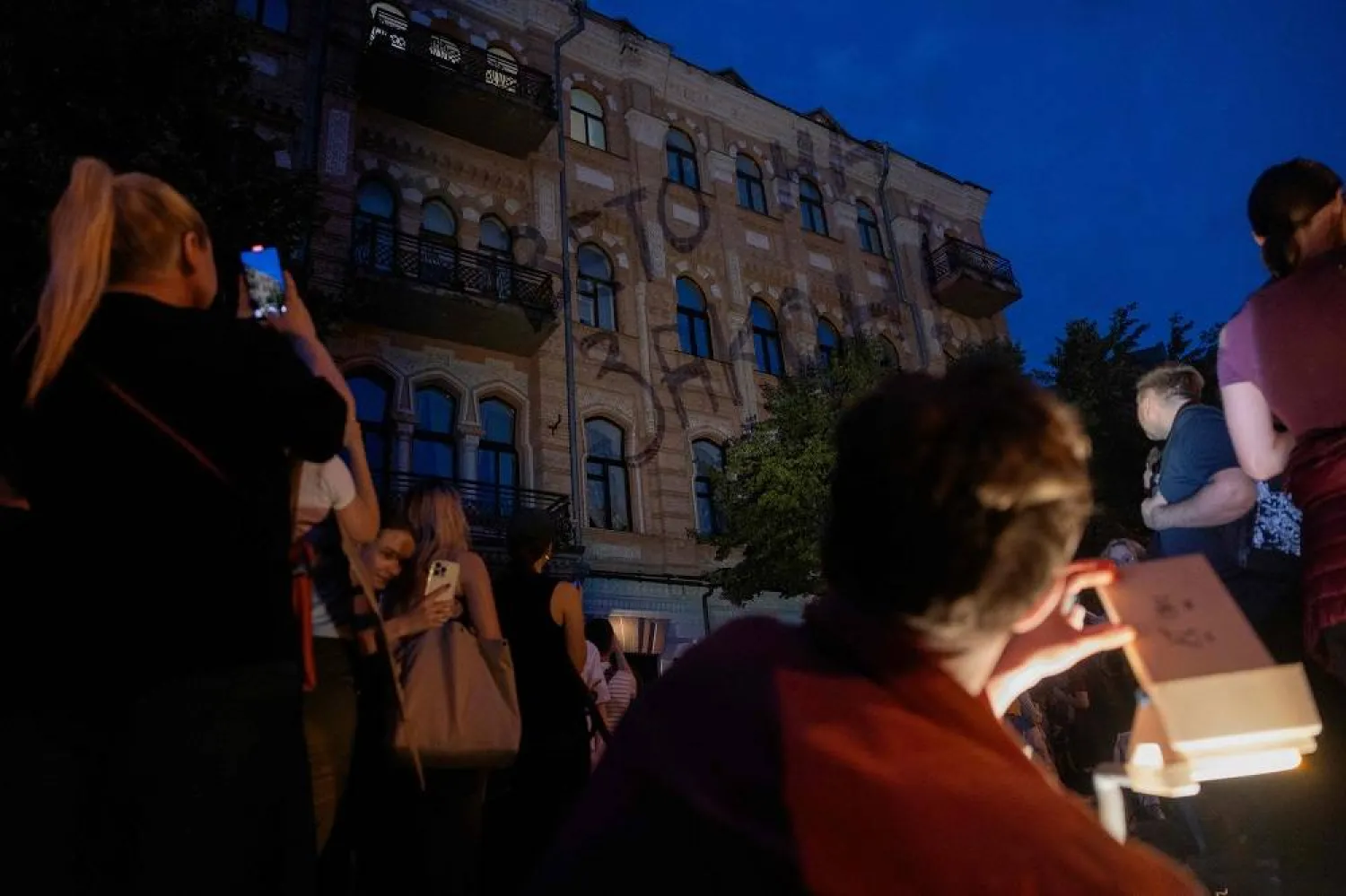
This photograph shows a projection reading "Veto the law" on a building façade during a demonstration calling for the Ukrainian president to veto a law passed by parliament that reduces the powers of Ukraine's National Anti-Corruption Bureau (NABU) and Specialized Anti-Corruption Prosecutor's Office (SAPO) in downtown Kyiv on July 22, 2025. (AFP)
TT

Thousands Gather to Protest as Zelenskyy Signs Bill Weakening Anti-Corruption Agencies 

This photograph shows a projection reading "Veto the law" on a building façade during a demonstration calling for the Ukrainian president to veto a law passed by parliament that reduces the powers of Ukraine's National Anti-Corruption Bureau (NABU) and Specialized Anti-Corruption Prosecutor's Office (SAPO) in downtown Kyiv on July 22, 2025. (AFP)

Thousands of people gathered in Kyiv and other cities across Ukraine on Tuesday to urge the president to veto a controversial bill that threatens anti-corruption infrastructure. It marked the first major rally against the government in more than three years of war.

Ukraine ’s parliament passed legislation that will tighten oversight of two key anti-corruption agencies, which critics say could significantly weaken their independence and give President Volodymyr Zelenskyy’s circle greater sway over investigations. Zelenskyy signed the bill into law, according to the parliament's website late Tuesday.

Fighting entrenched corruption is crucial for Ukraine's bid to join the European Union and maintain access to billions of dollars in Western aid. The legislation's passage has triggered public outrage in Ukraine, with some saying it appeared to be a greater moral blow than the routine Russian drone and missile attacks.

The changes would grant the prosecutor general new authority over investigations and cases handled by the National Anti-Corruption Bureau of Ukraine (NABU) and the Specialized Anti-Corruption Prosecutor’s Office (SAPO).

"In effect, if this bill becomes law, the head of SAPO will become a nominal figure, while NABU will lose its independence and turn into a subdivision of the prosecutor general’s office," the agencies said in a joint statement on Telegram.

In a post on X, the EU's Enlargement Commissioner Marta Kos expressed concern over the vote in the parliament, called the Rada, calling it "a serious step back."

Kos added: "Independent bodies like NABU & SAPO are essential for Ukraine’s EU path. Rule of Law remains in the very center of EU accession negotiations."

While rallies have taken place during the war in Ukraine, they have largely focused on the return of prisoners of war or missing people. Protests, however, remain a traditional form of public pressure in Ukraine, where two previous revolutions were victorious for the public.

"Corruption is a problem in any country, and it must always be fought," said Ihor Lachenkov, a blogger and activist who urged people to join the protest through his social media platforms, which reach more than 1.5 million followers.

"Ukraine has far fewer resources than Russia in this war," he said. "If we misuse them, or worse, allow them to end up in the pockets of thieves, our chances of victory diminish. All our resources must go toward the fight."

The Ukrainian branch of Transparency International criticized parliament’s decision, saying it undermines one of the most significant reforms since what Ukraine calls its Revolution of Dignity in 2014 and damages trust with international partners.

The group urged Zelenskyy to veto the law, warning that otherwise he would share responsibility with the Rada for "dismantling Ukraine’s anti-corruption infrastructure."

Many protesters carried signs reading "Veto the law,Protect the anti-corruption system, protect Ukraine’s future," or simply "We are against it."

The mood of anger and frustration among the war-weary Ukrainians prevailed in the crowd. Some protesters accused Ukraine’s leadership of prioritizing loyalty and personal connections over the fight against corruption.

"Those who swore to protect the laws and the Constitution have instead chosen to shield their inner circle, even at the expense of Ukrainian democracy," said veteran Oleh Symoroz, sitting in a wheelchair because both his legs were amputated after he was wounded in 2022.

"Instead of setting an example of zero tolerance for corruption, the president is using his power to take control of criminal cases involving his allies," he said.

On Monday, Ukraine’s domestic security agency detained two NABU officials on suspicion of links to Russia and searched other agency employees on unrelated allegations.

Zelenskyy's office didn’t respond to a request for comment. Last week, the president carried out a reshuffle of his wartime Cabinet, a move widely viewed as further consolidating power within his inner circle.



EU to Slash Asylum Cases from 7 Nations Deemed Safe

FILE - A convoy of buses carry Syrian refugees who return home from Lebanon, arrive at the Syrian border crossing point, in Jdeidet Yabous, Syria, Tuesday, July 29, 2025. (AP Photo/Omar Sanadiki, File)
TT

EU to Slash Asylum Cases from 7 Nations Deemed Safe

FILE - A convoy of buses carry Syrian refugees who return home from Lebanon, arrive at the Syrian border crossing point, in Jdeidet Yabous, Syria, Tuesday, July 29, 2025. (AP Photo/Omar Sanadiki, File)

The European Union on Thursday said it would drastically reduce asylum claims from seven nations in Africa, the Middle East and Asia by considering them safe countries of origin, prompting widespread outrage from human rights groups on International Migrants' Day.

An agreement between European Parliament and the European Council, or the group of the 27 EU heads of state, said that the countries would be considered safe if they lack “relevant circumstances, such as indiscriminate violence in the context of an armed conflict.”

Asylum requests by people from Bangladesh, Colombia, Egypt, Kosovo, India, Morocco and Tunisia will be "fast-tracked, with applicants having to prove that this provision should not apply to them,” read the announcement of the agreement. “The list can be expanded in the future under the EU’s ordinary legislative procedure.”

In 2024, EU nations endorsed sweeping reforms to the bloc’s failed asylum system. The rules were meant to resolve the issues that have divided the 27 countries since well over 1 million migrants swept into Europe in 2015, most fleeing war in Syria and Iraq.

Under the Pact on Migration and Asylum, which goes into force in June 2026, people can be sent to countries deemed safe, but not to those where they face the risk of physical harm or persecution.

According to The Associated Press, Amnesty International EU advocate Olivia Sundberg Diez said the new measures were “a shameless attempt to sidestep international legal obligations" and would endanger migrants.

French MEP Mélissa Camara said the safe countries of origins concept and others agreed to by the Council and Parliament “opens the door to return hubs outside the EU’s borders, where third-country nationals are sometimes subjected to inhumane treatment with almost no monitoring” and “undoubtedly places thousands of people in exile in situations of danger.”

Céline Mias, the EU director of the Danish Refugee Council said that "we are deeply worried that this fast-track system will fail to protect people in need of protection, including activists, journalists and marginalized groups in places where human rights are clearly under attack.”

Alessandro Ciriani, an Italian MEP with the European Conservatives and Reformists group, said the designation sends a firm message that the EU has toughened its borders.

“Europe wants enforceable rules and shared responsibility. Now this commitment must become operational: effective returns, structured cooperation with third countries and real measures to support EU member states,” he said.

He said that clear delineations of safe and unsafe nations would rid the EU of “excessive interpretative uncertainty” that led to a kind of paralysis for national decision makers over border controls.

The measures also allows individual nations within the bloc to designate other countries safe for their own immigration purposes.


Rubio Says US Sanctioning ICC Judges for Targeting Israel

US Secretary of State Marco Rubio speaks to traveling journalists at the John C. Munro Hamilton International Airport in Hamilton, Ontario, on November 12, 2025 after the G7 foreign ministers meeting. (Photo by Mandel NGAN / POOL / AFP)
TT

Rubio Says US Sanctioning ICC Judges for Targeting Israel

US Secretary of State Marco Rubio speaks to traveling journalists at the John C. Munro Hamilton International Airport in Hamilton, Ontario, on November 12, 2025 after the G7 foreign ministers meeting. (Photo by Mandel NGAN / POOL / AFP)

US Secretary of State Marco Rubio said on Thursday that the US was sanctioning two judges of the International Criminal Court for targeting Israel.

"Today, I am designating two International Criminal Court (ICC) judges, Gocha Lordkipanidze of Georgia and Erdenebalsuren Damdin of Mongolia, pursuant to Executive Order 14203," Rubio said in a statement, referring to the order President Donald Trump signed in February sanctioning the ICC, Reuters reported.

"These individuals have directly engaged in efforts by the ICC to investigate, arrest, detain, or prosecute Israeli nationals, without Israel's consent," he said.

The United States and Israel are not members of the ICC.

The US sanctions in February include freezing any US assets of those designated and barring them and their families from visiting the United States.


US Imposes Sanctions on Vessels Linked to Iran, Treasury Website Says

A crew member raises the Iranian flag on Iranian oil tanker Adrian Darya 1, previously named Grace 1, as it sits anchored after the Supreme Court of the British territory lifted its detention order, in the Strait of Gibraltar, Spain, August 18, 2019. REUTERS/Jon Nazca
TT

US Imposes Sanctions on Vessels Linked to Iran, Treasury Website Says

A crew member raises the Iranian flag on Iranian oil tanker Adrian Darya 1, previously named Grace 1, as it sits anchored after the Supreme Court of the British territory lifted its detention order, in the Strait of Gibraltar, Spain, August 18, 2019. REUTERS/Jon Nazca

The United States imposed sanctions on Thursday on 29 vessels and their management firms, the Treasury Department said, as Washington continues targeting Tehran's "shadow fleet" it says exports Iranian petroleum and petroleum products, Reuters reported.

The targeted vessels and companies have transported hundreds of millions of dollars of the products through deceptive shipping practices, Treasury said.

Thursday's action also targets businessman Hatem Elsaid Farid Ibrahim Sakr, whose companies are associated with seven of the vessels cited, as well as multiple shipping companies.