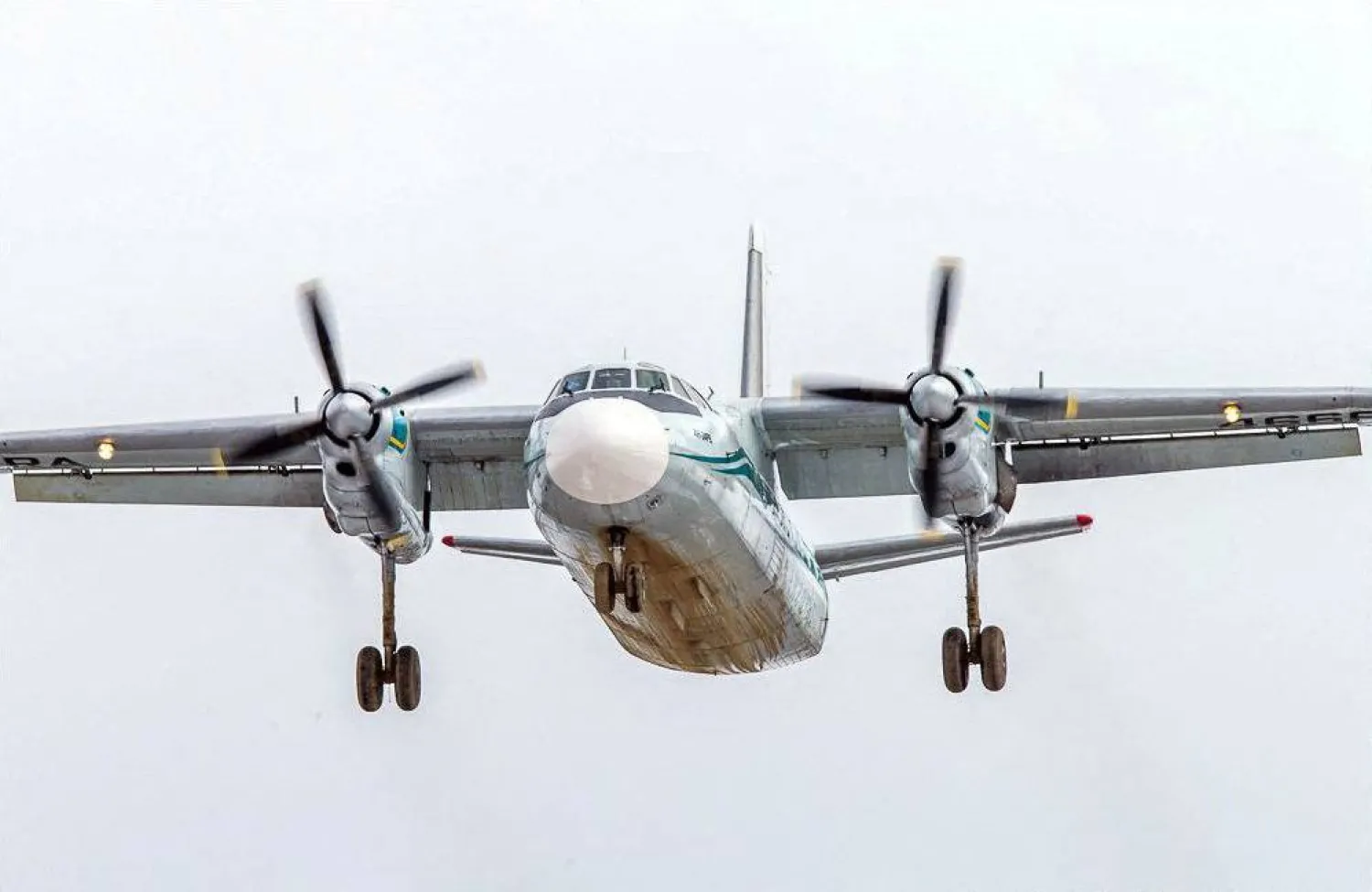
Russian Plane Crashes in Russia's Far East, Nearly 50 People on Board Feared Dead

FILE PHOTO: An An-24 aircraft of Angara Airlines lands at the airport of Irkutsk, Russia April 13, 2014. REUTERS/Marina Lystseva/File Photo
TT

Russian Plane Crashes in Russia's Far East, Nearly 50 People on Board Feared Dead

FILE PHOTO: An An-24 aircraft of Angara Airlines lands at the airport of Irkutsk, Russia April 13, 2014. REUTERS/Marina Lystseva/File Photo

An Antonov An-24 passenger plane carrying about 50 people crashed in Russia's far east on Thursday and initial information suggested that everyone on board was killed, Russian emergency services officials said.
The burning fuselage of the plane, which was from the Soviet era and was nearly 50 years old, was spotted on the ground by a helicopter and rescue crews were rushing to the scene.
Unverified video, shot from a helicopter and posted on social media, appeared to show that the plane had come down in a densely forested area.
The plane, whose tail number showed it was built in 1976, was operated by a Siberia-based airline called Angara.
It was en route from the city of Blagoveshchensk to Tynda and dropped off radar screens while approaching Tynda, a remote town in the Amur region bordering China.
There were 43 passengers, including five children, and six crew members on board according to preliminary data, Vasily Orlov, the regional governor said.
The emergencies ministry put the number of people on board somewhat lower, at around 40.
Debris from the plane was found on a hill around 15 km (10 miles) from Tynda, the Interfax news agency quoted emergency service officials as saying.
"During the search operation, a Mi-8 helicopter belonging to Rossaviatsiya discovered the fuselage of the aircraft, which was on fire," Yuliya Petina, an emergency services official, wrote on Telegram.
"Rescuers continue to make their way to the scene of the accident".
Authorities announced an investigation into the crash.



Sweden Jails Syrian Man for Life over 2012-2013 War Crimes

Police patrol at the scene of a shooting at an office of Israeli military technology firm Elbit Systems in Gothenburg on October 10, 2024.  Photo by Adam Ihse/TT / various sources / AFP) / Sweden OUT
Police patrol at the scene of a shooting at an office of Israeli military technology firm Elbit Systems in Gothenburg on October 10, 2024. Photo by Adam Ihse/TT / various sources / AFP) / Sweden OUT
TT

Sweden Jails Syrian Man for Life over 2012-2013 War Crimes

Police patrol at the scene of a shooting at an office of Israeli military technology firm Elbit Systems in Gothenburg on October 10, 2024.  Photo by Adam Ihse/TT / various sources / AFP) / Sweden OUT
Police patrol at the scene of a shooting at an office of Israeli military technology firm Elbit Systems in Gothenburg on October 10, 2024. Photo by Adam Ihse/TT / various sources / AFP) / Sweden OUT

A Swedish court on Monday sentenced a 55-year-old man to life in jail for his role in war crimes during the Syrian civil war in 2012 and 2013.

The court found that the man was guilty of participating in a shooting against a peaceful protest in July 2012 in the Damascus suburb of Yarmouk, where several demonstrators were killed, it said in a statement.

It also found that he had served at a roadblock set up by the Syrian government in the same area from December 2012 to July 2013, where "a very large number of civilians" had been arrested and taken away to be tortured and in some cases killed.

According to the court, both offences happened as part of the Syrian civil war, triggered by popular discontent with the rule of longtime leader Bashar al-Assad.

"The district court has found the offences to be aggravated because they were directed at a large number of civilians and several people have died and been injured," judge Hampus Lilja said, explaining this had warranted the life sentence.

The man, who denied the charges, was born in Yarmouk, left Syria in 2013 and was granted asylum in Sweden, according to court documents viewed by AFP. He then gained Swedish citizenship in 2017.

The court noted that the trial had taken 54 days and that a large number of people had been called as both plaintiffs and witnesses.

Sweden has adopted a principle of universal jurisdiction, which allows it to try cases of serious crimes against international law regardless of where the offences took place.


Rights Group Says Gaza Flotilla Activists Facing Abuse in Israel Jail

Brazilian activist Thiago Avila gestures upon his arrival at a court in Ashkelon on May 3, 2026.(Photo by Ilia YEFIMOVICH / AFP)
TT

Rights Group Says Gaza Flotilla Activists Facing Abuse in Israel Jail

Brazilian activist Thiago Avila gestures upon his arrival at a court in Ashkelon on May 3, 2026.(Photo by Ilia YEFIMOVICH / AFP)

Two foreign activists from a Gaza-bound flotilla who have been detained in Israeli prison are facing psychological abuse, death threats and poor detention conditions, a rights group representing them said Monday.

"Thiago Avila (one of the activists) reported being subjected to repeated interrogations lasting up to eight hours. Interrogators have explicitly threatened him, stating he would either be 'killed' or 'spend 100 years in jail'," rights group Adalah, whose attorneys visited both activists in their detention Monday, said in statement.

Adalah added that a court would decide Tuesday whether to further extend Spanish national Saif Abu Keshek and Brazilian Avila's detention.


US Denies Iran Struck a Military Vessel during New Effort to Reopen Strait of Hormuz

Vessels in the Strait of Hormuz near Bandar Abbas, Iran, May 4, 2026. Amirhosein Khorgooi/ISNA/WANA (West Asia News Agency) via REUTERS
TT

US Denies Iran Struck a Military Vessel during New Effort to Reopen Strait of Hormuz

Vessels in the Strait of Hormuz near Bandar Abbas, Iran, May 4, 2026. Amirhosein Khorgooi/ISNA/WANA (West Asia News Agency) via REUTERS

The US military on Monday denied claims that Iran struck a Navy vessel as US forces now offer to guide commercial ships through the Strait of Hormuz, where hundreds have been stuck since the Iran war began. Tehran over the past two months has attacked some vessels and blocked others that don’t receive its authorization.

The US military’s Central Command also said two American-flagged merchant ships have “successfully transited through the Strait of Hormuz" and that that Navy guided-missile destroyers in the Arabian Gulf are helping to restore commercial shipping traffic.

The statement on X said the destroyers transited the Strait of Hormuz “in support of Project Freedom” and that the merchant ships are "safely headed on their journey." It did not say when the Navy ships arrived or when the merchant vessels departed.

Meanwhile, Iranian news agencies had earlier claimed that Iran struck a US vessel near an Iranian port southeast of the strait, accusing it of “violating maritime security and navigation norms.” The reports said the vessel was forced to turn back.

Also, Iran's state television reported that the Iranian navy fired cruise missiles, rockets and combat drones near US destroyers crossing the Strait of Hormuz on Monday,

It said the navy had identified US destroyers in the Strait of Hormuz and fired multiple warning shots, adding, "following the Zionist American destroyers' disregard for the initial warning, the Navy issued a warning shot by firing cruise missiles, rockets, and combat drones around the aggressor enemy vessels".