


'Lungs of the Earth': the Indonesians Fighting for Peatland

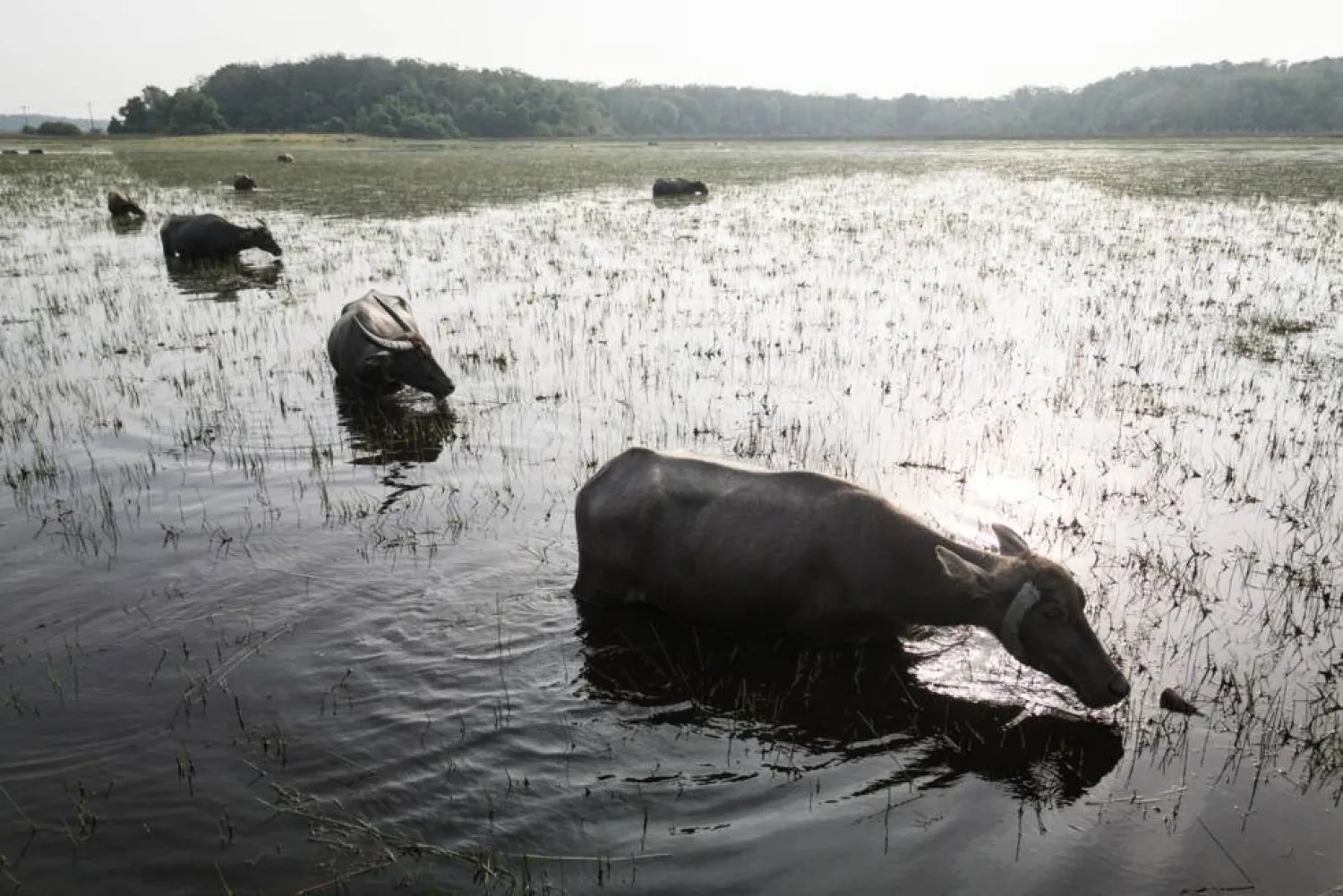
Indonesia has more tropical peatland than any country, but it is also quickly losing this poorly understood ecosystem. STR / AFP
TT

'Lungs of the Earth': the Indonesians Fighting for Peatland

Indonesia has more tropical peatland than any country, but it is also quickly losing this poorly understood ecosystem. STR / AFP

Indonesian environmentalist Pralensa steered his boat through a shallow canal in the marshy peatlands near his village, an environment he fears may soon disappear.

His oar stirred up rich organic material in the brackish water, evidence of the layers of plant matter that make peatlands vital carbon dioxide stores and key to biodiversity, AFP said.

Indonesia has more tropical peatland than any other country, but it is also quickly losing this poorly understood ecosystem.

That affects local residents and wildlife but also has global impacts, because converted peatland can release vast quantities of planet-warming carbon dioxide.

Pralensa worries a similar fate awaits much of the swampy peatland around his village of Lebung Itam in South Sumatra.

Locals say palm oil firm Bintang Harapan Palma has already begun digging canals to drain the peatlands for planting.

"We protested... we told them this is a community-managed area," said Pralensa, who, like many Indonesians, uses a single name.

"According to them, they already have rights to this land."

Bintang Harapan Palma did not respond to AFP's request for comment.

Peatlands are an in-between place -- seemingly neither water nor land -- an environment that slows plant decomposition and forms carbon-rich peat.

Covering just three percent of the world's surface, they hold an estimated 44 percent of all soil carbon.

Indonesia's peatlands are home to endangered orangutans, as well as economically important fish species. They also help prevent flooding and drought, lower local temperatures and minimize saltwater intrusion.

For Pralensa, peatlands are no less than a "spiritual bond".

"From the moment that we exist, that we're born, we are aware of this peatland. We encounter it every moment of every day," the 44-year-old said.

Catastrophic fires

Indonesia's peatland has long been converted for agriculture, drained of the water that is its lifeblood, with severe consequences.

Dry peat is highly flammable, and fire can smoulder underground and reignite seemingly at will.

The blazes sparked calls for action, including a moratorium on new peatland concessions.

Government regulations adopted the following year banned several damaging activities, including burning and drying out peatland.

The environment ministry did not respond to questions submitted by AFP.

"Weak oversight and law enforcement in Indonesia allow the exploitation of peatlands to continue," said Wahyu Perdana at peatland preservation NGO Pantau Gambut.

And fires still happen "almost every year," said Rohman, a farmer in Bangsal village, around two hours west of Lebung Itam.

Like Lebung Itam, it is ringed by plantations on converted peatland.

Bangsal residents could once rely on vast wetlands to feed their distinctive buffalo, which dive beneath the water to graze.

Fish traps supplied additional income, along with small rice paddies.

'We must protect nature'

Plantation infrastructure prevents water from subsiding properly when the rains end, complicating rice planting.

And then there is the seasonal haze.

"It's difficult to do anything" when it descends, said Rohman, with visibility sometimes dropping to just a few meters.

Everything from "economic activity to children playing and learning is very disrupted".

Rohman, 53, was one of several plaintiffs from Bangsal and Lebung Itam who filed a landmark lawsuit over the fires.

They argued three companies with nearby timber plantations on peatland bore legal responsibility for the health, economic and social impacts of local fires.

Filing the suit was not an easy decision, said Bangsal schoolteacher Marda Ellius, who alleges a company named in the case offered her money and help for her family if she withdrew.

"I kept thinking that, from the beginning, my goal here was for the environment, for many people," she said.

"I chose to continue."

AFP could not reach the companies named in the suit. Major firm Asia Pulp & Paper (APP), which buys from the three companies, did not respond.

This month, a local court rejected the suit, saying the plaintiffs lacked standing.

"The pain cannot be described," plaintiff Muhammad Awal Gunadi said of the ruling.

"It was tough because we were facing corporations.

The group has pledged to appeal, and Bangsal's villagers are lobbying local government for a new designation to protect their remaining peatland.

Healthy peat is "like the lungs of the Earth," said Bangsal resident and buffalo farmer Muhammad Husin.

"Hopefully, if we protect nature, nature will also protect us."


Saudi National Center for Wildlife, Soudah Development Company Release Birds of Prey

The release comes as part of reintroduction programs aimed at enhancing ecological balance and restoring biodiversity in one of the Kingdom’s most prominent mountainous environmental zones - SPA
TT

Saudi National Center for Wildlife, Soudah Development Company Release Birds of Prey

The release comes as part of reintroduction programs aimed at enhancing ecological balance and restoring biodiversity in one of the Kingdom’s most prominent mountainous environmental zones - SPA

Saudi Arabia's National Center for Wildlife (NCW), in cooperation with Soudah Development Company, has released a number of birds of prey in Al-Soudah Park, including three griffon vultures, a black kite, an Arabian scops owl, and an Eurasian sparrowhawk, after rehabilitating them at shelter centers.


The release comes as part of reintroduction programs aimed at enhancing ecological balance and restoring biodiversity in one of the Kingdom’s most prominent mountainous environmental zones, SPA reported.

This release followed the completion of rehabilitation and environmental acclimatization stages to ensure the birds’ readiness and ability to adapt to the nature of the area, contributing to the stability of local species and boosting their ecological roles within mountain ecosystems, particularly in regulating food chains and preserving the health of natural habitats.

The NCW noted that this step falls within its ongoing programs to breed and reintroduce threatened wildlife species, rehabilitate ecosystems, and enrich biodiversity across various regions of the Kingdom, in cooperation with national partners and in line with the objectives of the Saudi Green Initiative and the National Environment Strategy, which support the environmental development goals of the Saudi Vision 2030.

Specialized teams will continue to monitor the released birds and track their movements and ecological behavior using dedicated tools and technologies, supporting the evaluation of the program’s success and the improvement of its outcomes in the future in accordance with the best global environmental practices.


Ariane 6 Lifts Off with 2 European Navigation Satellites

The European Space Agency (ESA) Ariane 6 rocket carrying two Galileo satellites for the the EU's Global Navigation Satellite System (GNSS) launches at the Guiana Space Center in Kourou, on the French overseas department of Guiana, on December 17, 2025. (Photo by Ronan LIETAR / AFP)
TT

Ariane 6 Lifts Off with 2 European Navigation Satellites

The European Space Agency (ESA) Ariane 6 rocket carrying two Galileo satellites for the the EU's Global Navigation Satellite System (GNSS) launches at the Guiana Space Center in Kourou, on the French overseas department of Guiana, on December 17, 2025. (Photo by Ronan LIETAR / AFP)

A European Ariane 6 rocket blasted off from France's Kourou space base in French Guiana early Wednesday, carrying two Galileo global navigation satellites, according to an AFP correspondent.

Lift-off was at 2:01 am local time (0501 GMT) for the fourth commercial flight of the Ariane 6 launch system since the expendable rockets came into service last year.

The rocket was carrying two more satellites of the European Union's Galileo program, a global navigation satellite system that aims to make the bloc less dependent on the US's Global Positioning System (GPS).

The two satellites were set to be placed in orbit nearly four hours after lift-off.

They will bring to 34 the number of Galileo satellites in orbit and "will improve the robustness of the Galileo system by adding spares to the constellation to guarantee the system can provide 24/7 navigation to billions of users. The satellites will join the constellation in medium Earth orbit 23, 222 km (14,429 miles) above Earth’s surface," according to the European Space Agency (ESA) which oversees the program.

Previous Galileo satellites were primarily launched by Ariane 5 and Russian Soyuz rockets from Kourou.

After Russia's invasion of Ukraine, Europe halted space cooperation with Moscow.

Before the Ariane 6 rocket entered into service in July 2024, the EU contracted with Elon Musk's SpaceX to launch two Galileo satellites aboard Falcon 9 rockets in September 2024 from the Kennedy Space Center in Florida.


Delhi Restricts Vehicles, Office Attendance in Bid to Curb Pollution

Children ride a bicycle across a field on smoggy winter morning in New Delhi on December 17, 2025. (Photo by Arun SANKAR / AFP)
TT

Delhi Restricts Vehicles, Office Attendance in Bid to Curb Pollution

Children ride a bicycle across a field on smoggy winter morning in New Delhi on December 17, 2025. (Photo by Arun SANKAR / AFP)

Authorities in India's capital Delhi rolled out strict measures on Wednesday in an attempt to curb pollution, including a ban on vehicles not compliant with latest emission control norms and regulating attendance in private and government offices.

The air quality index (AQI) in the Delhi region, home to 30 million people, has been in the 'severe' category for the past few days, often crossing the 450-mark. In addition, shallow fog in parts of the city worsened visibility that impacted flights and trains.

This prompted the Commission for Air Quality Management to invoke stage four, the highest level, of the Graded Response Action Plan for Delhi and surrounding areas on Saturday.

The curbs ban the entry of older diesel trucks into the city, suspend construction, including on public projects, and impose hybrid schooling, Reuters reported.

Kapil Mishra, a minister in the local government, announced on Wednesday that all private and government offices in the city would operate with 50% attendance, with the remaining working from home.

Additionally, all registered construction workers, many of them earning daily wages, will be given compensation of 10,000 rupees ($110) because of the ban, Mishra said at a press conference in Delhi.

On Tuesday, the government enforced strict anti-pollution measures for vehicles in the city, banning vehicles that are not compliant with the latest emission control standards.

"Our government is committed to providing clean air in Delhi. We will take strict steps to ensure this in the coming days," Delhi's Environment Minister Manjinder Singh Sirsa said late on Tuesday.

Pollution is an annual winter problem in Delhi and its suburbs, when cold, dense air traps emissions from vehicles, construction sites and crop burning in neighboring states, pushing pollution levels to among the highest in the world and exposing residents to severe respiratory risks.

The area, home to 30 million people, gets covered in a thick layer of smog with AQI touching high 450-levels. Readings below 50 are considered good.
