


Netanyahu, Trump Appear to Abandon Gaza Ceasefire Negotiations with Hamas

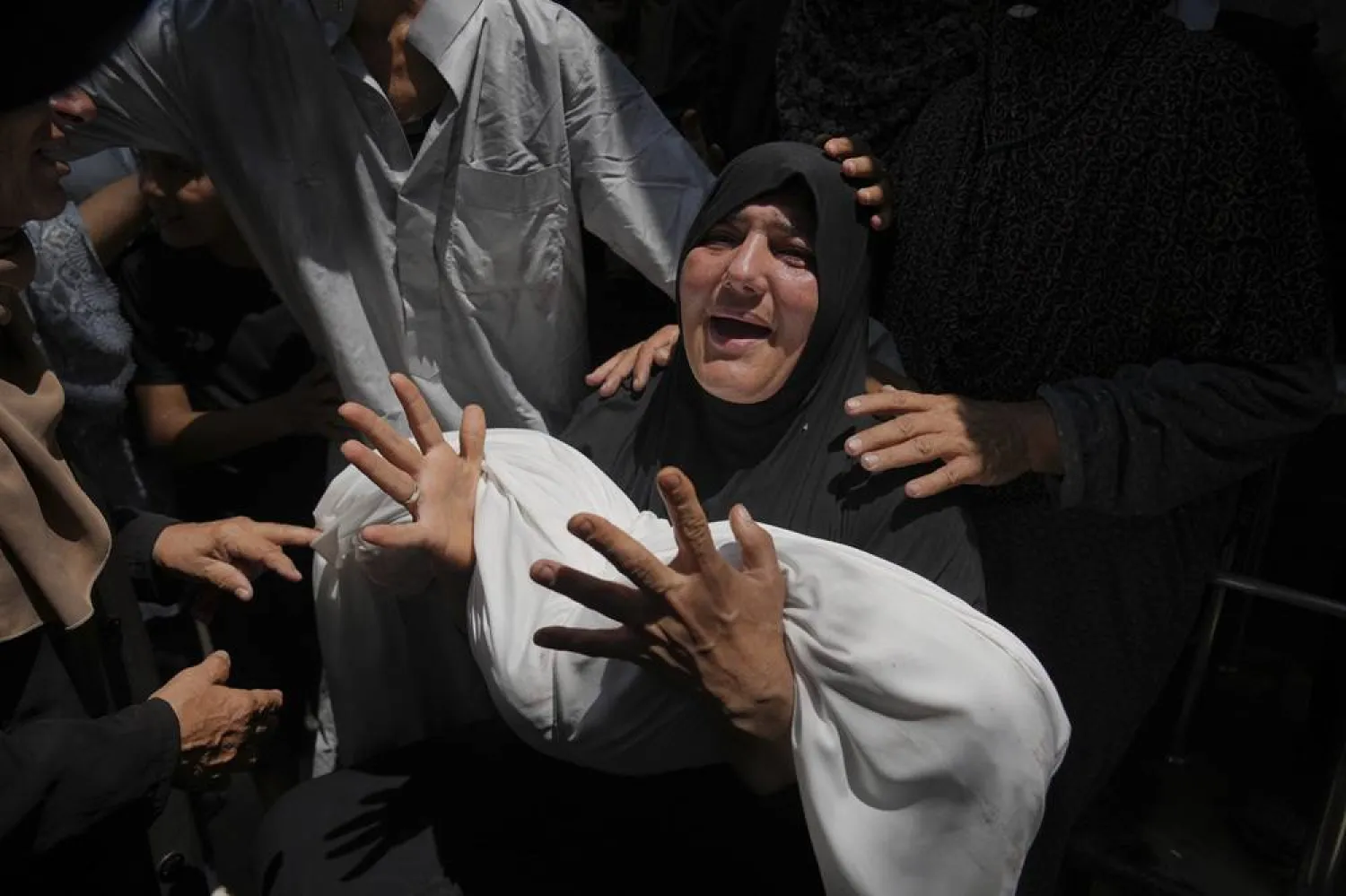
 Relatives mourn over the body of 11-year-old Palestinian boy Qais Adwan, who was killed in an Israeli airstrike on a school in Gaza that has been used as a shelter, during his burial at Al Shifa Hospital in Gaza City, Friday, July 25, 2025. (AP)
Relatives mourn over the body of 11-year-old Palestinian boy Qais Adwan, who was killed in an Israeli airstrike on a school in Gaza that has been used as a shelter, during his burial at Al Shifa Hospital in Gaza City, Friday, July 25, 2025. (AP)
TT

Netanyahu, Trump Appear to Abandon Gaza Ceasefire Negotiations with Hamas

 Relatives mourn over the body of 11-year-old Palestinian boy Qais Adwan, who was killed in an Israeli airstrike on a school in Gaza that has been used as a shelter, during his burial at Al Shifa Hospital in Gaza City, Friday, July 25, 2025. (AP)
Relatives mourn over the body of 11-year-old Palestinian boy Qais Adwan, who was killed in an Israeli airstrike on a school in Gaza that has been used as a shelter, during his burial at Al Shifa Hospital in Gaza City, Friday, July 25, 2025. (AP)

Israeli Prime Minister Benjamin Netanyahu and US President Donald Trump appeared on Friday to abandon Gaza ceasefire negotiations with Hamas, both saying it had become clear that the Palestinian group did not want a deal.

Netanyahu said Israel was now mulling "alternative" options to achieve its goals of bringing its hostages home from Gaza and ending Hamas rule in the enclave, where starvation is spreading and most of the population is homeless amid widespread ruin.

Trump said he believed Hamas leaders would now be "hunted down", telling reporters at the White House: "Hamas really didn't want to make a deal. I think they want to die. And it's very bad. And it got to be to a point where you're going to have to finish the job."

The remarks appeared to leave little to no room, at least in the short term, to resume negotiations to pause the fighting, at a time when international concern is mounting over worsening hunger in war-shattered Gaza.

French President Emmanuel Macron, responding to the deteriorating humanitarian situation in Gaza, announced overnight that Paris would become the first major Western power to recognize an independent Palestinian state. Britain and Germany said they were not yet ready to do so.

Trump dismissed Macron's move. "What he says doesn't matter," he told reporters at the White House. "He's a very good guy. I like him, but that statement doesn't carry weight."

Israel and the United States withdrew their delegations on Thursday from the ceasefire talks in Qatar, hours after Hamas submitted its response to a truce proposal.

Sources initially said on Thursday that the Israeli withdrawal was only for consultations and did not necessarily mean the talks had reached a crisis. But Netanyahu's remarks suggested Israel's position had hardened overnight.

US envoy Steve Witkoff said overnight Hamas was to blame for the impasse, and Netanyahu said Witkoff had got it right.

Senior Hamas official Basem Naim said on Facebook that the talks had been constructive, and criticized Witkoff's remarks as aimed at exerting pressure on Israel's behalf.

"What we have presented - with full awareness and understanding of the complexity of the situation - we believe could lead to a deal if the enemy had the will to reach one," he said.

The proposed ceasefire would suspend fighting for 60 days, allow more aid into Gaza, and free some of the 50 remaining hostages held by fighters in return for Palestinian prisoners jailed in Israel.

It has been held up by disagreement over how far Israel should withdraw its troops and the future beyond the 60 days if no permanent agreement is reached.

Itamar Ben-Gvir, the far-right national security minister in Netanyahu's coalition, welcomed Netanyahu's step, calling for a total halt of aid to Gaza and complete conquest of the enclave, adding in a post on X: "Total annihilation of Hamas, encourage emigration, (Jewish) settlement."

MASS HUNGER

International aid organizations say mass hunger has now arrived among Gaza's 2.2 million people, with stocks running out after Israel cut off all supplies to the territory in March, then reopened it in May but with new restrictions.

The Israeli military said on Friday it had agreed to let countries airdrop aid into Gaza. Hamas dismissed this as a stunt.

"The Gaza Strip does not need flying aerobatics, it needs an open humanitarian corridor and a steady daily flow of aid trucks to save what remains of the lives of besieged, starving civilians," Ismail Al-Thawabta, director of the Hamas-run Gaza government media office, told Reuters.

Gaza medical authorities said nine more Palestinians had died over the past 24 hours from malnutrition or starvation. Dozens have died in the past few weeks as hunger worsens.

Israel says it has let enough food into Gaza and accuses the United Nations of failing to distribute it, in what the Israeli foreign ministry called on Friday "a deliberate ploy to defame Israel". The United Nations says it is operating as effectively as possible under Israeli restrictions.

United Nations agencies said on Friday that supplies were running out in Gaza of specialized therapeutic food to save the lives of children suffering from severe acute malnutrition.

The ceasefire talks have been accompanied by continuing Israeli offensives on the ground. Palestinian health officials said Israeli airstrikes and gunfire had killed at least 21 people across the enclave on Friday, including five killed in a strike on a school sheltering displaced families in Gaza City.

In the city, residents carried the body of journalist Adam Abu Harbid through the streets wrapped in a white shroud, his blue flak jacket marked PRESS draped across his body. He was killed overnight in a strike on tents housing displaced people.

Mahmoud Awadia, another journalist attending the funeral, said the Israelis were deliberately trying to kill reporters. Israel denies intentionally targeting journalists.

Israel launched its assault on Gaza after Hamas-led fighters stormed Israeli towns near the border, killing some 1,200 people and capturing 251 hostages on October 7, 2023. Since then, Israeli forces have killed nearly 60,000 people in Gaza, health officials there say, and reduced much of the enclave to ruins.

Israel and the United States both criticized Macron's decision to recognize Palestinian independence. Netanyahu called it a "reward for terrorism".

Western countries have been committed for decades to an eventual independent Palestinian state but have long said it should arise out of a negotiated peace process.

Europe's two other big powers, Britain and Germany, made clear there were no plans to act on Palestinian statehood right away.

Germany has a long history of supporting Israel arising from its guilt in the Nazi Holocaust. Britain said on Friday its first priority was alleviating Gaza's humanitarian disaster and securing a ceasefire.

"Israel's security is of paramount importance to the German government," a German government spokesperson said. "The German government therefore has no plans to recognize a Palestinian state in the short term."



Israeli-Backed Group Kills a Senior Hamas Police Officer in Gaza, Threatens More Attacks

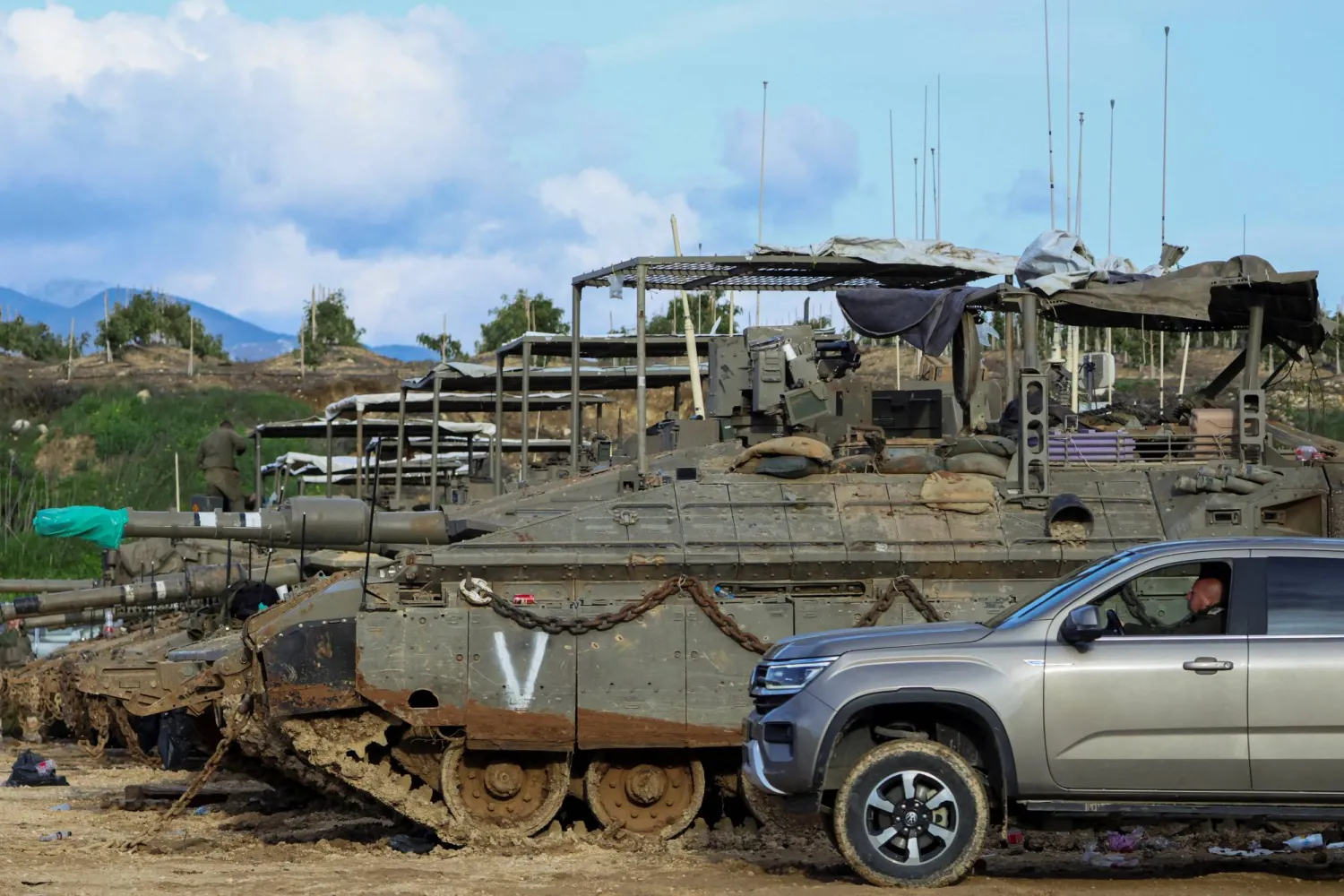
Palestinians walk along a road amid destroyed buildings in Jabalia, in the northern Gaza Strip, on January 10, 2026. (AFP)
TT

Israeli-Backed Group Kills a Senior Hamas Police Officer in Gaza, Threatens More Attacks

Palestinians walk along a road amid destroyed buildings in Jabalia, in the northern Gaza Strip, on January 10, 2026. (AFP)

An Israeli-backed Palestinian group said on Monday it had killed a senior Hamas police officer in the southern Gaza Strip, an incident which Hamas blamed on "Israeli collaborators".

A statement from the Hamas-run interior ministry said gunmen opened fire from a passing car, ​killing Mahmoud Al-Astal, head of the criminal police unit in Khan Younis, in the south of the enclave. It described the attackers as "collaborators with the occupation".

Hussam Al-Astal, leader of an anti-Hamas group based in an area under Israeli control east of Khan Younis, claimed responsibility for the killing in a video he posted on his Facebook page. The surname he shares with the dead man, Al-Astal, is common in that part of Gaza.

"To those who work with Hamas, your destiny is to be killed. Death is coming to you," he ‌said, dressed in ‌a black military-style uniform and clutching an assault rifle.

Reuters could ‌not ⁠independently ​verify ‌the circumstances of the attack. An Israeli military official said the army was not aware of any operations in the area.

The emergence of armed anti-Hamas groups, though still small and localized, has added pressure on the movement and could complicate efforts to stabilize and unify a divided Gaza, shattered by two years of war.

These groups remain unpopular among the local population as they operate in areas under Israeli control, although they publicly deny they take Israeli orders. Hamas has held public executions ⁠of people it accuses of collaboration.

Under a ceasefire in place since October, Israel has withdrawn from nearly half of ‌the Gaza Strip, but its troops remain in control of ‍the other half, largely a wasteland ‍where virtually all buildings have been levelled.

Nearly all of the territory's two million people ‍now live in Hamas-held areas, mostly in makeshift tents or damaged buildings, where the group has been reasserting its grip. Four Hamas sources said it continues to command thousands of fighters despite suffering heavy losses during the war.

Israel has been allowing rivals of Hamas to operate in areas it controls. In ​later phases, US President Donald Trump's plan for Gaza calls for Israel to withdraw further and for Hamas to yield power to an internationally backed administration, ⁠but there has so far been no progress towards those steps.

Prime Minister Benjamin Netanyahu acknowledged Israeli backing for anti-Hamas groups in June, saying Israel had "activated" clans, but has given few details since then.

The ceasefire has ended major combat in Gaza over the past three months, but both sides have accused the other of regular violations. More than 440 Palestinians and three Israeli soldiers have been killed since the truce took effect.

Gaza health authorities said on Monday Israeli drone fire killed at least three people near the center of Khan Younis.

The Israeli military did not have an immediate comment on the drone incident.

The war erupted on October 7, 2023 when Gazan fighters invaded Israel, killing about 1,200 people and taking some 250 hostages, according to ‌Israeli tallies.

Israel’s subsequent military assault on Gaza has killed more than 71,000 Palestinians, according to the enclave’s health ministry, and led to accusations of genocide and war crimes, which Israel denies.


Hamas Postpones Election of Political Bureau Chief Indefinitely

(From left) Nizar Awadallah, Khalil al-Hayya and Mohammad Ismail Darwish during a meeting with Iran’s Supreme Leader Ali Khamenei last February 2025. (Khamenei's website/AFP)
TT

Hamas Postpones Election of Political Bureau Chief Indefinitely

(From left) Nizar Awadallah, Khalil al-Hayya and Mohammad Ismail Darwish during a meeting with Iran’s Supreme Leader Ali Khamenei last February 2025. (Khamenei's website/AFP)

Senior sources within Hamas said the movement has decided to postpone the election of the head of its political bureau, which had been scheduled to take place within the first ten days of January.

The sources told Asharq Al-Awsat that the decision to delay the vote was taken “until further notice,” noting that no new date has been set, although elections “could be held at any moment.”

One source attributed the postponement to “security and political conditions,” as well as Hamas’ current preoccupation with negotiations aimed at moving to the second phase of the ceasefire, amid intensified mediation efforts involving regional brokers and the United States.

Other sources pointed to additional factors, including internal disagreements over organizational arrangements within the Gaza Strip, which have deepened in recent days and are now the subject of efforts to resolve them.

Hamas is facing what sources described as its most severe crisis since its founding in 1987. Israeli strikes launched after the Oct. 7, 2023 attack have targeted various levels and wings of the movement, triggering significant organizational and financial challenges.

Sources said the accelerating momentum surrounding a possible transition to the second phase of the ceasefire has become the main concern for Hamas’s leadership. While electing a new head of the political bureau is seen as a key step in reorganizing the movement’s internal affairs, the process may take longer than initially expected, they added.

Only days ago, sources had told Asharq Al-Awsat that the elections were expected to be held within the first ten days of the new year, with the aim of reinforcing internal stability and reassuring the outside world that the movement remains cohesive.

Those sources said at the time that electing a political bureau chief would not end the role of the current leadership council formed after the assassinations of Ismail Haniyeh and Yahya al-Sinwar. The council would instead continue as an advisory body overseeing Hamas’ internal and external affairs.

Asked whether internal divisions exist over who should lead Hamas, one source said only that “the electoral process is conducted according to established rules and regulations, and there are no disputes over the individual who will lead the movement.”

However, there have been suggestions that Khaled Meshaal, head of Hamas’s political bureau abroad, and Khalil al-Hayya, head of the political bureau in Gaza, are the top contenders for the post.

Some sources said there is strong support within Hamas’ external leadership and in the West Bank for Meshaal to assume the role, while a majority in Gaza favors al-Hayya.

The sources did not rule out the emergence of a third, currently unidentified figure. “Nothing can be predicted at this stage,” one source said. “What is happening should not be seen as rivalry driven by internal disputes over leadership, but rather as a healthy competitive process.”


Syrian Army on Alert after SDF Armed Groups Detected East of Aleppo

People walk down a street as a car drives by following a ceasefire which ended days of fighting between Syrian security forces and Kurdish fighters in the Kurdish-majority Sheikh Maqsoud neighborhood, of the northern city of Aleppo on January 11, 2026. (AFP)
TT

Syrian Army on Alert after SDF Armed Groups Detected East of Aleppo

People walk down a street as a car drives by following a ceasefire which ended days of fighting between Syrian security forces and Kurdish fighters in the Kurdish-majority Sheikh Maqsoud neighborhood, of the northern city of Aleppo on January 11, 2026. (AFP)

The Syrian army went on alert on Sunday after detecting armed groups aligned with the Syrian Democratic Forces (SDF) east of Aleppo city.

In statements to the SANA state news agency, the Operations Command said that the nature and objectives of these military reinforcements and troop concentrations brought by the SDF to eastern Aleppo have not yet been identified.

The Command added that Syrian army forces have been placed on full alert, deployment lines east of Aleppo have been reinforced, and all necessary measures have been taken to be ready for all possible scenarios.

First responders on Sunday entered a contested neighborhood in the northern city of Aleppo after days of deadly clashes between government forces and Kurdish-led forces. Syrian state media said the military was deployed in large numbers.

The clashes broke out Tuesday in the predominantly Kurdish neighborhoods of Sheikh Maqsoud, Achrafieh and Bani Zaid after the government and the SDF, the main Kurdish-led force in the country, failed to make progress on how to merge the SDF into the national army. Security forces captured Achrafieh and Bani Zaid.

The fighting between the two sides was the most intense since the fall of then-President Bashar Assad to opposition groups in December 2024. At least 23 people were killed in five days of clashes and more than 140,000 were displaced amid shelling and drone strikes.

The Kurdish fighters have now evacuated from the Sheikh Maqsoud neighborhood to northeastern Syria, which is under the control of the SDF.

However, they said in a statement they will continue to fight now that the wounded and civilians have been evacuated, in what they called a “partial ceasefire.”