


Ancient Site Sparks Heated Political Debate about India's Past

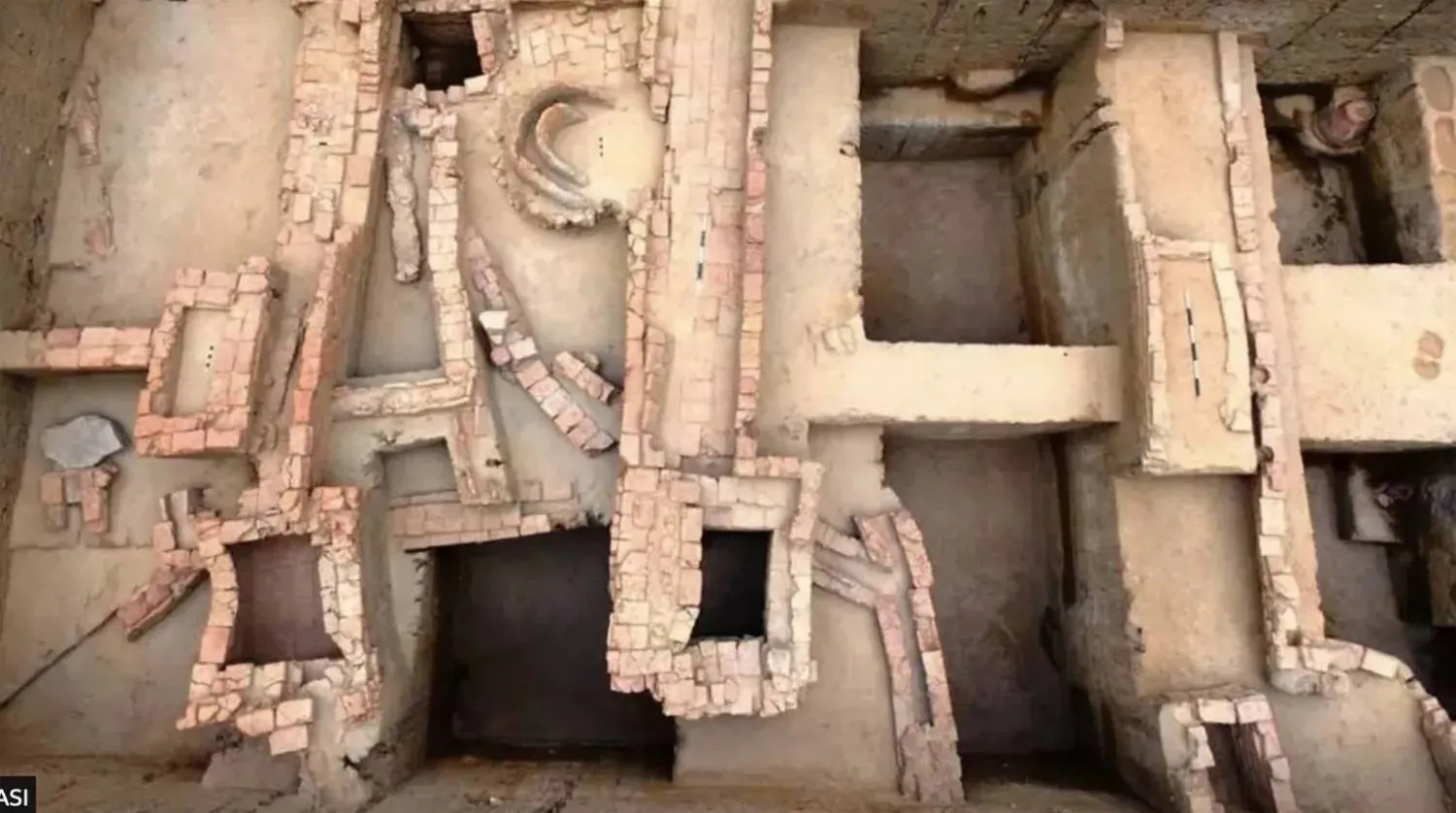
A view of an excavated site in Keeladi. (Archaeological Survey of India)
TT

Ancient Site Sparks Heated Political Debate about India's Past

A view of an excavated site in Keeladi. (Archaeological Survey of India)

The Keeladi village in India's southern Tamil Nadu state has unearthed archeological finds that have sparked a political and historical debate.

Amid coconut groves, a series of 15ft (4.5m) deep trenches reveal ancient artifacts buried in layers of soil - fragments of terracotta pots, and traces of long-lost brick structures, BBC reported on Monday.

Experts from the Tamil Nadu State Department of Archaeology estimate the artifacts to be 2,000 to 2,500 years old, with the oldest dating back to around 580 BCE. They say these findings challenge and reshape existing narratives about early civilization in the Indian subcontinent.

With politicians, historians, and epigraphists weighing in, Keeladi has moved beyond archaeology, becoming a symbol of state pride and identity amid competing historical narratives.

Yet history enthusiasts say it remains one of modern India's most compelling and accessible discoveries - offering a rare opportunity to deepen understanding of a shared past.

Keeladi, a village 12km (7 miles) from Madurai on the banks of the Vaigai river, was one of 100 sites shortlisted for excavation by Archaeological Survey of India (ASI) archaeologist Amarnath Ramakrishnan in 2013.

He selected a 100-acre site there because of its proximity to ancient Madurai and the earlier discovery of red-and-black pottery ware by a schoolteacher in 1975.

Ajay Kumar, leading the state archaeology team at Keeladi, said the key finds are elaborate brick structures and water systems - evidence of a 2,500-year-old urban settlement.

“This was a literate, urban society where people had separate spaces for habitation, burial practices and industrial work,” Kumar said, noting it's the first large, well-defined ancient urban settlement found in southern India.

William Daniel, a teacher from neighboring Kerala, said the discoveries made him feel proud about his heritage.

“It gives people from the south [of India] something to feel proud about, that our civilization is just as ancient and important as the one in the north [of India],” he said.

The politics surrounding Keeladi reflects a deep-rooted north-south divide - underscoring how understanding the present requires grappling with the past.

India's first major civilization, the Indus Valley, emerged in the north and central regions between 3300 and 1300 BCE. After its decline, a second urban phase, the Vedic period, rose in the Gangetic plains, lasting until the 6th Century BCE.

This phase saw major cities, powerful kingdoms and the rise of Vedic culture - a foundation for Hinduism. As a result, urbanization in ancient India is often viewed as a northern phenomenon, with a dominant narrative that the northern Aryans "civilized" the Dravidian south.

This is especially evident in the mainstream understanding of the spread of literacy.

It is believed that the Ashokan Brahmi script - found on Mauryan king Ashoka's rock edicts in northern and central India, dating back to the 3rd Century BCE - is the predecessor of most scripts in South and Southeast Asia.

Epigraphists like Iravatham Mahadevan and Y Subbarayalu have long held the view that the Tamil Brahmi script - the Tamil language spoken in Tamil Nadu and written in the Brahmi script - was an offshoot of the Ashokan Brahmi script.

But now, archaeologists from the Tamil Nadu state department say that the excavations at Keeladi are challenging this narrative.

“We have found graffiti in the Tamil Brahmi script dating back to the 6th Century BCE, which shows that it is older than the Ashokan Brahmi script. We believe that both scripts developed independently and, perhaps, emerged from the Indus Valley script,” Kumar said.

Epigraphist S Rajavelu, former professor of marine archaeology at the Tamil University, agrees with Kumar and said other excavation sites in the state too have unearthed graffiti in the Tamil Brahmi script dating back to the 5th and 4th Century BCE.

But some experts say that more research and evidence are needed to conclusively prove the antiquity of the Tamil Brahmi script.



Diriyah Art Futures to Launch 'Of the Earth: Earthly Technologies to Computational Biologies' Exhibition 

Diriyah Art Futures to Launch 'Of the Earth: Earthly Technologies to Computational Biologies' Exhibition 
TT

Diriyah Art Futures to Launch 'Of the Earth: Earthly Technologies to Computational Biologies' Exhibition 

Diriyah Art Futures to Launch 'Of the Earth: Earthly Technologies to Computational Biologies' Exhibition 

Diriyah Art Futures (DAF) announced on Wednesday the opening date of its fourth major exhibition, titled "Of the Earth: Earthly Technologies to Computational Biologies."

The exhibition will run in Diriyah from January 14 to May 16.

Curated by DAF’s Director of Exhibitions Irini Papadimitriou, the exhibition is organized into four thematic areas. It examines how technology is often viewed as a tool for controlling nature, while also addressing the environmental impact of digital systems on a planet with finite resources. The artworks will showcase how these technologies are constructed from the earth's own materials.

The collaborations between art, technology, and science provide creative ways to address urgent issues and challenge technological power structures. They propose pathways toward caring ecosystems, reimagining technology shaped by interspecies, collective, and planetary intelligence that serves more than just human needs.

A public program featuring panel discussions, practical workshops, and masterclasses will accompany the exhibition.


France's Louvre Museum Remains Shut as Workers Extend Strike

FILED - 07 December 2018, France, Paris: A View of the inner courtyard with the glass pyramid of the Louvre Museum in Paris. Photo: Christian Böhmer/dpa
TT

France's Louvre Museum Remains Shut as Workers Extend Strike

FILED - 07 December 2018, France, Paris: A View of the inner courtyard with the glass pyramid of the Louvre Museum in Paris. Photo: Christian Böhmer/dpa

Staff at France's Louvre museum in Paris on Wednesday unanimously voted in favor of extending a strike over pay and working conditions that began on Monday, leaving the world's most visited museum closed until further notice.

The museum is routinely closed on Tuesdays.

The strike comes after a spectacular jewel heist in October, as well as recent infrastructure problems, including a water leak that damaged ancient books, which have exposed glaring security gaps and revealed the museum's deteriorating state.

Unions have said that staff at the Louvre are overworked and mismanaged, and they are calling for more hiring, pay increases and a redirection of spending.

Louvre director Laurence des Cars, who has faced intense criticism since burglars in October made off with crown jewels worth 88 million euros ($103.14 million), is due to answer questions from the French Senate on Wednesday afternoon. 

Des Cars has acknowledged an “institutional failure” following the heist but has come under renewed scrutiny after admitting she only learned of a critical 2019 security audit after the robbery.

France’s Court of Auditors and a separate administrative inquiry have since criticized delays in implementing a long-promised security overhaul.

The Culture Ministry announced emergency anti-intrusion measures last month and assigned Philippe Jost, who oversaw the Notre Dame restoration, to help reorganize the museum. The move was widely seen as a sign of mounting pressure on Louvre leadership.


New Rome Metro Stations Showcase Ancient Treasures After Years of Delays

People examine artifacts on display during the inauguration of the Colosseo Fori Imperiali stop on Metro Line C in Rome, Italy, 16 December 2025. (EPA)
TT

New Rome Metro Stations Showcase Ancient Treasures After Years of Delays

People examine artifacts on display during the inauguration of the Colosseo Fori Imperiali stop on Metro Line C in Rome, Italy, 16 December 2025. (EPA)

After years of delays and spiraling costs, Rome inaugurated two new metro stations on Tuesday, including one by the Colosseum, showcasing archaeological discoveries that might become tourist attractions in their own right.

The driverless Metro C line now stretches from the Italian capital's eastern suburbs to Porta Metronia and the Colosseum, extending its reach into the historic city center.

Future plans will take it even deeper under Rome's baroque heart, beneath the river Tiber and onto the Vatican, though the next stop at Piazza Venezia is not expected to open before 2032.

Excavations for the new stations revealed remarkable finds, which slowed work as archaeologists painstakingly preserved layers of ancient Rome they hadn't known were there.

At Porta Metronia, drilling rigs uncovered a military barracks dating back 2,000 years, as well as a residential house, complete with frescoed rooms and mosaics, which are preserved in a museum within the station.

During the Colosseum excavations, workers discovered 28 ancient wells and hundreds of everyday artifacts, including hairpins, oil lamps, irrigation pipes, knives, and statues, many of which are on show.

"These two stations will travel around the world," Transport Minister Matteo Salvini said on Tuesday, predicting they would soon flood social media.

"Beyond serving commuters and Romans, anyone who comes here from Italy or from abroad will stop in these stations. They might take the metro even if they don't need it, just to enjoy the ride," he added.

LONG DELAYS, COST HIKES

Rome's Metro C was meant to link the city's two main Basilicas by the year 2000. Instead, the line only reached the imposing San Giovanni Basilica in 2018, and the Vatican station near St. Peter's Basilica won't be ready for at least another decade.

The initial plan to build 24 stations to the Colosseum was priced at 2.23 billion euros ($2.63 billion), but costs have surged past 3 billion euros, and the entire line could exceed 6 billion by the time the final seven stations are completed.

Engineers say Rome is among the most challenging cities in the world for metro construction, due to buried archaeological sites that require safeguarding and concerns that vibrations could damage the heritage above ground.

At the next stop, at Piazza Venezia, a construction team is digging an 85-meter deep (280 feet) ring around the site which will be filled with reinforced concrete to protect the six underground floors of the station that are being dug out.

Rome Mayor Roberto Gualtieri said it was worth the effort.

"Without these major works, we would never have discovered the barracks at Porta Metronia, we would never have found these wells, and today we would have known far less about our extraordinary past," he said.

Metro C is intended to carry 600,000 passengers a day, easing Rome's notorious traffic and speeding tourists between major landmarks. At present it carries 41,000 daily, but the new openings should see numbers climb.