


French Govt Prepares New Law to Return Colonial-era Art

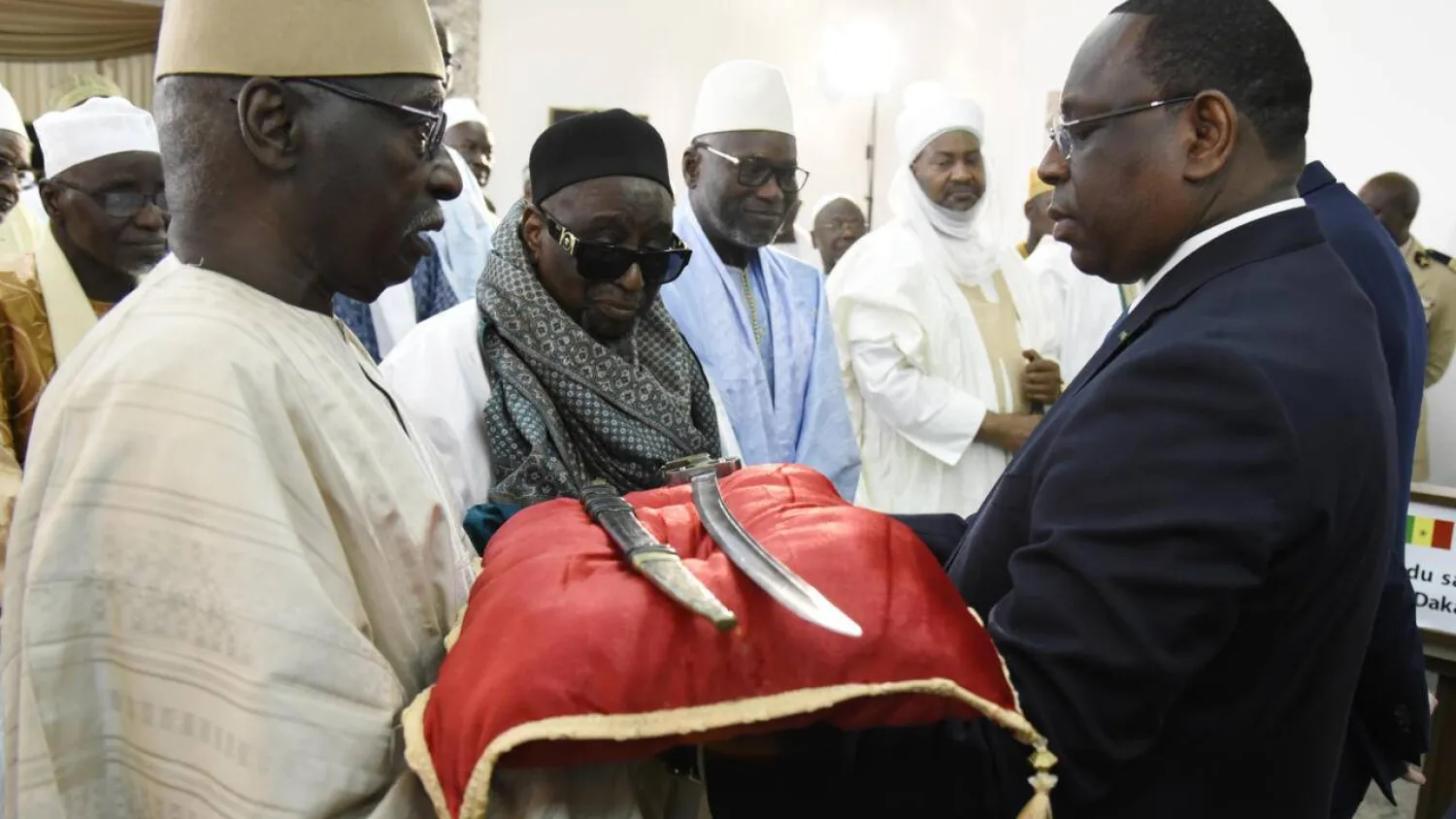
In 2019, France returned a 19th-century sword to Senegal's then-President Macky Sall (right). (AFP)
TT

French Govt Prepares New Law to Return Colonial-era Art

In 2019, France returned a 19th-century sword to Senegal's then-President Macky Sall (right). (AFP)

France's government on Wednesday discussed a bill designed to speed up the return of artworks looted during the colonial era to their countries of origin, officials said.

If approved, the law would make it easier for the country to return cultural goods in France's national collection "originating from states that, due to illicit appropriation, were deprived of them" between 1815 and 1972, said the culture ministry.

It will cover works obtained through "theft, looting, transfer or donation obtained through coercion or violence, or from a person who was not entitled to dispose of them", the ministry added.

The bill was presented during a cabinet meeting on Wednesday, a government spokeswoman told reporters. The Senate is due to discuss it September.

Former colonial powers in Europe have been slowly moving to send back some artworks obtained during their imperial conquests, but France is hindered by its current legislation.

The return of every item in the national collection must be voted on individually. Wednesday's draft law is designed to simplify and streamline the process.

France returned 26 formerly royal artifacts including a throne to Benin in 2021.

They were part of the collection of the Quai Branly-Jacques Chirac museum in Paris, which holds the majority of the 90,000 African works estimated to be in French museums, according to an expert report commissioned by French President Emmanuel Macron in 2018.

A "talking drum" that French colonial troops seized from the Ebrie tribe in 1916 was sent back to Ivory Coast earlier this year.

In 2019, France's then prime minister Edouard Philippe handed over a sword to the Senegalese president that was believed to have belonged to the 19th-century West African Islamic scholar and leader, Omar Tall.

Other European states, including Germany and the Netherlands, have handed back a limited number of artifacts in recent years

Britain faces multiple high-profile claims but has refused to return the Parthenon Marbles to Greece and the Kohinoor diamond to India, two of the best-known examples.

The French draft law is the third and final part of legislative efforts to speed up the removal and return of artworks held in France's national collection.

Two other laws -- one to return property looted by the Nazis, and a second to return human remains -- were approved in 2023.



Olympic Visitors to Milan Get a Rare Chance to Glimpse Restoration of a Long-Hidden Leonardo Gem

Marina Vece works on restoring the Sala delle Asse, part of the newly created Leonardo da Vinci itineraries inside Milan's Sforza Castle, Italy, Tuesday, Jan. 20, 2026. (AP)
TT

Olympic Visitors to Milan Get a Rare Chance to Glimpse Restoration of a Long-Hidden Leonardo Gem

Marina Vece works on restoring the Sala delle Asse, part of the newly created Leonardo da Vinci itineraries inside Milan's Sforza Castle, Italy, Tuesday, Jan. 20, 2026. (AP)

In honor of the Milan Cortina Olympics, Milan cultural officials are for a brief time only allowing visitors access to a long-hidden wall and ceiling painting by Leonardo da Vinci while restoration work is underway.

The vast painting of a pergola covered with intertwined flowering branches inside Milan’s Sforza Castle is concealed behind a six-meter (nearly 20-foot) towering scaffolding in the Sala delle Asse. Letters establish that Leonardo started the work, but it's one he left unfinished.

“In 1498, he had to flee because the French arrived in Milan, and after that date it was covered over, hidden,” said Luca Tosi, heritage curator at Milan’s landmark Sforza Castle, which is in the same Sempione Park where the Olympic flame will burn during the Feb. 6-22 Winter Games.

In another sign of Leonardo's impact on Milan, the Olympic cauldron itself is inspired by the Renaissance genius' geometric studies, officials announced this week.

Under the French, the castle became a military barracks and the painting, which covers the ceiling and part of the wall, was covered with plaster. The work was only rediscovered early last century, when restorers removed the plaster and filled in color to match Leonardo’s work.

“As a result, Leonardo scholars no longer recognized them as a true Leonardo, but rather as a repainted Leonardo, somewhat a fake, to use a popular term,” Tosi added.

Visitors will be able to climb up the scaffolding and view the restorers at work during a brief window from Feb. 7-March 14, after which it will be closed to the public again for another 18 months to complete the work.

Restorers are using Japanese rice paper with demineralized water to remove salts that have seeped into the walls, gradually cleaning the surface of the painting.

“The hardest part is that Leonardo’s painting is very delicate, there are some liftings, there are more fragile parts and therefore the work must be done centimeter by centimeter, with the utmost attention and care,” Tosi said.

The painting is a study of leaves and plant species that provides yet more evidence of Leonardo’s infamous scientific inquiry, said Tomasso Sacchi, Milan’s top culture official.

“It’s a thrill to know another Leonardo and to experience this extraordinary dedication to various forms of knowledge by this fundamental figure in our history,” Sacchi said.


Italy Uncovers Basilica Designed by Vitruvius, the 'Father of Architecture'

A handout photo made available by Regione Marche press office shows the excavations in Piazza Andrea Costa from which large columns emerge, remains believed of the Basilica of Vitruvius, in Fano, Italy, 19 January 2026. (EPA/Regione Marche press office)
TT

Italy Uncovers Basilica Designed by Vitruvius, the 'Father of Architecture'

A handout photo made available by Regione Marche press office shows the excavations in Piazza Andrea Costa from which large columns emerge, remains believed of the Basilica of Vitruvius, in Fano, Italy, 19 January 2026. (EPA/Regione Marche press office)

Italian officials on Monday hailed the discovery of a more than 2,000-year-old public building attributed to Vitruvius, the ancient Roman architect and engineer known as the "father of architecture."

"It is a sensational finding ... something that our grandchildren will be talking about," Italian Culture Minister Alessandro Giuli told a press conference.

Vitruvius, who lived in the ‌1st century BC, ‌is celebrated for having written "De architectura," ‌or ⁠The Ten ‌Books on Architecture, the oldest surviving treatise on the subject.

His teachings on the classical proportions of buildings have inspired artists over centuries, including Leonardo da Vinci, whose famous drawing of the human body is known as the "Vitruvian Man."

Archaeologists believe they have found ⁠the remains of an ancient basilica, or public building, in the central ‌Italian city of Fano northeast of ‍Rome, that was created ‍by Vitruvius.

"I feel like this is the discovery ‍of the century, because scientists and researchers have been searching for this basilica for over 500 years," said the Mayor of Fano Luca Serfilippi.

"We have absolute match" between what was discovered and the descriptions given by Vitruvius in his books, regional archaeological superintendent Andrea Pessina told reporters.

The basilica had a rectangular layout, with 10 columns on the long side, and four on the short ones, Pessina said.

During excavation, when traces of four columns emerged, archaeologists used Vitruvius' descriptions to calculate where the top right column should be. When they started digging, they found it immediately, Pessina said.

"The are few certainties in archaeology ... but we were impressed by the precision" of the match, he added.

Further digging will determine whether more of the ‌basilica lies underground and if the site can be shown to the public, the superintendent said.


French TV Broadcasts Louvre Robbery Images

People wait for the Louvre museum to open as employees at the Louvre Museum vote to extend a strike that has disrupted operations at the world's most visited museum, Thursday, Dec. 18, 2025 in Paris. (AP)
TT

French TV Broadcasts Louvre Robbery Images

People wait for the Louvre museum to open as employees at the Louvre Museum vote to extend a strike that has disrupted operations at the world's most visited museum, Thursday, Dec. 18, 2025 in Paris. (AP)

Footage of the spectacular robbery at the Louvre Museum has been broadcast for the first time on French television, showing the brazen jewel thieves breaking into display cases.

The images, filmed by surveillance cameras, were shown by the TF1 and public France Televisions channels on Sunday evening, three months after the hugely embarrassing break-in in October.

They show the two burglars, one wearing a black balaclava and a yellow high-visibility jacket, the other dressed in black with a motorcycle helmet, as they force their way into the Apollo Gallery.

After breaking in through a reinforced window with a high-powered disk cutters, they begin slicing into display cases under the eyes of several staff members who do not intervene.

Managers at the Louvre have stressed that staff are not trained to confront thieves and are asked to prioritize the evacuation of visitors.

During the roughly four minutes that the two men were inside the gallery, one staff member can be seen holding a bollard used to orient visitor through the gallery, according to France Televisions.

The images form a key part of the ongoing criminal investigation into the October 19 heist.

Details of the footage have been reported in French newspapers, including Le Parisien.

Four suspects are in police custody, including the two suspected thieves, but the eight stolen items of French crown jewels worth an estimated $102 million have not been found.

The security failures highlighted by the break-in on a Sunday morning in broad daylight have lead to major pressure on director Laurence des Cars, who has apologized.

Metal bars have since been installed over the windows of the Apollo Gallery.