


'If the Baby Could Speak, She Would Scream': The Risky Measures to Feed Small Babies in Gaza

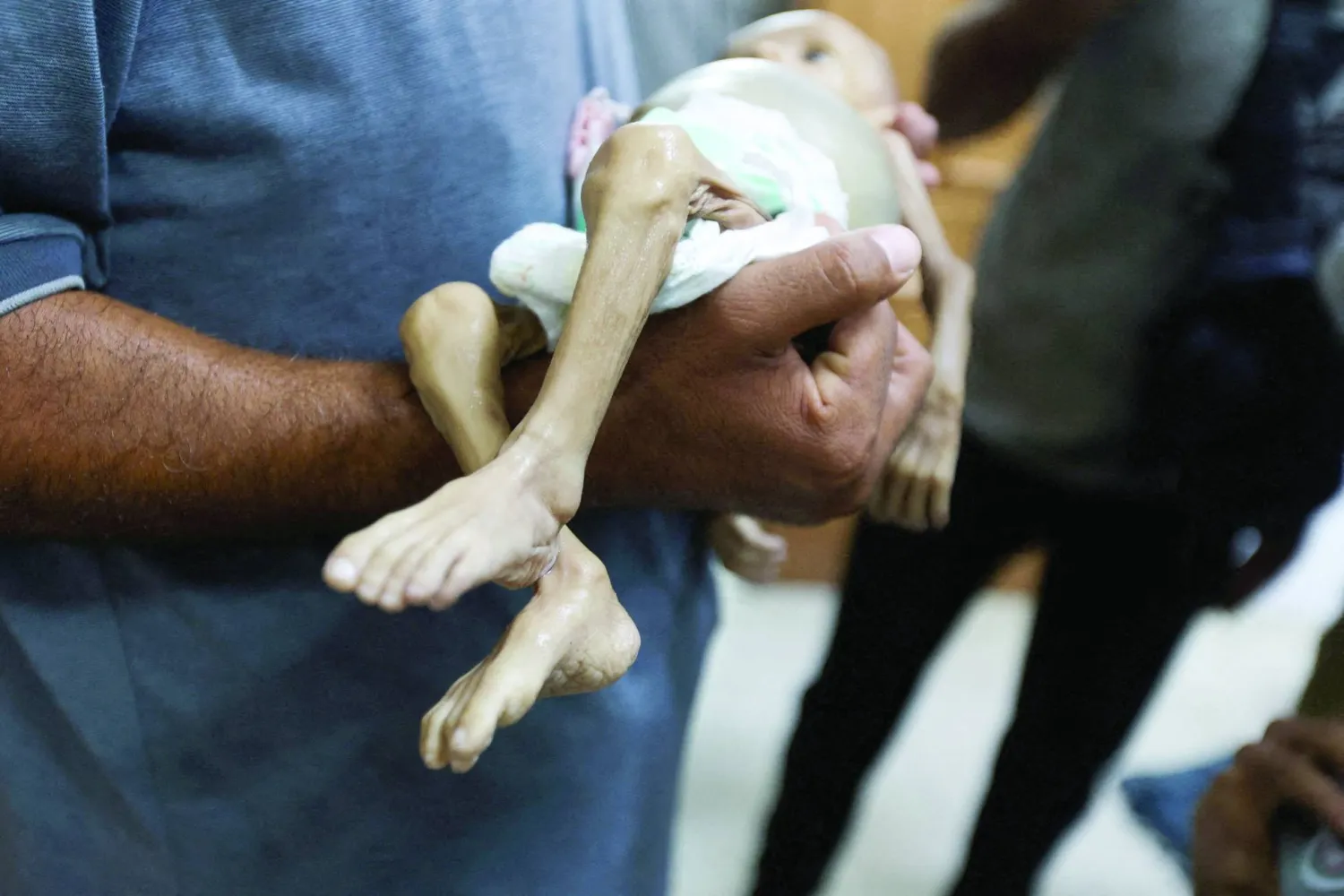
FILE PHOTO:  SENSITIVE MATERIAL. THIS IMAGE MAY OFFEND OR DISTURB    A man carries the body of Palestinian baby Zainab Abu Haleeb, who died due to malnutrition, according to health officials, at Nasser Hospital in Khan Younis, southern Gaza Strip, July 26, 2025. REUTERS/Ramadan Abed
FILE PHOTO: SENSITIVE MATERIAL. THIS IMAGE MAY OFFEND OR DISTURB A man carries the body of Palestinian baby Zainab Abu Haleeb, who died due to malnutrition, according to health officials, at Nasser Hospital in Khan Younis, southern Gaza Strip, July 26, 2025. REUTERS/Ramadan Abed
TT

'If the Baby Could Speak, She Would Scream': The Risky Measures to Feed Small Babies in Gaza

FILE PHOTO:  SENSITIVE MATERIAL. THIS IMAGE MAY OFFEND OR DISTURB    A man carries the body of Palestinian baby Zainab Abu Haleeb, who died due to malnutrition, according to health officials, at Nasser Hospital in Khan Younis, southern Gaza Strip, July 26, 2025. REUTERS/Ramadan Abed
FILE PHOTO: SENSITIVE MATERIAL. THIS IMAGE MAY OFFEND OR DISTURB A man carries the body of Palestinian baby Zainab Abu Haleeb, who died due to malnutrition, according to health officials, at Nasser Hospital in Khan Younis, southern Gaza Strip, July 26, 2025. REUTERS/Ramadan Abed

In a makeshift tent on a Gazan beach, three-month-old Muntaha's grandmother grinds up chickpeas into the tiniest granules she can to form a paste to feed the infant, knowing it will cause her to cry in pain, in a desperate race to keep the baby from starving.

"If the baby could speak, she would scream at us, asking what we are putting into her stomach," her aunt, Abir Hamouda said.

Muntaha grimaced and squirmed as her grandmother fed her the paste with a syringe, Reuters reported.

Muntaha's family is one of many in Gaza facing dire choices to try to feed babies, especially those below the age of six months who cannot process solid food.

Infant formula is scarce after a plummet in aid access to Gaza. Many women cannot breastfeed due to malnourishment, while other babies are separated from their mothers due to displacement, injury or, in Muntaha's case, death.

Her family says the baby's mother was hit by a bullet while pregnant, gave birth prematurely while unconscious in intensive care, and died a few weeks later. The director of the Shifa Hospital described such a case in a Facebook post on April 27, four days after Muntaha was born.

"I am terrified about the fate of the baby," said her grandmother, Nemah Hamouda. "We named her after her mother...hoping she can survive and live long, but we are so afraid, we hear children and adults die every day of hunger."

Muntaha now weighs about 3.5 kilograms, her family said, barely more than half of what a full-term baby her age would normally weigh. She suffers stomach problems like vomiting and diarrhoea after feeding.

Health officials, aid workers and Gazan families told Reuters many families are feeding infants herbs and tea boiled in water, or grinding up bread or sesame. Humanitarian agencies also reported cases of parents boiling leaves in water, eating animal feed and grinding sand into flour.

Feeding children solids too early can disrupt their nutrition, cause stomach problems, and risk choking, pediatric health experts say.

"It's a desperate move to compensate for the lack of food," said UNICEF spokesperson Salim Oweis. "When mothers can't breastfeed or provide proper infant formula they resort to grinding chickpeas, bread, rice, anything that they can get their hands on to feed their children... it is risking their health because these supplies are not made for infants to feed on."

BABY BOTTLES WITHOUT MILK

Gaza's spiraling humanitarian crisis prompted the main world hunger monitoring body on Tuesday to say a worst-case scenario of famine is unfolding and immediate action is needed to avoid widespread death. Images of emaciated Palestinian children have shocked the world.

Gazan health authorities have reported more and more people dying from hunger-related causes. The total so far stands at 154, among them 89 children, most of whom died in the last few weeks.

With the international furor over Gaza's ordeal growing, Israel announced steps over the weekend to ease aid access. But the UN World Food Program said on Tuesday it was still not getting the permissions it needed to deliver enough aid.

Israel and the US accuse the Hamas group of stealing aid - which the group deny - and the UN of failing to prevent it. The UN says it has not seen evidence of Hamas diverting much aid. Hamas accuses Israel of causing starvation and using aid as a weapon, which the Israeli government denies.

Humanitarian agencies say there is almost no infant formula left in Gaza. The cans available in the market cost over $100 – impossible to afford for families like Muntaha’s, whose father has been jobless since the war closed his falafel business and displaced the family from their home.

In the pediatric ward of Al-Aqsa Martyrs Hospital in the central Gaza city of Deir al-Balah, the infant formula supply is mostly depleted.

One mother showed how she poured thick tahini sesame paste into a bottle and mixed it with water.

"I am using this instead of milk, to compensate her for milk, but she won't drink it," said Azhar Imad, 31, the mother of four-month-old Joury.

"I also make her fenugreek, anise, caraway, any kind of herbs (mixed with water)," she said, panicked as she described how instead of nourishing her child, these attempts were making her sick.

Medical staff at the hospital spoke of helplessness, watching on as children's health deteriorated with no way to safely feed them.

"Now, children are being fed either water or ground hard legumes, and this is harmful for children in Gaza," said doctor Khalil Daqran.

"If the hunger continues ... within three or four days, if the child doesn't get access to milk immediately, then they will die," he said.



7 Killed in Drone Strike on Hospital in Sudan's Kordofan

A Sudanese man rides his decorated bicycle as others (unseen) rally in support of the Sudanese armed forces. (Photo by Ebrahim Hamid / AFP)
TT

7 Killed in Drone Strike on Hospital in Sudan's Kordofan

A Sudanese man rides his decorated bicycle as others (unseen) rally in support of the Sudanese armed forces. (Photo by Ebrahim Hamid / AFP)

A drone strike Sunday on an army hospital in the besieged southern Sudan city of Dilling left "seven civilians dead and 12 injured", a health worker at the facility told AFP.

The victims included patients and their companions, the medic said on condition of anonymity, explaining that the army hospital "serves the residents of the city and its surroundings, in addition to military personnel".

Dilling, in the flashpoint state of South Kordofan, is controlled by the Sudanese army but is besieged by the Rapid Support Forces (RSF).

The greater Kordofan region is currently facing the fiercest fighting in Sudan's war between the army and the RSF, as both seek to wrest control of the massive southern region.

The UN has repeatedly warned the region is in danger of witnessing a repeat of the atrocities that unfolded in North Darfur state capital El-Fasher, including mass killing, abductions and sexual violence.


Iraq's Election Result Ratified by Supreme Federal Court as Premiership Remains up for Grabs

Election workers gather parliamentary election ballots after the polls closed in Baghdad, Iraq, Nov. 11, 2025. (AP Photo/Hadi Mizban, File)
TT

Iraq's Election Result Ratified by Supreme Federal Court as Premiership Remains up for Grabs

Election workers gather parliamentary election ballots after the polls closed in Baghdad, Iraq, Nov. 11, 2025. (AP Photo/Hadi Mizban, File)

The result of last month’s parliamentary elections in Iraq was ratified by the Supreme Federal Court on Sunday, confirming that the party of caretaker prime minister Mohammed Shia al-Sudani won the largest number of seats — but not enough to assure him a second term.

The court confirmed that the voting process met all constitutional and legal requirements and had no irregularities affecting its validity.

The Independent High Electoral Commission submitted the final results of the legislative elections to the Supreme Federal Court on Monday for official certification after resolving 853 complaints submitted regarding the election results, according to The AP news.

Al-Sudani's Reconstruction and Development Coalition won 46 seats in the 329-seat parliament. However, in past elections in Iraq, the bloc taking the largest number of seats has often been unable to impose its preferred candidate.

The coalition led by former Prime Minister Nouri al-Maliki won 29 seats, the Sadiqoun Bloc, which is led by the leader of the Asaib Ahl al-Haq militia, Qais al-Khazali, won 28 seats, and the Kurdistan Democratic Party, led by Masoud Barzani, one of the two main Kurdish parties in the country, won 27 seats.

The Taqaddum (Progress) party of ousted former Parliament Speaker Mohammed al-Halbousi also won 27 seats, setting the stage for a contest over the speaker's role.


Hamas Confirms the Death of a Top Commander in Gaza after Israeli Strike

Destroyed buildings, amid a ceasefire between Israel and Hamas, in Khan Younis in the southern Gaza Strip November 18, 2025. (Reuters)
TT

Hamas Confirms the Death of a Top Commander in Gaza after Israeli Strike

Destroyed buildings, amid a ceasefire between Israel and Hamas, in Khan Younis in the southern Gaza Strip November 18, 2025. (Reuters)

Hamas on Sunday confirmed the death of a top commander in Gaza, a day after Israel said it had killed Raed Saad in a strike outside Gaza City.

The Hamas statement described Saad as the commander of its military manufacturing unit. Israel had described him as an architect of the Oct. 7, 2023, attack that sparked the war in Gaza, and asserted that he had been “engaged in rebuilding the terrorist organization” in a violation of the ceasefire that took effect two months ago, The AP news reported.

Israel said it killed Saad after an explosive device detonated and wounded two soldiers in the territory’s south.

Hamas also said it had named a new commander but did not give details.

Saturday's strike west of Gaza City killed four people, according to an Associated Press journalist who saw their bodies arrive at Shifa Hospital. Another three were wounded, according to Al-Awda hospital. Hamas in its initial statement described the vehicle struck as a civilian one.

Israel and Hamas have repeatedly accused each other of truce violations.

Israeli airstrikes and shootings in Gaza have killed at least 391 Palestinians since the ceasefire took hold, according to Palestinian health officials. Israel has said recent strikes are in retaliation for militant attacks against its soldiers, and that troops have fired on Palestinians who approached the “Yellow Line” between the Israeli-controlled majority of Gaza and the rest of the territory.

Israel has demanded that Palestinian militants return the remains of the final hostage, Ran Gvili, from Gaza and called it a condition of moving to the second and more complicated phase of the ceasefire. That lays out a vision for ending Hamas’ rule and seeing the rebuilding of a demilitarized Gaza under international supervision.

Israel’s two-year campaign in Gaza has killed more than 70,660 Palestinians, roughly half of them women and children, according to the territory’s Health Ministry, which does not distinguish between militants and civilians in its count. The ministry, which operates under the Hamas-run government, is staffed by medical professionals and maintains detailed records viewed as generally reliable by the international community.
