


Morocco’s King Expresses Readiness for ‘Frank and Responsible Dialogue’ with Algeria

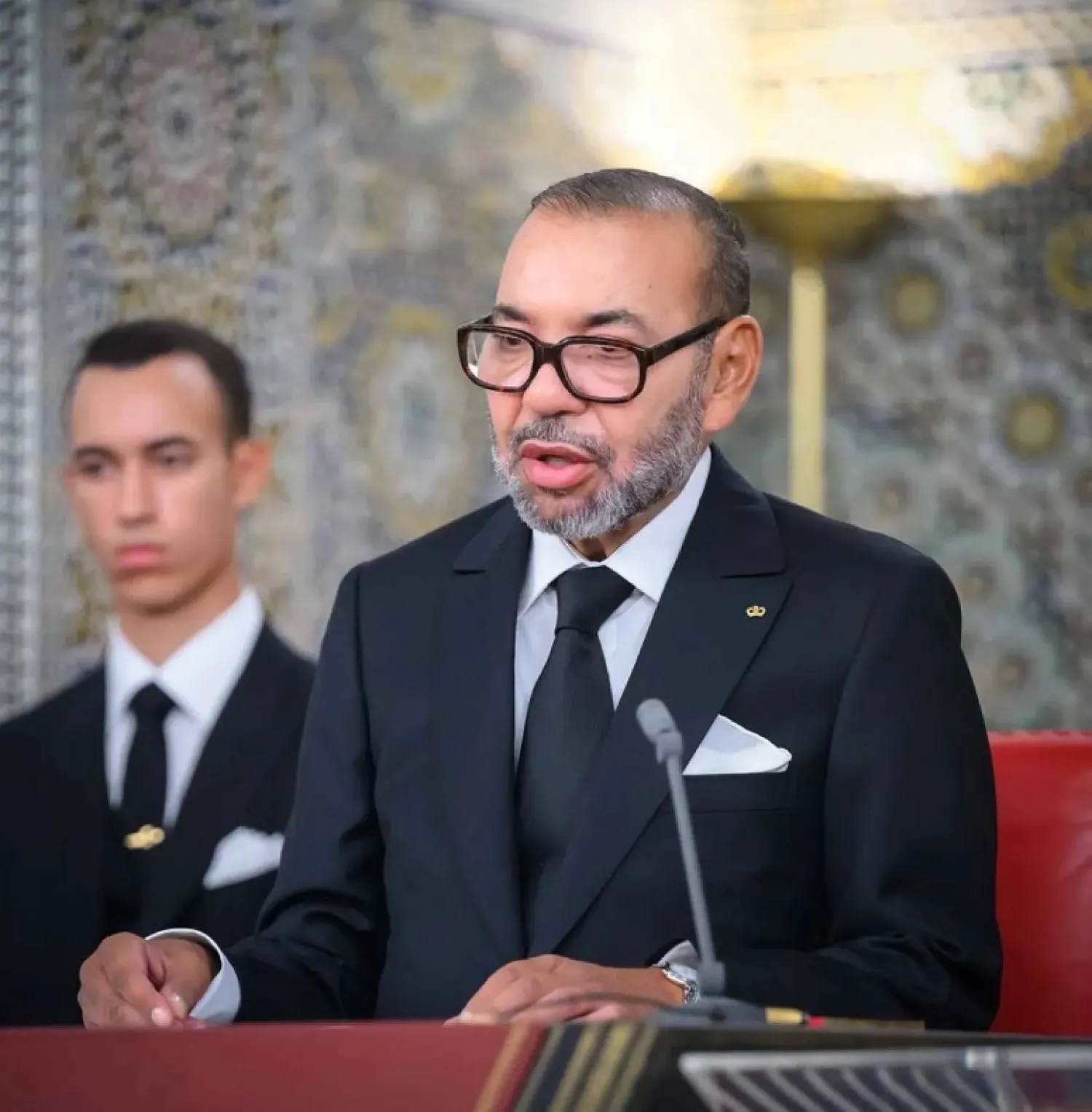
The Moroccan monarch delivering his speech on the occasion of Throne Day (MAP). 
TT

Morocco’s King Expresses Readiness for ‘Frank and Responsible Dialogue’ with Algeria

The Moroccan monarch delivering his speech on the occasion of Throne Day (MAP). 

Moroccan King Mohammed VI has reiterated his country’s willingness to engage in a “frank and responsible dialogue” with neighboring Algeria to resolve outstanding issues between the two countries.

In a national address Tuesday evening marking Throne Day, the King emphasized that Morocco’s autonomy plan remains the only viable solution to the dispute over the Western Sahara.

“We are committed to fostering good relations with the Algerian people,” the King said, reaffirming Morocco’s determination to find a consensual resolution to the Western Sahara conflict that preserves the dignity of all parties involved.

He stressed that this open-handed approach stems from a belief in the unity of North African peoples and their shared ability to move beyond the current impasse.

Reaffirming Morocco’s commitment to regional integration, King Mohammed VI stated that the Maghreb Union cannot be realized without the joint participation of both Morocco and Algeria, alongside other neighboring states.

Since 2018, the monarch has made repeated appeals for dialogue with Algeria, particularly in light of their decades-long tensions over the Western Sahara. His calls have intensified following Algeria’s decision in 2021 to sever diplomatic ties with Morocco, a move that has yet to be reversed.

During his address, the King also highlighted the growing international support for Morocco’s autonomy plan, which proposes granting the disputed territory a measure of self-governance under Moroccan sovereignty.

He welcomed recent endorsements from the United Kingdom and Portugal, joining earlier backers such as the United States (since 2020) and France (since 2024), positioning the proposal as the sole realistic path toward a lasting resolution.

Beyond foreign policy, the monarch used his speech to urge the government to ensure balanced development across all Moroccan regions. He stressed the need for a new generation of structural reforms aimed at equalizing access to development opportunities.

“There is no room today, or in the future, for a Morocco advancing at two different speeds,” he declared.

The King pointed to continued disparities in rural areas, where poverty and underdevelopment persist due to a lack of basic infrastructure and services. He called for reforms that focus on strengthening essential social services, particularly in education and healthcare, managing water resources sustainably, and implementing integrated territorial development projects.

Addressing the Moroccan public directly, King Mohammed VI expressed that economic progress and improved infrastructure alone are not enough if they do not translate into better living conditions for citizens across all regions and social classes. He emphasized his longstanding focus on advancing human development, expanding social protection, and delivering direct support to families in need.

The monarch also referenced the 2024 General Population Census, which revealed significant demographic, social, and spatial shifts that must be accounted for in public policymaking. Notably, he highlighted a sharp national decline in multidimensional poverty, from 11.9% in 2014 to 6.8% in 2024. He also announced that Morocco has now crossed the threshold to be officially classified among countries with high human development, according to the global Human Development Index.



7 Killed in Drone Strike on Hospital in Sudan's Kordofan

A Sudanese man rides his decorated bicycle as others (unseen) rally in support of the Sudanese armed forces. (Photo by Ebrahim Hamid / AFP)
TT

7 Killed in Drone Strike on Hospital in Sudan's Kordofan

A Sudanese man rides his decorated bicycle as others (unseen) rally in support of the Sudanese armed forces. (Photo by Ebrahim Hamid / AFP)

A drone strike Sunday on an army hospital in the besieged southern Sudan city of Dilling left "seven civilians dead and 12 injured", a health worker at the facility told AFP.

The victims included patients and their companions, the medic said on condition of anonymity, explaining that the army hospital "serves the residents of the city and its surroundings, in addition to military personnel".

Dilling, in the flashpoint state of South Kordofan, is controlled by the Sudanese army but is besieged by the Rapid Support Forces (RSF).

The greater Kordofan region is currently facing the fiercest fighting in Sudan's war between the army and the RSF, as both seek to wrest control of the massive southern region.

The UN has repeatedly warned the region is in danger of witnessing a repeat of the atrocities that unfolded in North Darfur state capital El-Fasher, including mass killing, abductions and sexual violence.


Iraq's Election Result Ratified by Supreme Federal Court as Premiership Remains up for Grabs

Election workers gather parliamentary election ballots after the polls closed in Baghdad, Iraq, Nov. 11, 2025. (AP Photo/Hadi Mizban, File)
TT

Iraq's Election Result Ratified by Supreme Federal Court as Premiership Remains up for Grabs

Election workers gather parliamentary election ballots after the polls closed in Baghdad, Iraq, Nov. 11, 2025. (AP Photo/Hadi Mizban, File)

The result of last month’s parliamentary elections in Iraq was ratified by the Supreme Federal Court on Sunday, confirming that the party of caretaker prime minister Mohammed Shia al-Sudani won the largest number of seats — but not enough to assure him a second term.

The court confirmed that the voting process met all constitutional and legal requirements and had no irregularities affecting its validity.

The Independent High Electoral Commission submitted the final results of the legislative elections to the Supreme Federal Court on Monday for official certification after resolving 853 complaints submitted regarding the election results, according to The AP news.

Al-Sudani's Reconstruction and Development Coalition won 46 seats in the 329-seat parliament. However, in past elections in Iraq, the bloc taking the largest number of seats has often been unable to impose its preferred candidate.

The coalition led by former Prime Minister Nouri al-Maliki won 29 seats, the Sadiqoun Bloc, which is led by the leader of the Asaib Ahl al-Haq militia, Qais al-Khazali, won 28 seats, and the Kurdistan Democratic Party, led by Masoud Barzani, one of the two main Kurdish parties in the country, won 27 seats.

The Taqaddum (Progress) party of ousted former Parliament Speaker Mohammed al-Halbousi also won 27 seats, setting the stage for a contest over the speaker's role.


Hamas Confirms the Death of a Top Commander in Gaza after Israeli Strike

Destroyed buildings, amid a ceasefire between Israel and Hamas, in Khan Younis in the southern Gaza Strip November 18, 2025. (Reuters)
TT

Hamas Confirms the Death of a Top Commander in Gaza after Israeli Strike

Destroyed buildings, amid a ceasefire between Israel and Hamas, in Khan Younis in the southern Gaza Strip November 18, 2025. (Reuters)

Hamas on Sunday confirmed the death of a top commander in Gaza, a day after Israel said it had killed Raed Saad in a strike outside Gaza City.

The Hamas statement described Saad as the commander of its military manufacturing unit. Israel had described him as an architect of the Oct. 7, 2023, attack that sparked the war in Gaza, and asserted that he had been “engaged in rebuilding the terrorist organization” in a violation of the ceasefire that took effect two months ago, The AP news reported.

Israel said it killed Saad after an explosive device detonated and wounded two soldiers in the territory’s south.

Hamas also said it had named a new commander but did not give details.

Saturday's strike west of Gaza City killed four people, according to an Associated Press journalist who saw their bodies arrive at Shifa Hospital. Another three were wounded, according to Al-Awda hospital. Hamas in its initial statement described the vehicle struck as a civilian one.

Israel and Hamas have repeatedly accused each other of truce violations.

Israeli airstrikes and shootings in Gaza have killed at least 391 Palestinians since the ceasefire took hold, according to Palestinian health officials. Israel has said recent strikes are in retaliation for militant attacks against its soldiers, and that troops have fired on Palestinians who approached the “Yellow Line” between the Israeli-controlled majority of Gaza and the rest of the territory.

Israel has demanded that Palestinian militants return the remains of the final hostage, Ran Gvili, from Gaza and called it a condition of moving to the second and more complicated phase of the ceasefire. That lays out a vision for ending Hamas’ rule and seeing the rebuilding of a demilitarized Gaza under international supervision.

Israel’s two-year campaign in Gaza has killed more than 70,660 Palestinians, roughly half of them women and children, according to the territory’s Health Ministry, which does not distinguish between militants and civilians in its count. The ministry, which operates under the Hamas-run government, is staffed by medical professionals and maintains detailed records viewed as generally reliable by the international community.