Russia's Lavrov Meets Syrian FM in Moscow, Invites Sharaa to Russia-Arab Summit

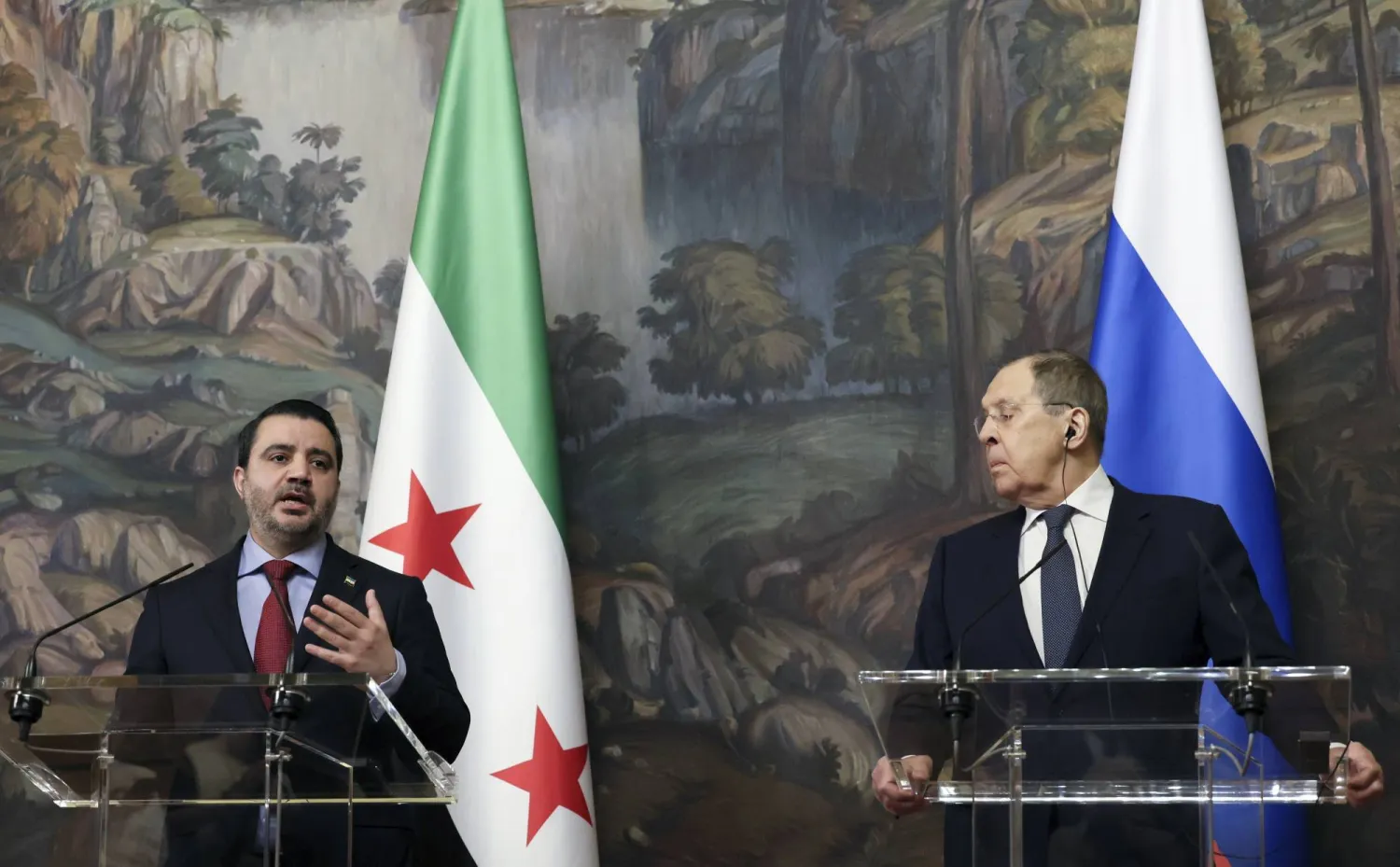
Syrian Foreign Minister Asaad Hassan al-Shibani (L) speaks during a press conference with Russian Foreign Minister Sergey Lavrov (R) following their meeting in Moscow, Russia, 31 July 2025.  EPA/SHAMIL ZHUMATOV/ POOL
Syrian Foreign Minister Asaad Hassan al-Shibani (L) speaks during a press conference with Russian Foreign Minister Sergey Lavrov (R) following their meeting in Moscow, Russia, 31 July 2025. EPA/SHAMIL ZHUMATOV/ POOL
TT

Russia's Lavrov Meets Syrian FM in Moscow, Invites Sharaa to Russia-Arab Summit

Syrian Foreign Minister Asaad Hassan al-Shibani (L) speaks during a press conference with Russian Foreign Minister Sergey Lavrov (R) following their meeting in Moscow, Russia, 31 July 2025.  EPA/SHAMIL ZHUMATOV/ POOL
Syrian Foreign Minister Asaad Hassan al-Shibani (L) speaks during a press conference with Russian Foreign Minister Sergey Lavrov (R) following their meeting in Moscow, Russia, 31 July 2025. EPA/SHAMIL ZHUMATOV/ POOL

Russian Foreign Minister Sergei Lavrov met Syria's foreign minister Asaad al-Shibani in Moscow on Thursday, the first visit by a top official from Syria's new government following the toppling of longtime Russian ally Bashar al-Assad in December.

Lavrov said Moscow hoped that Syria's new President Ahmed al-Sharaa would attend a summit between Russia and Arab League member states in Moscow in October, reported Reuters.

"Of course, we hope that President al-Sharaa will be able to take part in the first Russia-Arab League summit, which is scheduled for October 15," Lavrov said.

Sharaa led opposition factions into Damascus in December and installed a new government. Assad fled the capital and was granted asylum in Russia.

Moscow has since attempted to preserve ties with Syria's new authorities, including offering Damascus diplomatic support over Israeli strikes on Syrian territory.

At a joint news conference, Shibani said his trip to Moscow was intended "to start a necessary discussion ... based on the lessons of the past, to formulate the future".

He said he had agreed with Lavrov on establishing two committees tasked with re-evaluating past agreements between Syria and Russia.

"There are many opportunities for a united strong Syria, we hope Russia stands with us on this pathway," Shibani said.

Lavrov thanked Syrian authorities for ensuring the security of two Russian bases in the country, where Moscow continues to maintain a presence, as well as backing the removal of sanctions on Syria.

In May, the Russian foreign minister warned of "ethnic cleansing" of Syrian religious minorities by "radical militant groups".


Yemen's Legitimate Govt Restores Control over Hadhramaut, Mahra

Government soldiers ride on the back of a pick-up truck in the Arabian Sea port city of Mukalla,Yemen January 4, 2026. (Reuters)
TT

Yemen's Legitimate Govt Restores Control over Hadhramaut, Mahra

Government soldiers ride on the back of a pick-up truck in the Arabian Sea port city of Mukalla,Yemen January 4, 2026. (Reuters)

Yemen's legitimate government restored on Sunday control over the Hadhramaut and al-Mahra governorates. The National Shield forces, led by Hadhramaut Governor Salem al-Khanbashi, took control of the regions after the withdrawal of the Southern Transitional Council (STC) forces.

Chairman of the Presidential Leadership Council (PLC) and commander of the armed forces Dr. Rashad al-Alimi congratulated the residents of the two governorates and the local authorities on the success of the National Shield operations.

The record time in which they completed the handover will help consolidate security and stability, he added.

The success of the operation reflects the support enjoyed by the state and its institutions and paves the way for a new phase in coexistence and improved services, he added.

He praised the joint forces of the Saudi-led coalition to restore legitimacy in Yemen, saying they played a decisive role in securing the governorates, easing the tensions and protecting civilians.

On the ground, the National Shield forces were welcomed by civilians as they deployed in Hadhramaut and Mahra.

In Mukalla in Hadhramaut, the forces secured vital institutions, including the central bank, presidential palace and local authority building.

Khanbashi said the process was completed with high efficiency, a short time and with very limited losses.

"We had hoped to resolve the issue through political means, but we had to use force to get them out in record time," he said in televised remarks upon his arrival in Seiyun city.

Sources told Asharq Al-Awsat that the National Shield secured most of the vital institutions in Mukalla.

Speaking on condition of anonymity, they confirmed that the forces had deployed in the city at around 11:30 on Sunday morning.


Southern Yemen United in Welcoming Riyadh Conference

National Shield forces in Hadhramaut. (Reuters)
TT

Southern Yemen United in Welcoming Riyadh Conference

National Shield forces in Hadhramaut. (Reuters)

Parties in southern Yemen welcomed on Sunday Saudi Arabia’s call to hold a comprehensive conference on the issue of the South.

The conference will be held in Riyadh at an official request by Presidential Leadership Council (PLC) Chairman Dr. Rashad al-Alimi. The meeting will help shape the path of the southern issue, meeting the ambitions of southern and eastern Yemen governorates.

Local authorities in Hadhramaut, al-Mahra, Lahj, Shabwah and Socotra welcomed the conference, as did prominent political leaderships in the south. The Southern Transitional Council (STC) also notably welcomed the conference.

Saudi Arabia’s move to host the meeting was welcomed by Gulf and Arab countries and the international community over the weekend. It was viewed as a necessary step towards restoring dialogue in the South, overcoming efforts to eliminate the other and viewing the southern issue within a national and regional framework that would lead to a fair and sustainable solution.

Member of the PLC Dr. Abdullah al-Alimi expressed his deep appreciation for Saudi Arabia’s stance, calling all southern components, starting with the STC, to positively approach the conference and comprehensive dialogue that prioritizes the interests of the South above all else.

Serious dialogue is the only way to bridge divides, achieve rapprochement and unify southern ranks to serve security and stability, he stressed.

Shura Council Speaker Ahmed bin Dagher underlined the importance of the Riyadh conference, saying dialogue will help defuse strife.

The meeting will present realistic solutions to pending issues in the South, he added.

The STC welcomed Saudi Arabia’s call to hold the conference, saying it is in line with its policies that are based on dialogue.

It did place conditions, however, underscoring the “will of the people of the south” and demanding international guarantees, a clear timeframe, and popular referendum.

Observers said the conditions are an attempt by the STC to preserve its political position.

They noted that the very fact that it agreed to join the conference is an acknowledgment that the southern issue is greater than one party that is taking unilateral decisions.

The regional and international climate do not allow unilateral actions, they added.


Two Dead in Israeli Strike on South Lebanon

The wreckage of a car at the site after an Israeli strike on Al-Khiyam, in the Nabatieh governorate, southern Lebanon, 03 January 2026. (EPA)
TT

Two Dead in Israeli Strike on South Lebanon

The wreckage of a car at the site after an Israeli strike on Al-Khiyam, in the Nabatieh governorate, southern Lebanon, 03 January 2026. (EPA)

Lebanon said a strike in the south killed two Sunday while Israel said it had struck a Hezbollah operative, the latest raids as Beirut seeks to disarm the Iran-backed group.

Despite a year-old ceasefire between Israel and Hezbollah, Israel carries out regular strikes on Lebanon, usually saying it is targeting Hezbollah sites and operatives, and has maintained troops in five areas it deems strategic.

Lebanon's health ministry said two people were killed in an "Israeli enemy strike that targeted a vehicle" near the town of Jmaijmeh, around 10 kilometers (six miles) from the border.

An Israeli military statement said that "in response to Hezbollah's continued violations of the ceasefire understandings", it had struck an operative from the group in the area.

Under heavy US pressure and fears of expanded Israeli strikes, Beirut has committed to disarming Hezbollah, which was badly weakened after more than a year of hostilities with Israel including two months of open war that ended with the November 2024 ceasefire.

Lebanon's army was expected to complete the disarmament south of the Litani River -- about 30 kilometers from the border with Israel -- by the end of 2025, before tackling the rest of the country.

Lebanon's cabinet is to meet on Thursday to discuss the army's progress, while the ceasefire monitoring committee -- comprising Lebanon, Israel, the United States, France and UN peacekeepers -- is also set to meet this week.

On Sunday, Israel's Foreign Minister Gideon Saar acknowledged on X that the Lebanese government and army had made efforts to disarm Hezbollah but said "they are far from sufficient", citing "Hezbollah's efforts to rearm and rebuild, with Iranian support".

Israel has previously questioned the Lebanese military's effectiveness and has accused Hezbollah of rearming, while the group itself has rejected calls to surrender its weapons.

At least 350 people have been killed by Israeli fire in Lebanon since the ceasefire, according to an AFP tally of Lebanese health ministry reports.