

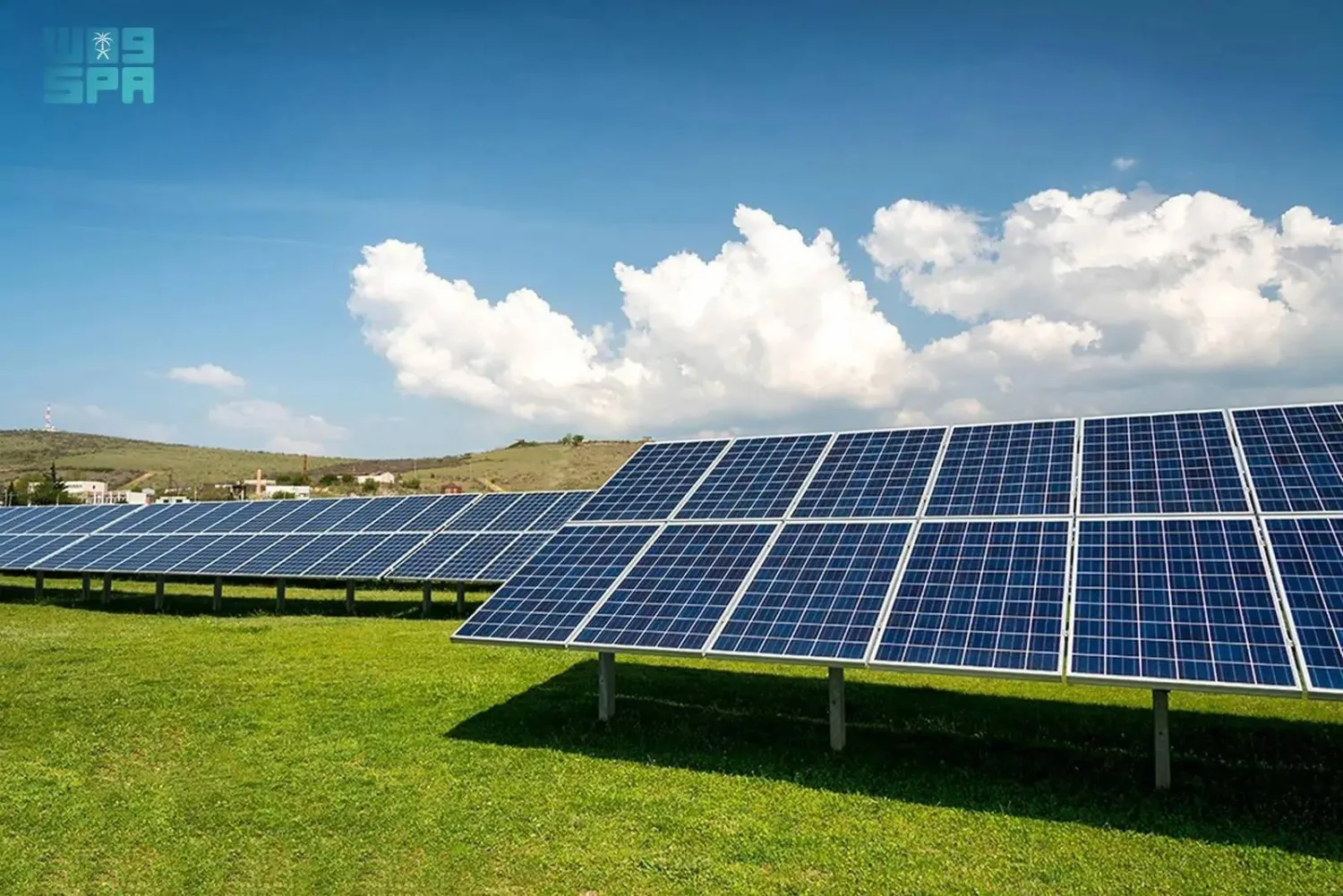

Saudi KAUST’s Center of Excellence for Renewable Energy Advances Energy Innovation

KAUST has leveraged the center’s research to boost energy security, reduce environmental impact, create new job opportunities for youth, and continue advancing education, training, and workforce development. (SPA)
TT

Saudi KAUST’s Center of Excellence for Renewable Energy Advances Energy Innovation

KAUST has leveraged the center’s research to boost energy security, reduce environmental impact, create new job opportunities for youth, and continue advancing education, training, and workforce development. (SPA)

Saudi Arabia’s King Abdullah University of Science and Technology (KAUST), through its Center of Excellence for Renewable Energy and Storage Technologies (CREST), has launched initiatives to support innovation in energy fields, in alignment with the goals of Saudi Vision 2030 to transition toward a knowledge-based economy and build sustainable development.

These efforts include transforming new ideas into practical solutions, developing prototypes of KAUST inventions and ensuring their reliability, and scaling up these prototypes through collaboration with local and international partners, reported the Saudi Press Agency on Monday.

KAUST has leveraged the center’s research to boost energy security, reduce environmental impact, create new job opportunities for youth, and continue advancing education, training, and workforce development.

These steps aim to support and localize renewable energy research, boost academic and industrial collaboration, and position the center as a leading research hub and a preferred destination for students, researchers, and faculty members.

CREST Chair Professor Husam Alshareef stressed that the center’s research, focused on prototype development and technology scaling, enhances energy efficiency, reliability, storage, and sustainability.

Many projects are based on innovative technologies developed at KAUST in cooperation with industrial partners. These include advanced photovoltaic cells and new battery chemistries that reduce cooling requirements and fire risks in harsh conditions, as well as lithium extraction and battery recycling to ensure a stable lithium supply and enhance the Kingdom’s battery sector, he added.

The center conducts research on sustainable cooling technologies aimed at improving the performance of electronic devices such as solar panels and LED lights, thereby extending their lifespan, he went on to say.

Additional research includes storing energy in chemical fuels and generating electricity, testing and modeling energy storage technologies, and integrating them across disciplines within the university by merging research strategies involving experts in chemistry, engineering, and software development, he revealed.




Uber, Autonomous Mobility Firms to Launch Europe's 1st Commercial Robotaxis

Aerial photo shows light installation during the Festival of Lights in Zagreb, Croatia, March 18, 2026. REUTERS/Antonio Bronic
TT

Uber, Autonomous Mobility Firms to Launch Europe's 1st Commercial Robotaxis

Aerial photo shows light installation during the Festival of Lights in Zagreb, Croatia, March 18, 2026. REUTERS/Antonio Bronic

Uber Technologies and autonomous mobility companies Verne and Pony.ai have partnered up to launch Europe's first commercial robotaxi service in the Croatian capital Zagreb, with plans to expand to other cities, they said on Thursday.

Robotaxis are rapidly expanding into US cities as companies race to commercialize ⁠autonomous ride-hailing worldwide.

Alphabet's ⁠Waymo remains the early leader, while Tesla hopes its vast manufacturing scale and financial resources could reshape the competitive landscape.

The first ⁠commercial robotaxi service in Zagreb will be launched "soon,” the companies said.

Initial deployment work is underway, including public-road validation.

Pony.ai will provide autonomous driving solutions, while Verne will act as the fleet owner and service operator.

The three companies plan ⁠to ⁠expand the fleet to thousands of robotaxis in European cities over the next few years.

Uber and Nvidia said earlier this month they planned to expand their robotaxi service in 28 cities across North America, Europe, Australia and Asia.


Samsung, SK Urge Employees to Cut Car Use Amid Rising Energy Risks

FILE - The logo of the Samsung is seen at the Samsung Electronics' Seocho building in Seoul, South Korea, Friday, July 5, 2024.  (AP Photo/Lee Jin-man, File)
FILE - The logo of the Samsung is seen at the Samsung Electronics' Seocho building in Seoul, South Korea, Friday, July 5, 2024. (AP Photo/Lee Jin-man, File)
TT

Samsung, SK Urge Employees to Cut Car Use Amid Rising Energy Risks

FILE - The logo of the Samsung is seen at the Samsung Electronics' Seocho building in Seoul, South Korea, Friday, July 5, 2024.  (AP Photo/Lee Jin-man, File)
FILE - The logo of the Samsung is seen at the Samsung Electronics' Seocho building in Seoul, South Korea, Friday, July 5, 2024. (AP Photo/Lee Jin-man, File)

South Korean tech giants Samsung Electronics and SK Group said they were asking employees to curb private car use and follow fuel-saving measures after South Korea rolled ⁠out emergency energy-conservation steps ⁠amid instability in Middle Eastern energy supplies.

Internal notices showed the companies encouraging car-use restrictions ⁠such as a five and 10-day vehicle rotation system, reduced parking availability and other energy-saving practices at offices from Thursday for Samsung and from March 30 ⁠for ⁠SK.

The moves follow government guidance aimed at cutting fuel consumption as concerns grow over prolonged disruptions linked to the Iran-related energy crisis.


Epic Games to Cut More Than 1,000 Jobs as Fortnite Usage Falls

The Epic Games logo, maker of the popular video game "Fortnite", is pictured on a screen in this picture illustration August 14, 2020. (Reuters)
TT

Epic Games to Cut More Than 1,000 Jobs as Fortnite Usage Falls

The Epic Games logo, maker of the popular video game "Fortnite", is pictured on a screen in this picture illustration August 14, 2020. (Reuters)

Epic Games said on Tuesday it would cut more than 1,000 jobs after a drop in engagement for "Fortnite," its flagship title, the latest cuts in the video-game industry whose growth has stalled amid economic uncertainty.

The cuts, along with more than $500 million in savings from lower contracting and marketing spending and unfilled roles would put the company in "a more stable place," Chief ‌Executive Tim Sweeney said ‌in a note to employees.

The ‌cuts ⁠are the latest ⁠in the gaming sector, where companies have faced weaker growth as consumers have been sticking with proven titles amid economic uncertainty.

But even those, especially live services games, which depend on a steady stream of new content to ⁠keep players engaged, are now showing signs ‌of cracks.

"We've had ‌challenges delivering consistent Fortnite magic," Sweeney said, adding "market conditions ‌today are the most extreme" since the early ‌days of the company founded in 1991.

"The layoffs aren't related to AI," Sweeney noted amid industry worries the technology could replace video-game developers.

The move marks ‌Epic's second major round of layoffs in three years. In September 2023, ⁠the company ⁠cut about 830 jobs, or roughly 16% of its workforce.

It was not immediately clear what percentage of staff would be impacted by Tuesday's announcement.

The gaming sector has faced mounting pressure. In September, Electronic Arts laid off hundreds of workers and canceled a Titanfall game that was in development at its Respawn Entertainment unit, according to media reports. Amazon's broader job cuts late last year also affected its gaming division.