


Livestream of Deep Sea Creatures Transfixes Argentina and Sparks Calls for Refunding Science 

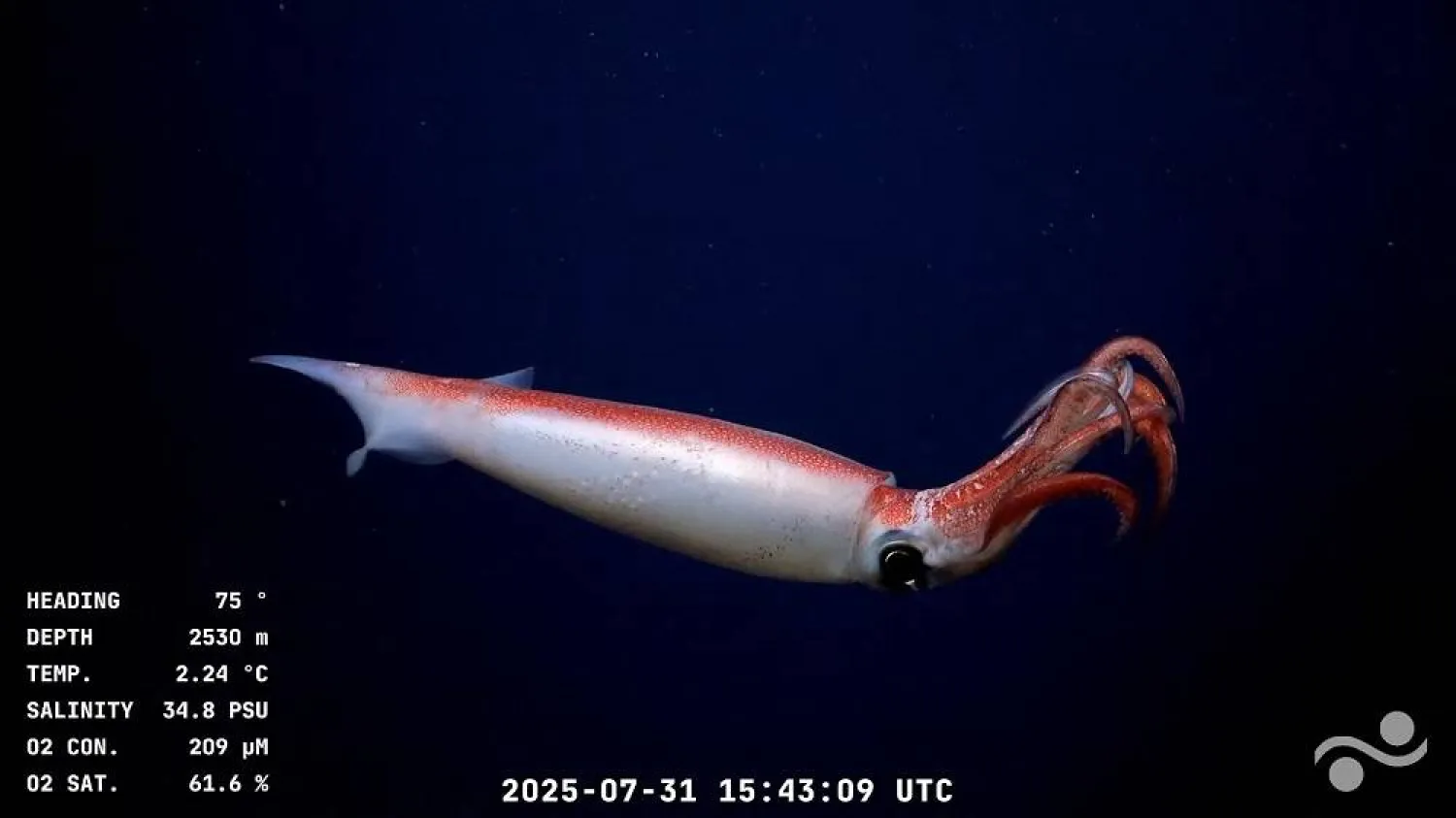
Screen grab taken from a handout video released by the Schmidt Ocean Institute and recorded by the ROV SuBastian while being commanded from the oceanographic research vessel RV Falkor (too) on July 30, 2025, displaying a squid at 2530 meters of depth at the Mar del Plata Canyon in the Argentine Sea, in the Atlantic Ocean about 300 Km off Mar del Plata, Buenos Aires Province, Argentina. (Handout / Schmidt Ocean Institute / ROV SuBastian / AFP)
TT

Livestream of Deep Sea Creatures Transfixes Argentina and Sparks Calls for Refunding Science 

Screen grab taken from a handout video released by the Schmidt Ocean Institute and recorded by the ROV SuBastian while being commanded from the oceanographic research vessel RV Falkor (too) on July 30, 2025, displaying a squid at 2530 meters of depth at the Mar del Plata Canyon in the Argentine Sea, in the Atlantic Ocean about 300 Km off Mar del Plata, Buenos Aires Province, Argentina. (Handout / Schmidt Ocean Institute / ROV SuBastian / AFP)

Transparent-faced fish drift through dusky waters. Snowlike flecks of dead plants sift down from the world above. Soft sponges peek through the soot of the seafloor. Only occasional mutters among marine biologists break the thick silence.

And somehow, this livestream of sea life in the South Atlantic feels like it has everyone in Argentina watching — or talking and making memes about it.

The group of Argentine and American researchers behind this remotely operated vehicle filming life-forms 4,000 meters (13,000 feet) undersea told The Associated Press on Monday that they couldn't have imagined that their expedition would become such a sensation. It has attracted more than 1.6 million views a day on YouTube, dominating TV news broadcasts and even sparking a national conversation about the defunding of Argentine science under libertarian President Javier Milei.

“It was a huge surprise for us,” said expedition leader Daniel Lauretta. “It's something that fills our hearts because we want to spread the word. Perhaps there are young people who are learning, maybe we're awakening some scientific curiosity.”

The vast array of creatures glimpsed via high-definition camera include a placid starfish so orange it evokes Patrick of “SpongeBob SquarePants” cartoon fame, a sea cucumber reminiscent of a sweet potato, a deep sea crab that looks like a hairy spider.

The images have created a sense of collective wonder at the mysteries of the deep sea and with it, a hearty dose of anthropomorphism as viewers assign zodiac stars to invertebrate and take social media quizzes along the lines of “Which deep sea creature are you based on how you handle stress?” (If you ignore the world you’re a translucent squid, if you explode with anger, you’re apparently a pistol shrimp).

Often peaking at 50,000 simultaneous viewers, the livestream began last week and runs everyday until Aug. 10 for up to 10 hours as the scientists map the little-researched submarine gorge off the coast of Buenos Aires, collecting samples and identifying scores of new species.

“The clarity was incredible. The colors, the zoom capability — that really amazed me,” Lauretta said. “I think that feeling reached the public too.”

The project is a collaboration between scientists mostly from Conicet, Argentina's leading scientific funding and research body, and the Schmidt Ocean Institute Foundation, a nonprofit set up by Google’s former executive chairman Eric E. Schmidt to advance oceanographic research. The expedition has also inspired pride in Argentine research at a time when Milei is slashing spending on science in a drive to eliminate Argentina's chronic fiscal deficit.

Researchers and fellows from Conicet have sought to seize on the attention by calling for a 48-hour nationwide strike Wednesday.

“Argentines are very passionate about everything that happens in Argentina,” said Georgina Valanci, 40, who seemed mesmerized by the livestream while crocheting on Monday. “I think it represents a bit of the pride that something like this is being done in our country.”

Milei dissolved the Ministry of Science and Technology after coming to power in late 2023. Conicet suffered a 21% budget cut in real terms last year. Salaries for Conicet researchers have lost 35% of their value in recent months. Industry estimates show state-funded science and technology organizations losing 3,400 jobs in the last year and a half.

Each day as the video shows sea stars regenerating arms or amoeba engulfing prey, comments pop up expressing support for Conicet in real time. “Long live Conicet!” several users posted on Monday.



Spain and Portugal Continue to Battle Storm Leonardo as New Storm Approaches

 A mountain landslide blocks railway tracks during heavy rains, as storm Leonardo hits parts of Spain, in Benaojan, Spain, February 6, 2026. (Reuters)
A mountain landslide blocks railway tracks during heavy rains, as storm Leonardo hits parts of Spain, in Benaojan, Spain, February 6, 2026. (Reuters)
TT

Spain and Portugal Continue to Battle Storm Leonardo as New Storm Approaches

 A mountain landslide blocks railway tracks during heavy rains, as storm Leonardo hits parts of Spain, in Benaojan, Spain, February 6, 2026. (Reuters)
A mountain landslide blocks railway tracks during heavy rains, as storm Leonardo hits parts of Spain, in Benaojan, Spain, February 6, 2026. (Reuters)

Storm Leonardo continued to batter the Iberian Peninsula on Friday, bringing floods and putting rivers at risk of bursting their banks while thousands of people were evacuated from their homes in Spain and Portugal.

In southern Spain's Andalusia region, some 7,000 people have had to leave their homes due to successive storms.

Among them were around 1,500 people ordered to evacuate the mountain village of Grazalema, where Andalusia's regional leader Juan Manuel Moreno warned that aquifers were "full to the brim with water,” and at risk of collapsing.

“It's raining on already saturated ground. The land is unable to drain," Moreno said. “We urge extreme caution. This is not over.”

Spanish police said Friday they had found a body located 1,000 meters (about 0.6 miles) away from where a woman had disappeared Wednesday after she fell into a river in Malaga province while trying to rescue her dog. Police said they had not yet identified the body, but believed it belonged to the 45-year-old woman.

Another storm front, Marta, was expected to arrive Saturday, with Spain's weather agency AEMET saying it would bring even more rain and heavy winds, including to areas already drenched by Storm Leonardo.

Marta is expected to affect Portugal, too.

Of particular concern was southern Spain's Guadalquivir River, which flows through Córdoba and Seville and eventually into the Atlantic Ocean, and whose water levels have dramatically risen in recent days.

Additional rain Saturday could leave many more homes at risk in Córdoba, local authorities warned.

In Portugal, parts of Alcacer do Sal were submerged after the Sado River overflowed, forcing residents to leave the city located 90 kilometers (about 56 miles) south of Lisbon.

Alerts were issued also for regions near the Tagus River due to rising water levels.

A separate storm in late January left a trail of destruction in Portugal, killing several people, according to Portuguese authorities.


AROYA Cruises Debuts Arabian Gulf Voyages for 2026

AROYA offers a curated experience featuring culturally inspired entertainment and diverse dining options - SPA
TT

AROYA Cruises Debuts Arabian Gulf Voyages for 2026

AROYA offers a curated experience featuring culturally inspired entertainment and diverse dining options - SPA

AROYA Cruises, a subsidiary of the PIF-owned Cruise Saudi, has officially launched its inaugural season in the Arabian Gulf.

Running from February 21 to May 8, the season marks a milestone in regional tourism by blending authentic Saudi hospitality with international maritime standards, SPA reported.

AROYA offers a curated experience featuring culturally inspired entertainment and diverse dining options.

The season is designed to provide guests with a dynamic way to explore the Gulf, setting a new benchmark for luxury travel that reflects the Kingdom's heritage on a global stage.


Snowstorm Brings Much of Denmark to a Halt

A car drives in heavy snow at Store Heddinge in South Zealand, Denmark, 05 February 2026.  EPA/Mads Claus Rasmussen
A car drives in heavy snow at Store Heddinge in South Zealand, Denmark, 05 February 2026. EPA/Mads Claus Rasmussen
TT

Snowstorm Brings Much of Denmark to a Halt

A car drives in heavy snow at Store Heddinge in South Zealand, Denmark, 05 February 2026.  EPA/Mads Claus Rasmussen
A car drives in heavy snow at Store Heddinge in South Zealand, Denmark, 05 February 2026. EPA/Mads Claus Rasmussen

Denmark authorities halted public transport, closed schools and cancelled flights on Friday as heavy snowfall blanketed much of the country.

The Nordic country's meteorological institute DMI warned that heavy snow would likely continue until Friday evening in the east, where the capital Copenhagen is located.

Police said people should avoid going outdoors unless necessary and stay indoors in the capital and the surrounding region.

Copenhagen's airport cancelled flights to Paris and Berlin and warned of "delay and cancellation risks because of snowy conditions." Many schools were closed.

In the second-largest city of Aarhus, bus services were cancelled.
