
Egypt's Sisi Says Israel's War in Gaza a 'Systematic Genocide'

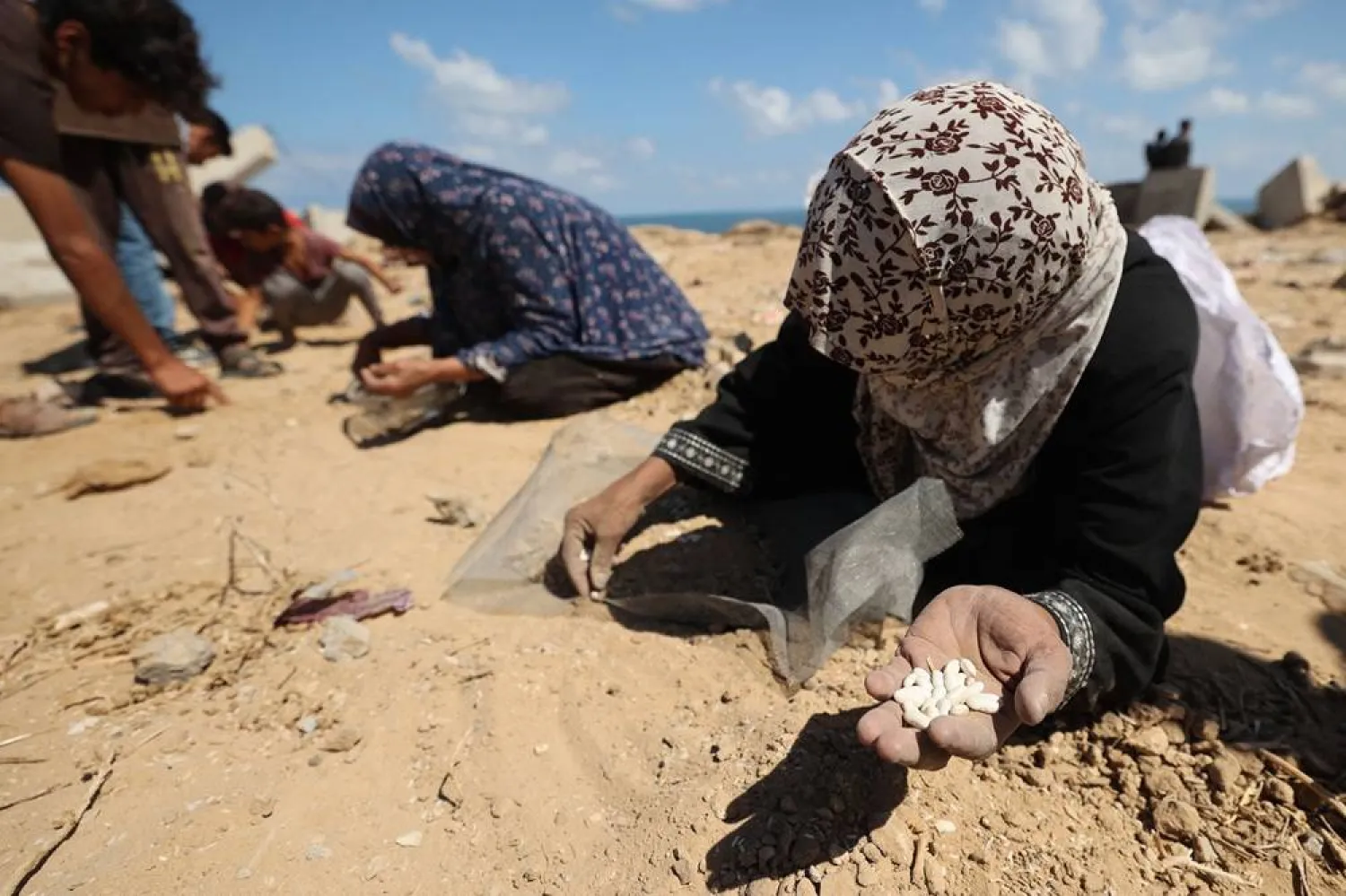
Palestinian women search the sand for legumes or rice in Nuseirat in the central Gaza Strip during an airdrop mission above the Israel-besieged Palestinian territory on August 5, 2025. (AFP)
TT

Egypt's Sisi Says Israel's War in Gaza a 'Systematic Genocide'

Palestinian women search the sand for legumes or rice in Nuseirat in the central Gaza Strip during an airdrop mission above the Israel-besieged Palestinian territory on August 5, 2025. (AFP)

Egyptian President Abdel Fattah al-Sisi said Tuesday Israel was pursuing "a war of starvation and genocide" in Gaza, and denied accusations Cairo prevented life-saving aid from entering the Palestinian territory.

"The war in Gaza is no longer merely a war to achieve political goals or release hostages," Sisi told a press conference in Cairo along with his Vietnamese counterpart.

Israel launched its offensive in response to Hamas's October 7, 2023 attack, vowing to crush the Palestinian group and to free hostages.

To Sisi, "this war has long since surpassed any logic or justification, and has become a war of starvation and genocide".

"There is systematic genocide to eradicate the Palestinian cause," he said.

Israeli Prime Minister Benjamin Netanyahu said Tuesday Israel must "complete" the defeat of Hamas to free hostages held in Gaza, a day after Israeli media reported the army could occupy the entire territory.

Israel has heavily restricted aid into Gaza which is slipping into a catastrophic famine 22 months into the war.

It has killed more than 61,000 Palestinians, according to the health ministry in the Hamas-run Gaza Strip.

Following mounting international pressure on Israel, in late May aid has only began trickling into Gaza, which borders Israel and Egypt.

In response to what Sisi said were "bankrupt" accusations of Egypt's complicity in the siege, the president reiterated that the Rafah border crossing with Gaza was "never closed".

The crossing at Rafah was a vital entry point of aid in the early months of the war, until Israeli troops took over its Palestinian side in May 2024, forcing it shut.

"The crossing was able to bring in aid as long as there were no Israeli troops stationed on the Palestinian side of the crossing," Sisi said, adding that there are 5,000 trucks loaded with aid waiting to enter Gaza.

He also defended what he said was Egypt's consistently "positive" role seeking an end to the conflict.

Since the war began, Cairo has undertaken a delicate balancing act, retaining its position as a mediator between Israel and Hamas -- along with the United States and Qatar -- while repeatedly criticizing Israel's assault.

Cairo has also repeatedly refused US plans to displace Palestinians into Egypt, lobbying for a reconstruction plan for the territory that has fallen by the wayside as truce talks repeatedly folded.

"Egypt will always remain a gateway for aid, not a gateway for the displacement of the Palestinian people," Sisi said on Tuesday.

"We are prepared to allow aid in at any time, but we are not prepared to receive or displace Palestinians from their land."

Last week, Sisi urged US President Donald Trump -- who had touted the plan to displace Palestinians into Egypt -- to intervene, saying he "is the one capable of ending the war, brining in aid and ending this suffering".


Israel to Reopen Jordan Border Crossing for Passage of Aid and Goods

Allenby Bridge Crossing between West Bank and Jordan is closed, in the Israeli-occupied West Bank, September 24, 2025. REUTERS/Ammar Awad/File Photo
TT

Israel to Reopen Jordan Border Crossing for Passage of Aid and Goods

Allenby Bridge Crossing between West Bank and Jordan is closed, in the Israeli-occupied West Bank, September 24, 2025. REUTERS/Ammar Awad/File Photo

Israel is set to reopen the Allenby Crossing with Jordan to the passage of goods and aid on Wednesday, an Israeli security official said on Tuesday.

The border crossing has been closed to aid and goods since September, when a driver bringing humanitarian aid to Gaza opened fire and killed two Israeli military personnel before being killed by security forces, Reuters reported.

The security official said the crossing would have tightened screening for Jordanian drivers and truck cargo, and that a dedicated security force had been assigned to the crossing.

The Allenby Bridge is a key route for trade between Jordan and Israel and the only gateway for more than 3 million Palestinians in the Israeli-occupied West Bank to reach Jordan and the wider world.

The crossing reopened to passenger traffic shortly after the attack, but had remained closed to aid trucks. The UN says the crossing is a major route for bringing food, tents and other goods into Gaza.


Arab League Condemns Israeli Forces' Raid on UNRWA Headquarters

A general view shows the opening session of the meeting of Arab foreign ministers at the Arab League Headquarters (Reuters)
TT

Arab League Condemns Israeli Forces' Raid on UNRWA Headquarters

A general view shows the opening session of the meeting of Arab foreign ministers at the Arab League Headquarters (Reuters)

Secretary-General of the Arab League Ahmed Aboul Gheit strongly condemned the Israeli forces' raid on the headquarters of the United Nations Relief and Works Agency for Palestine Refugees (UNRWA) in East Jerusalem.

He described this attack as part of an ongoing campaign by the occupying forces to undermine the agency's role and eliminate its contribution to safeguarding the rights of Palestinian refugees, SPA reported.

In a statement issued Tuesday, Aboul Gheit disclosed that the justifications provided by the occupying forces for this illegal raid have no logical or legal basis.

The secretary-general urged the international community to intervene effectively and decisively to halt this Israeli campaign targeting the international agency, which provides essential health, education, and employment services to millions of Palestinian refugees across its five areas of operation.

He also referenced the important vote at the United Nations a few days ago, which extended UNRWA's mandate for an additional three years.


‘Shockingly High’ Number of Gaza Children Still Acutely Malnourished After Truce, UN Says 

Displaced Palestinian students attend class at a tent school in the Tal Al-Hawa neighborhood in Gaza City, Gaza Strip, 09 December 2025. (EPA)
TT

‘Shockingly High’ Number of Gaza Children Still Acutely Malnourished After Truce, UN Says 

Displaced Palestinian students attend class at a tent school in the Tal Al-Hawa neighborhood in Gaza City, Gaza Strip, 09 December 2025. (EPA)

Thousands of children have been admitted for treatment for acute malnutrition in Gaza since an October ceasefire that was supposed to enable a major increase in humanitarian aid, the UN children's agency said on Tuesday.

UNICEF, the biggest provider of malnutrition treatment in Gaza, said that 9,300 children were treated for severe acute malnutrition in October, when the first phase of an agreement to end the two-year Israel-Hamas war came into effect.

While this is down from a peak of over 14,000 in August, the number is still significantly higher than during a brief February-March ceasefire and indicates that aid flows remain insufficient, UNICEF spokesperson Tess Ingram told a Geneva press briefing by video link from Gaza.

"It's still a shockingly high number," she said. "The number of children admitted is five times higher than in February, so we need to see the numbers come down further."

Ingram described meeting underweight babies weighing less than 1 kilogram born in hospitals "their tiny chests heaving with the effort of staying alive."

UNICEF is able to import considerably more aid into the enclave than it was before the October 10 agreement, but obstacles remain, she said, citing delays and denials of cargoes at crossings, route closures and ongoing security challenges.

"We have seen some improvement, but we continue to call for all of the available crossings into the Gaza Strip to be open," she added.

There are not enough commercial supplies entering Gaza, she added, saying that meat was still prohibitively expensive at around $20 a kilogram.

"Most families can't access this, and that's why we're still seeing high rates of malnutrition," she said.

In August, a UN-backed hunger monitor determined that famine conditions were affecting about half a million people - or a quarter of Gaza's population.

Children were severely affected by hunger as the war progressed, with experts warning that the effects could cause lasting damage.