Trump’s Envoy Meets Putin Ahead of Russia-Ukraine Peace Deadline, Kremlin Says 

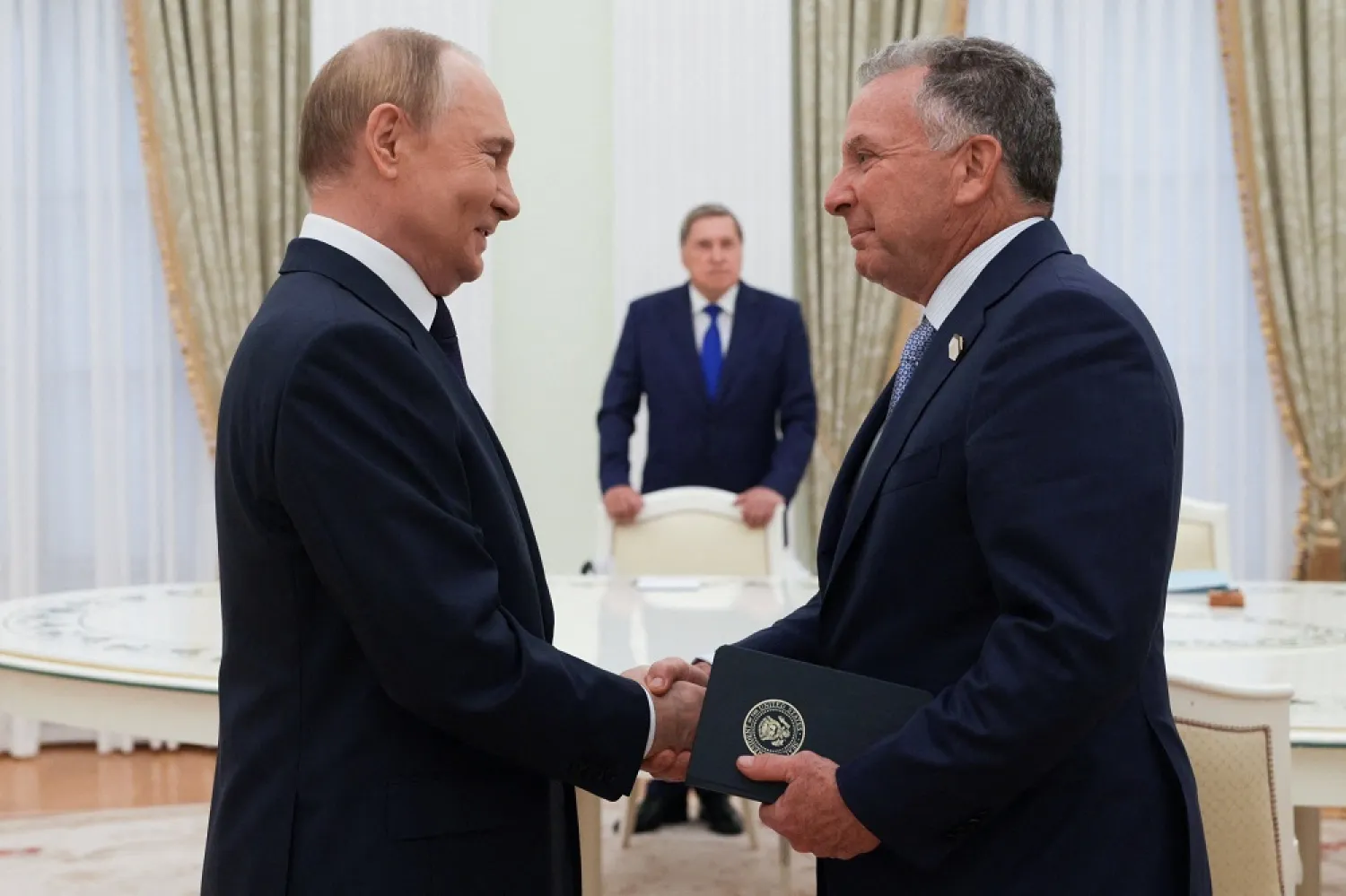
Russian President Vladimir Putin welcomes US President Donald Trump's envoy Steve Witkoff during a meeting in Moscow, Russia August 6, 2025. (Sputnik/Gavriil Grigorov/Pool via Reuters)
TT

Trump’s Envoy Meets Putin Ahead of Russia-Ukraine Peace Deadline, Kremlin Says 

Russian President Vladimir Putin welcomes US President Donald Trump's envoy Steve Witkoff during a meeting in Moscow, Russia August 6, 2025. (Sputnik/Gavriil Grigorov/Pool via Reuters)

Russian President Vladimir Putin held talks with US President Donald Trump’s special envoy Steve Witkoff in Moscow on Wednesday, the Kremlin said, days before the White House’s deadline for Russia to reach a peace deal with Ukraine or potentially face severe economic penalties that could also hit countries buying its oil. 

The Kremlin did not immediately provide more details of the meeting. Earlier, Witkoff took an early morning stroll through Zaryadye Park, a stone's throw from the Kremlin, with Kirill Dmitriev, the Russian president's envoy for investment and economic cooperation, footage aired by TASS showed. 

Dmitriev played a key role in three rounds of direct talks between delegations from Russia and Ukraine in Istanbul in recent months, as well as discussions between Russian and US officials. The negotiations have made no progress on ending the three-year war following Russia's invasion of its neighbor. 

Trump’s deadline for Putin ends on Friday. Washington has threatened “severe tariffs” and other economic penalties if the killing doesn’t stop. 

Trump has expressed increasing frustration with Putin over Russia’s escalating strikes on civilian areas of Ukraine, intended to erode morale and public appetite for the war. The intensified attacks have occurred even as Trump has urged the Russian leader in recent months to relent. 

Overnight from Tuesday to Wednesday, Russian forces hit a recreational center in Ukraine’s southern Zaporizhzhia region, killing two people and injuring 12, including two children, regional Gov. Ivan Fedorov said Wednesday. 

Russian forces launched at least four strikes on the area and initially attacked with powerful glide bombs. 

“There is zero military sense in this strike. Only cruelty to intimidate,” Ukrainian President Volodymyr Zelenskyy said in a post on Telegram. 

Western analysts and Ukrainian officials say Putin is stalling for time and avoiding serious negotiations while Russian forces push to capture more Ukraine land. A Russian offensive that started in the spring and is expected to continue through the fall is advancing faster than last year's push but is making only slow and costly gains and has been unable to take any major cities. 

The situation on the front line is critical for Ukrainian forces but defenses are not about to collapse, analysts say. 

On Tuesday, Trump said “we’ll see what happens” regarding his threat to slap tariffs on nations that buy Russian oil, which could increase import taxes dramatically on China and India. 

“We have a meeting with Russia tomorrow,” Trump said. “We’re going to see what happens. We’ll make that determination at that time.” 

The president said that he has not publicly committed to a specific tariff rate. 

Stepping up diplomatic and economic pressure on the Kremlin risks stoking international tensions amid worsening Russia-US relations. 

The Washington-based Center for European Policy Analysis warned in an assessment this week that there are “clear signs that the Kremlin is preparing for a broader confrontation with NATO,” including a military build-up along Russia’s western flank with alliance countries in recent years. 

Putin has given no hint that he might be ready to make concessions. Instead, the Russian leader and senior Kremlin officials have talked up the country’s military strength. 

Putin announced last week that Russia’s new hypersonic missile, which he says cannot be intercepted by current NATO air defense systems, has entered service. 

Former Russian President Dmitry Medvedev, meantime, warned that the Ukraine war could bring Russia and the US into armed conflict. Trump responded to that by ordering the repositioning of two US nuclear submarines. 

Kremlin spokesman Dmitry Peskov on Monday welcomed Witkoff's visit. “We consider (talks with Witkoff) important, substantive and very useful,” he said. 

Trump initially gave Moscow a 50-day deadline, but later moved up his ultimatum as the Kremlin continued to bomb Ukrainian cities. 

However, Trump himself doubted their effectiveness, saying Sunday that Russia has proven to be “pretty good at avoiding sanctions.” 

“They’re wily characters,” he said of the Russians. 

The Kremlin has insisted that international sanctions imposed since its February 2022 invasion of its neighbor have had a limited impact. 

Ukraine maintains the sanctions are taking their toll on Moscow’s war machine and wants Western allies to ramp them up. 


US Treasury Chief Blames Commerce Dept for Failure in Nvidia Scandal

 US Treasury Secretary Scott Bessent speaks during the National Committee on US-China Relations 60th Anniversary Gala Dinner in New York City, US, November 10, 2026. (Reuters)
US Treasury Secretary Scott Bessent speaks during the National Committee on US-China Relations 60th Anniversary Gala Dinner in New York City, US, November 10, 2026. (Reuters)
TT

US Treasury Chief Blames Commerce Dept for Failure in Nvidia Scandal

 US Treasury Secretary Scott Bessent speaks during the National Committee on US-China Relations 60th Anniversary Gala Dinner in New York City, US, November 10, 2026. (Reuters)
US Treasury Secretary Scott Bessent speaks during the National Committee on US-China Relations 60th Anniversary Gala Dinner in New York City, US, November 10, 2026. (Reuters)

US Treasury Secretary Scott Bessent on Friday blamed the Commerce Department for failing to blacklist Megaspeed, the Singapore company at the center of a scandal that prompted Nvidia chief executive Jensen Huang to resign.

Speaking on CNBC, Bessent said Treasury, the Defense Department, the US Trade Representative's office and the State Department had backed adding Megaspeed to the Washington's trade blacklist, "for months."

"But Commerce has the pen," Bessent said. "You will have to ask them about their internal processes."

He said he was "frustrated" because President Donald Trump "made it very clear that China should not receive any Nvidia chips above H100s."

"Any leakage is very frustrating because it hurts our great companies, and in the AI race gives the Chinese an advantage," he said.

The remarks are a rare public rebuke of one cabinet department by another. Commerce is led by Secretary Howard Lutnick.

Megaspeed is suspected of helping Chinese firms get around US export controls by buying Nvidia chips for its data centers in Southeast Asia and routing them to China.

The company reportedly traded more than $4 billion worth of Nvidia chips over two years.

Its former director Alice Huang was this week identified in US media as an alleged Chinese intelligence asset who had a relationship with Jensen Huang. The two are not related. Beijing has denied the spying allegations.

Jensen Huang acknowledged an extramarital affair in a November 8 letter to Nvidia employees that did not name the woman involved and resigned his position on Thursday.

Nvidia's board has said it will investigate, and three US Congress committee chairs have asked him to attend a closed-door briefing on November 18.

Bessent said coverage of the affair had focused too much on Huang's private life.

"The story thus far has been on Jensen Huang's personal foibles," he said. "The real story here should be: Did Nvidia know their client, and was there a robust effort at Nvidia to make sure that there was no leakage."

He questioned whether Nvidia had been selling to "what were obviously pass-through shell companies."

"I think it's important that anyone at the company there be held accountable for that," Bessent said.

He said there was "a lot of leakage in the system" and that the administration was "constantly working to close that down."


UN Chief Urges Drastic Emissions Cuts as COP31 Wrestles with Fossil Fuels

UN Secretary-General Antonio Guterres speaks at a press conference on the fifth day of the COP31 annual UN climate conference in Antalya, Türkiye, 13 November 2026. (EPA)
TT

UN Chief Urges Drastic Emissions Cuts as COP31 Wrestles with Fossil Fuels

UN Secretary-General Antonio Guterres speaks at a press conference on the fifth day of the COP31 annual UN climate conference in Antalya, Türkiye, 13 November 2026. (EPA)

UN Secretary-General Antonio Guterres on Friday called for an "immediate and drastic reduction" in greenhouse gas emissions, as divisions over fossil fuels dominated the first week of COP31 climate talks in Türkiye.

Big fossil fuel producers and consumers at the talks are resisting any deal that would specify firm new targets or a shift away from oil, gas and coal, observers said as the first week of talks drew to a close.

That poses a challenge for summit host Türkiye and lead negotiator Australia, which have another week to land the kind of ambitious agreement climate advocates such as Guterres say is needed.

"The central question is in the hands of member states, particularly the big emitters. They must recognize the need for an immediate and drastic reduction in emissions to keep the 1.5 goal still possible by the end of the century," he said, referring to the warming limit countries had agreed to ‌pursue under the 2015 ‌Paris Agreement.

A UN report last month found the world is on course to exceed ‌the 1.5 ⁠degrees Celsius (2.7 ⁠degrees Fahrenheit) warming threshold, a limit scientists say should prevent the worst effects of climate change.

As temperatures have risen, this year has been marked by extreme heatwaves across Western Europe and a glacier collapse in Nepal that triggered a flood that killed more than 1,450 people. Thousands more are still missing.

'DISPROPORTIONATE INFLUENCE'

Major oil producers have traditionally resisted language constraining fossil fuels, while large developing economies such as India have opposed measures they say could limit their development and energy choices, a dynamic that has compromised the outcomes of past deals.

The world’s biggest oil consumer, the United States, meanwhile, has skipped the talks for the second year ⁠in a row under President Donald Trump, who has called global warming a hoax and promoted ‌continued use of fossil fuels.

"We must confront the disproportionate influence of the fossil ‌fuel lobby. The future of our planet cannot be negotiated on the terms of those profiting from its destruction," said Guterres, who is leaving ‌his job at the end of December after two five-year terms.

"But I remain hopeful. I've also seen something extraordinary over ‌these 10 years. Renewable energy has moved from the margins to the mainstream. The economics have changed. The technology has advanced. A cleaner, safer, and more secure energy future is in our hands. The question is whether we have the courage and speed to reach for it."

ELECTRIFICATION AND NO FIRM TARGETS

COP31 host Türkiye is striving to place a proposal to expand global electrification at the center of an eventual deal, saying the ‌plan will lead to emissions cuts by speeding the shift away from fossil fuel-powered cars, boilers and other equipment.

The proposal does not require the increased electricity use to come ⁠from renewable sources, although some ⁠countries, including last year’s COP host Brazil, are advocating for progress on a plan to require countries to more clearly map out their transition away from fossil fuels.

Katrine Petersen, an observer for the non-governmental organization E3G, said whether those measures survive the talks depends on conversations in the days to come.

"We've also heard quite clearly from countries like India, the G77, that they don't want any firm targets. They don't want any kind of technology or fuel-specific language," she said. "(These are) the kind of consistent and ongoing divides that we've seen from those different parties before."

Diana Acconcia, head of the EU delegation, said Europe backed the electrification goal.

"Electrification is, in a way, an inclusive agenda because it is non-prescriptive in a way on how the electrification is achieved," she said. "Of course, for the European Union electrification is to be achieved by clean sources of energy."

The Australian team, which is leading negotiations under a split presidency arrangement, spent the first few days of the summit gathering views on what should be included in a political text agreed by consensus that will be followed by all the negotiated technical points.

Australia is taking further submissions from countries until Saturday night, with a view to formulating a draft text early next week.


Europe’s Security Cannot Be Part of Ukraine Peace Talks, EU Leaders Say

13 November 2026, Ireland, Dublin: German Chancellor Friedrich Merz speaks during a press conference on the sidelines of the EU summit at the Convention Centre in Dublin. (dpa)
TT

Europe’s Security Cannot Be Part of Ukraine Peace Talks, EU Leaders Say

13 November 2026, Ireland, Dublin: German Chancellor Friedrich Merz speaks during a press conference on the sidelines of the EU summit at the Convention Centre in Dublin. (dpa)

EU leaders said on Friday that Europe's security structure should not be a subject for Ukraine-Russia peace negotiations, but they did not answer the question of who should speak for Europe in any future talks.

The Kremlin said on Friday that Russia would be open to European countries taking part in Ukraine peace talks if it saw they were ready to contribute to the peace process.

German Chancellor Friedrich Merz described the Kremlin's comments as "the same old game" and said that Europe and the United States agreed on a clear message.

"There will be no discussions about ‌Ukraine without ‌Ukraine, and no discussions about Europe without Europe. Furthermore, there is no need ‌to ⁠talk about European ⁠security architecture. We have that already," Merz told reporters during a summit of European Union leaders in Dublin.

Russian officials have called for a broad agreement on Europe's security architecture to be reached before tackling the specifics of the war. Before its invasion of Ukraine in 2022, Russia demanded the withdrawal of NATO forces from countries that joined the alliance after 1997. NATO rejected the demand.

US negotiator Jared Kushner said in Moscow on Thursday that he had begun discussions with European partners on ⁠the continent's security architecture.

EUROPE PRIORITIZES CEASEFIRE IN RUSSIA-UKRAINE WAR

EU foreign policy chief ‌Kaja Kallas said Russian calls for discussions about Europe's ‌security architecture risked diverting attention from the need for a ceasefire. Latvian Prime Minister Andris Kulbergs called such ‌discussions "a trap".

During a meeting on Thursday, leaders from Poland, the Baltics and Nordic states warned ‌against brainstorming with the US or Russia about Europe’s security architecture, according to a European diplomat and a European official.

Forty European countries, meeting as a broader group in Dublin on Thursday, signed a declaration saying that any matter affecting European security should be decided with the involvement of Europeans.

EU leaders broadly agreed that Europe ‌needed to speak with one voice, but did not settle on a single individual to do so. Merz said discussions would continue.

"There are ⁠established institutional forms ⁠of (EU) representation — Kaja Kallas, for instance, is part of this — but the E3 format has also proven very effective," he said, in reference to an informal security grouping of France, Germany and Britain, which is no longer an EU member but a prominent NATO ally.

"Moreover, we always include Italy and Poland," Merz added.

Representatives from Britain, France, Germany, Italy and the EU attended Russia-Ukraine talks in Abu Dhabi earlier this week, where both Moscow and Kyiv cited some progress, though there was no sign of a breakthrough on key issues such as territory.

Swedish Prime Minister Ulf Kristersson said Britain, one of Europe's top three military powers, certainly had to be included in any future talks and that the five countries plus EU institutions would make sense.

"I'm quite flexible on that, so I think what we actually say is more important than the exact configuration of the people in the room," he said.