


Terrible Thirst Hits Gaza with Polluted Aquifers and Broken Pipelines 

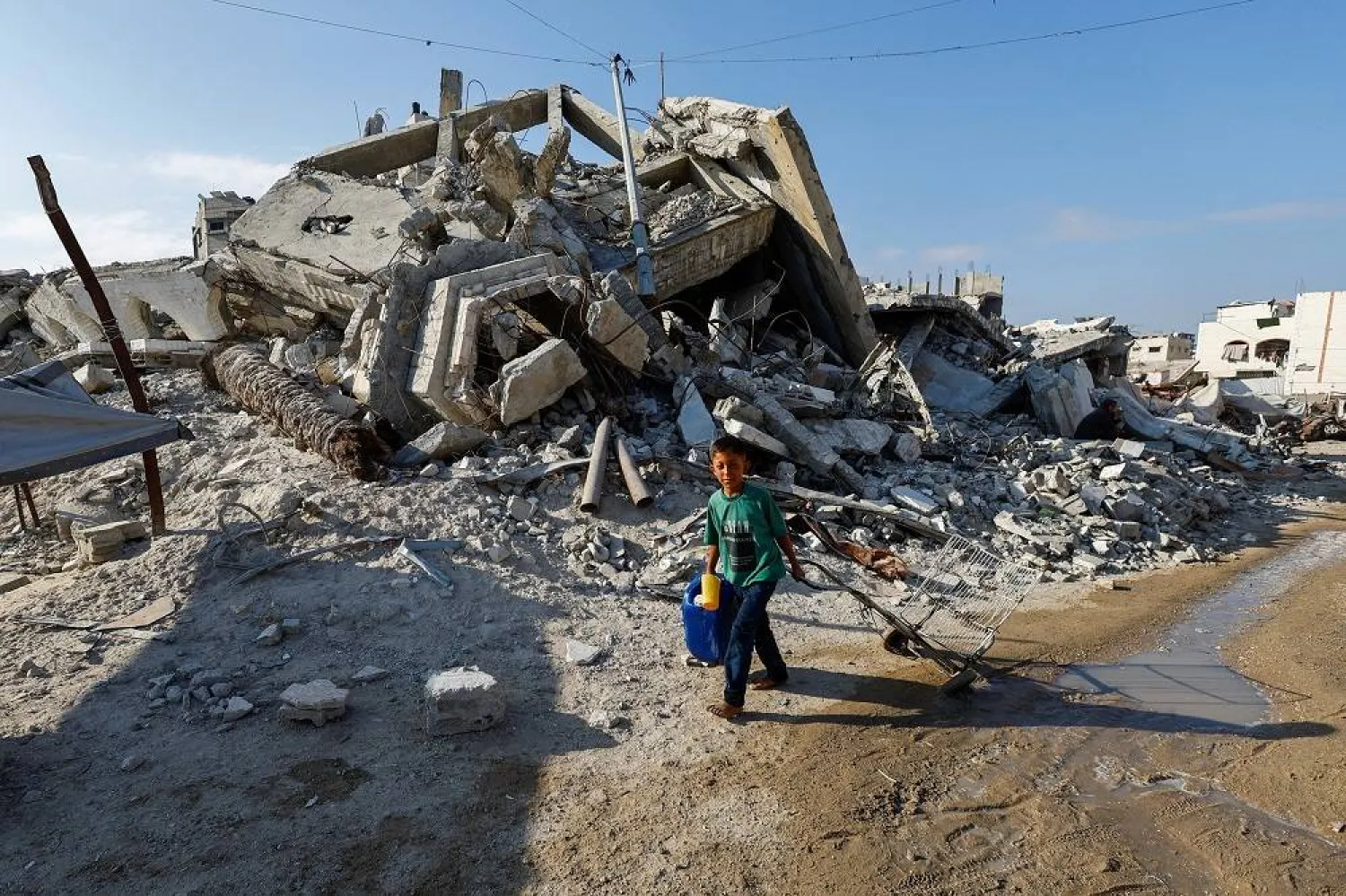
A Palestinian boy walks with a container of water amid shortages, in Gaza City August 6, 2025. (Reuters)
TT

Terrible Thirst Hits Gaza with Polluted Aquifers and Broken Pipelines 

A Palestinian boy walks with a container of water amid shortages, in Gaza City August 6, 2025. (Reuters)

Weakened by hunger, many Gazans trek across a ruined landscape each day to haul all their drinking and washing water - a painful load that is still far below the levels needed to keep people healthy.

Even as global attention has turned to starvation in Gaza, where after 22 months of a devastating Israeli military campaign a global hunger monitor says a famine scenario is unfolding, the water crisis is just as severe according to aid groups.

Though some water comes from small desalination units run by aid agencies, most is drawn from wells in a brackish aquifer that has been further polluted by sewage and chemicals seeping through the rubble, spreading diarrhea and hepatitis.

Israeli pipelines that once supplied Gaza with much of its clean water are now dry. Israel stopped all water and electricity supply to Gaza early in the war. Although it resumed some supply later, pipelines were damaged and Gaza water officials say none has entered recently.

COGAT, the Israeli military aid coordination agency, did not respond to a request for comment on whether Israel is supplying water.

Most water and sanitation infrastructure has been destroyed and pumps from the aquifer often rely on electricity from small generators - for which fuel is rarely available.

Moaz Mukhaimar, aged 23 and a university student before the war, said he has to walk about a kilometer, queuing for two hours, to fetch water. He often goes three times a day, dragging it back to the family tent over bumpy ground on a small metal handcart.

"How long will we have to stay like this?" he asked, pulling two larger canisters of very brackish water to use for cleaning and two smaller ones of cleaner water to drink.

His mother, Umm Moaz, 53, said the water he collects is needed for the extended family of 20 people living in their small group of tents in Deir al-Balah in the central Gaza Strip.

"The children keep coming and going and it is hot. They keep wanting to drink. Who knows if tomorrow we will be able to fill up again," she said.

Their struggle for water is replicated across the tiny, crowded territory where nearly everybody is living in temporary shelters or tents without sewage or hygiene facilities and not enough water to drink, cook and wash as disease spreads.

The United Nations says the minimum emergency level of water consumption per person is 15 liters a day for drinking, cooking, cleaning and washing. Average daily consumption in Israel is around 247 liters a day according to Israeli rights group B'Tselem.

Bushra Khalidi, humanitarian policy lead for aid agency Oxfam in the Israeli-occupied Palestinian territories said the average consumption in Gaza now was 3-5 liters a day.

Oxfam said last week that preventable and treatable water-borne diseases were "ripping through Gaza", with reported rates increasing by almost 150% over the past three months.

Israel blames Hamas for the suffering in Gaza and says it provides adequate aid for the territory's 2.3 million inhabitants.

QUEUES FOR WATER

"Water scarcity is definitely increasing very much each day and people are basically rationing between either they want to use water for drinking or they want to use a lot for hygiene," said Danish Malik, a global water and sanitation official for the Norwegian Refugee Council.

Merely queuing for water and carrying it now accounts for hours each day for many Gazans, often involving jostling with others for a place in the queue. Scuffles have sometimes broken out, Gazans say.

Collecting water is often the job of children as their parents seek out food or other necessities.

"The children have lost their childhood and become carriers of plastic containers, running behind water vehicles or going far into remote areas to fill them for their families," said Munther Salem, water resources head at the Gaza Water and Environment Quality Authority.

With water so hard to get, many people living near the beach wash in the sea.

A new water pipeline funded by the United Arab Emirates is planned, to serve 600,000 people in southern Gaza from a desalination plant in Egypt. But it could take several more weeks to be connected.

Much more is needed, aid agencies say. UNICEF spokesperson James Elder said the long-term deprivations were becoming deadly. "Starvation and dehydration are no longer side effects of this conflict. They are very much frontline effects."

Oxfam's Khalidi said a ceasefire and unfettered access for aid agencies was needed to resolve the crisis.

"Otherwise, we will see people dying from the most preventable diseases in Gaza - which is already happening before our eyes."



Rescue Teams Search for Survivors in Building Collapse that Killed at Least 2 in Northern Lebanon

A Lebanese flag is pictured, in the aftermath of a massive explosion, in Beirut's damaged port area, Lebanon August 17, 2020. REUTERS/Hannah McKay
TT

Rescue Teams Search for Survivors in Building Collapse that Killed at Least 2 in Northern Lebanon

A Lebanese flag is pictured, in the aftermath of a massive explosion, in Beirut's damaged port area, Lebanon August 17, 2020. REUTERS/Hannah McKay

At least two people were killed and four rescued from the rubble of a multistory apartment building that collapsed Sunday in the city of Tripoli in northern Lebanon, state media reported.

Rescue teams were continuing to dig through the rubble. It was not immediately clear how many people were in the building when it fell.

The bodies pulled out were of a child and a woman, the state-run National News Agency reported.

Dozens of people crowded around the site of the crater left by the collapsed building, with some shooting in the air.

The building was in the neighborhood of Bab Tabbaneh, one of the poorest areas in Lebanon’s second largest city, where residents have long complained of government neglect and shoddy infrastructure. Building collapses are not uncommon in Tripoli due to poor building standards, according to The AP news.

Lebanon’s Health Ministry announced that those injured in the collapse would receive treatment at the state’s expense.

The national syndicate for property owners in a statement called the collapse the result of “blatant negligence and shortcomings of the Lebanese state toward the safety of citizens and their housing security,” and said it is “not an isolated incident.”

The syndicate called for the government to launch a comprehensive national survey of buildings at risk of collapse.


Israel to Take More West Bank Powers and Relax Settler Land Buys

A view of Israeli settlement of Maale Adumim, in the West Bank, Sunday, June 18, 2023. (AP)
TT

Israel to Take More West Bank Powers and Relax Settler Land Buys

A view of Israeli settlement of Maale Adumim, in the West Bank, Sunday, June 18, 2023. (AP)

Israel's security cabinet approved a series of steps on Sunday that would make it easier for settlers in the occupied West Bank to buy land while granting Israeli authorities more enforcement powers over Palestinians, Israeli media reported.

The West Bank is among the territories that the Palestinians seek for a future independent state. Much of it is under Israeli military control, with limited Palestinian self-rule in some areas run by the Western-backed Palestinian Authority (PA).

Citing statements by Finance Minister Bezalel Smotrich and Defense Minister Israel Katz, Israeli news sites Ynet and Haaretz said the measures included scrapping decades-old regulations that prevent Jewish private citizens buying land in the West Bank, The AP news reported.

They were also reported to include allowing Israeli authorities to administer some religious sites, and expand supervision and enforcement in areas under PA administration in matters of environmental hazards, water offences and damage to archaeological sites.

Palestinian President Mahmoud Abbas said the new measures were dangerous, illegal and tantamount to de-facto annexation.

The Israeli ministers did not immediately respond to requests for comment.

The new measures come three days before Prime Minister Benjamin Netanyahu is scheduled to meet in Washington with US President Donald Trump.

Trump has ruled out Israeli annexation of the West Bank but his administration has not sought to curb Israel's accelerated settlement building, which the Palestinians say denies them a potential state by eating away at its territory.

Netanyahu, who is facing an election later this year, deems the establishment of any Palestinian state a security threat.

His ruling coalition includes many pro-settler members who want Israel to annex the West Bank, land captured in the 1967 Middle East war to which Israel cites biblical and historical ties.

The United Nations' highest court said in a non-binding advisory opinion in 2024 that Israel's occupation of Palestinian territories and settlements there is illegal and should be ended as soon as possible. Israel disputes this view.


Arab League Condemns Attack on Aid Convoys in Sudan

A general view shows the opening session of the meeting of Arab foreign ministers at the Arab League Headquarters (Reuters)
TT

Arab League Condemns Attack on Aid Convoys in Sudan

A general view shows the opening session of the meeting of Arab foreign ministers at the Arab League Headquarters (Reuters)

Arab League Secretary-General Ahmed Aboul Gheit strongly condemned the attack by the Rapid Support Forces on humanitarian aid convoys and relief workers in North Kordofan State, Sudan.

In a statement reported by SPA, secretary-general's spokesperson Jamal Rushdi quoted Aboul Gheit as saying the attack constitutes a war crime under international humanitarian law, which prohibits the deliberate targeting of civilians and depriving them of their means of survival.

Aboul Gheit stressed the need to hold those responsible accountable, end impunity, and ensure the full protection of civilians, humanitarian workers, and relief facilities in Sudan.