


Oil Rebounds on Trump Threats on Russian Crude Buyers

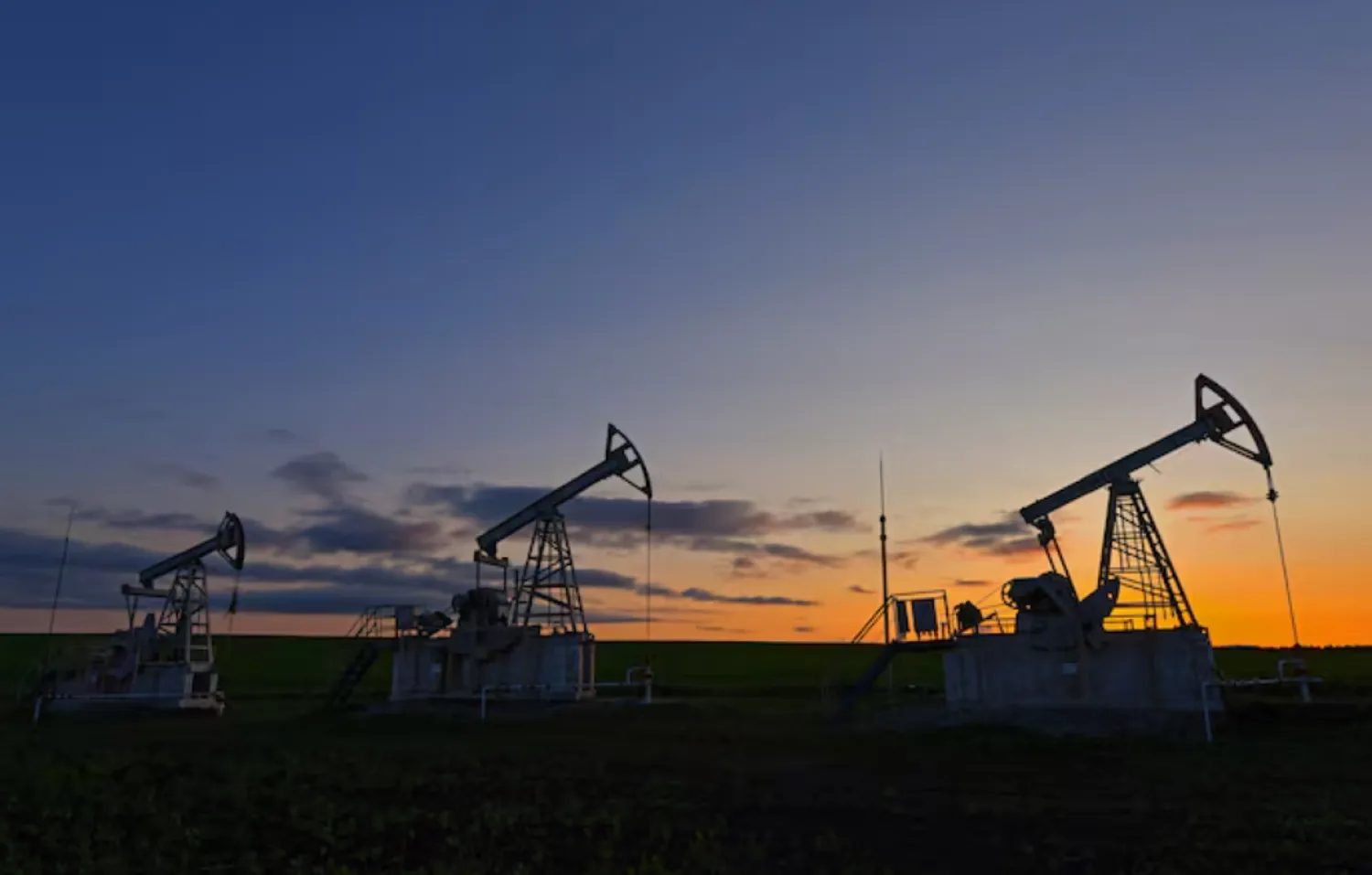
FILE PHOTO A view shows oil pump jacks outside Almetyevsk in the Republic of Tatarstan, Russia June 4, 2023. REUTERS/Alexander Manzyuk/ File Photo
TT

Oil Rebounds on Trump Threats on Russian Crude Buyers

FILE PHOTO A view shows oil pump jacks outside Almetyevsk in the Republic of Tatarstan, Russia June 4, 2023. REUTERS/Alexander Manzyuk/ File Photo

Oil prices rebounded from the previous session's five-week low on Wednesday, as traders focused on US President Donald Trump threatening India with higher tariffs over its Russian crude purchases, and a larger-than-expected US crude draw.

Brent crude futures gained $1.11, or 1.6%, to $68.75 a barrel by 1119 GMT, while US West Texas Intermediate crude was up $1.12, or 1.7%, at $66.28 a barrel.

Both oil contracts fell by more than $1 on Tuesday to settle at their lowest in five weeks, marking a fourth session of losses.

"Prices bounced up on the potential higher tariffs on India but the market is waiting for some sort of a formal implementation as well as which elements in the market are to be affected," said Rystad analyst Janiv Shah.

Trump renewed threats to impose higher import tariffs on Indian goods over the country's buying of Russian energy. India, along with China, is a major buyer of Russian oil, Reuters reported.

"Expectations appear that India may reduce its buying of Russian crude, but I can't see them doing so entirely as they have been making supernormal profits on buying cheap Russian crude," said Ashley Kelty, an analyst at Panmure Liberum.

US envoy Steve Witkoff arrived in Moscow on Wednesday on a last-minute mission to seek a breakthrough in the Ukraine war, two days before the expiry of a deadline set by Trump for Russia to agree to peace or face new sanctions.

Rystad's Shah said that although the meeting could lead to some concessions, a planned supply increase from the OPEC+ group would offset a potential decline in Russian oil supply.

The market was also finding support from a fall in US crude inventories last week, analysts said, as sources citing American Petroleum Institute figures said on Tuesday that stockpiles had fallen by 4.2 million barrels.

That compares with a Reuters poll estimate of a 600,000 barrels draw for the week to August 1.

"For all that has been thrown the oil market's way geopolitically, Brent futures have struggled to even hold the floor at $70 a barrel for any convincing length of time," said independent analyst Gaurav Sharma.

Brent is down 9.4% so far this year, which Sharma said was due to the market remaining well supplied at a time of uncertain demand. That, along with a cloudy macro-economic outlook, made the case for any lasting bullishness in crude unlikely, he added.



World Shares Are Mixed and US Futures Slip as Brent Hovers Above $100 a Barrel

 A person walks near a stock price monitor showing Nikkei index at a security company Tuesday, March 17, 2026, in Tokyo. (AP)
A person walks near a stock price monitor showing Nikkei index at a security company Tuesday, March 17, 2026, in Tokyo. (AP)
TT

World Shares Are Mixed and US Futures Slip as Brent Hovers Above $100 a Barrel

 A person walks near a stock price monitor showing Nikkei index at a security company Tuesday, March 17, 2026, in Tokyo. (AP)
A person walks near a stock price monitor showing Nikkei index at a security company Tuesday, March 17, 2026, in Tokyo. (AP)

Shares were mixed in Europe and Asia on Tuesday after a drop in oil prices helped send the US stock market to its best day since the war in Iran began.

The reprieve in prices for crude was short-lived, with Brent crude climbing nearly 4% early Tuesday to $104.13 a barrel. US benchmark crude also climbed, to $97.53 per barrel after dipping to about $93 on Monday.

US futures fell back, with the contracts for the S&P 500 and the Dow Jones Industrial Average down 0.3%.

In Asian trading, Tokyo's Nikkei 225 gave up early gains to slip 0.1% to 53,700.39 and the Kospi in South Korea jumped 1.6% to 5,640.48.

Hong Kong's Hang Seng added 0.1% to 25,668.54, while the Shanghai Composite index dropped 0.9% to 4,049.91.

In Australia, the S&P/ASX 200 gained 0.4% to 8,614.30 after the central bank hiked its benchmark interest rate to 4.1%.

Citing higher fuel prices, the Reserve Bank of Australia on Tuesday lifted the cash rate from 3.85% which it set at its Feb. 3 meeting in response to surging inflation. That rise was Australia’s first since November 2023.

Taiwan's Taiex rose 1.5% and India's Sensex picked up 0.6%.

On Monday, the S&P 500 climbed 1% for its biggest gain in five weeks. The Dow Jones Industrial Average added 0.8% and the Nasdaq composite jumped 1.2%.

The driver for markets has been oil prices, which have spiked from roughly $70 before the United States and Israel began their attacks on Iran. In response, Iran has nearly halted traffic through the narrow Strait of Hormuz, where a fifth of the world’s oil typically sails from the Gulf to customers worldwide. That has oil producers cutting production because their crude has nowhere to go.

The worry in financial markets is that if the strait remains closed for a long time, it could keep enough oil off the market to drive inflation up to a debilitating level for the global economy.

“The panic is still there, just dialed down a notch as crude slipped off the boil. Brent easing back toward $100 flipped the tape from bunker mentality to opportunistic risk-taking in a heartbeat,” Stephen Innes of SPI Asset Management said in a commentary.

President Donald Trump over the weekend demanded that other countries hurt by the closure of the Strait of Hormuz “take care of that passage” and said his country “will help - A LOT!”

The US and Israel have kept pummeling what they describe as military targets in Iran’s capital, and Israel stepped up its campaign against Iran-backed Hezbollah in Lebanon. More than 1 million people have been displaced in Lebanon — roughly 20% of the nation’s population — as UN peacekeepers say Israel is massing ground troops along the border.

Uncertainty over the war's scope and duration have roiled financial markets since the war began just over two weeks ago, though markets have a track record of bouncing back relatively quickly from military conflicts. Many professional investors are expecting that to be the case again, if oil prices don't go too high for too long. That has helped keep US stock prices near their record levels.

Higher prices are complicating the Federal Reserve's mission of balancing growth and inflation as President Donald Trump pushes the central bank to slash interest rates. Traders do not expect the Fed to cut rates at its policy meeting that wraps up on Wednesday.

Nvidia, whose chips are powering much of the world’s move into artificial-intelligence technology rose 1.6% on Monday as its CEO, Jensen Huang, talked up AI's possibilities at a conference, saying he foresaw $1 trillion in demand for AI chips through 2027. It was the strongest single force lifting the S&P 500.

In other dealings early Tuesday, the US dollar rose to 159.18 Japanese yen from 159.05 yen. The euro slipped to $1.1498 from $1.1507.


Gold Firms as Investors Assess Middle East Fallout ahead of Policy Decisions

 AFP_A salesperson displays gold bangles for sale in a gold shop at the Grand Baazar in Istanbul
AFP_A salesperson displays gold bangles for sale in a gold shop at the Grand Baazar in Istanbul
TT

Gold Firms as Investors Assess Middle East Fallout ahead of Policy Decisions

 AFP_A salesperson displays gold bangles for sale in a gold shop at the Grand Baazar in Istanbul
AFP_A salesperson displays gold bangles for sale in a gold shop at the Grand Baazar in Istanbul

Gold prices edged higher on Tuesday, buoyed by easing fears of prolonged disruptions to oil shipments, while investors assessed the economic impact of the Middle East conflict ahead of a slew of central bank policy decisions this week.

Spot gold was up 0.2% at $5,013.71 per ounce as of 0644 GMT. US gold futures for April delivery rose 0.3% to $5,018.10.

"Gold ‌prices pulled back ‌in the first 24 hours of ‌trade ⁠this week. That seems ⁠to echo the markets' positive response to Iran's foreign minister's comments... In response, crude oil pulled back, yields ticked lower, and the US dollar gave back some recent gains as stocks rose," said Ilya Spivak, head of global macro at Tastylive.

Iran's Foreign Minister Abbas Araghchi said on Monday that the Strait of Hormuz is not ⁠closed to everyone, while some vessels sailed through the ‌critical strait.

However, oil held above $100 ‌a barrel as the US-Israeli war against Iran kept the strait largely ‌shut, stranding tankers for weeks, in the biggest disruption to ‌global supplies on record. US President Donald Trump repeated his call for nations to help unblock the Strait, and complained that none were willing to offer assistance.

Higher crude prices fuel inflation by raising transport and production costs. While ‌gold is seen as an inflation hedge, higher interest rates boost yield-bearing assets, dampening demand for the ⁠metal.

"Watching news-flow ⁠from the US-Iran war and what it does to crude oil remains a key input, but the upcoming Fed meeting also has big catalyst potential. Gold may weaken if the central bank strikes a relatively hawkish tone," Spivak said.

The US Federal Reserve is widely expected to hold rates steady for a second straight meeting when it announces its policy statement on Wednesday.

Central banks in Britain, the euro zone, Japan, Australia, Canada, Switzerland, and Sweden also meet this week for the first time since the Iran war began.

Spot silver rose 0.3% to $80.97 per ounce. Spot platinum gained 0.9% to $2,133.93, while palladium fell 0.2% to $1,595.75.


Saudi Arabia Reinforces Global Mining Leadership at PDAC 2026 in Canada

Al-Belushi noted that the Kingdom has offered over 46,000 km² for exploration - SPA
TT

Saudi Arabia Reinforces Global Mining Leadership at PDAC 2026 in Canada

Al-Belushi noted that the Kingdom has offered over 46,000 km² for exploration - SPA

Saudi Arabia participated in the Prospectors and Developers Association of Canada (PDAC) convention, held March 1–4, 2026, highlighting exploration and mining opportunities in the Kingdom built on vast geological data and supported by a reformed regulatory framework.

On the sidelines of the conference, Deputy Minister of Industry and Mineral Resources for Mineral Resources Management Abdulrahman Al-Belushi, delivered keynote remarks at the Saudi Showcase titled “KSA: The Future Hub for Global Mineral Processing,” highlighting the Kingdom’s transformation from an emerging jurisdiction to a top global mining destination.

Al-Belushi emphasized that Saudi Arabia’s $2.5 trillion mineral wealth, modern regulatory framework, transparent licensing rounds, large-scale geological mapping program covering 700,000 km² of the Arabian Shield, and its world-class mine-to-market facilities provide a strong foundation for global investors seeking long-term opportunities across the mining sector, SPA reported.

During his participation at the International Mines Ministers Summit (IMMS), Al-Belushi highlighted the importance of global partnerships to meet rising mineral demand and shared details of the Future Minerals Forum’s Ministerial Roundtable Initiative, which promotes economic development, responsible supply, and capacity building across the mining sector.

Al-Belushi noted that the Kingdom has offered over 46,000 km² for exploration and is actively addressing financing gaps through a suite of competitive incentives, including the Exploration Enablement Program to support early-stage investment.

He also highlighted ongoing talent development initiatives, such as the recently launched Saudi School of Mines at the fifth Future Minerals Forum in January, alongside more than 80 years of geological data made digitally accessible to investors through the National Geological Database (NGD).

Throughout PDAC 2026, the Saudi delegation engaged in a series of bilateral meetings with global mining executives, investors, and institutional partners to accelerate collaboration across exploration, mining services, processing, and downstream integration.

By combining governance reform, large-scale geological data, financial risk-sharing mechanisms, and integrated mine-to-market infrastructure, Saudi Arabia is positioning itself as a strategic partner in strengthening global mineral supply chains.

Saudi Arabia’s participation at PDAC affirms that the Kingdom’s mining sector has moved from an emerging market to a competitive global destination. Through a modernized regulatory framework, extensive geological data, and competitive incentives, the Kingdom continues to strengthen its position as a trusted and preferred destination for mining investment—a reliable partner in building resilient and sustainable mineral supply chains.