


A Young Surgeon Tries to Save Lives at a Crippled Gaza Hospital

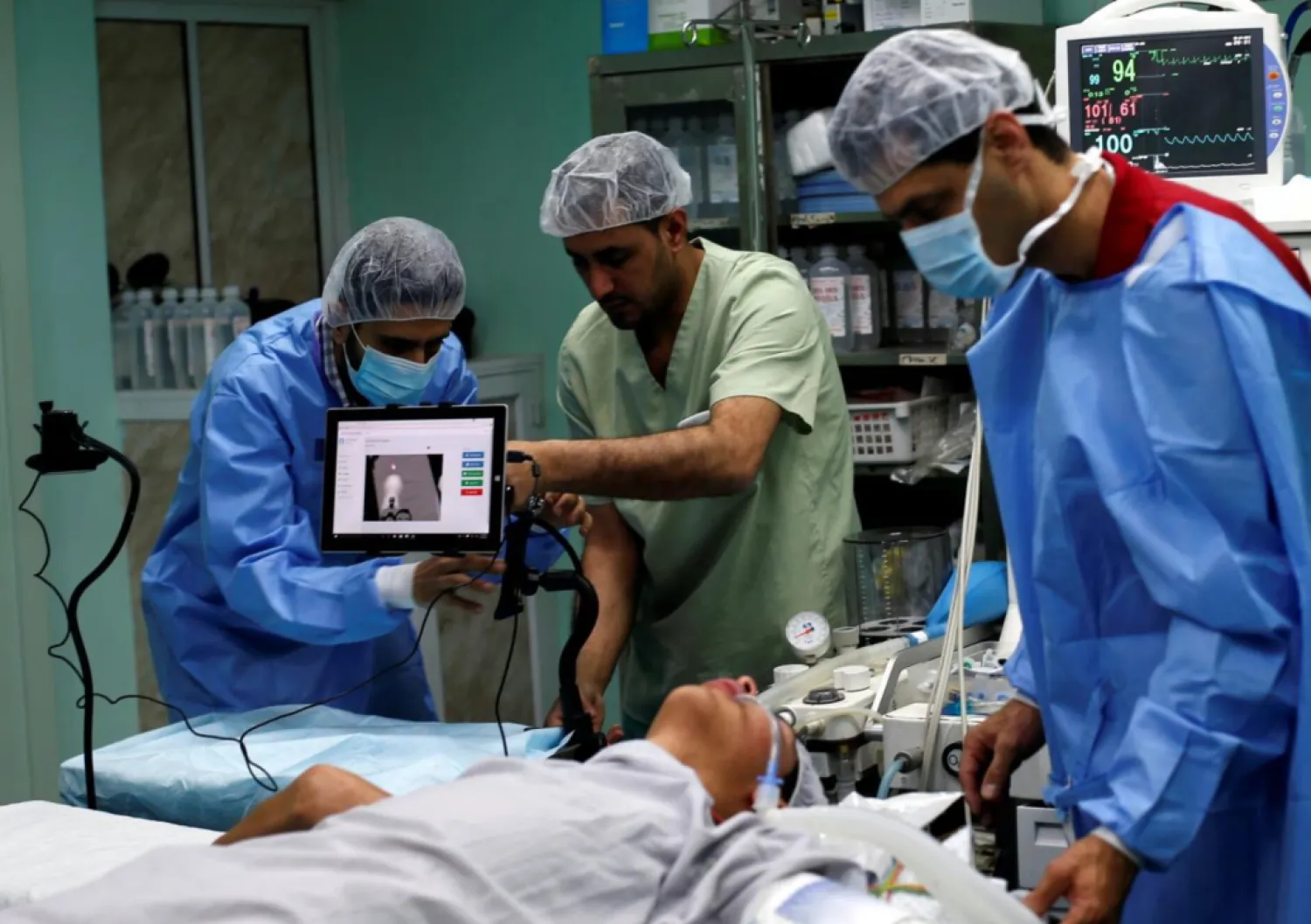
A patient lies on a bed as a technician (L) adjusts a screen before the start of a Proximie surgery, with doctor Ghassan Abu Sitta in Beirut guiding Palestinian surgeon Hafez Abu Khousa in the operating room at Al Awda Hospital in the northern Gaza Strip April 30, 2016. REUTERS/Suhaib Salem
TT

A Young Surgeon Tries to Save Lives at a Crippled Gaza Hospital

A patient lies on a bed as a technician (L) adjusts a screen before the start of a Proximie surgery, with doctor Ghassan Abu Sitta in Beirut guiding Palestinian surgeon Hafez Abu Khousa in the operating room at Al Awda Hospital in the northern Gaza Strip April 30, 2016. REUTERS/Suhaib Salem

At Shifa hospital in the Gaza Strip, nothing is sterilized, so Dr. Jamal Salha and other surgeons wash their instruments in soap. Infections are rampant. The stench of medical waste is overwhelming. And flies are everywhere.

Without painkillers, patients moan while lying on metal beds lining the corridors. There’s no electricity and no ventilation amid searing heat, leaving anxious visitors to fan bedridden relatives with pieces of cardboard.

Shifa, once the largest hospital in Gaza and the cornerstone of its health care system, is a shell of its former self after 22 months of war. The hospital complex the size of seven soccer fields has been devastated by frequent bombings, two Israeli raids and blockades on food, medicine and equipment. Its exhausted staff works around the clock to save lives, The AP news reported.

“It is so bad, no one can imagine,” said Salha, a 27-year-old neurosurgeon who, like countless doctors in Gaza, trained at Shifa after medical school and hopes to end his career there.

But the future is hard to think about when the present is all-consuming. Salha and other doctors are overwhelmed by a wartime caseload that shows no sign of easing. It has gotten more challenging in recent weeks as patients' bodies wither from rampant malnutrition.

Shifa was initially part of a British military post when it opened in 1946. It developed over the years to boast Gaza’s largest specialized surgery department, with over 21 operating rooms. Now, there are only three, and they barely function.

Because Shifa's operating rooms are always full, surgeries are also performed in the emergency room, and some of the wounded must be turned away. Bombed-out buildings loom over a courtyard filled with patients and surrounded by mounds of rubble.

Salha fled northern Gaza at the start of the war — and only returned to Shifa at the beginning of this year. While working at another extremely busy hospital in central Gaza, he kept tabs on Shifa's worsening condition.

“I had seen pictures," he said. "But when I first got back, I didn’t want to enter.”

A young doctor and a war After graduating from medical school in 2022, Salha spent a year training at Shifa. That is when he and a friend, Bilal, decided to specialize in neurosurgery.

But everything changed on Oct. 7, 2023, when Hamas attacked Israel and Israel's retaliatory campaign began.

For the first few weeks of the war, Salha was an intern at Shifa. Because Israel had cut off Gaza's internet service, one of Salha's jobs was to bring scans to doctors around the complex. He had to navigate through thousands of displaced people sheltering there and run up and down stairwells when elevators stopped working.

Once Israeli troops moved into northern Gaza, he and has family left. Bilal, who stayed in Gaza City, was killed a few months later, Salha said.

Not long after Salha left, Israeli forces raided Shifa for the first time in November 2023.

Israel said the hospital served as a major Hamas command and control center. But it provided little evidence beyond a single tunnel with two small rooms under the facility.

It made similar arguments when raiding and striking medical facilities across Gaza even as casualties from the war mounted. Israel says it makes every effort to deliver medical supplies and avoid harming civilians.

Under international law, hospitals lose their protected status if they are used for military purposes. Hamas has denied using hospitals for military purposes, though its security personnel can often be seen inside them and they have placed parts of hospitals off limits to the public.

Israeli forces returned to Shifa in March 2024, igniting two weeks of fighting in which the military said it killed some 200 militants who had regrouped there.

The hospital was left in ruins. The World Health Organization said three hospital buildings were extensively damaged and that its oxygen plant and most equipment were destroyed, including 14 baby incubators.

While all this was going on, Salha worked at a hospital in central Gaza, where he performed over 200 surgeries and procedures, including dozens of operations on fractured skulls. Some surgeons spend a lifetime without ever seeing one.

When he returned to Shifa as a neurosurgeon resident, the buildings he used to run between — some had been rehabilitated — felt haunted.

“They destroyed all our memories,” he said.

A shrunken hospital is stretched to its limits Shifa once had 700 beds. Today there are roughly 200, and nearly as many patients end up on mattresses on the floor, the hospital manager said. Some beds are set up in storage rooms, or in tents. An extra 100 beds, and an additional three surgery rooms, are rented out from a nearby facility.

The hospital once employed 1,600 doctors and nurses. Now there about half as many, according to Shifa's administrative manager, Rami Mohana. With Gaza beset by extreme food insecurity, the hospital can no longer feed its staff, and many workers fled to help their families survive. Those who remain are rarely paid.

On a recent morning, in a storage room-turned-patient ward, Salha checked up on Mosab al-Dibs, a 14-year-old boy suffering from a severe head injury and malnutrition.

“Look how bad things have gotten?” Salha said, pulling at al-Dibs’ frail arm.

Al-Dibs’ mother, Shahinez, was despondent. “We’ve known Shifa since we were kids, whoever goes to it will be cured,” she said. “Now anyone who goes to it is lost. There’s no medicine, no serums. It’s a hospital in name only.”

There are shortages of basic supplies, like gauze, so patients' bandages are changed infrequently. Gel foams that stop bleeding are rationed.

Shifa's three CT scan machines were destroyed during Israeli raids, Mohana said, so patients are sent to another nearby hospital if they need one. Israel has not approved replacing the CT scanners, he said.

Patients wait for hours — and sometimes days — as surgeons prioritize their caseload or as they arrange scans. Some patients have died while waiting, Salha said.

After months without a pneumatic surgical drill to cut through bones, Shifa finally got one. But the blades were missing, and spare parts were not available, Salha said.

″So instead of 10 minutes, it could take over an hour just to cut the skull bones,” he said. “It leaves us exhausted and endangers the life of the patient.”

When asked by The Associated Press about equipment shortages at Shifa, the Israeli military agency in charge of aid coordination, COGAT, did not address the question. It said the military ’’consistently and continuously enables the continued functioning of medical services through aid organizations and the international community.″

Unforgettable moments From his time at the hospital in central Gaza, Salha can't shake the memory of the woman in her 20s who arrived with a curable brain hemorrhage. The hospital wouldn’t admit her because there were no beds available in the intensive care unit.

He had wanted to take her in an ambulance to another hospital, but because of the danger of coming under Israeli attack, no technician would go with him to operate her ventilator.

“I had to tell her family that we will have to leave her to die," he said.

Other stories have happier endings.

When a girl bleeding from her head arrived at Shifa, Salha’s colleague stopped it with his hand until a gel foam was secured. The girl, who had temporarily lost her vision, greeted Salha after her successful recovery.

“Her vision was better than mine,” the bespectacled Salha said, breaking a smile.

“Sometimes it seems we are living in a stupor. We deal with patients in our sleep and after a while, we wake up and ask: what just happened?”


A US Shift Marked Kurdish-Led Forces’ Fall from Power in Syria

 Syrian government forces patrol inside the al-Hol camp as smoke rises from an arms depot explosion in northeastern Syria's Hasakeh province, Syria, Wednesday, Jan. 21, 2026, after the withdrawal of the Syrian Democratic Forces (SDF). (AP)
Syrian government forces patrol inside the al-Hol camp as smoke rises from an arms depot explosion in northeastern Syria's Hasakeh province, Syria, Wednesday, Jan. 21, 2026, after the withdrawal of the Syrian Democratic Forces (SDF). (AP)
TT

A US Shift Marked Kurdish-Led Forces’ Fall from Power in Syria

 Syrian government forces patrol inside the al-Hol camp as smoke rises from an arms depot explosion in northeastern Syria's Hasakeh province, Syria, Wednesday, Jan. 21, 2026, after the withdrawal of the Syrian Democratic Forces (SDF). (AP)
Syrian government forces patrol inside the al-Hol camp as smoke rises from an arms depot explosion in northeastern Syria's Hasakeh province, Syria, Wednesday, Jan. 21, 2026, after the withdrawal of the Syrian Democratic Forces (SDF). (AP)

Two tumultuous weeks saw the fall from power in Syria of the Kurdish-led force that was once the main US partner there, as Washington shifts its backing to the country's nascent government.

Analysts say the Syrian Democratic Forces miscalculated, taking a hard stance in negotiations with the new leaders in Damascus on the assumption that if a military conflict erupted between them, Washington would support the SDF as it had for years when they battled the ISIS group.

Instead, the Kurdish-led force lost most of its territory in northeast Syria to a government offensive after intense clashes erupted in the northern city of Aleppo on Jan. 6. Washington did not intervene militarily and focused on mediating a ceasefire.

By Wednesday, the latest ceasefire was holding, and the SDF had signed onto a deal that would effectively dissolve it.

Elham Ahmad, a senior official with the de facto autonomous administration in the Kurdish-led northeast, expressed surprise to journalists Tuesday that its calls for intervention by the US-led coalition against ISIS “have gone unanswered.”

Experts had seen it coming. "It’s been very clear for months that the US views Damascus as a potential strategic partner," said Noah Bonsey, senior advisor on Syria with the International Crisis Group, according The Associated Press.

US President Donald Trump has strongly backed the government of interim President Ahmed al-Sharaa, a former opposition leader, since his forces ousted former President Bashar al-Assad in December 2024 following years of civil war. Under al-Sharaa, Syria has joined the global coalition against ISIS.

US envoy to Syria Tom Barrack in a blunt statement Tuesday said the SDF’s role as Syria's primary anti-ISIS force “has largely expired" since the new government is "both willing and positioned to take over security responsibilities.” The US is not interested in "prolonging a separate SDF role,” he said.

Stalled negotiations led to gunfire

As al-Sharaa sought to pull the country together after 14 years of civil war, he and SDF leader Mazloum Abdi in March 2025 agreed that the SDF's tens of thousands of fighters would be integrated into the new army. The government would take over key institutions in northeast Syria, including border crossings, oil fields and detention centers housing thousands of suspected IS members.

But for months, US-mediated negotiations to implement the deal stalled.

Syrian government officials who spoke to The AP blamed fractured SDF leadership and their maximalist demands.

Syria’s ambassador to the United Nations, Ibrahim Olabi, said Abdi on several occasions agreed to proposals that the group’s more hardline leaders then rejected.

“Then he stopped agreeing to things and started saying, ‘I have to go back’ (to consult with other officials), which obviously didn’t work with us and the Americans," Olabi said. “We wanted to spend a week in one room and get everything done.”

A senior Syrian government official who spoke on condition of anonymity because he was not authorized to comment publicly said Barrack slammed his hand on the table during one negotiating session and demanded that Abdi clarify whether he wanted to continue with the agreement. Barrack declined to comment via a spokesperson.

Ahmad with the Kurdish-led administration accused Damascus officials of dodging meetings and said those that occurred "were only possible because of the Americans pushing Damascus to come and join.”

Talks were always likely to be thorny. The SDF's Kurdish base was wary of the new government, particularly after outbreaks of sectarian violence targeting other minority groups in Syria.

There was “a major disagreement over a huge substantive set of questions around the future of Syrian governance, how decentralized or centralized it should be,” Bonsey said.

Meghan Bodette, director of research at the pro-SDF Kurdish Peace Institute think tank, said the impasse came down to an “astronomical” gulf in political outlook.

Damascus sought to create a centralized state, while the (Kurdish-led authorities) wanted to keep maximum local autonomy through decentralization and institutionalizing minority rights, she said.

Integrating forces was especially tricky

Much debate focused on how the SDF forces would be integrated into the new army.

The senior Syrian official said SDF leaders at one point proposed integrating Syrian government military groups into their forces instead.

He said the government rejected that but agreed to keep the SDF unified in three battalions in northeastern Syria along with a border brigade, a women’s brigade and a special forces brigade.

In return, the government demanded that non-SDF military forces have freedom of movement in the northeast and that SDF divisions would report to the Ministry of Defense and not move without orders. The senior official said Abdi asked to be named deputy minister of defense, and the government agreed.

At the last negotiation session in early January, however, SDF commander Sipan Hamo — seen by Damascus as part of the hardline faction — demanded that the northeast brigades and battalions report to a person chosen by the SDF and that other forces could only enter the region in small patrols and with SDF permission, the senior official said. The government rejected that.

SDF officials did not respond to request for comment on details of negotiations.

Aleppo was a turning point

Days after that session, clashes erupted in Aleppo.

Olabi, the ambassador, said the Syrian military's success in limiting civilian casualties in Aleppo was another key to the diplomatic breakthrough with the SDF.

Syria's military leadership appeared to have learned lessons from confrontations elsewhere in which government-affiliated fighters carried out sectarian revenge attacks on civilians.

In Aleppo, the military opened “humanitarian corridors” so civilians could flee.

“If Aleppo had gone wrong, I think we would be in a very different place,” Olabi said.

After Syrian forces captured the Arab-majority oil-rich provinces of Raqqa and Deir Ezzor from the SDF, the two sides announced a deal. SDF would retain a presence only in Hasakeh province, the country's Kurdish heartland. And SDF fighters would be integrated into the army as individuals.

Bonsey said the SDF had been warned during negotiations that their effort to maintain their dominant role in the northeast conflicted with geopolitical shifts.

They ended up accepting a deal that is “much worse” than what was on offer just two weeks ago, he said.


Israeli Settler Outpost Becomes a Settlement within a Month

Israeli finance minister Bezalel Smotrich, center, strides through the newly-legalized Jewish settlement of Yatziv, adjacent to the Palestinian town of Beit Sahour, in the West Bank, Jan. 19, 2026. (AP)
TT

Israeli Settler Outpost Becomes a Settlement within a Month

Israeli finance minister Bezalel Smotrich, center, strides through the newly-legalized Jewish settlement of Yatziv, adjacent to the Palestinian town of Beit Sahour, in the West Bank, Jan. 19, 2026. (AP)

Celebratory music blasting from loudspeakers mixed with the sounds of construction, almost drowning out calls to prayer from a mosque in the Palestinian town across this West Bank valley.

Orthodox Jewish women wearing colorful head coverings and with babies on their hips, shared platters of fresh vegetables as soldiers encircled the hilltop, keeping guard.

The scene Monday reflected the culmination of Israeli settlers’ long campaign to turn this site overlooking the Palestinian town of Beit Sahour into a settlement. Over the years they fended off plans to build a hospital for Palestinian children on the land, always holding to the hope it would one day become theirs.

That moment is now, they say.

Smotrich goes on settlement spree

After two decades of efforts, it took just a month for their new settlement, called “Yatziv,” to go from an unauthorized outpost of a few mobile homes to a fully recognized settlement. Fittingly, the new settlement's name means “stable” in Hebrew.

“We are standing stable here in Israel,” Finance Minister and settler leader Bezalel Smotrich told The Associated Press at Monday’s inauguration ceremony. “We’re going to be here forever. We will never establish a Palestinian state here.”

With leaders like Smotrich holding key positions in Israel’s government and establishing close ties with the Trump administration, settlers are feeling the wind at their backs.

Smotrich, who has been in charge of Israeli settlement policy for the past three years, has overseen an aggressive construction and expansion binge aimed at dismantling any remaining hopes of establishing a Palestinian state in the occupied West Bank.

While most of the world considers the settlements illegal, their impact on the ground is clear, with Palestinians saying the ever-expanding construction hems them in and makes it nearly impossible to establish a viable independent state. The Palestinians seek the West Bank, captured by Israel in 1967, as part of a future state.

Emboldened

Settlers had long set their sights on the hilltop, thanks to its position in a line of settlements surrounding Jerusalem and because they said it was significant to Jewish history. But they put up the boxy prefab homes in November because days earlier, Palestinian attackers had stabbed an Israeli to death at a nearby junction.

The attack created an impetus to justify the settlement, settlement council chair, Yaron Rosenthal, told the AP. With the election of Israel’s far-right government in late 2022, Trump’s return to office last year and the November attack, conditions were ripe for settlers to make their move, Rosenthal said.

“We understood that there was an opportunity,” he said. “But we didn’t know it would happen so quickly.”

“Now there is the right political constellation for this to happen."

Smotrich announced approval of the outpost, along with 18 others, on Dec. 21. That capped 20 years of effort, said Nadia Matar, a settler activist.

“Shdema was nearly lost to us,” said Matar, using the name of an Israeli military base at the site. “What prevented that outcome was perseverance.”

Back in 2006, settlers were infuriated upon hearing that Israel's government was in talks with the US to build a Palestinian children's hospital on the land, said Hagit Ofran, a director at Peace Now, an anti-settlement watchdog group, especially as the US Agency for International Development was funding a “peace park” at the base of the hill.

The mayor of Beit Sahour urged the US Consulate to pressure Israel to begin hospital construction, while settlers began demonstrations at the site calling on Israel to quash the project, according to consulate files obtained through WikiLeaks.

It was “interesting” that settlers had “no religious, legal, or ... security claim to that land,” wrote consulate staffer Matt Fuller at the time, in an email he shared with the AP. "They just don’t want the Palestinians to have it — and for a hospital no less — a hospital that would mean fewer permits for entry to Jerusalem for treatment.”

The hospital was never built. The site was converted into a military base after the Netanyahu government came to power in 2009. From there, settlers quickly established a foothold by creating a makeshift cultural center at the site, putting on lectures, readings and exhibits.

Speaking to the AP, Ehud Olmert, the Israeli prime minister at the time the hospital was under discussion, said that was the tipping point.

“Once it is military installation, it is easier than to change its status into a new outpost, a new settlement and so on,” he said.

Olmert said Netanyahu — who has served as prime minister nearly uninterrupted since then — was “committed to entirely different political directions from the ones that I had,” he said. “They didn’t think about cooperation with the Palestinians.”

Palestinians say the land is theirs

The continued legalization of settlements and spiking settler violence — which rose by 27% in 2025, according to Israel’s military — have cemented a fearful status quo for West Bank Palestinians.

The land now home to Yatziv was originally owned by Palestinians from Beit Sahour, said the town’s mayor, Elias Isseid.

“These lands have been owned by families from Beit Sahour since ancient times,” he said.

Isseid worries more land loss is to come. Yatziv is the latest in a line of Israeli settlements to pop up around Beit Sahour, all of which are connected by a main highway that runs to Jerusalem without entering Palestinian villages. The new settlement “poses a great danger to our children, our families," he said.


Respiratory Virus Claims Lives in Gaza amid Limited Capacity for Testing

A Palestinian man carries the body of his three-month-old daughter on Tuesday after she died from the cold in Gaza City. (AFP)
TT

Respiratory Virus Claims Lives in Gaza amid Limited Capacity for Testing

A Palestinian man carries the body of his three-month-old daughter on Tuesday after she died from the cold in Gaza City. (AFP)

Gaza resident Yusra al-Hajjar, 32, went through harrowing moments after she was shocked by a sharp rise in the temperature of her five-month-old infant, Nidal, prompting her to rush him to a clinic at the Al-Shifa Medical Complex in Gaza City as his condition worsened.

Initial medical examinations failed to determine the exact cause of the infant’s illness, forcing the medical team to resort to basic measures such as intravenous fluids and fever-reducing medication in an attempt to control the symptoms.

The treatment was temporarily successful, and the baby’s condition improved after several hours.

“We left the clinic in a better condition, but less than a day later, we brought him back after a new deterioration,” al-Hajjar told Asharq Al-Awsat.

“As of this morning, Tuesday, five days have passed since my baby fell ill. I am still trying basic methods, such as cooling his forehead with cold water and giving him some medication to reduce the fever and stop the vomiting and weakness, while doctors have been unable to determine the cause,” she added.

The infant’s case is not the only one. Residents of Gaza have been struggling in recent weeks with what medical officials describe as a widespread outbreak of identical symptoms, particularly among the elderly and children, according to Mohammed Abu Salmiya, director of the Al-Shifa Medical Complex.

Abu Salmiya said that for nearly a month, new deaths have been recorded on an almost daily basis due to the spread of what he described as a dangerous and deadly virus.

He said the virus causes severe pneumonia, leading to fatalities primarily among vulnerable patients with weakened immune systems, and secondarily among individuals with stronger immunity, including some young people whose deaths were recorded in recent days.

No capacity for testing

Abu Salmiya said Gaza’s health system lacks even the most basic laboratory capabilities needed to identify the virus, suggesting it could be a new COVID variant spreading in the world.

Earlier on Tuesday, a seven-month-old infant, Shaza Abu Jarrad, died due to extreme cold and a lack of adequate shelter and heating, raising the number of child deaths from similar conditions to about 10.

Abu Salmiya said the current cold weather has fueled the spread of the virus, contributing to a high number of deaths amid the harsh living conditions in Gaza following the Israeli war.

He said there is a direct link between the war and weakened immunity among Gaza’s population, who have endured repeated bouts of hunger, alongside water contamination.

He added that this comes amid severe shortages of medicines and medical supplies, leaving health authorities unable to mount an effective and rapid response to the current health crisis.

The United Nations Relief and Works Agency for Palestine Refugees, UNRWA, said in a post on X that despite the collapse of Gaza’s health system, it continues to provide primary health care to thousands of people every day, but faces an acute shortage of medicines.

UNRWA accused Israel of preventing its aid supplies stuck in warehouses in Jordan and Egypt from entering Gaza since March 2 last year, stressing the urgent need to allow its assistance into the territory.

It said harsh winter conditions are compounding the suffering of families in Gaza who have been exhausted by war and repeated displacement, calling for large-scale access for humanitarian aid.

Mahmoud Bassal, spokesman for Gaza’s Civil Defense, warned of a rise in deaths, particularly among young children, due to the severe cold wave coinciding with the deterioration of humanitarian conditions in the enclave.

He said field and health conditions are extremely harsh, especially for infants, the sick, and the elderly, as most families live in dilapidated tents that offer little protection from the cold, rain, and other environmental conditions.
