




South Africa has unveiled its ambition to establish an electricity interconnection with Saudi Arabia, as part of the growing cooperation between the two countries in climate technology and the green economy.
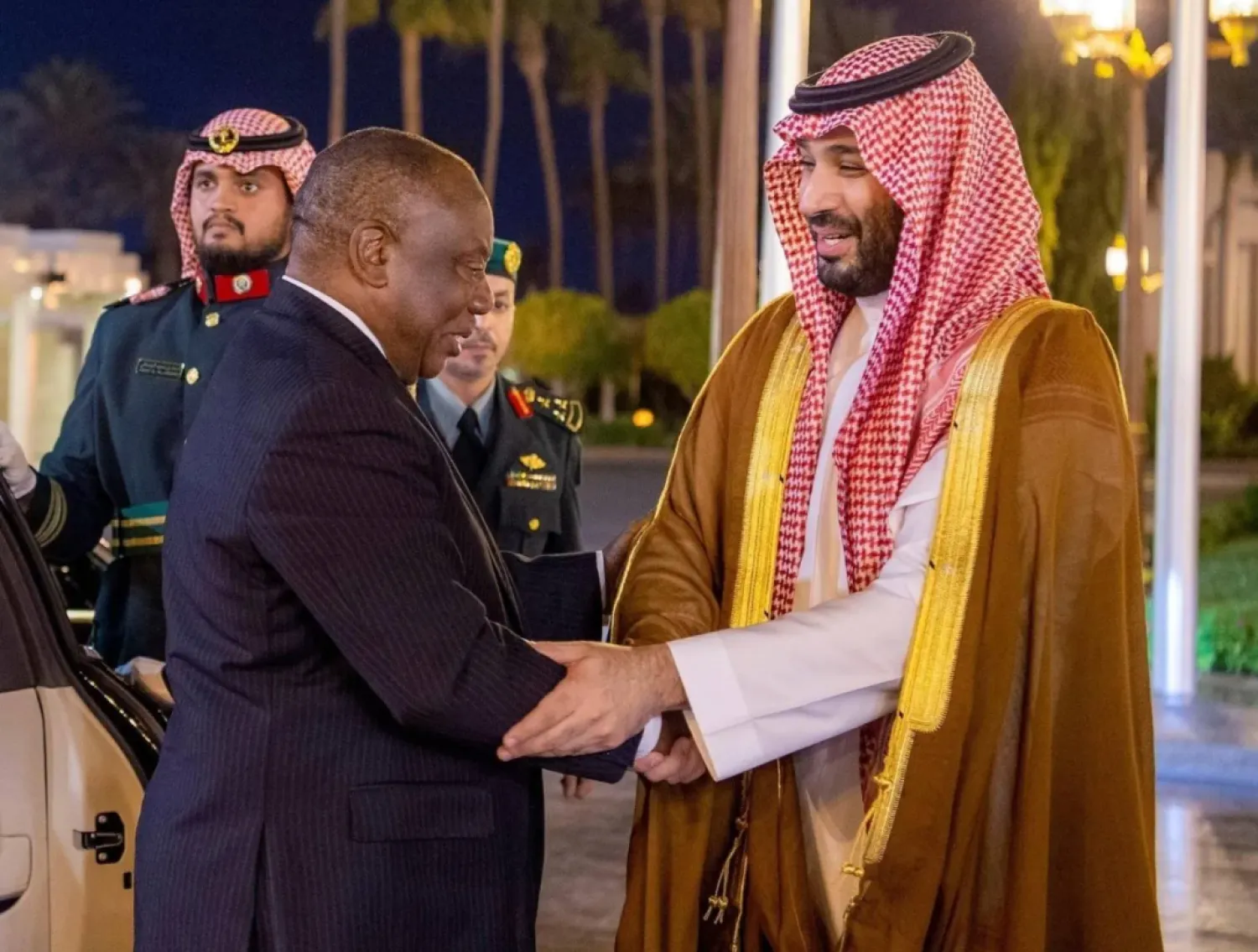
The comes following a meeting in 2022 between Saudi Crown Prince Mohammed bin Salman and South African President Cyril Ramaphosa, which was attended by hundreds of business leaders.
Subsequent high-level visits and business delegations have resulted in negotiations and investments estimated at around $5 billion, covering renewable energy, logistics, fuel stations, and real estate, with some agreements signed while others remain under discussion.
South Africa is set to chair the G20 Summit, scheduled for November 2025 in Johannesburg.
In remarks to Asharq Al-Awsat, South Africa’s Ambassador to the Kingdom Mogobo David Magabe noted that discussions are ongoing regarding the energy sector between the two countries.
“While interconnection remains aspirational, discussions continue regarding grid investments and power-sector partnerships.”
Magabe confirmed that bilateral trade between the two nations reached $44.4 billion USD in 2024.
“Trade is expanding but remains imbalanced in Saudi Arabia’s favor,” he said. As of 2023, the total trade volume stood at $3.43 billion, reflecting a 9.6% increase from 2022. South Africa’s exports were valued at $404.5 million USD, while imports stood at $3.03 billion USD, primarily crude oil and chemicals. He added that opportunities exist to diversify South Africa’s export basket through automotive, agro-processed, and value-added sectors.
Regarding industrial cooperation, Magabe noted that South African firms are exploring contracts under Vision 2030 projects like NEOM and the Red Sea Development. In the field of the green economy, he said Saudi firm ACWA Power has invested over $1.2 billion USD in South African renewable projects.
“Collaboration is advancing in fintech, AI, and digital infrastructure, with proposed cooperation under the 2025 Joint Economic Commission Digital Economy pillar,” Magabe added.
He emphasized that the proposed 2025 Joint Economic Commission (JEC) agenda includes a focus on power grid investment under the Energy Transition pillar, indicating that electricity cooperation may move beyond dialogue into concrete planning in the near future.
Magabe highlighted flagship initiatives under discussion for the JEC, including hydrogen, agro-tech, and logistics corridors. He explained that the upcoming 10th Joint Economic Commission will be hosted in Riyadh in September 2025 by Saudi Minister of Industry and Mineral Resources, Bandar bin Ibrahim Al-Khorayef, co-chaired with South African Minister of Trade, Industry, and Competition, Mpho Parks Franklyn Tau. “This meeting is a key opportunity to advance shared G20 objectives through a focus on food security, energy, logistics, and financial resilience,” Magabe stressed.
When asked about the extent to which South Africa benefited from Saudi Arabia’s 2020 G20 Presidency, Magabe said that South Africa indirectly drew on the Kingdom’s frameworks for global economic cooperation, digital transformation, and emergency financing.
“While there is no direct evidence of legislative transposition, the policy influence was clear in multilateral forums,” he explained. He noted that South Africa supported key Saudi-led initiatives on equitable vaccine access and fiscal support for developing countries. “The two countries now share an interest in post-pandemic recovery through industrialization, infrastructure, renewables, and food security,” Magabe added.
On opportunities for cooperation within the BRICS group, Magabe stated that collaboration prospects are significant, particularly in development financing, infrastructure investment, digital governance, and global governance reform. He remarked that Saudi Arabia’s growing engagement with BRICS economies, especially South Africa and China, aligns with its broader shift toward a multipolar diplomatic strategy.
He recalled that during South Africa’s 2023 BRICS Chairship, President Ramaphosa extended invitations to a select group of countries to join BRICS.
“While several countries, including Egypt and the UAE, accepted the invitation to join as full members, Saudi Arabia indicated it was still considering the invitation,” he said. Nonetheless, he noted, “Saudi Arabia has participated in all subsequent BRICS summits and ministerial-level meetings as an observer or partner. This sustained engagement reflects the Kingdom’s interest in deepening economic ties with BRICS members without formally committing to full membership at this stage.”
Magabe concluded by saying that South Africa views Saudi Arabia’s potential inclusion in BRICS as a move that would enhance the group’s economic and geopolitical weight, particularly in energy security, investment flows, and South-South cooperation.


