


Can Lebanon Disarm Hezbollah?

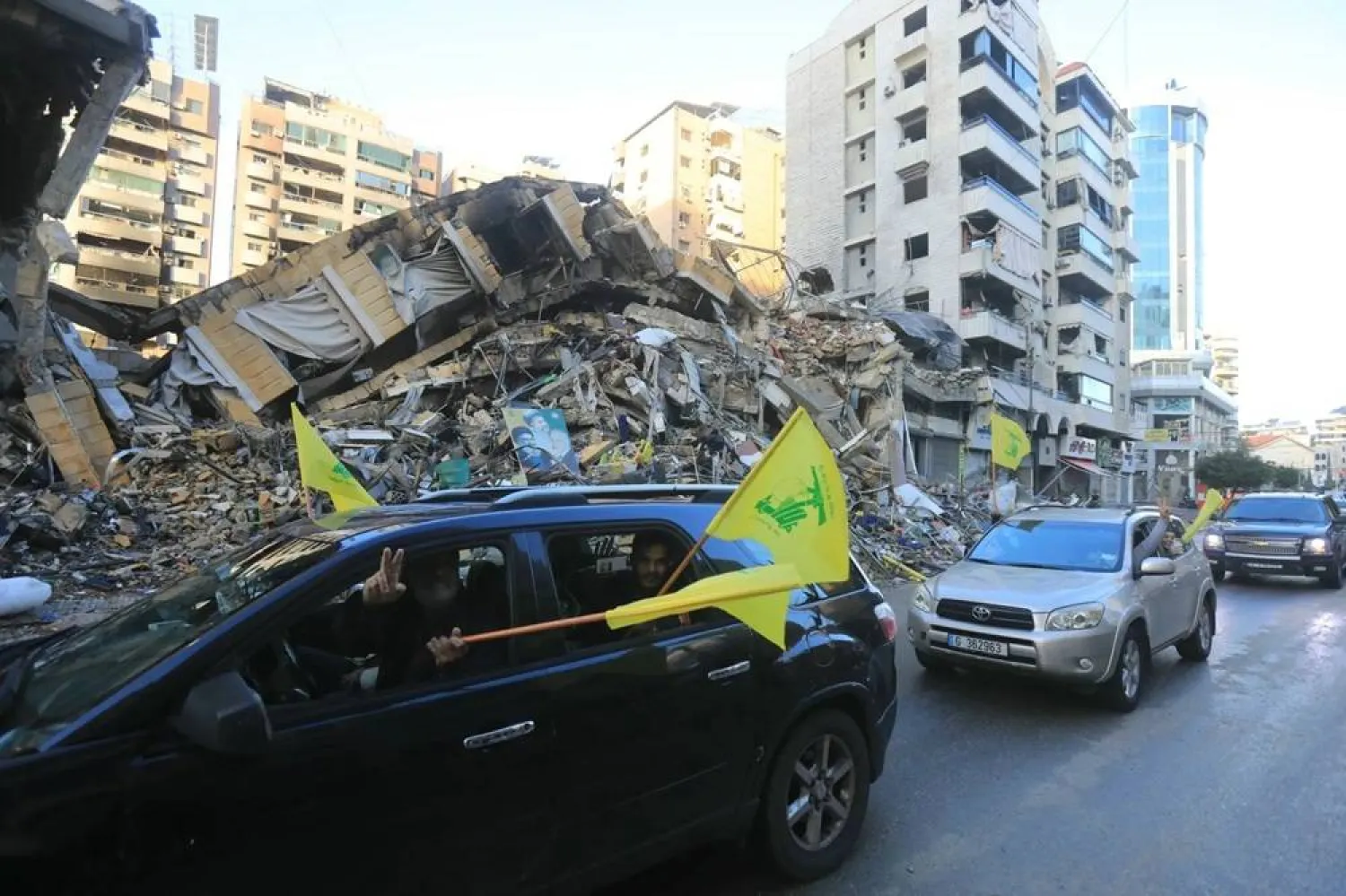
Motorists wave Hezbollah flags as they parade in Beirut's southern suburbs on Nov. 27, 2024. (AFP/Getty Images)
TT

Can Lebanon Disarm Hezbollah?

Motorists wave Hezbollah flags as they parade in Beirut's southern suburbs on Nov. 27, 2024. (AFP/Getty Images)

Lebanon's cabinet has told the army to draw up a plan to establish a state monopoly on arms in a challenge to the Iran-backed Shiite group Hezbollah, which rejects calls to disarm.

WHY IS THERE A PUSH TO DISARM HEZBOLLAH NOW?

Israel pummeled Hezbollah last year in a war sparked by the conflict in Gaza, killing many of its top brass and 5,000 of its fighters before a November truce brokered by the United States.

That deal committed Lebanon to restricting arms to six specific state security forces, and further stipulated that it should confiscate unauthorized weapons and prevent rearmament by non-state groups.

In the months since, a new Lebanese government vowed to confine arms across the country to state control, Hezbollah's main arms route was cut when its Syrian ally Bashar al-Assad was ousted in December and Israel attacked its sponsor Iran in June.

The government is facing pressure from Washington and Hezbollah's domestic rivals to act swiftly amid fears that Israel could intensify air strikes on Lebanon.

Despite November's ceasefire, Israel has continued to carry out strikes on what it says are Hezbollah arms depots and fighters, mostly in southern Lebanon.

HOW IS THE UNITED STATES INVOLVED?

In June, US envoy Thomas Barrack proposed a roadmap to Lebanese officials to fully disarm Hezbollah in exchange for Israel halting its strikes on Lebanon and withdrawing its troops from five points they still occupy in southern Lebanon.

But Hezbollah and its main Shiite ally the Amal Movement, led by Parliament Speaker Nabih Berri, say the sequencing should be reversed, with Israel withdrawing and halting strikes before any talks on Hezbollah's arms.

Washington has grown impatient, demanding the Beirut government make the first move with a formal commitment to disarm Hezbollah.

WHY IS HEZBOLLAH SO WELL-ARMED?

After Lebanon's 15-year civil war ended in 1990 Hezbollah, founded by Iran's Revolutionary Guards in 1982, was the only group allowed to keep its weapons on the grounds that it was fighting Israel's occupation of the country's south.

After Israel withdrew in 2000 the group did not give up its arms, arguing its ability to fight was still a critical element of national defense against future Israeli aggression.

A ceasefire agreement after a war between Hezbollah and Israel in 2006 was backed by a UN resolution demanding the disarmament of all militant groups, but Hezbollah again kept its weapons, accusing Israel of having violated other parts of the truce deal, which Israel denies.

Hezbollah took over parts of Beirut in fighting in 2008, underscoring its dominance. The group exercised decisive sway over state affairs in the following years as its power grew.

WHAT DOES HEZBOLLAH SAY AND COULD THERE BE CIVIL STRIFE?

Hezbollah has called the government's decision to ask the army to draw up plans to disarm it a "grave sin" that "fully serves Israel's interest".

Hezbollah chief Sheikh Naim Qassem rejected each clause in Barrack's roadmap and when he spoke on Tuesday, dozens of motorcycles with men carrying Hezbollah flags drove around the group's stronghold in Beirut's southern suburbs - a show of its enduring strength.

Hovering over any attempt to force Hezbollah to disarm is the specter of previous bouts of civil unrest, including the 2008 fighting, triggered by the government's attempt to shut down the group's military telecoms network - an important facility for the group, but still less central than its arms.

WHAT ARE THE POLITICAL COMPLICATIONS?

Lebanon's power-sharing system apportions public sector posts, including in parliament, the cabinet and other roles, to different religious sects according to quotas.

The system is meant to ensure no sect is cut out of decision making, but critics say it leads to political paralysis.

Shiite representation in both parliament and cabinet is dominated by Hezbollah and its political ally Amal.

Two Shiite ministers were travelling during Tuesday's cabinet session, and the other two walked out in the final moments as the decision was being taken. Qassem has said any government decision would require a national consensus and may challenge the legitimacy of cabinet decisions taken without Shiites.

WHAT HAPPENS NEXT?

The cabinet decision gave the army a deadline to submit a disarmament plan to the government by the end of August. Another session scheduled for Thursday will discuss Barrack's proposal.

Some Lebanese parties may keep trying to find a workaround that avoids a confrontation between Hezbollah and the state while warding off heavier Israeli strikes.


Israeli Settler Outpost Becomes a Settlement within a Month

Israeli finance minister Bezalel Smotrich, center, strides through the newly-legalized Jewish settlement of Yatziv, adjacent to the Palestinian town of Beit Sahour, in the West Bank, Jan. 19, 2026. (AP)
TT

Israeli Settler Outpost Becomes a Settlement within a Month

Israeli finance minister Bezalel Smotrich, center, strides through the newly-legalized Jewish settlement of Yatziv, adjacent to the Palestinian town of Beit Sahour, in the West Bank, Jan. 19, 2026. (AP)

Celebratory music blasting from loudspeakers mixed with the sounds of construction, almost drowning out calls to prayer from a mosque in the Palestinian town across this West Bank valley.

Orthodox Jewish women wearing colorful head coverings and with babies on their hips, shared platters of fresh vegetables as soldiers encircled the hilltop, keeping guard.

The scene Monday reflected the culmination of Israeli settlers’ long campaign to turn this site overlooking the Palestinian town of Beit Sahour into a settlement. Over the years they fended off plans to build a hospital for Palestinian children on the land, always holding to the hope it would one day become theirs.

That moment is now, they say.

Smotrich goes on settlement spree

After two decades of efforts, it took just a month for their new settlement, called “Yatziv,” to go from an unauthorized outpost of a few mobile homes to a fully recognized settlement. Fittingly, the new settlement's name means “stable” in Hebrew.

“We are standing stable here in Israel,” Finance Minister and settler leader Bezalel Smotrich told The Associated Press at Monday’s inauguration ceremony. “We’re going to be here forever. We will never establish a Palestinian state here.”

With leaders like Smotrich holding key positions in Israel’s government and establishing close ties with the Trump administration, settlers are feeling the wind at their backs.

Smotrich, who has been in charge of Israeli settlement policy for the past three years, has overseen an aggressive construction and expansion binge aimed at dismantling any remaining hopes of establishing a Palestinian state in the occupied West Bank.

While most of the world considers the settlements illegal, their impact on the ground is clear, with Palestinians saying the ever-expanding construction hems them in and makes it nearly impossible to establish a viable independent state. The Palestinians seek the West Bank, captured by Israel in 1967, as part of a future state.

Emboldened

Settlers had long set their sights on the hilltop, thanks to its position in a line of settlements surrounding Jerusalem and because they said it was significant to Jewish history. But they put up the boxy prefab homes in November because days earlier, Palestinian attackers had stabbed an Israeli to death at a nearby junction.

The attack created an impetus to justify the settlement, settlement council chair, Yaron Rosenthal, told the AP. With the election of Israel’s far-right government in late 2022, Trump’s return to office last year and the November attack, conditions were ripe for settlers to make their move, Rosenthal said.

“We understood that there was an opportunity,” he said. “But we didn’t know it would happen so quickly.”

“Now there is the right political constellation for this to happen."

Smotrich announced approval of the outpost, along with 18 others, on Dec. 21. That capped 20 years of effort, said Nadia Matar, a settler activist.

“Shdema was nearly lost to us,” said Matar, using the name of an Israeli military base at the site. “What prevented that outcome was perseverance.”

Back in 2006, settlers were infuriated upon hearing that Israel's government was in talks with the US to build a Palestinian children's hospital on the land, said Hagit Ofran, a director at Peace Now, an anti-settlement watchdog group, especially as the US Agency for International Development was funding a “peace park” at the base of the hill.

The mayor of Beit Sahour urged the US Consulate to pressure Israel to begin hospital construction, while settlers began demonstrations at the site calling on Israel to quash the project, according to consulate files obtained through WikiLeaks.

It was “interesting” that settlers had “no religious, legal, or ... security claim to that land,” wrote consulate staffer Matt Fuller at the time, in an email he shared with the AP. "They just don’t want the Palestinians to have it — and for a hospital no less — a hospital that would mean fewer permits for entry to Jerusalem for treatment.”

The hospital was never built. The site was converted into a military base after the Netanyahu government came to power in 2009. From there, settlers quickly established a foothold by creating a makeshift cultural center at the site, putting on lectures, readings and exhibits.

Speaking to the AP, Ehud Olmert, the Israeli prime minister at the time the hospital was under discussion, said that was the tipping point.

“Once it is military installation, it is easier than to change its status into a new outpost, a new settlement and so on,” he said.

Olmert said Netanyahu — who has served as prime minister nearly uninterrupted since then — was “committed to entirely different political directions from the ones that I had,” he said. “They didn’t think about cooperation with the Palestinians.”

Palestinians say the land is theirs

The continued legalization of settlements and spiking settler violence — which rose by 27% in 2025, according to Israel’s military — have cemented a fearful status quo for West Bank Palestinians.

The land now home to Yatziv was originally owned by Palestinians from Beit Sahour, said the town’s mayor, Elias Isseid.

“These lands have been owned by families from Beit Sahour since ancient times,” he said.

Isseid worries more land loss is to come. Yatziv is the latest in a line of Israeli settlements to pop up around Beit Sahour, all of which are connected by a main highway that runs to Jerusalem without entering Palestinian villages. The new settlement “poses a great danger to our children, our families," he said.


Respiratory Virus Claims Lives in Gaza amid Limited Capacity for Testing

A Palestinian man carries the body of his three-month-old daughter on Tuesday after she died from the cold in Gaza City. (AFP)
TT

Respiratory Virus Claims Lives in Gaza amid Limited Capacity for Testing

A Palestinian man carries the body of his three-month-old daughter on Tuesday after she died from the cold in Gaza City. (AFP)

Gaza resident Yusra al-Hajjar, 32, went through harrowing moments after she was shocked by a sharp rise in the temperature of her five-month-old infant, Nidal, prompting her to rush him to a clinic at the Al-Shifa Medical Complex in Gaza City as his condition worsened.

Initial medical examinations failed to determine the exact cause of the infant’s illness, forcing the medical team to resort to basic measures such as intravenous fluids and fever-reducing medication in an attempt to control the symptoms.

The treatment was temporarily successful, and the baby’s condition improved after several hours.

“We left the clinic in a better condition, but less than a day later, we brought him back after a new deterioration,” al-Hajjar told Asharq Al-Awsat.

“As of this morning, Tuesday, five days have passed since my baby fell ill. I am still trying basic methods, such as cooling his forehead with cold water and giving him some medication to reduce the fever and stop the vomiting and weakness, while doctors have been unable to determine the cause,” she added.

The infant’s case is not the only one. Residents of Gaza have been struggling in recent weeks with what medical officials describe as a widespread outbreak of identical symptoms, particularly among the elderly and children, according to Mohammed Abu Salmiya, director of the Al-Shifa Medical Complex.

Abu Salmiya said that for nearly a month, new deaths have been recorded on an almost daily basis due to the spread of what he described as a dangerous and deadly virus.

He said the virus causes severe pneumonia, leading to fatalities primarily among vulnerable patients with weakened immune systems, and secondarily among individuals with stronger immunity, including some young people whose deaths were recorded in recent days.

No capacity for testing

Abu Salmiya said Gaza’s health system lacks even the most basic laboratory capabilities needed to identify the virus, suggesting it could be a new COVID variant spreading in the world.

Earlier on Tuesday, a seven-month-old infant, Shaza Abu Jarrad, died due to extreme cold and a lack of adequate shelter and heating, raising the number of child deaths from similar conditions to about 10.

Abu Salmiya said the current cold weather has fueled the spread of the virus, contributing to a high number of deaths amid the harsh living conditions in Gaza following the Israeli war.

He said there is a direct link between the war and weakened immunity among Gaza’s population, who have endured repeated bouts of hunger, alongside water contamination.

He added that this comes amid severe shortages of medicines and medical supplies, leaving health authorities unable to mount an effective and rapid response to the current health crisis.

The United Nations Relief and Works Agency for Palestine Refugees, UNRWA, said in a post on X that despite the collapse of Gaza’s health system, it continues to provide primary health care to thousands of people every day, but faces an acute shortage of medicines.

UNRWA accused Israel of preventing its aid supplies stuck in warehouses in Jordan and Egypt from entering Gaza since March 2 last year, stressing the urgent need to allow its assistance into the territory.

It said harsh winter conditions are compounding the suffering of families in Gaza who have been exhausted by war and repeated displacement, calling for large-scale access for humanitarian aid.

Mahmoud Bassal, spokesman for Gaza’s Civil Defense, warned of a rise in deaths, particularly among young children, due to the severe cold wave coinciding with the deterioration of humanitarian conditions in the enclave.

He said field and health conditions are extremely harsh, especially for infants, the sick, and the elderly, as most families live in dilapidated tents that offer little protection from the cold, rain, and other environmental conditions.


Khartoum Markets Back to Life but 'Nothing Like Before'

Men walk along a street past destroyed high-rise building, as efforts to restore the city's infrastructure resumes after nearly three years of devastation caused by war, in the Sudanese capital Khartoum on January 17, 2025. (AFP)
TT

Khartoum Markets Back to Life but 'Nothing Like Before'

Men walk along a street past destroyed high-rise building, as efforts to restore the city's infrastructure resumes after nearly three years of devastation caused by war, in the Sudanese capital Khartoum on January 17, 2025. (AFP)

The hustle and bustle of buyers and sellers has returned to Khartoum's central market, but "it's nothing like before," fruit vendor Hashim Mohamed told AFP, streets away from where war first broke out nearly three years ago.

On April 15, 2023, central Khartoum awoke to battles between the Sudanese army and the paramilitary Rapid Support Forces, who had been allies since 2021, when they ousted civilians from a short-lived transitional government.

Their war has since killed tens of thousands and displaced millions. In greater Khartoum alone, nearly 4 million people -- around half the population -- fled the city when the RSF took over.

Hashim Mohamed did not.

"I had to work discreetly, because there were regular attacks" on businesses, said the fruit seller, who has worked in the sprawling market for 50 years.

Like him, those who stayed in the city report living in constant fear of assaults and robberies from fighters roaming the streets.

Last March, army forces led an offensive through the capital, pushing paramilitary fighters out and revealing the vast looting and destruction left behind.

"The market's not what it used to be, but it's much better than when the RSF was here," said market vendor Adam Haddad, resting in the shade of an awning.

In the market's narrow, dusty alleyways, fruits and vegetables are piled high, on makeshift stalls or tarps spread on the ground.

- Two jobs to survive -

Khartoum, where entire neighborhoods were once under siege, is no longer threatened by the mass starvation that stalks battlefield cities and displacement camps elsewhere in Sudan.

But with the economy a shambles, a good living is still hard to provide.

"People complain about prices, they say it's too expensive. You can find everything, but the costs keep going up: supplies, labor, transportation," said Mohamed.

Sudan has known only triple-digit annual inflation for years. Figures for 2024 stood at 151 percent -- down from a 2021 peak of 358.

The currency has also collapsed, going from trading at 570 Sudanese pounds to the US dollar before the war to 3,500 in 2026, according to the black market rate.

One Sudanese teacher, who only a few years ago could provide comfortably for his two children, told AFP he could no longer pay his rent with a monthly salary of 250,000 Sudanese pounds ($71).

To feed his family, pay for school, and cover healthcare, he "works in the market or anywhere" on his days off.

"You have to have another job to pay for the bare minimum of basic needs," he said, asking for anonymity to protect his privacy.

For Adam Haddad, the road to recovery will be a long one.

"We don't have enough resources or workers or liquidity going through the market," he said, adding that reliable electricity was still a problem.

"The government is striving to restore everything, and God willing, in the near future, the power will return and Khartoum will become what it once was."
