

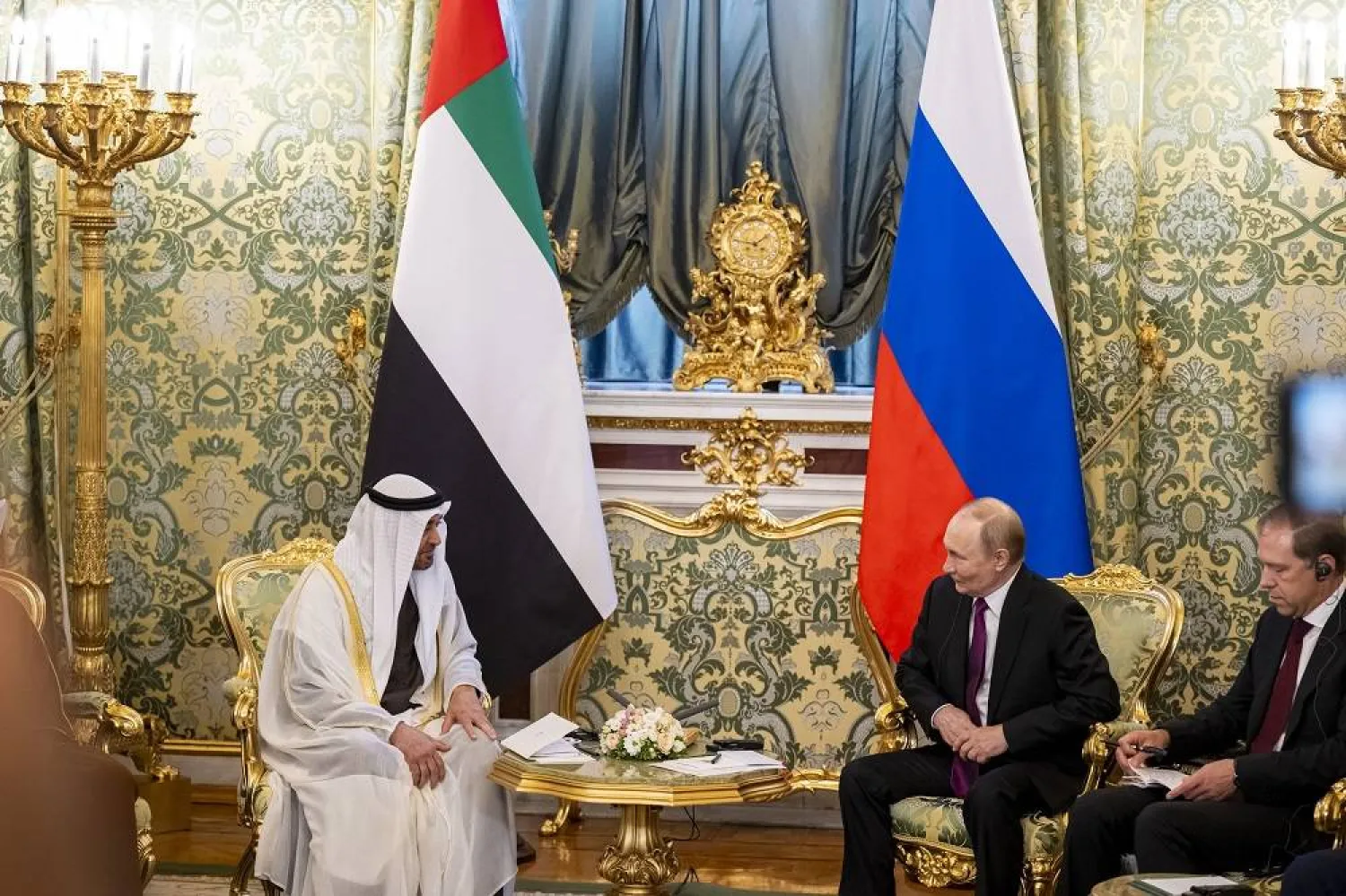

Mohamed bin Zayed, Putin Discuss Bilateral Strategic Partnership, Cooperation on Int’l Affairs

UAE President Sheikh Mohamed bin Zayed Al Nahyan and Russian President Vladimir Putin meet in Moscow on Thursday. (WAM)
TT

Mohamed bin Zayed, Putin Discuss Bilateral Strategic Partnership, Cooperation on Int’l Affairs

UAE President Sheikh Mohamed bin Zayed Al Nahyan and Russian President Vladimir Putin meet in Moscow on Thursday. (WAM)

UAE President Sheikh Mohamed bin Zayed Al Nahyan held talks in Moscow on Thursday with Russian President Vladimir Putin on boosting the strategic partnership between their countries, as well as regional and international issues of common interest.

The two leaders met at the Kremlin as part of Sheikh Mohamed’s official visit to Russia.

They reviewed progress in UAE-Russia cooperation, particularly in the fields of the economy, trade, investment, space, and energy, as well as other areas that serve the development-focused priorities of both countries and reflect their aim to bolster their strategic partnership, reported the UAE state news agency (WAM).

UAE-Russia relations are based on mutual trust and respect and deep-rooted and constructive engagement spanning more than 50 years, said Sheikh Mohamed bin Zayed.

He underlined the UAE's commitment to building effective partnerships with other countries and deepening international cooperation to address shared global challenges and foster prosperity and development for all.

Sheikh Mohamed bin Zayed and Putin also exchanged views on regional and international issues of mutual interest. Sheikh Mohamed bin Zayed stressed the UAE's steadfast commitment to strengthening peace and stability, while advancing diplomatic solutions both regionally and globally.

The leaders discussed the importance of the Russia-Arab summit, scheduled to be held in October at the direction of Putin, in strengthening Russia's relations with the Arab world.

They reviewed developments in the Middle East, underscoring the need to intensify efforts towards achieving a just, comprehensive, and lasting peace based on the two-state solution with the aim of promoting stability and security for all.

Putin said Russia attaches great importance to developing its relations with the UAE, noting that the two countries’ cooperation continues to grow, especially in the economic and investment fields.

Putin hosted a luncheon for Sheikh Mohamed bin Zayed and the accompanying delegation.

On the sidelines of the visit, the two countries signed the Trade in Services and Investment Agreement (TISIA).

The agreement was signed UAE Minister of Foreign Trade Dr. Thani bin Ahmed Al Zeyoudi and Russian Minister of Economic Development Maxim Reshetnikov.

The UAE-Russia TISIA complements the Economic Partnership Agreement signed between the UAE and the Eurasian Economic Union (EAEU), which includes Armenia, Belarus, Kazakhstan, Kyrgyzstan, and Russia.

It provides a special bilateral cooperation framework focusing on services and investment, including the areas of financial technology, healthcare, transportation, logistics, professional services, and others.

UAE Minister of Energy and Infrastructure Suhail MohamMed Al Mazrouei and Russian Minister of Transport Andrey Nikitin also signed a Memorandum of Understanding on cooperation in the field of land transport.



Saudi Support for Inclusive Southern Dialogue Without Monopoly or Exclusion

Caption: Saudi Arabia seeks comprehensive solutions for southern Yemenis through the forthcoming dialogue (Reuters).
TT

Saudi Support for Inclusive Southern Dialogue Without Monopoly or Exclusion

Caption: Saudi Arabia seeks comprehensive solutions for southern Yemenis through the forthcoming dialogue (Reuters).

Riyadh has hosted the Southern Consultative Meeting as a prelude to a comprehensive Southern Dialogue Conference, signaling the return of southern Yemen as a core issue in the country’s peace process. The meeting brought together a broad range of southern leaders and groups, including advocates of restoring the state that existed in southern and eastern Yemen before the 1990 unification with the north.

The consultative talks were attended by Yemeni Presidential Leadership Council Vice President Abdul Rahman Al-Mahrami, who read the final communiqué.

Saudi sponsorship reflects a shift in the Kingdom’s role from primarily military support for Yemen’s internationally recognized government to that of a key political sponsor of a comprehensive settlement.

The communiqué underscored this approach, stressing that Saudi Arabia “does not adopt a hostile position toward any southern option,” provided it is the outcome of an inclusive, non-exclusive intra-dialogue.

Beyond politics, Saudi backing extended to urgent economic measures, including the allocation of SAR 1.9 billion to support the economy and ensure payment of salaries for civil servants and military personnel. Observers say these steps give Saudi mediation tangible credibility and directly link economic stability with the success of the political process.

Criticism of External Interference

The final statement, and reactions surrounding it, carried pointed — if indirect — criticism of the United Arab Emirates.

Analysts accuse Abu Dhabi of deepening southern divisions by backing specific factions, particularly those previously led by Aidarous al-Zubaidi, former head of the dissolved Southern Transitional Council, who reportedly moved to Abu Dhabi after refusing to join the Riyadh-sponsored dialogue.

This contrast casts Riyadh as an alternative to what critics describe as “chaotic” Emirati interference, emphasizing inclusive dialogue among southerners and support for state institutions as part of a pathway toward broader Yemeni stability.

Southern visions remain diverse. Some leaders seek secession and restoration of the pre-1990 state, others favor a federal Yemen with self-governing regions, while additional voices propose alternative arrangements they see as fairer and less centralized. These differing perspectives place Saudi Arabia in the role of mediator seeking to unify southerners, while Abu Dhabi is increasingly portrayed by critics as a force fueling fragmentation.

Yemen’s Presidential Leadership Council Chairman Rashad al-Alimi has previously called on the UAE to withdraw militarily from Yemen and halt interference in internal affairs, accusing it of backing unilateral moves to impose control by force over Hadramout and Al-Mahra.

Internal Reckoning and a Historic Chance

The consultative meeting also highlighted internal challenges that have weakened the southern cause. Participants rejected any monopoly over representation or attempts to reduce the issue to a single leader or group. The statement distinguished between the legitimacy of the southern cause as a political and rights-based demand and the harmful practices of some leaders accused of exploiting it for regional agendas or corruption.

This self-criticism, particularly from figures once associated with the Transitional Council, suggests a desire to correct course and rebuild credibility with the southern public and the international community. Calls for popular support “with awareness and responsibility” aim to restore grassroots legitimacy and prevent the manipulation of protests for narrow interests.

The communiqué described the upcoming comprehensive Southern Dialogue Conference as a “rare historic opportunity,” enabled by Saudi sponsorship and a growing southern consensus on dialogue as the only safe path forward.

Regionally and internationally, resolving the southern issue is increasingly seen as a key gateway to a comprehensive peace in Yemen. However, success will depend on overcoming deep internal divisions and shielding the process from destabilizing interference.


GCC Chief Welcomes Syrian Government's Agreement with SDF

Secretary General of the Gulf Cooperation Council Jasem Mohamed Albudaiwi. GCC
TT

GCC Chief Welcomes Syrian Government's Agreement with SDF

Secretary General of the Gulf Cooperation Council Jasem Mohamed Albudaiwi. GCC

Gulf Cooperation Council (GCC) Secretary-General Jasem Albudaiwi welcomed the new agreement between the Syrian government and the Syrian Democratic Forces, the Saudi Press Agency reported on Tuesday.

Albudaiwi welcomed the announcement by Syria’s President Ahmed al-Sharaa regarding a new agreement with the SDF and the provisions it includes that contribute to strengthening and maintaining security and stability in Syria.

He emphasized that the final communiqué issued by the 46th session of the Supreme Council of the leaders of the GCC states stresses the importance of respecting the sovereignty, independence, and territorial integrity of Syria, noting that Syria’s security and stability are a fundamental pillar of regional security and stability.


Saudi FM Holds Phone Calls with US Envoy for Syria, Omani Counterpart, US Secretary of State

Saudi Minister of Foreign Affairs Prince Faisal bin Farhan bin Abdullah.
TT

Saudi FM Holds Phone Calls with US Envoy for Syria, Omani Counterpart, US Secretary of State

Saudi Minister of Foreign Affairs Prince Faisal bin Farhan bin Abdullah.

Saudi Minister of Foreign Affairs Prince Faisal bin Farhan bin Abdullah held a phone call on Monday with US Special Envoy for Syria Tom Barrack, the Saudi Press Agency reported. 

During the call, they discussed the latest developments in Syria. 

The Saudi minister also spoke by telephone with his Omani counterpart, Sayyid Badr bin Hamad bin Hamood Albusaidi. They exchanged views on the latest regional developments and the efforts being made in this regard. 

Earlier on Monday, the Saudi minister held a phone call with United States Secretary of State Marco Rubio. They discussed the latest regional developments.