

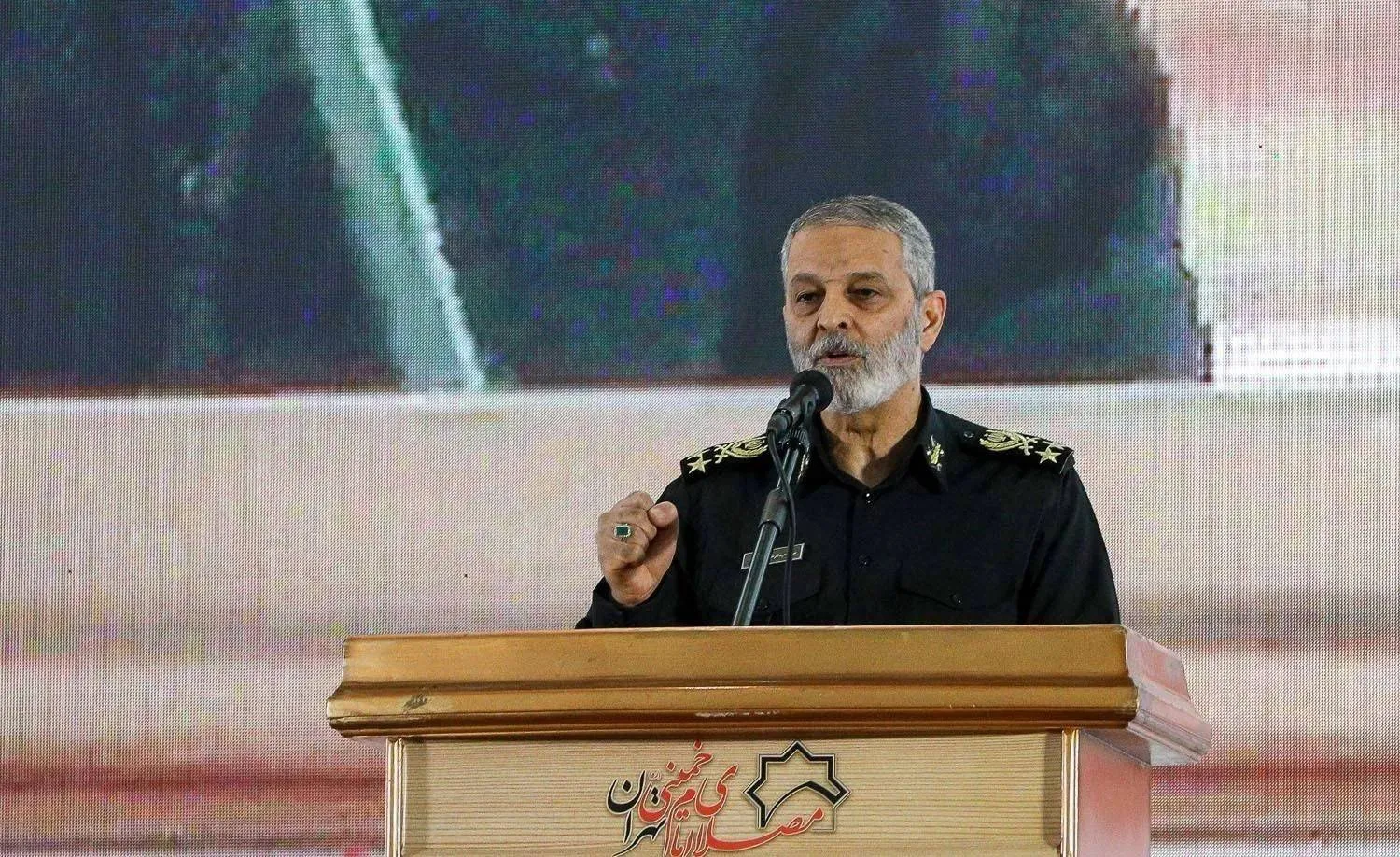

Iran Military Chief: Any New Attack to Face Full Response

Maj. Gen. Abdolrahim Mousavi (DefaPress)
TT

Iran Military Chief: Any New Attack to Face Full Response

Maj. Gen. Abdolrahim Mousavi (DefaPress)

Iran’s armed forces chief, Maj. Gen. Abdolrahim Mousavi, warned the United States and Western powers on Thursday that any new aggression would meet a “decisive, overwhelming and unprecedented” response, vowing retaliation for past strikes on the country’s nuclear facilities.

Hours earlier, US President Donald Trump warned Tehran against resuming uranium enrichment, threatening further military action.

Speaking at a news conference, Trump described Iran as a source of hatred and a very evil place, predicting a very different situation there in the coming years without offering details.

He defended US strikes on Iran’s nuclear program, saying the US prevented wars in the Middle East by stopping Iran from getting a nuclear weapon.

On June 22, US B-2 bombers hit key nuclear facilities in Fordow, south of Tehran, and in the central cities of Isfahan and Natanz, during a 12-day air war between Israel and Iran. The strikes came two days before a ceasefire took effect on June 24.

Tasnim news agency, affiliated with Iran’s Revolutionary Guards, quoted Mousavi as saying that Iran had withstood “fierce attacks” by Israel during the June conflict.

“We are fighting the enemy on multiple fronts,” he said. “We must be ready for all battlefields - military, cognitive, media, cultural and economic.”

Mousavi acknowledged the killing of field commanders and nuclear scientists, praising their “historic responsibility” in the face of threats. “The recent events clearly show that this illegitimate entity’s claims are worthless,” he said, accusing Israel of seeking to drag Iran into chaos and war. “If an aggressor sets foot on this land, Iranians of all faiths will stand united against it.”

Post-war, Mousavi said, Iran was “stronger and more united” despite economic challenges, warning of a “hybrid war” targeting national unity and morale. On Israel’s future, he said: “It has none. This entity is like a vehicle with failed brakes heading aimlessly towards collapse.”

Addressing US policymakers, Mousavi asked: “Do you really want to sacrifice your country’s fate and future generations to save Netanyahu? The Iranian nation will never forget America’s crimes, and future generations will take revenge.”

Foreign Minister Abbas Araghchi told state TV on Wednesday night that “the Americans realized the military option was useless,” rejecting any US pledge as a basis for restarting talks. “If they think bombing our facilities will make us back down, it’s the opposite - our position has become more resolute,” he said.

Araghchi stressed that while facilities could be rebuilt and equipment replaced, “science does not vanish under bombardment.”

Parliament’s national security commission chief Ebrahim Azizi dismissed US threats as “worn-out language” and warned that Iran’s security was a red line. Revolutionary Guards intelligence head Majid Khademi said Tehran had drawn “valuable lessons” from the war and would “inevitably force the enemy to stay in its place.”



Russia Says It Hopes for New Round of Ukraine Talks with US as Soon as Conditions Allow

FILE PHOTO: Kremlin spokesman Dmitry Peskov looks on as Russia's President Vladimir Putin (not pictured) and Togo's President of the Council of Ministers Faure Gnassingbe (not pictured) meet at the Kremlin in Moscow, Russia November 19, 2025. REUTERS/Ramil Sitdikov/Pool/File Photo
TT

Russia Says It Hopes for New Round of Ukraine Talks with US as Soon as Conditions Allow

FILE PHOTO: Kremlin spokesman Dmitry Peskov looks on as Russia's President Vladimir Putin (not pictured) and Togo's President of the Council of Ministers Faure Gnassingbe (not pictured) meet at the Kremlin in Moscow, Russia November 19, 2025. REUTERS/Ramil Sitdikov/Pool/File Photo

Russia is in contact with the United States about a new round of talks on a Ukraine peace settlement as soon as conditions allow, the Kremlin said on Thursday.

"We remain open, we are in contact with the Americans, and we are counting on holding the next round of talks as soon ‌as circumstances permit," ‌Kremlin spokesman Dmitry Peskov said.

Peskov rejected ‌the ⁠thesis of a ⁠New York Times opinion piece that said the Iran war had caused President Vladimir Putin to lose interest in negotiating an end to the Ukraine conflict, Reuters reported.

"This is an absolutely false invention that does not correspond to reality. During the rounds of trilateral talks that ⁠have taken place, some progress was made ‌toward a settlement," Peskov told ‌reporters.

Peskov said Russia had not lost interest in peace ‌talks but added that key issues - including territory - had ‌yet to be settled.

The NYT opinion piece, by Russian journalist Mikhail Zygar, said Russia's economy had been faltering earlier this year, prompting Putin at that point to take negotiations on ‌a Ukraine settlement more seriously.

However, Zygar said the Iran war had reversed those dynamics by ⁠boosting ⁠oil prices, easing the economic pressure on Moscow and reducing the US focus on Ukraine, weakening any incentive for the Kremlin to seek a settlement.

Earlier this week, Kremlin aide Yuri Ushakov said the US had briefed Russia about Washington's latest round of talks with a Ukrainian delegation in Florida, which took place last Saturday.

The last three-way peace talks between Russia, Ukraine and the US took place last month, before the Trump administration and Israel began airstrikes against Iran on February 28.


Pentagon Reportedly Weighs Diverting Ukraine Military Aid to the Middle East

FILE - The Pentagon and the surrounding area is seen in this aerial view in Washington, Jan. 26, 2020. (AP Photo/Pablo Martinez Monsivais, File)
TT

Pentagon Reportedly Weighs Diverting Ukraine Military Aid to the Middle East

FILE - The Pentagon and the surrounding area is seen in this aerial view in Washington, Jan. 26, 2020. (AP Photo/Pablo Martinez Monsivais, File)

The Pentagon is weighing whether to redirect weapons originally meant for Ukraine to the Middle East, as the war in Iran strains supplies of some of the US military's most critical munitions, the Washington Post reported Thursday, citing three people familiar with the matter.

The weapons that could be redirected include air defense interceptor missiles purchased through a NATO initiative launched last year, under which ⁠partner countries buy ⁠US arms for Kyiv, the report said.

The consideration comes as US operations in the region intensify. Admiral Brad Cooper, the Central Command chief leading US forces in the Middle East, on Wednesday said the US had hit ⁠over 10,000 targets inside Iran and was on track to limit Iran's ability to project power outside its borders.

A Pentagon spokesperson told the newspaper that the Defense Department would "ensure that US forces and those of our allies and partners have what they need to fight and win."

In response to a query about the report, a NATO official said members of ⁠the ⁠alliance and its partners continue to contribute to its Prioritized Ukraine Requirements List (PURL) program that funds the supply of US arms for Kyiv.

"Equipment is continuously flowing into Ukraine," the official added. "The amount pledged to PURL so far is of several billion US dollars and we expect more contributions to follow."

The Pentagon and the US State Department did not immediately respond to Reuters' requests for comment.


Israel Defense Minister Says Iran Guards Navy Commander Killed in Strike

(FILES) This handout photo provided by Iran's Revolutionary Guard Corps (IRGC) official website Sepah News on February 1, 2025, shows navy commander Admiral Alireza Tangsiri. (Photo by SEPAH NEWS / AFP)
TT

Israel Defense Minister Says Iran Guards Navy Commander Killed in Strike

(FILES) This handout photo provided by Iran's Revolutionary Guard Corps (IRGC) official website Sepah News on February 1, 2025, shows navy commander Admiral Alireza Tangsiri. (Photo by SEPAH NEWS / AFP)

Defense Minister Israel Katz announced on Thursday that an Israeli airstrike had killed Alireza Tangsiri, commander of the Iranian Revolutionary Guards' navy.

"Last night, in a precise and lethal operation, the IDF eliminated the commander of the Revolutionary Guards' navy, Tangsiri, along with senior officers of the naval command," Katz said in a video statement.

"The man who was directly responsible for the terrorist operation of mining and blocking the Strait of Hormuz to shipping was blown up and eliminated."

Since the start of the joint US-Israeli attacks on Iran on February 28, Israel has announced the killing of several top Iranian officials, including supreme leader Ali Khamenei and the security chief, Ali Larijani.

In recent days, Israeli forces have carried out several strikes targeting the naval assets of Iran.

Last week, Israeli airstrikes hit several Iranian naval ships in the Caspian Sea, including ones equipped with missile systems, support vessels and patrol craft.