

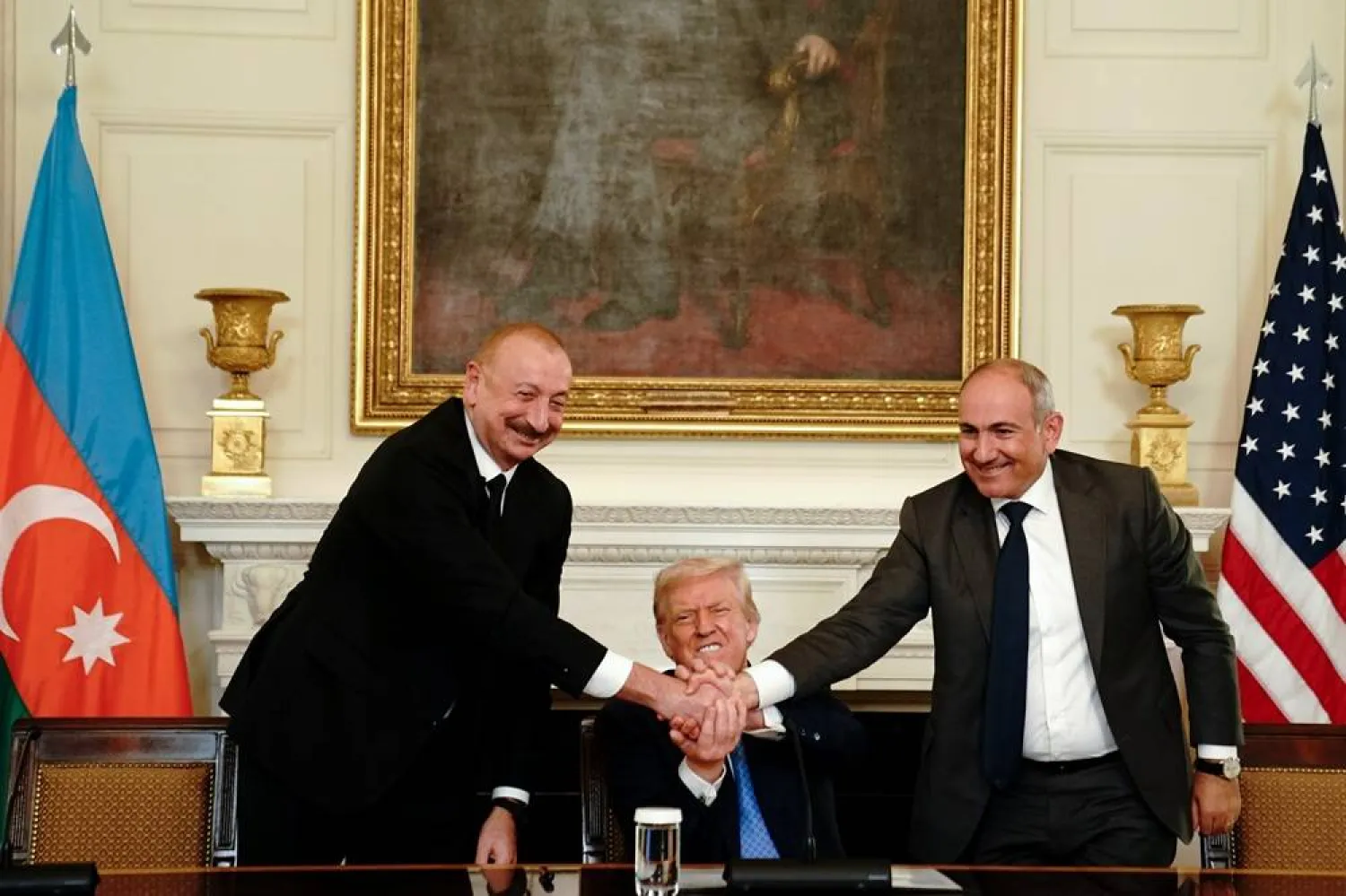

Trump Announces Peace Agreement Between Azerbaijan and Armenia

(L-R) Azerbaijan's President Ilham Aliyev, US President Donald Trump, and Armenia's Prime Minister Nikol Pashinyan join hands during a signing ceremony in the State Dining Room of the White House in Washington, DC, USA, 08 August 2025. (EPA)
TT

Trump Announces Peace Agreement Between Azerbaijan and Armenia

(L-R) Azerbaijan's President Ilham Aliyev, US President Donald Trump, and Armenia's Prime Minister Nikol Pashinyan join hands during a signing ceremony in the State Dining Room of the White House in Washington, DC, USA, 08 August 2025. (EPA)

Azerbaijan and Armenia signed a US-brokered peace agreement on Friday during a meeting with US President Donald Trump that would boost bilateral economic ties after decades of conflict and move them toward a full normalization of their relations.

The deal between the South Caucasus rivals - assuming it holds - would be a significant accomplishment for the Trump administration that is sure to rattle Moscow, which sees the region as within its sphere of influence.

"It's a long time - 35 years - they fought and now they're friends, and they're going to be friends for a long time," Trump said at a signing ceremony at the White House, where he was flanked by Azerbaijani President Ilham Aliyev and Armenian Prime Minister Nikol Pashinyan.

Armenia and Azerbaijan have been at odds since the late 1980s when Nagorno-Karabakh, a mountainous Azerbaijani region mostly populated by ethnic Armenians, broke away from Azerbaijan with support from Armenia. Azerbaijan took back full control of the region in 2023, prompting almost all of the territory's 100,000 ethnic Armenians to flee to Armenia.

Trump said the two countries had committed to stop fighting, open up diplomatic relations and respect each other's territorial integrity.

The agreement includes exclusive US development rights to a strategic transit corridor through the South Caucasus that the White House said would facilitate greater exports of energy and other resources.

Trump said the United States signed separate deals with each country to expand cooperation on energy, trade and technology, including artificial intelligence. Details were not released.

He said restrictions had also been lifted on defense cooperation between Azerbaijan and the United States, a development that could also worry Moscow.

Both leaders praised Trump for helping to end the conflict and said they would nominate him for the Nobel Peace Prize.

Trump has tried to present himself as a global peacemaker in the first months of his second term. The White House credits him with brokering a ceasefire between Cambodia and Thailand and sealing peace deals between Rwanda and the Democratic Republic of Congo, and Pakistan and India.

However, he has not managed to end Russia's 3-1/2-year-old war in Ukraine or Israel's conflict with Hamas in Gaza. Trump on Friday said he would meet Russian President Vladimir Putin in Alaska on August 15 to work on ending the war.

ENDING SANCTIONS EVASION BLIND SPOT

US officials said the agreement was hammered out during repeated visits to the region and would provide a basis for working toward a full normalization between the countries.

The peace deal could transform the South Caucasus, an energy-producing region neighboring Russia, Europe, Türkiye and Iran that is criss-crossed by oil and gas pipelines but riven by closed borders and longstanding ethnic conflicts.

Brett Erickson, a sanctions expert and adviser to Loyola University's Chicago School of Law, said the agreement would help the West crack down on Russian efforts to evade sanctions.

"The Caucasus has been a blind spot in sanctions policy," he said. "A formal peace creates a platform for the West to engage Armenia and Azerbaijan ... to shut down the evasion pipelines."

Tina Dolbaia, an associate fellow at the Center for Strategic and International Studies, said Friday's signing was a big symbolic move, but many questions remained, including which US companies might control the new transit corridor and how involved Armenia and Azerbaijan would be in its construction.

She said Russia would likely be irritated by being excluded from the agreement and the US role in the corridor. "Now the fact that ... Armenians are shaking hands with Azerbaijanis, and they are talking about US involvement in this corridor - this is huge for Russia," she said.

Olesya Vartanyan, an independent regional expert, said the deal added greater predictability to the region, but its long-term prospects would depend on continued US engagement.

"Armenia and Azerbaijan ... have a much longer track record of failed negotiations and violent escalations than of peaceful resolutions," she said. "Without proper and continued US involvement, the issue will likely get deadlocked again, increasing the chances of renewed tensions."

Senior administration officials said the agreement marked the end to the first of several frozen conflicts on Russia's periphery since the end of the Cold War, sending a powerful signal to the entire region.

Armenia plans to award the US exclusive special development rights for an extended period on the transit corridor, US officials told Reuters this week. The so-called Trump Route for International Peace and Prosperity has already drawn interest from nine companies, including three US firms, one official said on condition of anonymity.

Daphne Panayotatos, with the Washington-based rights group Freedom Now, said it had urged the Trump administration to use the meeting with Aliyev to demand the release of some 375 political prisoners held in the country.

Azerbaijan, an oil-producing country that hosted the United Nations climate summit last November, has rejected Western criticism of its human rights record, describing it as unacceptable interference.



Half of Ukraine’s Capital in the Dark After Russian Strikes, Ministry Says

 People use a flashlight as they walk during a power blackout after critical civil infrastructure was hit by recent a Russian missile and drone attacks, amid Russia's attack on Ukraine, in Kyiv, Ukraine December 8, 2025. (Reuters)
People use a flashlight as they walk during a power blackout after critical civil infrastructure was hit by recent a Russian missile and drone attacks, amid Russia's attack on Ukraine, in Kyiv, Ukraine December 8, 2025. (Reuters)
TT

Half of Ukraine’s Capital in the Dark After Russian Strikes, Ministry Says

 People use a flashlight as they walk during a power blackout after critical civil infrastructure was hit by recent a Russian missile and drone attacks, amid Russia's attack on Ukraine, in Kyiv, Ukraine December 8, 2025. (Reuters)
People use a flashlight as they walk during a power blackout after critical civil infrastructure was hit by recent a Russian missile and drone attacks, amid Russia's attack on Ukraine, in Kyiv, Ukraine December 8, 2025. (Reuters)

Power was out for roughly half of residents in the Ukrainian capital Kyiv on Tuesday after the latest Russian attacks on the country's energy system, the energy ministry said.

"The situation in Kyiv remains one of the most difficult – currently, up to 50% of consumers in the capital are without electricity," the ministry said on Telegram.

Russia has sharply increased both the number and intensity of attacks on Ukrainian gas and energy infrastructure in recent months, targeting both power generation facilities and electricity transmission systems.

Ukraine operates three nuclear power plants, which produce more than 50% of all electricity, but the plants are forced to reduce production due to damage to power lines.

The energy shortage is forcing power grid operator Ukrenergo to restrict supplies to consumers, plunging entire regions into darkness. Power cuts also affect heat and water supplies.

Residents of Kyiv and the Kyiv region have been getting electricity for only about 10 hours out of 24 over the past week.


Germany Plans Production of Advanced Taurus Missiles from 2029

A man pauses on a pedestrian bridge as a German flag flies over the Reichstag building in Berlin on October 23, 2024. (AFP)
TT

Germany Plans Production of Advanced Taurus Missiles from 2029

A man pauses on a pedestrian bridge as a German flag flies over the Reichstag building in Berlin on October 23, 2024. (AFP)

Germany plans to begin production of an upgraded version of its Taurus cruise missile in 2029, according to a budget proposal seen by Reuters on Tuesday, which is expected to be approved by parliament next week.

German forces currently have some 600 Taurus missiles with an official range of more than 500 km (311 miles) in their inventories, to be launched from fighter jets such as the Tornado, the F-15 or the F-18.

The weapon, built by European defence company MBDA , is designed to destroy high-value targets behind enemy lines such as command bunkers, ammunition and fuel dumps, airfields and bridges.

The German government has repeatedly denied requests by Ukraine to supply it with Taurus cruise missiles amid concerns over their long range and their potential use against targets inside Russia, according to Reuters.

The upgraded Taurus NEO missile, as outlined in the 415-million-euro ($483 million) budget proposal which is classified as confidential, will feature an extended range, improved shielding against interference, and advancements in navigation and seeker head technology.

Sweden's Saab and US-based Williams International are identified as the main subcontractors for the enhanced missile.

At a later stage, Sweden and Spain may join the contract, the document said.

According to previous information, Germany aims to purchase some 600 Taurus NEO for around 2 billion euros in total.

The Kremlin has told Germany that delivering cruise missiles to Kyiv would lead to a further round of "spiralling tension" in the Ukraine conflict.


Putin Does Not Want to Restore the USSR or Attack NATO, the Kremlin Says 

Russian President Vladimir Putin speaks during his meeting with members of the Council of the Collective Security Treaty Organization (CSTO) Parliamentary Assembly at the Senate Palace of the Kremlin in Moscow, Russia December 8, 2025. (Pavel Bednyakov/Pool via Reuters)
TT

Putin Does Not Want to Restore the USSR or Attack NATO, the Kremlin Says 

Russian President Vladimir Putin speaks during his meeting with members of the Council of the Collective Security Treaty Organization (CSTO) Parliamentary Assembly at the Senate Palace of the Kremlin in Moscow, Russia December 8, 2025. (Pavel Bednyakov/Pool via Reuters)

The Kremlin said on Tuesday that European claims that Russian President Vladimir Putin wanted to restore the Soviet Union were wrong and that claims Putin plans to invade a NATO member were complete stupidity.

Putin, who was born in the Soviet Union, in 2005 cast the collapse of the Soviet Union as the biggest geopolitical catastrophe of the 20th century because tens of millions of Russians were impoverished and Russia itself faced the threat of disintegration.

Opponents say Putin's Russia is decaying in a potent brew of absurdity and repression that is comparable to the Leonid Brezhnev-era of the Soviet Union. Western leaders say that Putin, if he wins in Ukraine, will one day attack NATO.

Putin has repeatedly denied that he has any plans to attack NATO and has said that such a step would be foolish for Russia given the conventional military superiority of NATO over Russia.

German Chancellor Friedrich Merz said on Monday that Putin wanted to bring the "old Soviet Union" back and that Europe had to defend itself against what he said were clear Russian intentions, set out, he said, in Russian state doctrines, to attack NATO.

"This is not true," Kremlin spokesman Dmitry Peskov told reporters when asked about Merz's remarks. "Vladimir Putin does not want to restore the USSR because it is impossible, and he himself has repeatedly said this."

"To talk about it is not respectful to our partners," Peskov said. "Apparently, Mr. Merz does not know this."

"As for preparing for an attack on NATO, this is complete stupidity," Peskov said.