


Nagasaki Marks 80th A-Bomb Anniversary as Survivors Put Hopes of Nuke Ban in the Hands of Youth

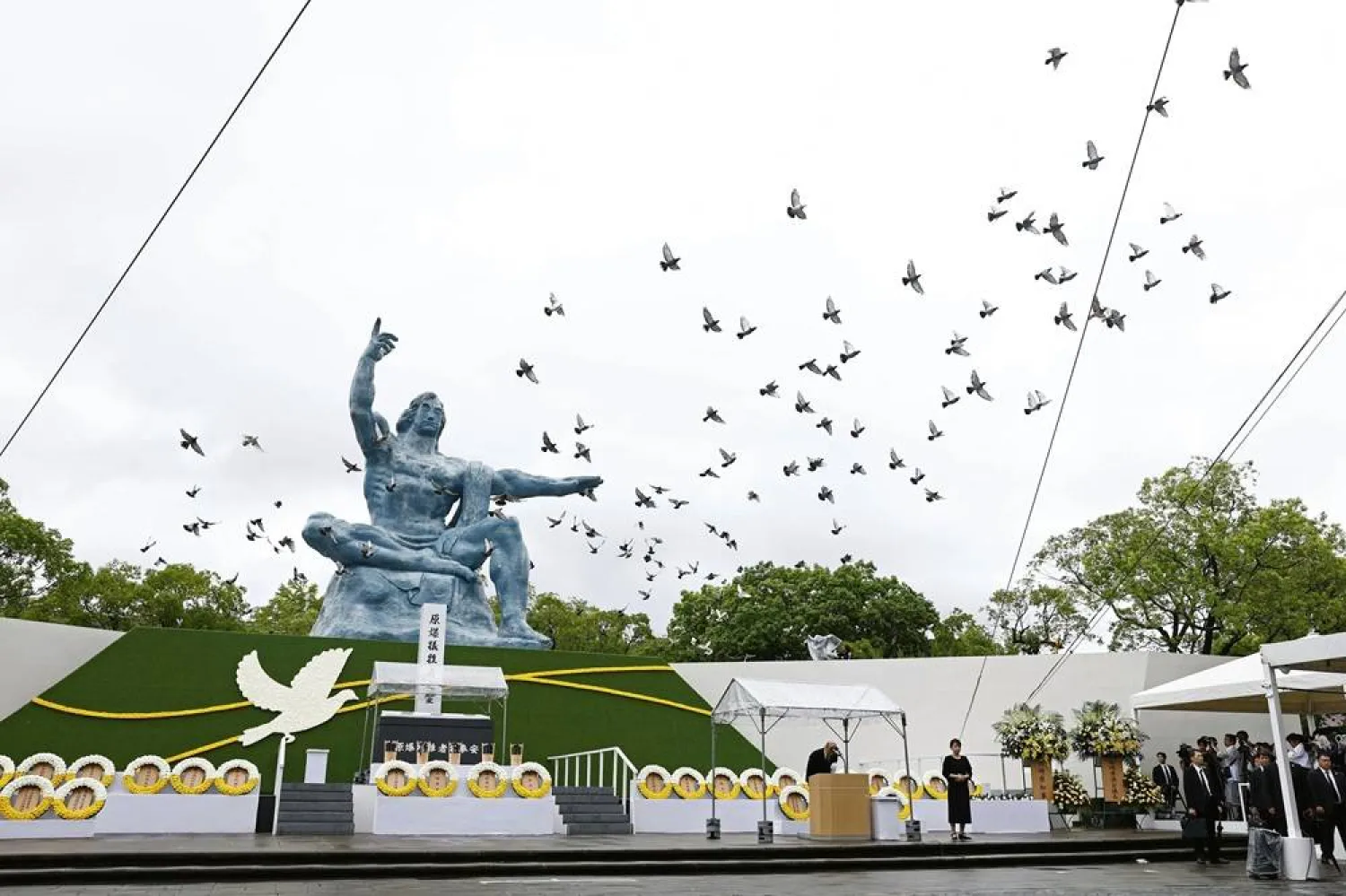
 Doves are leased over the Peace Statue during a ceremony to mark the 80th anniversary of the US atomic bombing at the Peace Park in Nagasaki, southern Japan Saturday, Aug. 9, 2025. (Kyodo News via AP)
Doves are leased over the Peace Statue during a ceremony to mark the 80th anniversary of the US atomic bombing at the Peace Park in Nagasaki, southern Japan Saturday, Aug. 9, 2025. (Kyodo News via AP)
TT

Nagasaki Marks 80th A-Bomb Anniversary as Survivors Put Hopes of Nuke Ban in the Hands of Youth

 Doves are leased over the Peace Statue during a ceremony to mark the 80th anniversary of the US atomic bombing at the Peace Park in Nagasaki, southern Japan Saturday, Aug. 9, 2025. (Kyodo News via AP)
Doves are leased over the Peace Statue during a ceremony to mark the 80th anniversary of the US atomic bombing at the Peace Park in Nagasaki, southern Japan Saturday, Aug. 9, 2025. (Kyodo News via AP)

The southern Japanese city of Nagasaki on Saturday marked 80 years since the US atomic attack that killed tens of thousands and left survivors who hope their harrowing memories can help make their hometown the last place on Earth to be hit by a nuclear bomb.

The United States launched the Nagasaki attack on Aug. 9, 1945, killing 70,000 by the end of that year, three days after the bombing of Hiroshima that killed 140,000. Japan surrendered on Aug. 15, 1945, ending World War II and the country’s nearly half-century of aggression across Asia.

About 2,600 people, including representatives from more than 90 countries, attended a memorial event at Nagasaki Peace Park, where Mayor Shiro Suzuki and Prime Minister Shigeru Ishiba spoke, among other guests. At 11:02 a.m., the exact time when the plutonium bomb exploded above Nagasaki, participants observed a moment of silence as a bell rang.

Dozens of doves, a symbol of peace, were released after a speech by Suzuki, whose parents are survivors of the attack. He said the city’s memories of the bombing are “a common heritage and should be passed down for generations” in and outside Japan.

“The existential crisis of humanity has become imminent to each and every one of us living on Earth,” Suzuki said. “In order to make Nagasaki the last atomic bombing site now and forever, we will go hand-in-hand with global citizens and devote our utmost efforts toward the abolition of nuclear weapons and the realization of everlasting world peace.”

Praying for nuclear abolition and no war

Survivors and their families gathered Saturday in rainy weather at Peace Park and nearby Hypocenter Park, located below the bomb’s exact detonation spot, hours before the official ceremony.

“I simply seek a world without war," said Koichi Kawano, an 85-year-old survivor who laid flowers at the Hypocenter monument decorated with colorful paper cranes and other offerings.

Some others prayed at churches in Nagasaki, home to Catholic converts who went deep underground during centuries of violent persecution in Japan’s feudal era.

The twin bells at Urakami Cathedral, which was destroyed in the bombing, also rang together again after one of the bells that had gone missing following the attack was restored by volunteers.

Despite their pain from wounds, discrimination and illnesses from radiation, survivors have publicly committed to a shared goal of abolishing nuclear weapons. But they worry about the world moving in the opposite direction.

Survivors put their hopes in younger hands

Aging survivors and their supporters in Nagasaki now put their hopes of achieving nuclear weapons abolition in the hands of younger people, telling them the attack is not distant history, but an issue that remains relevant to their future.

“There are only two things I long for: the abolition of nuclear weapons and prohibition of war,” survivor Fumi Takeshita said. “I only see a world where nuclear weapons are never used and everyone can live in peace.”

In hopes of passing on the lessons of history, Takeshita visits schools to share her experience with children.

“When you grow up and remember what you learned today, please think what each of you can do to prevent war,” Takeshita, 83, told students during a school visit earlier this week.

Teruko Yokoyama, an 83-year-old member of a Nagasaki organization supporting survivors, said she feels the absence of those she has worked, which fuels her strong desire to document the lives of remaining survivors.

The number of survivors has fallen to 99,130, about a quarter of the original number, with their average age exceeding 86. Survivors worry about fading memories, as the youngest of the survivors were too young to recall the attack clearly.

“We must keep records of the atomic bombing damages of the survivors and their lifetime story,” said Yokoyama, whose two sisters died after suffering illnesses linked to radiation.

Her organization has started to digitalize the narratives of survivors for viewing on YouTube and other social media platforms with the help of a new generation.

“There are younger people who are beginning to take action,” Yokoyama told The Associated Press on Friday. “So I think we don’t have to get depressed yet.”

Nagasaki hosted a “peace forum” on Friday where survivors shared their stories with more than 300 young people from around the country. Seiichiro Mise, a 90-year-old survivor, said he is handing seeds of “flowers of peace” to the younger generation in hopes of seeing them bloom.

Japan's security dilemma

Survivors are frustrated by a growing nuclear threat and support among international leaders for developing or possessing nuclear weapons for deterrence. They criticize the Japanese government’s refusal to sign or even participate in the Treaty on the Prohibition of Nuclear Weapons because Japan, as an American ally, needs US nuclear possession as deterrence.

In Ishiba's speech, the prime minister reiterated Japan’s pursuit of a nuclear-free world and pledged to promote dialogue and cooperation between countries with nuclear weapons and non-nuclear states at the Non-Proliferation of Nuclear Weapons review conference scheduled for April and May 2026 in New York City. Ishiba, however, did not mention the nuclear weapons ban treaty.

Nagasaki invited representatives from all countries to attend the ceremony Saturday. China notably notified the city it would not be present without providing a reason.

The ceremony last year stirred controversy due to the absence of the US ambassador and other Western envoys in response to the Japanese city’s refusal to invite Israel.



3 Authors Win $10,000 Prizes for Blending Science and Literature

This combination of images shows cover art for “Ancient Light” by Kimberly Blaeser, left, “Bog Queen” by Anna North, center, and “Forest Euphoria: The Abounding Queerness of Nature” by Patricia Ononiwu Kaishian. (University of Arizona Press/Bloomsbury Publishing/Spiegel & Grau via AP)
TT

3 Authors Win $10,000 Prizes for Blending Science and Literature

This combination of images shows cover art for “Ancient Light” by Kimberly Blaeser, left, “Bog Queen” by Anna North, center, and “Forest Euphoria: The Abounding Queerness of Nature” by Patricia Ononiwu Kaishian. (University of Arizona Press/Bloomsbury Publishing/Spiegel & Grau via AP)

Three authors who demonstrated how scientific research can be wedded to literary grace have been awarded $10,000 prizes.

On Wednesday, the National Book Foundation and the Alfred P. Sloan Foundation announced the winners of the fifth annual Science + Literature awards. The books include Kimberly Blaeser's poetry collection, “Ancient Light,” inspired in part by the environmental destruction of Indigenous communities; the novel “Bog Queen” by Anna North, the story of a forensic anthropologist and a 2000-year-old Celtic druid; and a work of nonfiction, Patricia Ononiwu Kaishian's “Forest Euphoria: The Abounding Queerness of Nature.”

“These gifted storytellers shine a scientific and poetic light on the beauties and terrors of nature and what they reveal to us about our deepest selves, our humanity, and our existence on this planet,” Doron Weber, vice president and program director at the Sloan Foundation, said in a statement, The AP news reported.

Ruth Dickey, executive director of the National Book Foundation, said in a statement that the new winners continue the awards' mission to highlight “diverse voices in science writing that ... enlighten, challenge, and engage readers everywhere.”

The Book Foundation presents the National Book Awards, one of the literary world's most prestigious events. The Sloan Foundation has a long history of supporting books that join science and the humanities, including Kai Bird's and Martin J. Sherwin’s Pulitzer Prize-winning “American Prometheus,” which director Christopher Nolan adapted into the Oscar-winning “Oppenheimer.”

“At a time when science is under attack, it has become more urgent to elevate books that bring together the art of literature with the wonders of science,” Daisy Hernández, this year's chair of the awards committee and a 2022 Science + Literature honoree, said in a statement.


Meteorologists Blame a Stretched Polar Vortex, Moisture, Lack of Sea Ice for Dangerous Winter Blast

Ice forms along the Lake Michigan shore as People walk their dogs on a beach, Tuesday, Jan. 20, 2026, in Chicago. (AP Photo/Kiichiro Sato)
TT

Meteorologists Blame a Stretched Polar Vortex, Moisture, Lack of Sea Ice for Dangerous Winter Blast

Ice forms along the Lake Michigan shore as People walk their dogs on a beach, Tuesday, Jan. 20, 2026, in Chicago. (AP Photo/Kiichiro Sato)

Warm Arctic waters and cold continental land are combining to stretch the dreaded polar vortex in a way that will send much of the United States a devastating dose of winter later this week with swaths of painful subzero temperatures, heavy snow and powerline-toppling ice.

Meteorologists said the eastern two-thirds of the nation is threatened with a winter storm that could rival the damage of a major hurricane and has some origins in an Arctic that is warming from climate change. They warn that the frigid weather is likely to stick around through the rest of January and into early February, meaning the snow and ice that accumulates will take a long time to melt.

Wednesday’s forecast has the storm stretching from New Mexico to New England, threatening at least 250 million people.

“I think people are underestimating just how bad it’s going to be,” said former National Oceanic and Atmospheric Administration chief scientist Ryan Maue, now a private meteorologist.

The polar vortex, a patch of bitter cold air that often stays penned up in northern Canada and Alaska, is being elongated by a wave in the upper atmosphere that goes back to a relatively ice-free part of the Arctic and snow-buried Siberia. As the bone-chilling temperatures sweep through the US, they'll meet with moisture from off California and the Gulf of Mexico to set up crippling ice and snow in many areas.

Origins of the system in a warming Arctic The origins of the system begin in the Arctic, where relatively warmer temperatures add energy to the polar vortex and help push its cold air south.

“The atmosphere is aligned perfectly that the pattern is locked into this warm Arctic, cold continent," Maue said. "And it’s not just here for us in North America, but the landmass of Eastern Europe to Siberia is also exceptionally cold. The whole hemisphere has gone into the deep freeze.”

As far back as October 2025, changes in the Arctic and low sea ice were setting up conditions for the kind of stretched polar vortex that brings severe winter weather to the US, said winter weather expert Judah Cohen, an MIT research scientist. Heavy Siberian snowfall added to the push-and-pull of weather that warps the shape of the normally mostly circular air pattern. Those conditions “kind of loaded the dice a bit'' for a stretching of the polar vortex, he said, The AP news reported.

Cohen co-authored a July 2025 study that found more stretched polar vortex events linked to severe winter weather bursts in the central and eastern US over the past decade. Cohen said part of the reason is that dramatically low sea ice in the Barents and Kara seas in the Arctic helps set up a pattern of waves that end up causing US cold bursts. A warmer Arctic is causing sea ice in that region to shrink faster than other places, studies have found.

Arctic sea ice is at a record low extent for this time of year, according to the National Snow and Ice Data Center.

Where the winter blast will strike The center of the stretched polar vortex will be somewhere above Duluth, Minnesota, by Friday morning, ushering in “long-lasting brutal cold,” Maue said. Temperatures in the North and Midwest will get about as cold as possible, even down to minus 25 or 30 degrees Fahrenheit (minus 32 to minus 34 degrees Celsius), Maue said. The average low temperature for the Lower 48 states will dance around 11 or 12 degrees (minus 12 to minus 11 degrees Celsius) on Saturday, Sunday and Monday, Maue said.

Two Great Lakes — Erie and Ontario — may freeze up, which would at least reduce the famed lake-effect snow a bit, Maue said.

National Weather Service meteorologist Zack Taylor of the national Weather Prediction Center said most areas east of the Rockies will be impacted by the bitter cold, snow or ice. Treacherous freezing rain could stretch from the southern plains through the mid-South and into the Carolinas, he said.

“We’re looking at the potential for impactful ice accumulation. So the kind of ice accumulation that could cause significant or widespread power outages or potentially significant tree damage,” he said.

And if you don't get ice, you could get “another significant swath of heavy snow,” Taylor said. He said it was too early to predict how many inches will fall, but “significant snowfall accumulations” could hit "the Ozarks region, Tennessee and Ohio valleys, the central Appalachians, and then into the mid-Atlantic, and perhaps into the portions of the northeast.”

Maue said in the mid-Atlantic around the nation's capital, there's a possibility that “you can get two blizzards on top of each other in the next 14 days.”


How to Protect Yourself from Food Poisoning

Food poisoning usually resolves within a few days without severe symptoms (Pexels)
TT

How to Protect Yourself from Food Poisoning

Food poisoning usually resolves within a few days without severe symptoms (Pexels)

Many people around the world suffer from food poisoning, a condition that occurs after consuming contaminated food or beverages.

Symptoms of food poisoning may appear in some people immediately after eating contaminated food, while others may not experience them until several days later.

Food poisoning usually resolves within a few days without severe or long-lasting symptoms. Treatment focuses on drinking enough fluids and reducing symptoms like nausea and diarrhea. Prevention strategies, such as eating well-cooked and properly stored food, can reduce the risk of food poisoning.

Symptoms of Food Poisoning

The symptoms of food poisoning are very similar to those of viral gastroenteritis. Symptoms may disappear in as little as 24 hours or last for up to a week.

According to the Health website, symptoms of food poisoning include:

Diarrhea

Fever

Nausea

Stomach cramps

Vomiting

Symptoms in infants and children include:

Changes in mental state, such as increased nervousness

Lack of energy

Diarrhea that lasts more than 24 hours

Frequent loose stools or vomiting

Some symptoms of food poisoning are more severe and require medical attention. These symptoms include:

Blood in the stool

Diarrhea that lasts more than three days

Symptoms of dehydration, such as severe dry mouth, little or no urination, and dizziness

A high fever above 39 degrees Celsius

Persistent vomiting that prevents you from drinking fluids

Causes

Food poisoning most often results from eating food or beverages contaminated with bacteria, viruses, or parasites. The cause can be determined by knowing what you ate or drank and how quickly symptoms appeared.

Potential causes of food poisoning include:

Escherichia coli (E. coli): A bacterium that causes symptoms about three to four days after eating raw or undercooked ground beef, vegetables, or sprouts. Unpasteurized milk is another possible source of E. coli.

Salmonella: A bacterium that causes symptoms from six hours to six days after eating raw fruits or vegetables, or raw or undercooked meat or eggs. Unpasteurized milk is another possible source of Salmonella.

Staphylococcus aureus: A bacterium that causes symptoms 30 minutes to eight hours after consuming food that was handled improperly, such as sliced meats or sandwiches.

Vibrio: A bacterium that causes symptoms within 24 hours, usually from eating raw or undercooked shellfish.

Norovirus: A virus that causes symptoms 12 to 48 hours after touching contaminated cooking surfaces or eating contaminated green leafy vegetables, fruits, or shellfish. Norovirus may also cause intestinal infections.

Food poisoning can also occur from exposure to:

Parasites such as protozoa, nematodes, and tapeworms

Mold or toxins

Food allergies that trigger the immune system to respond after eating certain foods, including nuts, eggs, fish, wheat, and soybeans

Ways to Prevent Food Poisoning

Food poisoning cannot always be prevented, but you can reduce the risk by following food safety recommendations:

Wash your hands frequently while preparing and handling food.

Sanitize and wash cooking surfaces regularly.

Use separate surfaces for preparing raw meats.

Wash fruits and vegetables before eating, cutting, or cooking them.

Use a food thermometer to ensure food is cooked to the proper internal temperature. For example, cook meat to an internal temperature of at least 60 degrees Celsius or higher, depending on the type of meat.

Refrigerate perishable foods within two hours of cooking them, and store them in airtight containers when necessary to limit bacterial growth.

If the outside temperature is above 32 degrees Celsius, do not leave foods that may spoil unrefrigerated for more than one hour (for example, during a picnic).

When traveling, always drink bottled or treated water to reduce the risk of traveler’s diarrhea, a condition that may occur when traveling to places with untreated water sources.