


Iran Threatens Planned Trump Corridor Envisaged by Azerbaijan-Armenia Peace Deal

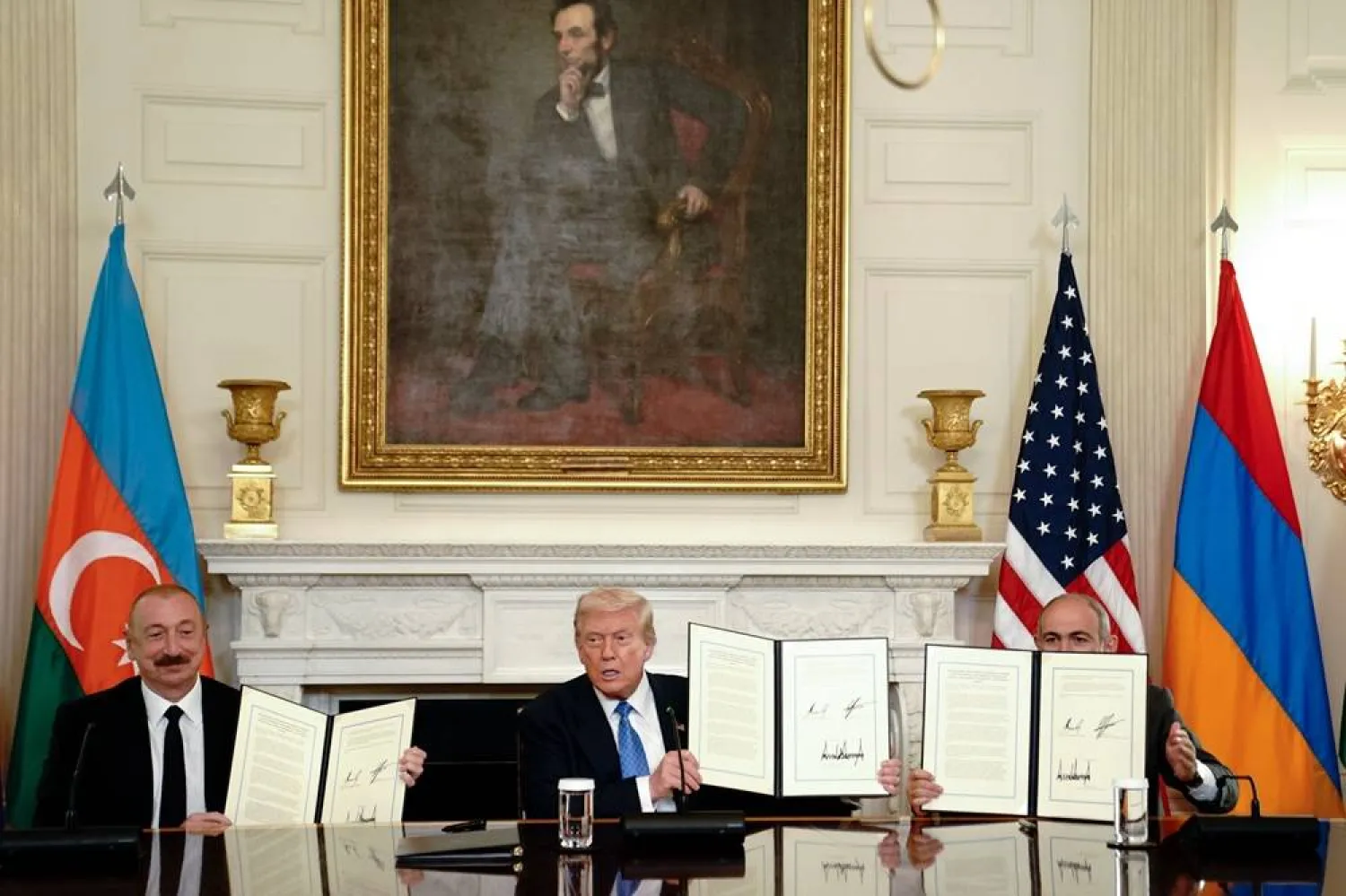
(L-R) Azerbaijan's President Ilham Aliyev, US President Donald Trump, and Armenia's Prime Minister Nikol Pashinyan display the signed agreements during a signing ceremony in the State Dining Room of the White House in Washington, DC, USA, 08 August 2025. (EPA)
TT

Iran Threatens Planned Trump Corridor Envisaged by Azerbaijan-Armenia Peace Deal

(L-R) Azerbaijan's President Ilham Aliyev, US President Donald Trump, and Armenia's Prime Minister Nikol Pashinyan display the signed agreements during a signing ceremony in the State Dining Room of the White House in Washington, DC, USA, 08 August 2025. (EPA)

Iran threatened on Saturday to block a corridor planned in the Caucasus under a regional deal sponsored by US President Donald Trump, Iranian media reported, raising a new question mark over a peace plan hailed as a strategically important shift.

A top Azerbaijani diplomat said earlier that the plan, announced by Trump on Friday, was just one step from a final peace deal between his country and Armenia, which reiterated its support for the plan.

The proposed Trump Route for International Peace and Prosperity (TRIPP) would run across southern Armenia, giving Azerbaijan a direct route to its exclave of Nakhchivan and in turn to Türkiye.

The US would have exclusive development rights to the corridor, which the White House said would facilitate greater exports of energy and other resources.

It was not immediately clear how Iran, which borders the area, would block it but the statement from Ali Akbar Velayati, top adviser to Iran's supreme leader, raised questions over its security.

He said military exercises carried out in northwest Iran demonstrated the country's readiness and determination to prevent any geopolitical changes.

"This corridor will not become a passage owned by Trump, but rather a graveyard for Trump's mercenaries," Velayati said.

Iran's foreign ministry earlier welcomed the agreement "as an important step toward lasting regional peace", but warned against any foreign intervention near its borders that could "undermine the region's security and lasting stability".

Analysts and insiders say that Iran, under mounting US pressure over its disputed nuclear program and the aftermath of a 12-day war with Israel in June, lacks the military power to block the corridor.

MOSCOW SAYS WEST SHOULD STEER CLEAR

Trump welcomed Azerbaijani President Ilham Aliyev and Armenian Prime Minister Nikol Pashinyan in the White House on Friday and witnessed their signing of a joint declaration aimed at drawing a line under their decades-long on-off conflict.

Russia, a traditional broker and ally of Armenia in the strategically important South Caucasus region which is crisscrossed with oil and gas pipelines, was not included, despite its border guards being stationed on the border between Armenia and Iran.

While Moscow said it supported the summit, it proposed "implementing solutions developed by the countries of the region themselves with the support of their immediate neighbors – Russia, Iran and Türkiye" to avoid what it called the "sad experience" of Western efforts to mediate in the Middle East.

Azerbaijan's close ally, NATO member Türkiye, welcomed the accord.

Baku and Yerevan have been at odds since the late 1980s when Nagorno-Karabakh, a mountainous Azerbaijani region mostly populated by ethnic Armenians, broke away from Azerbaijan with support from Armenia. Azerbaijan took back full control of the region in 2023, prompting almost all of the territory's 100,000 ethnic Armenians to flee to Armenia.

"The chapter of enmity is closed and now we're moving towards lasting peace," said Elin Suleymanov, Azerbaijan's ambassador to Britain, predicting that the wider region's prosperity and transport links would be transformed for the better.

"This is a paradigm shift," said Suleymanov, who as a former envoy to Washington who used to work in President Aliyev's office, is one of his country's most senior diplomats.

Suleymanov declined to speculate on when a final peace deal would be signed however, noting that Aliyev had said he wanted it to happen soon.

There remained only one obstacle, said Suleymanov, which was for Armenia to amend its constitution to remove a reference to Nagorno-Karabakh.

"Azerbaijan is ready to sign any time once Armenia fulfils the very basic commitment of removing its territorial claim against Azerbaijan in its constitution," he said.

MANY QUESTIONS UNANSWERED

Pashinyan this year called for a referendum to change the constitution, but no date for it has been set yet. Armenia is to hold parliamentary elections in June 2026, and the new constitution is expected to be drafted before the vote.

The Armenian leader said on X that the Washington summit had paved the way to end the decades of conflict and open transport connections that would unlock strategic economic opportunities.

Asked when the transit rail route would start running, Suleymanov said that would depend on cooperation between the US and Armenia whom he said were already in talks.

Joshua Kucera, Senior South Caucasus analyst at International Crisis Group, said Trump may not have got the easy win he had hoped for as the agreements left many questions unanswered.

The issue of Armenia's constitution continued to threaten to derail the process, and it was not clear how the new transport corridor would work in practice.

"Key details are missing, including about how customs checks and security will work and the nature of Armenia's reciprocal access to Azerbaijani territory. These could be serious stumbling blocks," said Kucera.

Suleymanov played down suggestions that Russia, which still has extensive security and economic interests in Armenia, was being disadvantaged.

"Anybody and everybody can benefit from this if they choose to," he said.


Ukraine’s New Defense Minister Reveals Scale of Desertions as Millions Avoid the Draft

Ukraine's newly appointed Defense Minister Mykhailo Fedorov attends a parliamentary session in Kyiv, Ukraine, 14 January 2026. (EPA)
TT

Ukraine’s New Defense Minister Reveals Scale of Desertions as Millions Avoid the Draft

Ukraine's newly appointed Defense Minister Mykhailo Fedorov attends a parliamentary session in Kyiv, Ukraine, 14 January 2026. (EPA)

Wide-scale desertions and 2 million draft-dodgers are among a raft of challenges facing Ukraine's military as Russia presses on with its invasion of its neighbor after almost four years of fighting, the new defense minister said Wednesday.

Mykhailo Fedorov told Ukraine's parliament that other problems facing Ukraine’s armed forces include excessive bureaucracy, a Soviet-style approach to management, and disruptions in the supply of equipment to troops along the about 1,000-kilometer (600-mile) front line.

“We cannot fight a war with new technologies but an old organizational structure,” Fedorov said.

He said the military had faced some 200,000 troop desertions and draft-dodging by around 2 million people.

President Volodymyr Zelenskyy appointed 34-year-old Fedorov at the start of the year. The former head of Ukraine’s digital transformation policies is credited with spearheading the army's drone technology and introducing several successful e-government platforms.

His appointment was part of a broad government reshuffle that the Ukrainian leader said aimed to sharpen the focus on security, defense development and diplomacy amid a new US-led push to find a peace settlement.

Fedorov said the defense ministry is facing a shortfall of 300 billion hryvnia ($6.9 billion) in funding needs.

The European Union will dedicate most of a massive new loan program to help fund Ukraine’s military and economy over the next two years, European Commission President Ursula von der Leyen said Wednesday.

Fedorov said Ukraine’s defense sector has expanded significantly since Russia’s full-scale invasion in February 2022. At the start of the war, he said, the country had seven private drone companies and two firms developing electronic warfare systems. Today, he said, there are nearly 500 drone manufacturers and about 200 electronic warfare companies in Ukraine.

He added that some sectors have emerged from scratch, including private missile producers, which now number about 20, and more than 100 companies manufacturing ground-based robotic systems.


France Explores Sending Eutelsat Terminals to Iran Amid Internet Blackout

 Protesters hold up placards with pictures of victims as they demonstrate in support of anti-government protests in Iran, outside Downing Street, in London, Wednesday, Jan. 14, 2026. (AP)
Protesters hold up placards with pictures of victims as they demonstrate in support of anti-government protests in Iran, outside Downing Street, in London, Wednesday, Jan. 14, 2026. (AP)
TT

France Explores Sending Eutelsat Terminals to Iran Amid Internet Blackout

 Protesters hold up placards with pictures of victims as they demonstrate in support of anti-government protests in Iran, outside Downing Street, in London, Wednesday, Jan. 14, 2026. (AP)
Protesters hold up placards with pictures of victims as they demonstrate in support of anti-government protests in Iran, outside Downing Street, in London, Wednesday, Jan. 14, 2026. (AP)

France is looking into sending Eutelsat satellite terminals to Iran to help citizens after Iranian authorities imposed a blackout of internet services in a bid to quell the country's most violent domestic unrest in decades.

"We are exploring all options, and the one you have mentioned is among them," French Foreign Minister Jean-Noel Barrot said on Wednesday in ‌the lower house ‌after a lawmaker asked whether France ‌would ⁠send Eutelsat ‌gear to Iran.

Backed by the French and British governments, Eutelsat owns OneWeb, the only low Earth orbit constellation, or group of satellites, besides Elon Musk's Starlink.

The satellites are used to beam internet service from space, providing broadband connectivity to businesses, governments and consumers in underserved areas.

Iranian authorities in recent days have ⁠launched a deadly crackdown that has reportedly killed thousands during protests against clerical rule, ‌and imposed a near-complete shutdown of internet ‍service.

Still, some Iranians have ‍managed to connect to Starlink satellite internet service, three people ‍inside the country said.

Even Starlink service appears to be reduced, Alp Toker, founder of internet monitoring group NetBlocks said earlier this week.

Eutelsat declined to comment when asked by Reuters about Barrot's remarks and its activities in Iran.

Starlink’s more than 9,000 satellites allow higher speeds than Eutelsat's fleet of over 600, ⁠and its terminals connecting users to the network are cheaper and easier to install.

Eutelsat also provides internet access to Ukraine's military, which has relied on Starlink to maintain battlefield connectivity throughout the war with Russia.

Independent satellite communications adviser Carlos Placido said OneWeb terminals are bulkier than Starlink’s and easier to jam.

"The sheer scale of the Starlink constellation makes jamming more challenging, though certainly not impossible," Placido said. "With OneWeb it is much easier to predict which satellite will become online over a given ‌location at a given time."


China Says It Opposes Outside Interference in Iran’s Internal Affairs

Iranians walk next to a billboard reading "Iran is our Homeland" at Enqelab Square in Tehran, Iran, 13 January 2026. (EPA)
TT

China Says It Opposes Outside Interference in Iran’s Internal Affairs

Iranians walk next to a billboard reading "Iran is our Homeland" at Enqelab Square in Tehran, Iran, 13 January 2026. (EPA)

China opposes any outside interference in Iran's ​internal affairs, the Chinese foreign ministry said on Wednesday, after US President Donald Trump warned that Washington ‌would take "very ‌strong action" ‌against Tehran.

China ⁠does ​not ‌condone the use or the threat of force in international relations, Mao Ning, spokesperson at ⁠the Chinese foreign ministry, said ‌at a ‍regular ‍news conference when ‍asked about China's position following Trump's comments.

Trump told CBS News in ​an interview that the United States would take "very ⁠strong action" if Iran starts hanging protesters.

Trump also urged protesters to keep protesting and said that help was on the way.
