


US and China Extend Trade Truce Another 90 Days, Easing Tension Between World’s Largest Economies 

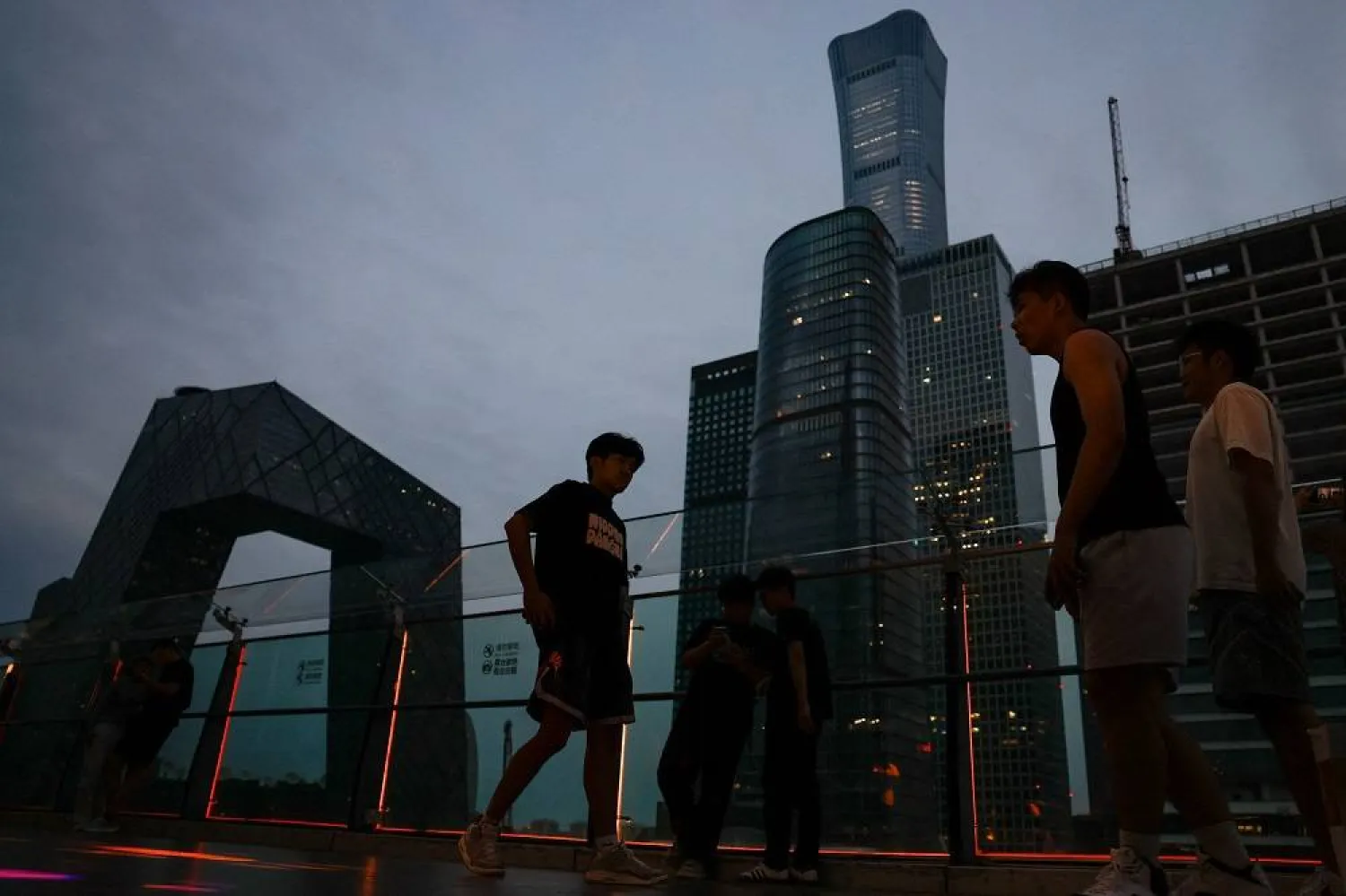
People walk on a terrace of a shopping mall at the central business district (CBD), in Beijing, China August 11, 2025. (Reuters)
TT

US and China Extend Trade Truce Another 90 Days, Easing Tension Between World’s Largest Economies 

People walk on a terrace of a shopping mall at the central business district (CBD), in Beijing, China August 11, 2025. (Reuters)

President Donald Trump extended a trade truce with China for another 90 days Monday, at least delaying once again a dangerous showdown between the world’s two biggest economies.

Trump posted on his Truth Social platform that he signed the executive order for the extension, and that “all other elements of the Agreement will remain the same.” Beijing at the same time also announced the extension of the tariff pause, according to the Ministry of Commerce.

The previous deadline was set to expire at 12:01 a.m. Tuesday. Had that happened the US could have ratcheted up taxes on Chinese imports from an already high 30%, and Beijing could have responded by raising retaliatory levies on US exports to China.

The pause buys time for the two countries to work out some of their differences, perhaps clearing the way for a summit later this year between Trump and Chinese President Xi Jinping, and it has been welcomed by the US companies doing business with China.

Sean Stein, president of the US-China Business Council, said the extension is “critical” to give the two governments time to negotiate a trade agreement that US businesses hope would improve their market access in China and provide the certainty needed for companies to make medium- and long-term plans.

“Securing an agreement on fentanyl that leads to a reduction in US tariffs and a rollback of China’s retaliatory measures is acutely needed to restart US agriculture and energy exports,” Stein said.

China said Tuesday it would extend relief to American companies who were placed on an export control list and an unreliable entities list. After Trump initially announced tariffs in April, China restricted exports of dual-use goods to some American companies, while banning others from trading or investing in China. The Ministry of Commerce said it would stop those restrictions for some companies, while giving others another 90-day extension.

Reaching a pact with China remains unfinished business for Trump, who has already upended the global trading system by slapping double-digit taxes – tariffs – on almost every country on earth.

The European Union, Japan and other trading partners agreed to lopsided trade deals with Trump, accepting once unthinkably US high tariffs (15% on Japanese and EU imports, for instance) to ward off something worse.

Trump’s trade policies have turned the United States from one of the most open economies in the world into a protectionist fortress. The average US tariff has gone from around 2.5% at the start of the year to 18.6%, highest since 1933, according to the Budget Lab at Yale University.

But China tested the limits of a US trade policy built around using tariffs as a cudgel to beat concessions out of trading partners. Beijing had a cudgel of its own: cutting off or slowing access to its rare earths minerals and magnets – used in everything from electric vehicles to jet engines.

In June, the two countries reached an agreement to ease tensions. The United States said it would pull back export restrictions on computer chip technology and ethane, a feedstock in petrochemical production. And China agreed to make it easier for US firms to get access to rare earths.

“The US has realized it does not have the upper hand,” said Claire Reade, senior counsel at Arnold & Porter and former assistant US trade representative for China affairs.

In May, the US and China had averted an economic catastrophe by reducing massive tariffs they'd slapped on each other’s products, which had reached as high as 145% against China and 125% against the US.

Those triple-digit tariffs threatened to effectively end trade between the United States and China and caused a frightening sell-off in financial markets. In a May meeting in Geneva they agreed to back off and keep talking: America’s tariffs went back down to a still-high 30% and China’s to 10%.

Having demonstrated their ability to hurt each other, they’ve been talking ever since.

“By overestimating the ability of steep tariffs to induce economic concessions from China, the Trump administration has not only underscored the limits of unilateral US leverage, but also given Beijing grounds for believing that it can indefinitely enjoy the upper hand in subsequent talks with Washington by threatening to curtail rare earth exports,” said Ali Wyne, a specialist in US-China relations at the International Crisis Group. “The administration’s desire for a trade détente stems from the self-inflicted consequences of its earlier hubris.”

It’s unclear whether Washington and Beijing can reach a grand bargain over America’s biggest grievances. Among these are lax Chinese protection of intellectual property rights and Beijing’s subsidies and other industrial policies that, the Americans say, give Chinese firms an unfair advantage in world markets and have contributed to a massive US trade deficit with China of $262 billion last year.

Reade doesn’t expect much beyond limited agreements such as the Chinese saying they will buy more American soybeans and promising to do more to stop the flow of chemicals used to make fentanyl and to allow the continued flow of rare-earth magnets.

But the tougher issues will likely linger, and “the trade war will continue grinding ahead for years into the future,” said Jeff Moon, a former US diplomat and trade official who now runs the China Moon Strategies consultancy.



Mawani Signs Agreement to Construct Offshore Structures at Ras Al-Khair Port

Mawani Signs Agreement to Construct Offshore Structures at Ras Al-Khair Port
TT

Mawani Signs Agreement to Construct Offshore Structures at Ras Al-Khair Port

Mawani Signs Agreement to Construct Offshore Structures at Ras Al-Khair Port

The Saudi Ports Authority (Mawani) has signed a contract with Singatac Arabia to establish a fabrication center for offshore structures and platforms at Ras Al-Khair Port.

The contract supports the oil and gas industry and includes warehouses for prefabricated parts, specialized welding equipment, systems, and cranes to serve offshore platform and marine structure projects with an investment of SAR139 million across 100,000 square meters, according to SPA.

The project aims to create over 500 direct and indirect jobs, strengthen Ras Al-Khair Port’s operational capabilities and value-added services, expand port capacity, and increase the contribution of exports to the national economy.

Ras Al-Khair Port is distinguished by its strategic location and its ability to efficiently handle a wide range of goods. It features 14 berths with a total capacity of 35 million tons and spans an area of 23 kilometers.


Asian Shares Rise, Tracking Wall Street Gains as Trump Backs Down on Greenland

Traders work in front of screens at Hana Bank in Seoul (EPA)
TT

Asian Shares Rise, Tracking Wall Street Gains as Trump Backs Down on Greenland

Traders work in front of screens at Hana Bank in Seoul (EPA)

Asian shares mostly advanced on Thursday, tracking Wall Street, after US President Donald Trump walked back from imposing tariffs on eight European countries over Greenland and ruled out using military force to take control of the territory.

The future for the S&P 500 gained less than 0.1% and that for the Dow Jones Industrial Average was virtually flat on Thursday, The Associated Press reported.

Tokyo’s Nikkei 225 climbed 1.7% to 53,688.89, with technology stocks leading gains. SoftBank Group jumped 11.6% and equipment maker Disco Corp. soared 17.1%. Advantest, which makes testing equipment for computer chips, surged 5%.

South Korea’s Kospi closed 0.9% higher at 4,952.44 after crossing the 5,000 mark for the first time, as traders cheered. Technology-related stocks drove the rally. Shares of chipmaker SK Hynix picked up 2%, while Samsung Electronics rose 1.9%.

Hong Kong’s Hang Seng edged less than 0.1% higher to 26,600.68. The Shanghai Composite index edged 0.1% higher to 4,122.58.

In Australia, the S&P/ASX 200 gained nearly 0.8% to 8,848.70.

Taiwan’s Taiex rose 1.6%, while India’s Sensex added 0.2%.

US markets logged their biggest losses since October on Tuesday as investors reacted to Trump’s threat over the weekend to slap tariffs of 10% on Denmark, Norway, Sweden, Germany, France, the United Kingdom, the Netherlands and Finland for opposing US control of Greenland, sparking concerns over worsening relationships between the US and its European allies.

But Trump, attending the World Economic Forum in Davos, Switzerland, backed down on Wednesday and said he would not use force to acquire Greenland. The US president also said in a post on his social media site that he had agreed with the head of NATO on a “framework of a future deal” on Greenland and on Arctic security.

The easing tensions drove Wall Street optimism. On Wednesday, the S&P 500 climbed 1.2% to 6,875. The Dow Jones Industrial Average gained 1.2% to 49,077.23, while the Nasdaq composite also rose 1.2%, to 23,224.82.

Halliburton, the oil field services company, jumped 4.1% following stronger-than-expected profits for the latest quarter. United Airlines rose 2.2% also after better-than-expected quarterly profits. Netflix fell 2.2% even as it reported a stronger profit than expected, as investors focused on factors including a slowing growth of subscribers.

The price of gold fell 0.2% to $4,828.70 per ounce, reflecting investors’ reduced worries, after passing the $4,800 mark ahead of Trump’s reversal of stance on Greenland as many flocked to safe-haven assets.

In the bond market, US Treasury yields also eased following lessened fear among investors as well as a calming of Japan’s bond market turmoil. The yield on the 10-year Treasury eased to 4.25% from 4.30% late Tuesday.

Japan’s long-term bond yields surged to records earlier this week after Prime Minister Sanae Takaichi’s decision to call a snap election in February. That sparked concerns over her pledges to cut taxes and increase spending, which could hinder efforts to rein in government debt.

The US dollar rose to 158.75 Japanese yen from 158.27 yen, prompting analysts to speculate that authorities might intervene if the yen falls any further.

The euro rose to $1.1692 from $1.1687.

US benchmark crude oil shed 16 cents to $60.46 per barrel. Brent crude, the international standard, fell 24 cents to $65.00 per barrel.


Goldman Sachs Raises 2026-end Gold Price Forecast to $5,400/oz

A customer waits his turn to trade gold behind a glass window displaying gold prices at a gold shop in Bangkok (EPA)
TT

Goldman Sachs Raises 2026-end Gold Price Forecast to $5,400/oz

A customer waits his turn to trade gold behind a glass window displaying gold prices at a gold shop in Bangkok (EPA)

Goldman Sachs has raised its end-2026 gold price forecast to $5,400 per ounce from $4,900/oz earlier, noting private-sector and emerging market central banks' diversification ​into gold.

Spot gold climbed to a peak of $4,887.82 per ounce on Wednesday. The safe-haven metal has climbed more than 11% so far in 2026, extending a blistering rally that saw it jump 64% last year.

"We assume private sector diversification buyers, whose purchases hedge ‌global policy ‌risks and have driven the ‌upside ⁠surprise ​to our ‌price forecast, don't liquidate their gold holdings in 2026, effectively lifting the starting point of our price forecast," the brokerage said in a note dated Wednesday.

The brokerage also expects central bank buying to average 60 tons in 2026 as ⁠emerging market central banks are likely to continue diversification of ‌their reserves into gold.

Commerzbank, last ‍week, raised its ‍gold price forecast to $4,900 by the end ‍of this year, citing increased safe-haven demand.