


Aid Groups Call on Israel to End 'Weaponization' of Aid in Gaza

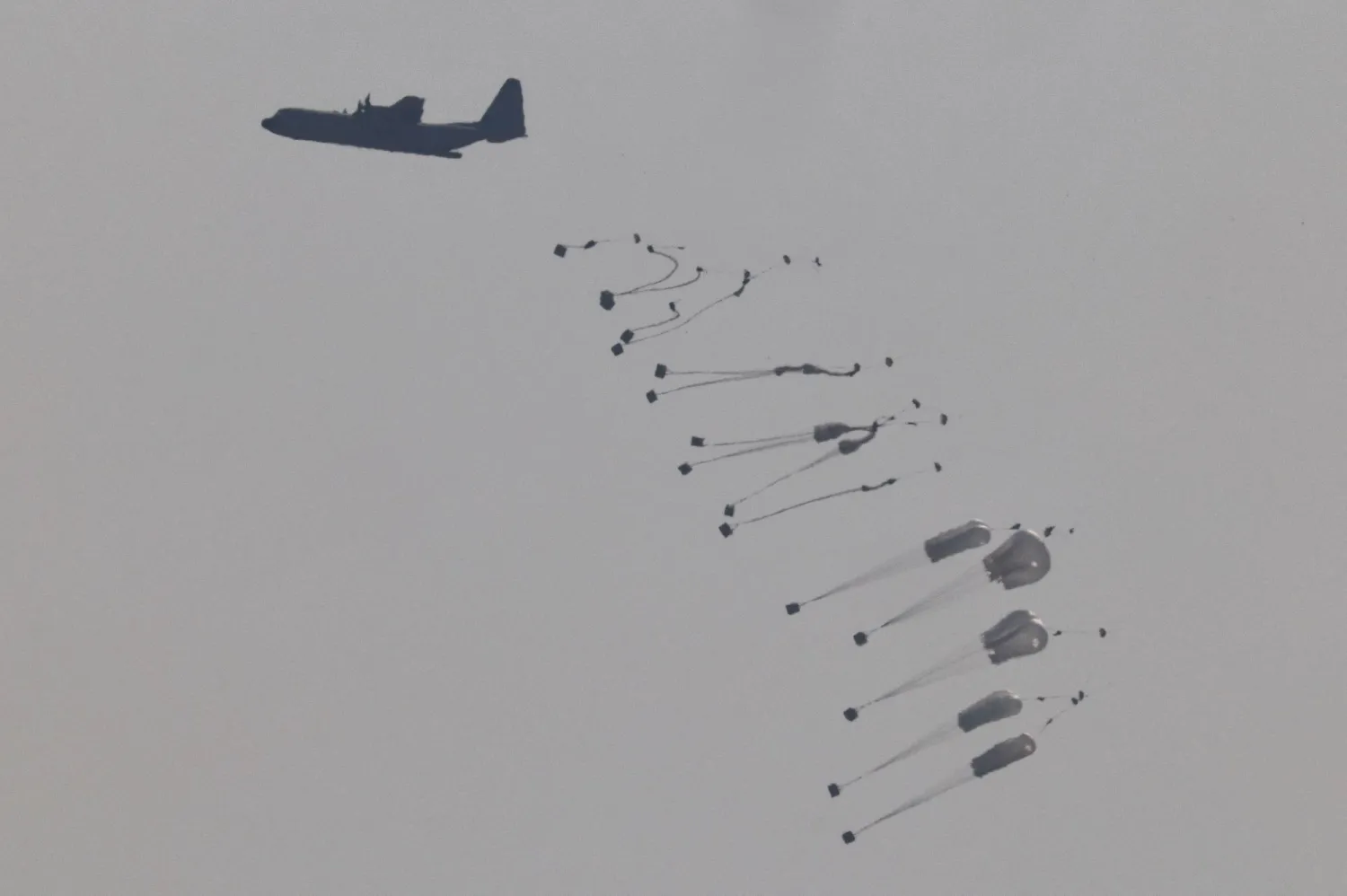
Aid packages dropped from an airplane descend over Gaza Strip, as seen from Israel, August 13, 2025. REUTERS/Amir Cohen
TT

Aid Groups Call on Israel to End 'Weaponization' of Aid in Gaza

Aid packages dropped from an airplane descend over Gaza Strip, as seen from Israel, August 13, 2025. REUTERS/Amir Cohen

More than 100 nonprofit groups warned Thursday that Israel’s rules for aid groups working in the Gaza Strip and occupied West Bank will block much-needed relief and replace independent organizations with those that serve Israel's political and military agenda — charges that Israel denied.

A letter signed by organizations including Oxfam, Doctors Without Borders and CARE accused Israel of “weaponizing aid” as people starve in war-torn Gaza and using it as a tool to entrench control, The Associated Press reported.

The groups were responding to registration rules announced by Israel in March that require organizations to hand over full lists of their donors and Palestinian staff for vetting.

The groups contend that doing so could endanger their staff and give Israel broad grounds to block aid if groups are deemed to be “delegitimizing” the country or supporting boycotts or divestment.

The registration measures were “designed to control independent organizations, silence advocacy, and censor humanitarian reporting,” they said.

The letter added that the rules violate European data privacy regulations, noting that in some cases aid groups have been given only seven days to comply.

COGAT, the Israeli military body in charge of humanitarian aid to Gaza, denied the letter’s claims. It alleged the groups were being used as cover by Hamas to “exploit the aid to strengthen its military capabilities and consolidate its control” in Gaza.

“The refusal of some international organizations to provide the information and cooperate with the registration process raises serious concerns about their true intention,” it said in a statement on Thursday. “The alleged delay in aid entry ... occurs only when organizations choose not to meet the basic security requirements intended to prevent Hamas’s involvement.”

Israel has long claimed that aid groups and United Nations agencies issue biased assessments.

The aid groups stressed on Thursday that most of them haven’t been able to deliver “a single truck” of life-saving assistance since Israel implemented a blockade in March.

A vast majority of aid isn’t reaching civilians in Gaza, where tens of thousands have been killed, most of the population has been displaced and famine looms. UN agencies and a small number of aid groups have resumed delivering assistance, but say the number of trucks allowed in remains far from sufficient.

Meanwhile, tensions have flared over Israel and the United States backing the Gaza Humanitarian Foundation to serve as the main distributor of aid in the besieged territory. The American contractor, meant to replace the traditional UN-led aid distribution system in Gaza, has faced international condemnation after hundreds of Palestinians were killed while trying to get food near its distribution sites.

Israel has pressed UN agencies to accept military escorts to deliver goods into Gaza, a demand the agencies have largely rejected, citing their commitment to neutrality. The standoff has been the source of competing claims: Israel maintains it allows aid into Gaza that adheres to its rules, while aid groups that have long operated in Gaza decry the amount of life-saving supplies stuck at border crossings.

“Oxfam has over $2.5 million worth of goods that have been rejected from entering Gaza by Israel, especially WASH (water, sanitation and hygiene) items as well as food,” said Bushra Khalidi, an aid official with Oxfam in Gaza.

Aid groups' “ability to operate may come at the cost of their independence and ability to speak out,” she added.



At Least 19 Killed in Collapse of Two Buildings in Morocco’s Fez

Emergency personnel search for victims in the rubble of two collapsed buildings in Fez late on December 9, 2025. (AFP)
TT

At Least 19 Killed in Collapse of Two Buildings in Morocco’s Fez

Emergency personnel search for victims in the rubble of two collapsed buildings in Fez late on December 9, 2025. (AFP)

At least 19 people were killed and 16 injured early on Wednesday after two buildings collapsed in Fez, one of Morocco's oldest cities, the state news media reported, saying the blocks had shown signs of neglect for some time. 

Local authorities in the Fez prefecture reported two adjacent four-storey buildings had collapsed overnight, the state news agency said. 

The buildings were inhabited by eight families and were in the Al-Mustaqbal neighborhood, it reported. 

As soon as they were informed of the incident, local authorities, security services, and civil protection units moved to the scene and immediately began search and rescue operations, it said. 

Fez, a former capital dating back to the eighth century and the country's third-most populous city, was caught up in a wave of protests two months ago against the government over deteriorating living conditions and poor public services. 

The state news website SNRT said "the scene indicates that the two collapsed buildings had been showing signs of cracking for some time, without any effective preventive measures being taken." 


Netanyahu Denies Contacts with Syria Have Led to Final Agreement

Israeli tanks deployed near the buffer zone on the Syrian Golan, Dec. 8, 2024. (AFP)
TT

Netanyahu Denies Contacts with Syria Have Led to Final Agreement

Israeli tanks deployed near the buffer zone on the Syrian Golan, Dec. 8, 2024. (AFP)

Contacts and meetings held between Israel and Syria have not reached any final understanding or agreement between both sides, the office of Israeli Prime Minister Benjamin Netanyahu said on Tuesday in response to a report published by Asharq Al-Awsat.

Asharq Al-Awsat had quoted unnamed sources saying US mediation brought Netanyahu and Syrian President Ahmed al-Sharaa together for a meeting during September’s UN General Assembly in New York.

Those talks advanced far enough that Netanyahu declined to endorse a draft security arrangement with Damascus, it wrote.

The Prime Minister’s Office said in statement: “There were contacts and meetings organized by the US, but no agreements and understandings with Syria were ever reached.”

Amid the controversy, a Syrian source familiar with the details told Channel 12: “The final draft of the agreement is almost ready and in its last stages. A breakthrough could happen very soon.”

The source added: “The agreement’s terms are largely agreed upon, with many clauses symbolically signed and written, waiting for US officials to approach Israel and say: ‘This is the final formula, and we want to move forward.’”

He said the pause is currently on Israel’s side, not Syria’s. “So far, the formula is acceptable to Syria and largely acceptable to Israel.”

Israeli media outlets recalled what happened between both sides last September.

The i24 News channel said that at the time, Sharaa had affirmed Damascus and Jerusalem will soon share a new security agreement. His comments came shortly after Reuters said Washington is pushing for enough progress to be made by the time world leaders gather in New York for the UN General Assembly at the end of the month to allow Trump to announce a breakthrough.

The Israeli channel said the deal was obstructed after Syria presented territorial demands that Israel cannot accept, including a withdrawal from the strategically sensitive Mount Hermon and areas in Syria’s buffer zone.

Later, the Times of Israel newspaper confirmed the reports saying that while there was optimism in September that a deal could be signed, Reuters reported at the time of the assembly that contacts between Israel and Syria regarding the deal had reached a dead end due to Israel’s demand to open a “humanitarian corridor” into the Sweida province in southern Syria – where sectarian violence has killed hundreds of people from the Druze community, which Israel has vowed to protect.

The newspaper also cited an Axios report saying Israel has reportedly presented Syria with a detailed proposal for a new security agreement regarding southwest Syria, demanding a no-fly zone and demilitarized zone over its border in Syria, with no limits on Israeli deployment on its own territory.

In return, Israel would withdraw in stages from the buffer zone it established after Syrian leader Bashar al-Assad fell last December, but would remain on the peak of Mount Hermon.

The Israeli army has been deployed to nine posts inside southern Syria for nearly a year, since the Assad regime was brought down, mostly within a UN-patrolled buffer zone on the border between the countries. Two posts are on the Syrian side of Mount Hermon.

Israel said it seized the areas in southern Syria last December due to fears they would fall into the wrong hands after the regime collapsed and said it would hold on to them until a new security deal was signed.

The Walla website reported that Netanyahu was present at the UN General Assembly meeting and was planning to meet with the Syrian leader and sign a security deal with Syria.

But Damascus insisted on Israel’s withdrawal from territory seized in the Golan Heights since Assad’s fall. Tel Aviv refused, saying its troops need to remain in the area to protect its residents in the north.


Le Drian Holds Talks in Lebanon to Consolidate Ceasefire with Israel

A photograph released by the Lebanese Presidency Press Office on December 8, 2025, shows Lebanese President Joseph Aoun (R) meeting with French Envoy Jean-Yves Le Drian (L) at the Presidential Palace in Baabda, east of Beirut. (Lebanese Presidency)
TT

Le Drian Holds Talks in Lebanon to Consolidate Ceasefire with Israel

A photograph released by the Lebanese Presidency Press Office on December 8, 2025, shows Lebanese President Joseph Aoun (R) meeting with French Envoy Jean-Yves Le Drian (L) at the Presidential Palace in Baabda, east of Beirut. (Lebanese Presidency)

French presidential envoy Jean-Yves Le Drian continued his meetings with Lebanese officials on Tuesday over consolidating the ceasefire between Israel and Hezbollah.

Le Drian held talks on Monday with President Joseph Aoun and parliament Speaker Nabih Berri, Prime Minister Nawaf Salam, Foreign Minister Youssef Rajji, Army Commander Rodolphe Haykal and former Progressive Socialist Party leader Walid Jumblatt and his son MP Taymur Jumblatt on Tuesday.

Aoun told Le Drian that Lebanon welcomes any role France can play within the Mechanism committee overseeing the ceasefire, rejecting accusations that the Lebanese army was not doing enough to meet its end of the agreement.

The committee aims to end the hostilities, ensure Israel’s withdrawal from regions it is occupying in southern Lebanon and release Lebanese detainees held by Israel.

A Lebanese presidency statement said Aoun welcomed French President Emmanuel’s constant support for Lebanon, stressing that they reflect the depth of Lebanese-French ties.

Aoun revealed to Le Drian that the Mechanism will meet again on December 19.

“Our desire to activate the Mechanism meetings reflects our willingness to negotiate to reach diplomatic solutions because we never want to adopt war rhetoric,” Aoun added.

Lebanese and Israeli civilian representatives held their first direct talks in decades last week under the auspices of a year-old ceasefire monitoring mechanism.

The two sides met at the UN peacekeeping force's headquarters in Lebanon's Naqoura near the border with Israel, where the guarantors of the November 2024 ceasefire between Israel and Hezbollah regularly convene.

Former Lebanese ambassador to the US Simon Karam and Israeli National Security Council official Uri Resnick were included as civilian representatives in the ceasefire mechanism for the first time.

Aoun told Le Drian that “the positive stances from fraternal and friendly states that followed last week’s meeting reflect their support for this step and will inevitably ease the pressure” that Lebanon was under.

He reiterated his rejection of criticism that the army was not doing enough to enforce the ceasefire agreement.

He instead accused Israel of continuing its attacks against Lebanon in violation of the ceasefire. He said it has destroyed homes and properties, preventing the army, United Nations Interim Force in Lebanon (UNIFIL) and Mechanism from completing their duties.

He stressed that the army and UNIFIL were acting in complete coordination, while urging the need to provide the military with the necessary equipment to allow it to fulfill its mission in full.

The mission, he remarked, is not limited to regions south of the Litani River, but includes all of Lebanon.

Le Drian, for his part, conveyed to Aoun Macron’s support for Karam’s appointment to the Lebanon’s negotiating team, adding that Paris “will always stand by Beirut’s national choices.”

Talks between Berri and the envoy, which lasted over an hour, tackled the situation in Lebanon and the region, especially Israel’s ongoing violations of the ceasefire.

Paris is set to hold next week a meeting between France, the United States and Saudi Arabia in preparation for a conference aimed at backing the Lebanese army and support a roadmap for a long-term ceasefire.