


Heat and Thirst Drive Families in Gaza to Drink Water That Makes Them Sick

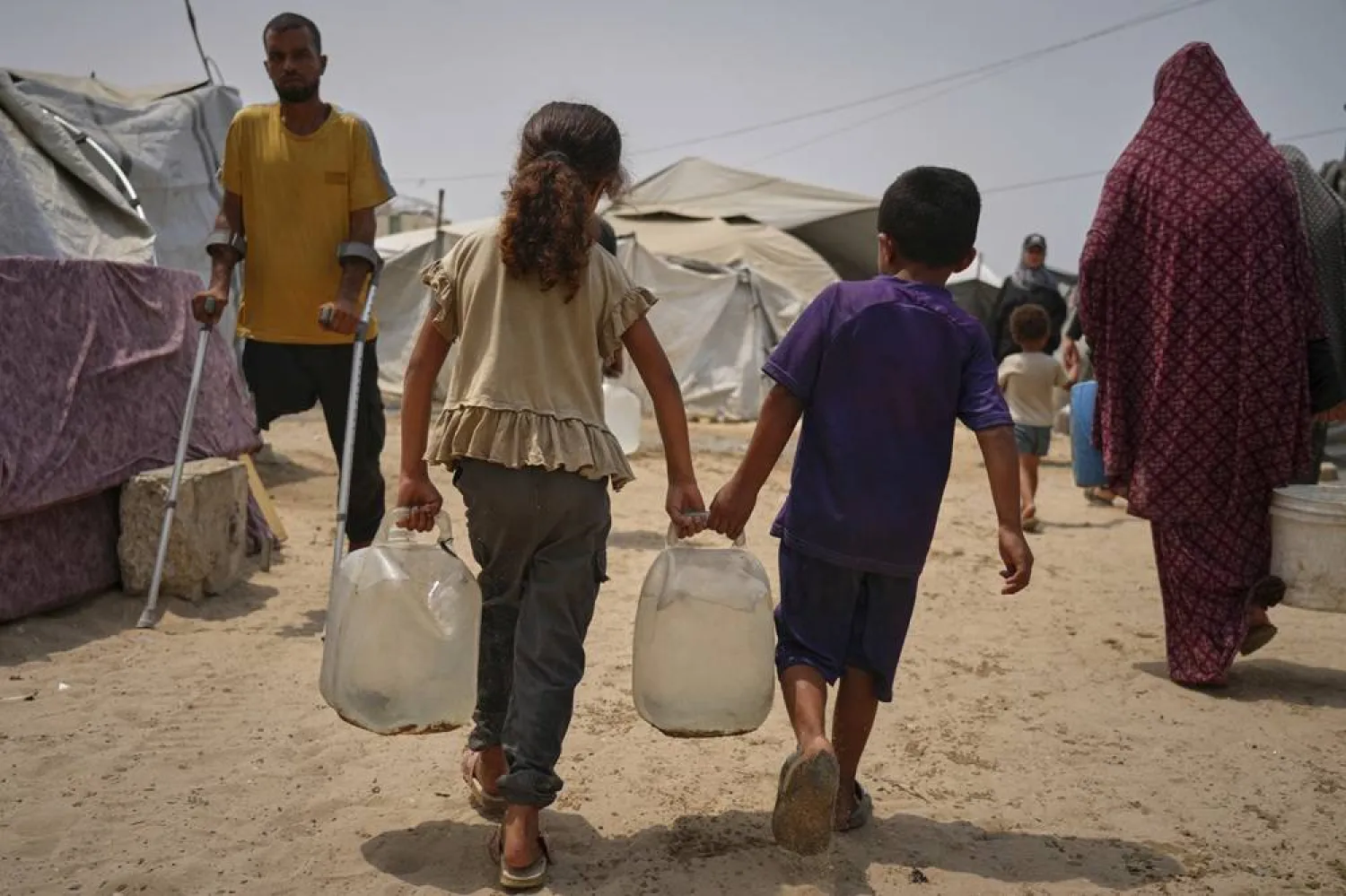
 Palestinian children haul jerrycans of water collected from a distribution point in Gaza City, Aug. 12, 2025, amid scorching temperatures. (AP)
Palestinian children haul jerrycans of water collected from a distribution point in Gaza City, Aug. 12, 2025, amid scorching temperatures. (AP)
TT

Heat and Thirst Drive Families in Gaza to Drink Water That Makes Them Sick

 Palestinian children haul jerrycans of water collected from a distribution point in Gaza City, Aug. 12, 2025, amid scorching temperatures. (AP)
Palestinian children haul jerrycans of water collected from a distribution point in Gaza City, Aug. 12, 2025, amid scorching temperatures. (AP)

After waking early to stand in line for an hour under the August heat, Rana Odeh returns to her tent with her jug of murky water. She wipes the sweat from her brow and strategizes how much to portion out to her two small children. From its color alone, she knows full well it’s likely contaminated.

Thirst supersedes the fear of illness.

She fills small bottles for her son and daughter and pours a sip into a teacup for herself. What's left she adds to a jerrycan for later.

"We are forced to give it to our children because we have no alternative," Odeh, who was driven from her home in Khan Younis, said of the water. "It causes diseases for us and our children."

Such scenes have become the grim routine in Muwasi, a sprawling displacement camp in central Gaza where hundreds of thousands endure scorching summer heat. Sweat-soaked and dust-covered, parents and children chase down water trucks that come every two or three days, filling bottles, canisters and buckets and then hauling them home, sometimes on donkey-drawn carts.

Each drop is rationed for drinking, cooking, cleaning or washing. Some reuse what they can and save a couple of cloudy inches in their jerrycans for whatever tomorrow brings — or doesn’t.

When water fails to arrive, Odeh said, she and her son fill bottles from the sea.

Over the 22 months since Israel launched its offensive, Gaza's water access has been progressively strained. Limits on fuel imports and electricity have hampered the operation of desalination plants while infrastructure bottlenecks and pipeline damage choked delivery to a dribble. Gaza’s aquifers became polluted by sewage and the wreckage of bombed buildings. Wells are mostly inaccessible or destroyed, aid groups and the local utility say.

Meanwhile, the water crisis has helped fuel the rampant spread of disease, on top of Gaza's rising starvation. UNRWA — the UN agency for Palestinian refugees — said Thursday that its health centers now see an average 10,300 patients a week with infectious diseases, mostly diarrhea from contaminated water.

Efforts to ease the water shortage are in motion, but for many the prospect is still overshadowed by the risk of what may unfold before a new supply comes.

And the thirst is only growing as a heat wave bears down, with humidity and temperatures in Gaza soaring on Friday to 35 degrees Celsius (95 degrees Fahrenheit).

Searing heat and sullied water

Mahmoud al-Dibs, a father displaced from Gaza City to Muwasi, dumped water over his head from a flimsy plastic bag — one of the vessels used to carry water in the camps.

"Outside the tents it is hot and inside the tents it is hot, so we are forced to drink this water wherever we go," he said.

Al-Dibs was among many who told The Associated Press they knowingly drink non-potable water.

The few people still possessing rooftop tanks can’t muster enough water to clean them, so what flows from their taps is yellow and unsafe, said Bushra Khalidi, an official with Oxfam, an aid group working in Gaza.

Before the war, the coastal enclave’s more than 2 million residents got their water from a patchwork of sources. Some was piped in by Mekorot, Israel’s national water utility. Some came from desalination plants. Some was pulled from high-saline wells, and some imported in bottles.

Every source has been jeopardized.

Palestinians are relying more heavily on groundwater, which today makes up more than half of Gaza's supply. The well water has historically been brackish, but still serviceable for cleaning, bathing, or farming, according to Palestinian water officials and aid groups.

Now people have to drink it.

The effects of drinking unclean water don’t always appear right away, said Mark Zeitoun, director general of the Geneva Water Hub, a policy institute.

"Untreated sewage mixes with drinking water, and you drink that or wash your food with it, then you’re drinking microbes and can get dysentery," Zeitoun said. "If you’re forced to drink salty, brackish water, it just does your kidneys in, and then you’re on dialysis for decades."

Deliveries average less than three liters (12.5 cups) per person per day — a fraction of the 15-liter (3.3-gallon) minimum humanitarian groups say is needed for drinking, cooking and basic hygiene. In February, acute watery diarrhea accounted for less than 20% of reported illnesses in Gaza. By July, it had surged to 44%, raising the risk of severe dehydration, according to UNICEF, the UN children’s agency.

System breakdown

Early in the war, residents said deliveries from Israel's water company Mekorot were curtailed — a claim that Israel has denied. Airstrikes destroyed some of the transmission pipelines as well as one of Gaza’s three desalination plants.

Bombardment and advancing troops damaged or cut off wells – to the point that today only 137 of Gaza’s 392 wells are accessible, according to UNICEF. Water quality from some wells has deteriorated, fouled by sewage, the rubble of shattered buildings and the residue of spent munitions.

Fuel shortages have strained the system, slowing pumps at wells and the trucks that carry water. The remaining two desalination plants have operated far below capacity or ground to a halt at times, aid groups and officials say.

In recent weeks, Israel has taken some steps to reverse the damage. It delivers water via two of Mekorot's three pipelines into Gaza and reconnected one of the desalination plants to Israel’s electricity grid, Deputy Foreign Minister Sharren Haskel told The Associated Press.

Still, the plants put out far less than before the war, Monther Shoblaq, head of Gaza’s Coastal Municipalities Water Utility, told AP. That has forced him to make impossible choices.

The utility prioritizes getting water to hospitals and to people. But that means sometimes withholding water needed for sewage treatment, which can trigger neighborhood backups and heighten health risks.

Water hasn’t sparked the same global outrage as limits on food entering Gaza. But Shoblaq warned of a direct line between the crisis and potential loss of life.

"It’s obvious that you can survive for some days without food, but not without water," he said.

Supply's future

Water access is steadying after Israel's steps. Aid workers have grown hopeful that the situation won't get worse and could improve.

Southern Gaza could get more relief from a United Arab Emirates-funded desalination plant just across the border in Egypt. COGAT, the Israeli military body in charge of humanitarian aid to Gaza, said it has allowed equipment into the enclave to build a pipeline from the plant and deliveries could start in a few weeks.

The plant wouldn't depend on Israel for power, but since Israel holds the crossings, it will control the entry of water into Gaza for the foreseeable future.

But aid groups warn that access to water and other aid could be disrupted again by Israel’s plans to launch a new offensive on some of the last areas outside its military control. Those areas include Gaza City and Muwasi, where much of Gaza's population is now located.

In Muwasi's tent camps, people line up for the sporadic arrivals of water trucks.

Hosni Shaheen, whose family was also displaced from Khan Younis, already sees the water he drinks as a last resort.

"It causes stomach cramps for adults and children, without exception," he said. "You don’t feel safe when your children drink it."


From Wells to Budget: Where Does Libya’s Oil Money Go?

Tugboat Al-Hani begins operations at Zueitina port (National Oil Corporation)
TT

From Wells to Budget: Where Does Libya’s Oil Money Go?

Tugboat Al-Hani begins operations at Zueitina port (National Oil Corporation)

Libya depends on oil for nearly 98% of its income. Yet a central question persists: How are those revenues collected and spent in a country divided between rival governments? And why do Libyans complain of poverty when their country holds Africa’s largest oil reserves and produces and exports about 1.4 million barrels a day?

The process starts with the National Oil Corporation, which collects proceeds from crude oil and gas sales in US dollars and deposits them in accounts at the Libyan Foreign Bank. The money is then transferred to the Central Bank of Libya's accounts in Tripoli, recorded as state budget sovereign revenue, and converted into Libyan dinars.

The dollar trades at 6.36 dinars at the official rate, compared with 9.12 on the parallel market.

The Finance Ministry in Tripoli then issues spending authorizations under approved financial arrangements, after which the central bank releases funds to ministries and other state bodies through the main budget chapters.

Libya’s oil export revenues have swung sharply in recent years, ranging between $18 billion and $22 billion. They rose to about $18 billion in the first half of this year, nearly double the level in the same period last year, according to the Economy Ministry in the interim Government of National Unity.

Libyan oil expert Mohamed al-Shahati attributed the increase during that period to the war involving Iran.

Where is the breakdown?

Economists say Libya’s dependence on oil as its near-exclusive source of income lies at the heart of the crisis.

Ayoub al-Farsi, an economics professor at the University of Benghazi, said Libya showed how excessive reliance on natural resources could turn into a complex financial crisis when combined with political fragmentation and a lack of economic diversification.

“The Libyan economy is a clear example of how excessive dependence on natural resources can become a complex financial crisis,” he said, adding that political fragmentation and the absence of diversification had created conditions that directly affected people’s lives.

Al-Farsi, a member of the Central Bank of Libya’s Monetary Policy Committee, said the economy was built around a rentier-state model that depended almost entirely on oil exports to fund the treasury and provide foreign currency.

That dependence, he told Asharq Al-Awsat, had created deep structural distortions.

Agriculture and industry had been marginalized, the state bureaucracy had expanded to absorb workers into unproductive public-sector jobs, and the country had grown heavily dependent on imports for most consumer goods, he said.

Industrial activity remains limited, largely confined to the private sector and small-scale production. Critics also point to a market dominated by a small number of traders and importers, helping imported goods crowd out local production.

At protests across Libyan cities, the question is often the same: Where is the oil money going? Why are people struggling in an energy-producing country?

Al-Shahati said part of the answer lies in the difference between the value of the oil Libya produces and the amount that actually reaches the state treasury.

“Not every barrel produced in Libya is converted directly into a dollar entering the public treasury, because foreign partners have a share,” he told Asharq Al-Awsat.

Foreign companies have become production partners under various contractual arrangements, he said.

He also pointed to a stark contradiction: Libya produces oil, yet depends heavily on imports of gasoline, diesel, and other petroleum products to meet domestic demand.

That means a growing share of the country’s resources is converted into foreign currency to pay for fuel imports.

Al-Shahati said another problem was the lack of a regularly published, unified, and easy-to-read account that answers basic questions, such as: What was the total value of the oil produced? How much went to foreign partners? How much was exported for the state? How much went to the domestic market? And how much net revenue was actually available for public spending?

“The figures in circulation provide parts of the picture,” he said, “but they do not always show the full flow of revenues from the wellhead to the state’s public accounts.”

Libya’s oil fields are concentrated mainly in the eastern Sirte Basin, which holds about 82% of its oil reserves, as well as in the Murzuq Basin in the southwest and offshore areas along the coast.

Fuel and power crises

Those weaknesses in the oil revenue chain are unfolding as Libya grapples with a severe electricity crisis.

The country has suffered several “blackouts” in recent days, with some areas going without electricity for more than 17 hours a day.

Researcher Ezzedine Mokhtar sees the power cuts as one part of a wider pattern of recurring financial failures, including fuel shortages.

He blamed the hardship facing many Libyans on “corruption” and “unlimited spending” by two rival governments competing for power in the country’s east and west.

He also cited “oil smuggling through Arkenu, whose revenues go to specific individuals rather than the state treasury.”

Mokhtar said Libya’s subsidy system was another core problem, with more than 60% of the country’s budget going to fuel subsidies.

He called on the Tripoli government to phase out those subsidies gradually and to draw up a national plan to develop the workforce.

“We have no industrial skills in anything,” he said. “We import everything — yogurt, dairy products, fruit, vegetables, frozen fish, and even underwear. Everything comes from abroad.”

Libya ranks 10th globally in proven oil reserves, with about 48.3 billion barrels, according to Worldometer.

The UN Panel of Experts said in its latest report on Libya, covering October 2024 to February 2026, that Arkenu had moved at least $3 billion in oil revenues to bank accounts outside Libya between January 2024 and November 2025.

According to the report, Arkenu was established in 2023 as a private company and is indirectly controlled by Saddam Haftar, deputy commander-in-chief of the Libyan National Army. It faces accusations of “oil smuggling.”

Reuters previously investigated the company and concluded, based on shipping documents, London Stock Exchange Group data, and information from Kpler, that some oil revenues were being diverted away from the Central Bank of Libya.

How are revenues distributed?

Oil revenues are distributed across the four main chapters of the state budget, according to experts and economists.

Chapter One, salaries and wages, takes the largest share. It covers public-sector employees across eastern, western, and southern Libya through the unified national identification number system.

Chapter Two covers operating expenses for ministries and public institutions.

Chapter Three covers subsidies, including fuel, water, and electricity.

Chapter Four covers development and projects, including infrastructure, as well as allocations to the National Oil Corporation to sustain and increase production.

Al-Shahati said 26% of oil revenues went toward importing fuel products, equivalent to about $7 billion if crude traded at $70 a barrel.

This year, he said, the figure could rise to between $8 billion and $9 billion because oil prices had climbed above $85 a barrel and the gap between crude prices and diesel and gasoline prices had widened amid shortages.

He also pointed to higher domestic consumption driven by economic growth and a rise in smuggling.

A second problem, al-Shahati said, is the absence of an approved national budget, which would make it possible to determine how spending should be allocated among population groups and regions.

“What is clear is that the main cities control most spending,” he said.

He also pointed to “a large and obvious imbalance” in salaries across Libya’s three regions, job grades, and types of employment.

Those gaps, he said, risk widening financial divisions between social groups.

Even an agreement to unify development spending did not appear to be properly implemented because there were no clear standards and no comprehensive budget.

“There are no criteria for distributing oil revenues,” al-Shahati said. “The distribution process is random and unsustainable.”

Libya fell to 177th out of 182 countries in the 2025 Corruption Perceptions Index, from 173rd out of 180 countries in 2024, reflecting worsening corruption and no tangible improvement over the past two years.

Pressure on the local economy

A report by UN Secretary-General Antonio Guterres on Libya highlighted deep structural strains in the economy, driven by high public spending, near-total dependence on oil and gas revenues, and mounting pressure from food, fuel, and electricity prices.

The report, submitted to the UN Security Council on Aug. 17, covers the period from April 1 to July 28.

Citing the International Monetary Fund, it said Libya’s fiscal deficit reached 30% of gross domestic product last year, while public debt climbed to 146% of GDP.

Inflation also rose into double digits, eroding purchasing power.

The UN report noted unjustified increases in fuel consumption by military and security agencies and the energy sector, as well as repeated double purchasing.

The cost of institutional division

Libya’s political and institutional split and the presence of multiple authorities have made the economic crisis worse, al-Farsi said.

The distortions, he said, were no longer merely structural.

They had created parallel public finances and pushed consumer spending higher to meet the demands of rival authorities, sending salaries and subsidies to unprecedented levels.

Repeated shutdowns of oil fields in previous years, combined with lower actual revenues, pushed financial authorities toward deficit financing and higher public debt, al-Farsi said.

That flooded the market with money without a corresponding rise in domestic production.

Oil revenues reached $21.9 billion in 2025, according to the National Oil Corporation, up from $18.6 billion in 2024, an increase of 15%.

Al-Farsi said the deterioration in public finances had left monetary authorities in a difficult position and forced them into emergency measures to protect reserves and contain the deficit.

The result, he said, was a weaker national currency, liquidity shortages and a collapse in confidence.

Development tools had also been paralyzed.

“Monetary policy shifted from an instrument for stimulating growth and investment into a tool for managing daily crises,” he said.

Why has the crisis not been solved?

Economists point to several reasons.

Al-Shahati put “corruption spreading on an unprecedented scale” near the top of the list.

“Corruption is no longer confined to the margins,” he said. “It has come to dominate the core of public finances in key sectors, obstructing any attempt at reform.”

He also blamed the absence of an institutional vision following the breakdown of middle management, which had once linked fiscal and monetary policy to economic realities and provided unified political backing.

Policies, he said, had become detached from the economy and lost their ability to restore balance.

Conventional reforms that had worked elsewhere would not work in Libya, al-Shahati said, because the country lacked a central political authority capable of building an institutional vision and curbing corruption that had spread through both the state and private sector.

Al-Farsi said Libya could not escape its fiscal and monetary crisis without addressing the roots of the problem.

That meant unifying the management of public finances, curbing government spending, and launching genuine structural reforms that would gradually shift Libya from consuming oil rents to building a diversified economy.

Mokhtar also called on the Tripoli government to develop a strategic plan to make better use of human resources and support small and medium-sized industries.

For him, breaking Libya’s dependence on oil revenues is part of the way out.

Masoud Suleiman, chairman of Libya’s National Oil Corporation, said in media remarks last week that the country needed between $30 billion and $40 billion in investment to develop untapped oil and gas resources.

The corporation, he said, aims to raise production to 2 million barrels a day by 2030.


Bandar Abbas, Iran’s Trade Hub on Hormuz Thrust to Frontline of US War

Fishermen check their nets and small boats on the seashore in the port city of Bandar Abbas, in southern Iran on August 10, 2026. (AFP)
TT

Bandar Abbas, Iran’s Trade Hub on Hormuz Thrust to Frontline of US War

Fishermen check their nets and small boats on the seashore in the port city of Bandar Abbas, in southern Iran on August 10, 2026. (AFP)

With a long shoreline on the Strait of Hormuz, Iran's southern trade hub of Bandar Abbas has found itself at the frontlines of the war with the United States, with residents struggling to revive livelihoods battered by months of fighting.

Like elsewhere in Iran, economic strain has squeezed households since US-Israeli strikes triggered the Middle East war on February 28. But unlike much of the country, the port city of around half a million people has remained exposed to fighting even after an April 8 ceasefire brought relief elsewhere.

But despite a lull in hostilities in July, residents still feel squeezed. Saeed Tajik, 42, used to work at a shipyard before losing his job and turning to driving a taxi.

"The prices of housing and food have become extremely high. Almost all the basics -- rice, yoghurt, and oil -- have doubled," said Tajik.

Fuel shortages have long been common in southern Iran, where authorities restrict supplies in an effort to curb widespread fuel smuggling.

But now, "the queues have become longer ... it happens that we wait in the long line for fuel only to get told 'there is none' upon arriving," Tajik said as he drove past a station where motorists waited under the punishing summer heat.

Hormuz has emerged as a central flashpoint after an April ceasefire and June framework deal failed to resolve disagreements between Washington and Tehran over the future management of the strait.

During the war, US strikes hit bridges, highways and railway infrastructure around Bandar Abbas until mid-July, in what analysts saw as attempts to cut off the city and disrupt Iranian military logistics in the south.

- 'Nothing left' -

Inside the city, under a towering concrete statue of two armed men with their arms trained towards Hormuz waters, economic strains play out in long queues snaking outside petrol stations and soaring prices squeezing shoppers in local markets.

The city's repeatedly hit airport remained largely closed until August 15, leaving travelers facing arduous road journeys, sometimes combined with flights and boat crossings.

Outside the city, construction crews still toil under the sweltering summer sun to repair the Gachin bridge, split by a US strike, as cars rumble along a dusty detour below.

Along the waterfront, traditional wooden vessels known as lenjes sit moored alongside fishing and commercial boats, part of a centuries-old trading network linking southern Iran with Arab states across the Gulf.

Arash Tondro, 45, used his lenj to carry Iranian fresh and dried fruit to the United Arab Emirates and return with household goods and other imports.

"My income dropped to zero at the beginning of the war," said Tondro, who later rerouted some trade through Oman's Khasab port as regional seaways were disrupted and "many of the lenjes were hit by drones".

After the UAE suspended trade with Iran on Tuesday following a missile attack on a ship that Tehran denied carrying out, Tondro said he was again unsure how his work would be impacted.

"People in the south mostly rely on trade or fishing. If you take the sea and trade away from them, there is practically nothing left. We don't have agriculture here; whatever there is comes from the sea," he said.

- 'No sales' -

As night falls and August's oppressive heat begins to ease, fish vendors set up along a busy street, laying out shark, tuna and shrimp as the smell of the day's catch hangs in the humid air.

Among them is 22-year-old Anoush Mallah, who recently moved onto the street after soaring rents forced him to close his shop in one of the city's bazaars.

"Business has been terrible since the war started. There are no sales, it's very weak," he told AFP.

"People are short of money. The fishermen aren't going fishing either."

Many fishermen around Bandar Abbas only began returning to sea in recent weeks, after months ashore for fear of being caught in the crossfire of US-Iran fighting.

Diplomatic efforts have so far failed to end the war. For Mallah, the uncertainty only adds to the strain.

"Let it (the war) start and get some result; right now, we're just left in limbo," he said.


The Ethiopian Dam Dispute and Egypt’s ‘Right to Self-Defense’

Egyptian Foreign Minister Badr Abdelatty. Photo: Foreign Ministry
TT

The Ethiopian Dam Dispute and Egypt’s ‘Right to Self-Defense’

Egyptian Foreign Minister Badr Abdelatty. Photo: Foreign Ministry

Over the past two weeks, Egypt has repeatedly stressed its right to prevent any actions by Addis Ababa on the Nile River that could harm its water interests, stressing that it possesses the “right to self-defense” over Ethiopia’s Grand Ethiopian Renaissance Dam (GERD).

According to experts who spoke to Asharq Al-Awsat, Egypt’s signaling means that it “will not hesitate to use all legitimate means to safeguard its water security.”

They explained that the message is a stern warning to Ethiopia and suggests that Cairo is seeking to shift from a policy of protesting Ethiopian measures to preventive deterrence, aimed at stopping the establishment of a new status quo on the Nile.

New Egyptian Warning

Egyptian Foreign Minister Badr Abdelatty said that “Egypt will not allow the construction of additional dams ... that affect its water interests,” stressing Cairo’s commitment to a legally binding agreement that guarantees its water rights.

In a television interview on Wednesday evening, Abdelatty said that Egypt does not oppose African countries’ right to development, noting Cairo’s participation in dam and infrastructure projects in several Nile Basin states. However, he stressed the need to balance the right to development with the rights of downstream countries.

He also underscored Egypt’s commitment to protecting its water interests. “We have the right to self-defense to protect our interests and water security,” said the minister. “We will not accept any agreement regarding the Nile River unless it is legally binding,” he reiterated.

Mohamed Hegazy, a member of the Egyptian Council for Foreign Affairs and a former assistant foreign minister, says the right of self-defense is protected under international law after all peaceful means have been exhausted.

According to Hegazy, the core message is that Cairo still prefers agreement and negotiation, but it no longer accepts using negotiations to impose a fait accompli.

He argued that the most significant aspect of Abdelatty’s statements is that they send three simultaneous messages - Rejection of unilateral measures, rejection of additional dams, and insistence on the right of self-defense to protect water security.

Hussein El-Behairy, an African affairs expert at the National Center for Middle East Studies, said the minister’s recent statements reaffirm Egypt’s right to defend its historical and water rights in the Nile by whatever means the Egyptian state deems appropriate to preserve what Egyptians view as a matter of life and death.

Ethiopia’s Grand Ethiopian Renaissance Dam (GERD). Reuters

Escalating Egyptian Position

This is the third time Egypt has signaled the possibility of using its “right to self-defense” and preventing dam construction on the Nile.

On August 16, Egypt’s state news agency quoted an unnamed Egyptian official as saying that Cairo “will neither accept nor allow any party to control the flow of Nile waters to downstream countries,” stressing that the Egyptian state possesses multiple tools capable of protecting its people’s interests in the Nile.

The statement came in response to remarks attributed to Ethiopian Minister of Water and Energy Habtamu Itefa concerning the construction of additional dams on the Nile and control over water flows to downstream states, namely Egypt and Sudan.

Earlier, on August 4, Egyptian Minister of Water Resources and Irrigation Hani Sewilam stated during a press conference that Egypt “will not allow the construction of new Ethiopian dams on the Nile River.”

He said: “It is well known that Ethiopia has plans to build additional dams, but will the Egyptian state allow this? No.”

According to Hegazy, the ball is now in Ethiopia’s court. If Addis Ababa agrees to resume serious negotiations leading to a legally binding agreement on GERD, the crisis can be contained.

However, if Ethiopia continues to create new realities on the Nile, the scope for a diplomatic solution will narrow, making risk management and deterrence a more prominent part of Egypt’s strategy.

El-Behairy does not expect the escalation to pave the way for new negotiations on GERD unless the Ethiopian government is willing to make concessions in response to Cairo’s demands. These demands include reaching a legally binding agreement that guarantees Egypt’s water rights during periods of drought and severe drought, and providing Egypt with information regarding the operation of the dam in a manner that does not harm its water interests.
