


Hawaii’s Kilauea Volcano Is on the Verge of Erupting Again 

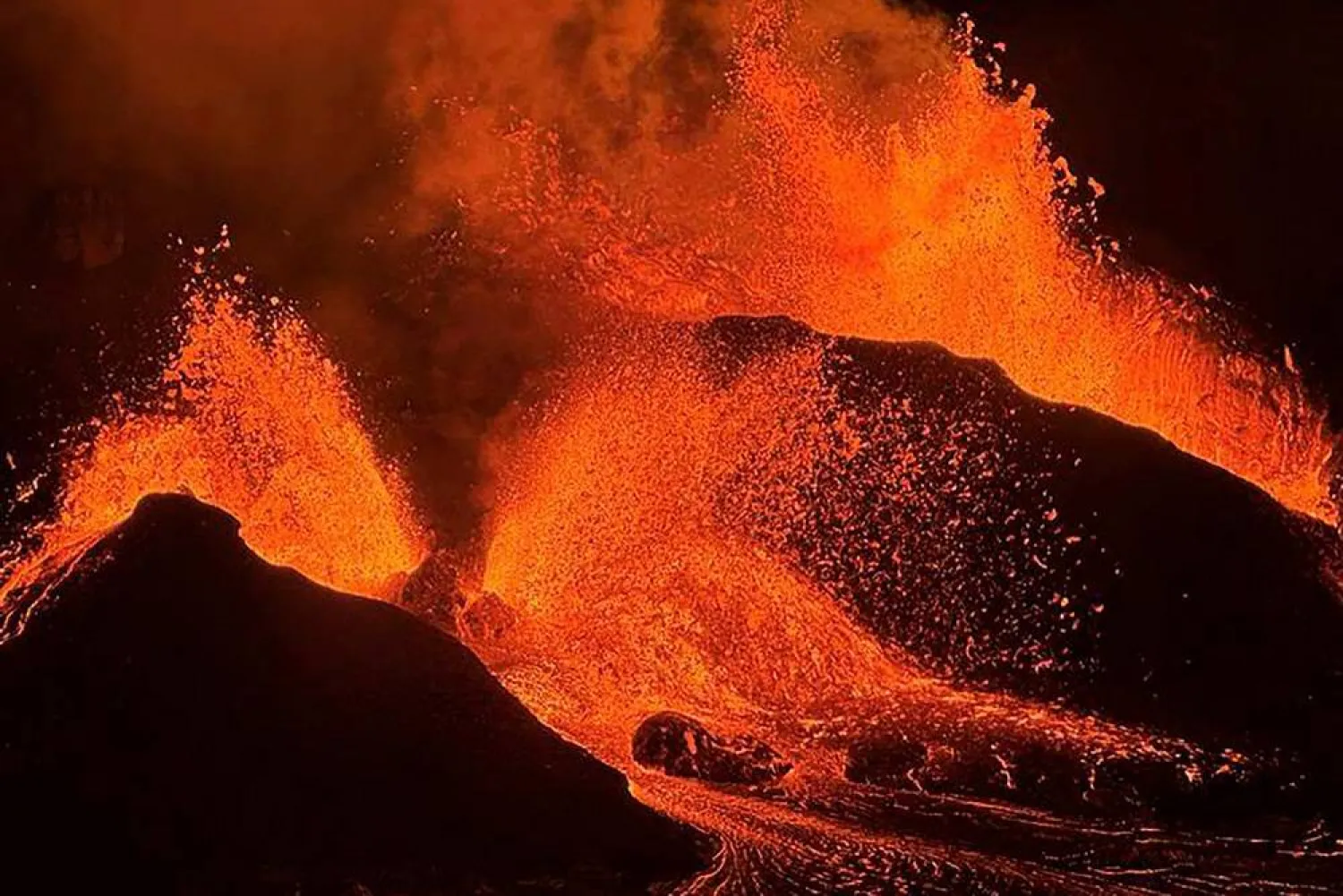
This image provided by the US Geological Survey (USGS) shows evening views of lava fountaining from Haleumaumau Crater at the summit of Kilauea volcano inside Hawaii Volcanoes National Park, Hawaii., Feb. 11, 2025. (M. Patrick/US Geological Survey via AP)
TT

Hawaii’s Kilauea Volcano Is on the Verge of Erupting Again 

This image provided by the US Geological Survey (USGS) shows evening views of lava fountaining from Haleumaumau Crater at the summit of Kilauea volcano inside Hawaii Volcanoes National Park, Hawaii., Feb. 11, 2025. (M. Patrick/US Geological Survey via AP)

Lava shoots high into the sky. Molten rock erupts from two vents simultaneously. The nighttime sky glows red and orange, reflecting the lava oozing across a summit crater.

Scientists expect Kilauea volcano to again gush lava in the coming days for the 31st time since December as the mountain lives up to its identity of one of the world’s most active volcanoes.

A few lucky residents and visitors will have a front row view at Hawaii Volcanoes National Park. If the past is a guide, hundreds of thousands more will be watching popular livestreams made possible by three camera angles set up by the US Geological Survey.

Whenever she gets word the lava is back, Park Service volunteer Janice Wei hustles to shoot photos and videos of Halemaumau Crater, which Native Hawaiian tradition says is the home to the volcano goddess Pele. She said when the molten rock shoots high like a fountain it sounds like a roaring jet engine or crashing ocean waves. She can feel its heat from over a mile away.

"Every eruption feels like I am sitting in the front row at nature’s most extraordinary show," Wei said in an email.

Kilauea is on Hawaii Island, the largest of the Hawaiian archipelago. It’s about 200 miles (320 kilometers) south of the state’s largest city, Honolulu, which is on Oahu.

Here's what to know about Kilauea's latest eruption:

Towering fountains of molten rock A lower magma chamber under Halemaumau Crater is receiving magma directly from the earth’s interior about 5 cubic yards (3.8 cubic meters) per second, said Ken Hon, the scientist-in-charge at the Hawaiian Volcanoes Observatory. This blows the chamber up like a balloon and forces magma into an upper chamber. From there, it gets pushed above ground through cracks.

Magma has been using the same pathway to rise to the surface since December, making the initial release and subsequent episodes all part of the same eruption, Hon said.

Many have featured lava soaring into the air, in some cases more than 1,000 feet (300 meters.) The fountains are generated in part because magma, which holds gasses that are released as it rises, has been traveling to the surface through narrow, pipe-like vents.

The expanding magma supply is capped by heavier magma that had expelled its gas at the end of the prior episode. Eventually enough new magma accumulates to force the degassed magma off, and the magma shoots out like champagne bottle that was shaken before the cork was popped.

This is the fourth time in 200 years that Kilauea has shot lava fountains into the air in repeated episodes. There were more episodes the last time Kilauea followed this pattern: the eruption that began in 1983 started with 44 sessions of shooting fountains. Those were spread out over three years, however. And the fountains emerged in a remote area so few got to watch.

The other two occurred in 1959 and 1969.

Predicting Kilauea's future Scientists don't know how the current eruption will end or how it may change. In 1983, magma built enough pressure that Kilauea opened a vent at a lower elevation and started continuously leaking lava from there rather than periodically shooting out of a higher elevation. The eruption continued in various forms for three decades and only ended in 2018.

Something similar could happen again. Or the current eruption could instead stop at the summit if its magma supply peters out.

Scientists can estimate a few days or even a week ahead of time when lava is likely to emerge with the help of sensors around the volcano that detect earthquakes and miniscule changes in the angle of the ground, which indicate when magma is inflating or deflating.

"Our job is like being a bunch of ants crawling on an elephant trying to figure out how the elephant works," Hon said.

The lava fountains have been shorter lately. Steve Lundblad, a University of Hawaii at Hilo geology professor, said the vent may have gotten wider, leaving molten rock less pressurized.

"We’re still gonna have spectacular eruptions," he said. "They’re just going to be wider and not as high."

Carrying stories of Pele Some people may see lava flows as destructive. But Huihui Kanahele-Mossman, the executive director of the Edith Kanakaʻole Foundation, said lava is a natural resource that hardens into land and forms the foundation for everything on Hawaii Island.

Kanahele-Mossman's nonprofit is named after her grandmother — the esteemed practitioner of Hawaiian language and culture, and founder of a noted hula halau, or school. Hālau o Kekuhi is celebrated for its mastery of a style of hula rooted in the stories of Pele and her sister, Hiʻiaka.

Kanahele-Mossman has visited the crater a few times since the eruption began. She initially watches in awe and reverence. But then she observes more details so she can go home and compare it to the lava in the centuries-old tales that her school performs. At the crater, she delivers a chant prepared in advance and places offerings. Recently she presented awa, a drink made with kava, and a fern lei.

Visiting the volcano Park visitation has risen all eight months of the year so far, in part because of the eruption. In April, there were 49% more visitors than the same month of 2024.

Park spokesperson Jessica Ferracane noted that the last several episodes have only lasted about 10 to 12 hours. Those wanting to go should sign up for US Geological Survey alert notifications because the eruption could be over before you know it, she said.

She cautioned that visitors should stay on marked trails and overlooks because unstable cliff edges and earth cracks may not be immediately apparent and falling could lead to serious injury or death. People should also keep young children close.

Volcanic gas, glass and ash can also be dangerous. Those visiting at night should bring a flashlight.



7 Drinks That Boost Your Brain Health Naturally

Green tea contains compounds beneficial for the brain (Reuters)
TT

7 Drinks That Boost Your Brain Health Naturally

Green tea contains compounds beneficial for the brain (Reuters)

Caring for brain health is not limited to mental exercises and good sleep; it also extends to the foods and beverages we consume on a daily basis.

Certain natural drinks contain nutrients and antioxidants that play an important role in supporting brain function, enhancing memory and concentration, and protecting against cognitive decline associated with aging.

Below are some of the most notable drinks that may help support brain health in a natural and simple way, according to the scientific website Verywell Health:

Green Tea

Green tea contains compounds with antioxidant and anti-inflammatory properties and has been studied for potential benefits related to metabolic health, aging, and immune support. Green tea has been widely studied for its effects on brain health. Regular consumption appears to be more beneficial than occasional use.

Green tea contains catechins, antioxidants that may reduce oxidative stress in the brain. It also provides L-theanine, an amino acid linked to improved attention and calm focus, especially when combined with small amounts of caffeine.

Coffee

Coffee is a major dietary source of antioxidants, and its effects on brain health have been widely studied.
In the short term, the caffeine in coffee works by inhibiting adenosine, a neurotransmitter that contributes to promoting drowsiness. This effect may temporarily improve alertness, reaction speed, and concentration.

Observational studies suggest that moderate coffee consumption, in the long term, may be associated with a reduced risk of age-related cognitive decline.

Blueberry Smoothies

Blueberries are rich in flavonoids, especially anthocyanins, which are plant compounds linked to brain health. Research indicates that regular consumption of blueberries may support memory, learning, and overall cognitive functions by helping to protect brain cells from oxidative stress and inflammation. Blending blueberries into smoothies or drinks helps retain many of their beneficial compounds while making them easy to consume regularly.

Beet Juice

Beetroot contains a combination of dietary nitrate, betalains, and polyphenols that may support brain health. Research suggests these compounds help improve blood flow, support antioxidant defenses, and influence processes involved in cognitive decline. Dietary nitrate from beetroot increases nitric oxide, which helps improve blood flow to the brain. Research suggests nitrate-rich foods may support brain blood flow and be linked to slower cognitive decline, while other beetroot compounds may help reduce oxidative stress and inflammation. Most studies are small, and more research is needed to confirm long-term benefits.

Turmeric Golden Milk

Turmeric contains curcumin, a plant compound with antioxidant and anti-inflammatory effects. Research suggests that curcumin may help protect brain cells by reducing inflammation and oxidative stress, which are associated with cognitive decline. Curcumin also affects pathways involved in memory and learning. However, it is poorly absorbed on its own, limiting the amount that reaches the brain.

Pomegranate Juice

Pomegranate juice is rich in polyphenols, plant compounds with powerful antioxidant effects. Research indicates that these compounds may help protect brain cells by reducing oxidative stress and inflammation, which are associated with cognitive decline and Alzheimer’s disease. Preliminary studies conducted on animals suggest that pomegranate compounds may also support healthy blood flow to the brain by increasing nitric oxide production. These effects combined may support brain function over time.

Omega-3-Fortified Drinks

Omega-3 fatty acids, especially docosahexaenoic acid (DHA) and eicosapentaenoic acid (EPA), are essential for normal brain function, as they help support communication between brain cells. Drinks fortified with DHA and EPA may help people increase their intake of these important fats.


Qassim Falcons Festival Concludes with Record Attendance

Photo by SPA
Photo by SPA
TT

Qassim Falcons Festival Concludes with Record Attendance

Photo by SPA
Photo by SPA

The Qassim Falcons Festival concluded yesterday in Al-Asyah Governorate, with 675 falconers from various Arab countries and over 20,000 visitors and 15 local families attending, contributing to the festival’s economic and social activities, SPA reported.

This edition of the festival featured numerous competitions and programs that attracted falconry enthusiasts and reinforced its status as one of the region’s premier heritage events.


Ethiopia Must Suspend Biggest Gold Mine over Toxic Chemicals

Mine workers stand underground at Gold Fields' South Deep mine, south-west of Johannesburg, South Africa October 12, 2022. REUTERS/Siphiwe Sibeko/File Photo
TT

Ethiopia Must Suspend Biggest Gold Mine over Toxic Chemicals

Mine workers stand underground at Gold Fields' South Deep mine, south-west of Johannesburg, South Africa October 12, 2022. REUTERS/Siphiwe Sibeko/File Photo

Work at Ethiopia's largest gold mine must be suspended to protect nearby children from the toxic chemicals it has released into the soil, Human Rights Watch (HRW) said Thursday.

Operations at the Lega Dembi mine, around 500 kilometres (310 miles) south of the capital Addis Ababa, were halted by authorities in 2018 following protests from locals over pollution.

The government promised to reopen the mine only after environmental concerns had been addressed, but did so in 2021 "without public announcement" and "quashed publication of a government health study", said HRW in a statement.

The rights group said several studies had revealed high concentrations of toxic chemicals including cadmium, mercury, lead and arsenic.

Residents had "for years complained about serious health impacts, including children born with long-term health conditions, miscarriages, and stillbirths".

The campaign group urged the UN Committee on the Rights of the Child, due to meet soon, to press Ethiopia to suspend mining operations and "ensure victims of abuse are provided effective remedy, including compensation, medical care, and access to justice".

The Ethiopian government did not respond to a request for comment from AFP.

Ethiopia, the continent's second most populous country with some 130 million inhabitants, is regularly criticised by NGOs for human rights abuses.

But mining is crucial to a country in which more than 40 percent live below the poverty line, with gold exports generating $2.1 billion in the first nine months of 2024, according to the latest figures from the mining ministry.