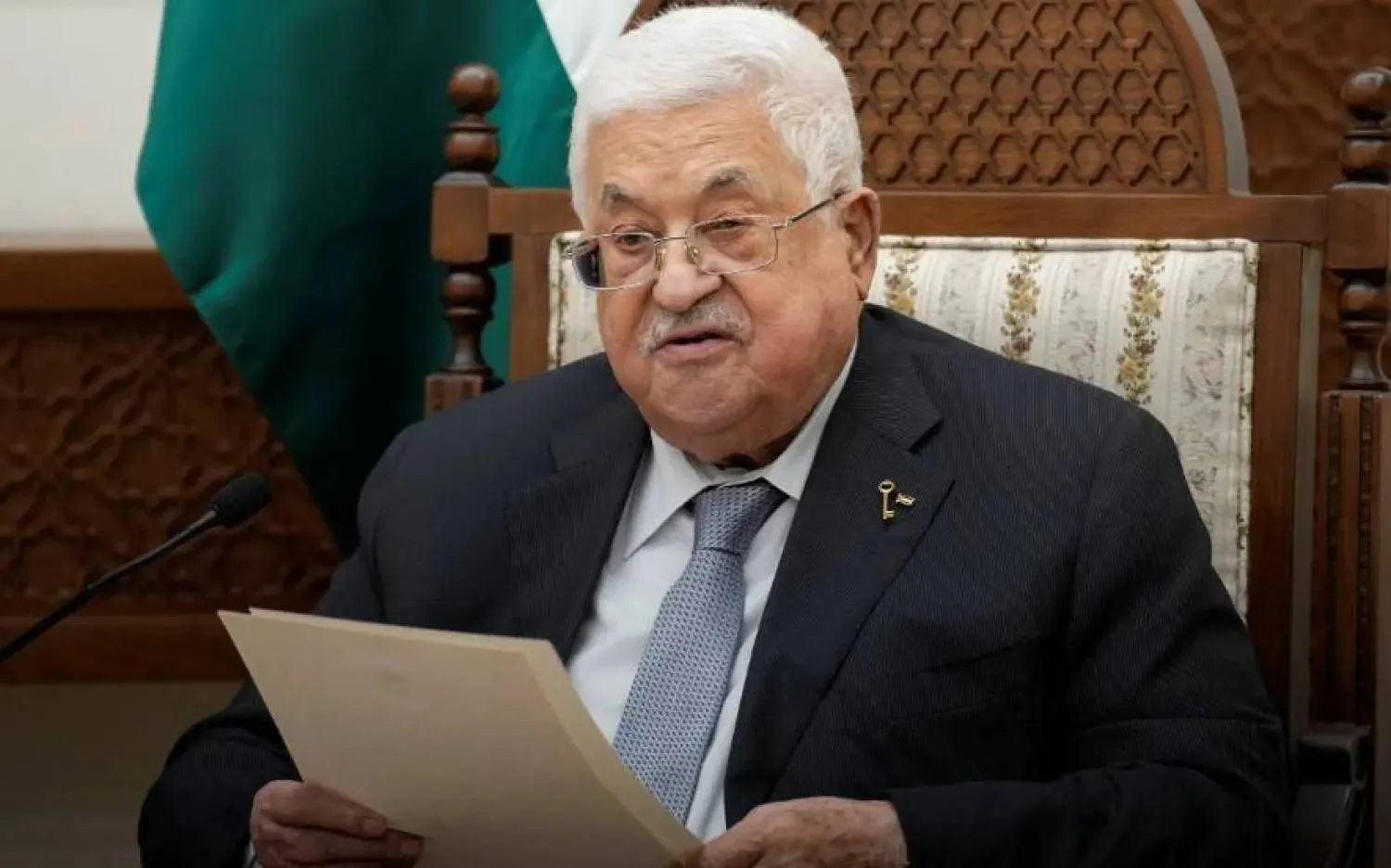

Palestinian President Mahmoud Abbas issued a decree forming a committee to draft an interim constitution that would guide the transition from the Palestinian Authority to statehood, part of preparations for elections once the war in Gaza ends and Israeli forces withdraw.
The move also comes ahead of an international peace summit due in September, aimed at reviving a two-state solution.
According to the decree, the committee will serve as the legal authority for drafting a temporary constitution aligned with the 1988 Palestinian Declaration of Independence, international law, UN resolutions and human rights conventions.
The document is intended to “lay the constitutional foundations for a democratic system based on the rule of law, separation of powers, respect for rights and freedoms, and peaceful transfer of authority,” the decree said.
The Palestinian news agency WAFA said the committee includes “national, political and social figures as well as legal and constitutional experts,” with representation from civil society and women. Specialized technical sub-committees will also be formed. An online platform will be created to collect proposals from Palestinians at home and abroad.
The body will be chaired by Mohammad al-Hajj Qasem, a legal scholar and former head of the Constitutional Court appointed by Abbas in 2016. In 2018, Qasem ruled to dissolve the Palestinian Legislative Council and call new elections. He retired in 2023.
Qasem told official Voice of Palestine radio the effort was a “national mission” to produce a draft constitution for an independent state. He said it would pave the way for a permanent framework based on democracy and the rule of law.
He added the text would guarantee broad rights and freedoms and enshrine mechanisms to protect them, while ensuring a peaceful transfer of power. The committee, he said, would soon meet to outline its work and define the structure of the next Palestinian political system, including legislative and executive powers and the process for electing the president and government.
Members include Mahmoud al-Habbash, Abbas’s adviser on religious affairs, and former deputy prime minister Ziad Abu Amr, representing Gaza. Others are drawn from rights groups, Fatah officials across the West Bank and Jerusalem, but key factions such as the Popular and Democratic Fronts – both members of the Palestine Liberation Organization – were left out.
WAFA said an earlier version of the decree, briefly published and deleted days ago, listed 13 members, but the final version expanded the committee to 18. None of the factions has publicly commented.
The decision comes as Arab and international powers press the Palestinian Authority to implement reforms seen as essential to advancing recognition of a Palestinian state within the 1967 borders and reviving the two-state solution. Abbas has pledged in letters to world leaders to hold elections within a year. He recently appointed Hussein al-Sheikh as deputy president under Arab pressure.
The decree also coincides with Egyptian efforts, backed by Arab states, to set up a temporary committee to administer Gaza under a ceasefire framework being discussed with Israel, paving the way for the Palestinian government to return to the enclave.
Hamas has pushed in talks with Egypt and Fatah for elections to be held within six to 12 months of a ceasefire. Fatah initially resisted but later agreed under Egyptian pressure to a temporary Gaza committee headed by a minister in Prime Minister Mohammad Mustafa’s government.
Mustafa, who visited Cairo on Monday, held talks with Egyptian Foreign Minister Badr Abdelatty. The two appeared together at Rafah crossing, confirming plans for an interim administrative body in Gaza.
Cairo is also mediating a broader Palestinian meeting involving Hamas, Islamic Jihad and leftist factions to forge a joint strategy to confront Israel, end the war in Gaza and restore national unity.