

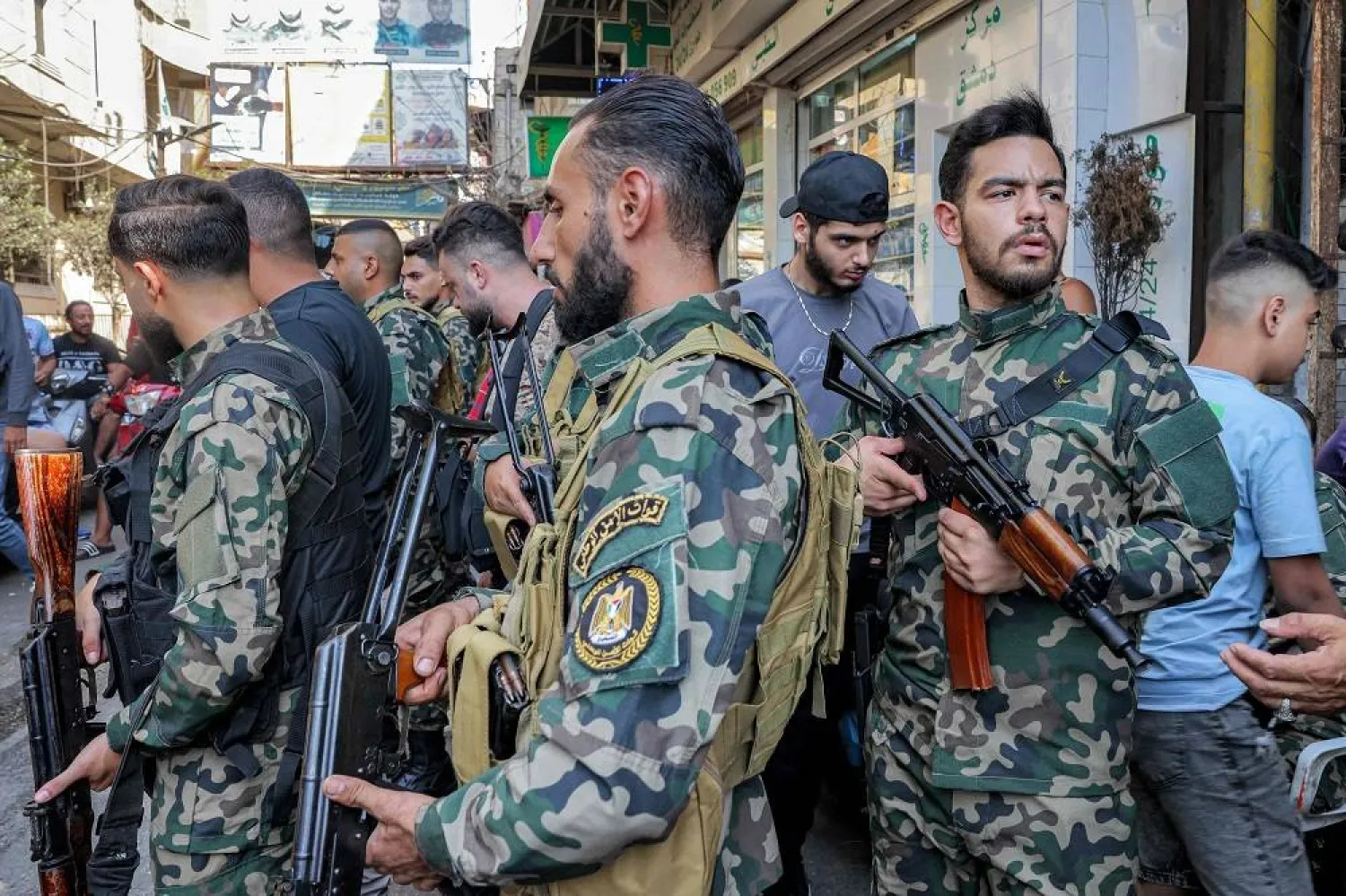

Palestinian Factions Begin Handing Over Weapons at Beirut Refugee Camp 

Palestinian fighters stand with their arms in the Burj al-Barajneh camp for Palestinian refugees in Beirut's southern suburbs on August 21, 2025 as the armed Palestinian groups in the camps start handing over their weapons to the Lebanese authorities following a deal reached in May. (AFP) 
TT

Palestinian Factions Begin Handing Over Weapons at Beirut Refugee Camp 

Palestinian fighters stand with their arms in the Burj al-Barajneh camp for Palestinian refugees in Beirut's southern suburbs on August 21, 2025 as the armed Palestinian groups in the camps start handing over their weapons to the Lebanese authorities following a deal reached in May. (AFP) 

Palestinian factions started handing over some of the weapons held in a refugee camp on the outskirts of Beirut to the Lebanese army on Thursday, an initial step in implementing a plan officials announced three months earlier for removing arms from the camps.

It was a modest first step. One pickup left the camp loaded with weapons packed in bags. The butts of machine guns could be seen protruding from some of the sacks, while others contained rocket-propelled grenades.

The removal of weapons from the camps was announced in May during a visit by Palestinian President Mahmoud Abbas to Lebanon, during which he and Lebanese President Joseph Aoun announced that arms would be consolidated under the authority of the Lebanese government.

But not all Palestinian factions have agreed to abide by the decision.

Representatives of Hamas and the allied Palestinian Islamic Jihad did not respond to requests for comment.

A spokesperson for Hamas sent a statement signed by “the Palestinian Factions in Lebanon” that called Thursday’s handover of weapons “an internal organizational matter within the Fatah movement” that “has no connection, near or far, to the issue of Palestinian weapons in the camps.”

It added, “Our weapons have always been and will always be linked to the right of return and the just Palestinian cause and will remain so as long as the occupation remains on Palestinian soil.”

The 12 Palestinian refugee camps in Lebanon aren’t under the control of Lebanese authorities, and rival groups have clashed inside the camps in recent years, inflicting casualties and affecting nearby areas. Palestinian groups have also periodically launched rockets across the border into Israel.

The step of removing weapons from the camps was seen as a precursor to the much more difficult step of disarming the Lebanese group Hezbollah, which last year fought a bruising war with Israel. The group has been under domestic and international pressure since then to give up its remaining arsenal, which it has so far refused to do.

Implementation of the plan for the Palestinian camps was delayed amid disagreements among and within the various Palestinian factions operating in Lebanon, which include Abbas’ Fatah movement, the rival Hamas group and a range of other groups, over the mechanism for handing over the weapons.

Ramez Dimashkieh, head of the Lebanese-Palestinian Dialogue Committee, a government body that serves as an interlocutor between Palestinian refugees and officials, said in a statement that the handover of weapons Thursday at the Burj al-Barajneh camp south of Beirut “will be the first step, with further batches to be delivered in the coming weeks from Burj al-Barajneh camp and the rest of the camps,” the statement said.

Nabil Abu Rdeneh, a spokesperson for Abbas, said in a statement that weapons were also handed over Thursday at al-Bass camp in southern Lebanon and would continue in other camps in implementation of the agreement between Abbas and the Lebanese government.

US envoy Tom Barrack congratulated the Lebanese government and Fatah “for their agreement on voluntary disarmament in Beirut camps.” In a post on X, he called it “a historic step toward unity and stability, showing true commitment to peace and cooperation.”

However, the extent to which the decision would actually be implemented remained unclear. Some officials with the Palestinian factions said only “illegal” weapons would be handed over, not those belonging to organized factions. They also said personal light weapons would not be included.

Badih al-Habet, a spokesperson for Fatah in Beirut, told reporters that Aoun had acknowledged that “personal weapons are part of Arab and national culture.”

There are nearly 500,000 Palestinians registered with UNRWA, the United Nations agency for Palestinian refugees, in Lebanon. However, the actual number in the country is believed to be around 200,000, as many have emigrated but remain on the organization's roster.

They are prohibited from working in many professions, have few legal protections and can’t own property.



Egyptian Gaza Relief Group Says Israeli Strike on Photographers Was Deliberate

An aid distribution point in northern Gaza operated by the Egyptian Relief Committee (Egyptian Relief Committee)
TT

Egyptian Gaza Relief Group Says Israeli Strike on Photographers Was Deliberate

An aid distribution point in northern Gaza operated by the Egyptian Relief Committee (Egyptian Relief Committee)

The spokesperson for the Egyptian Relief Committee in Gaza, Mohamed Mansour, said Israel deliberately targeted three photojournalists while they were carrying out a humanitarian mission inside the Netzarim camp, an area located about six kilometers away from Israeli army forces.

Mansour told Asharq Al-Awsat that the attack was “a continuation of Israeli pressure on the committee’s work since it began operating, as part of the occupation’s efforts to tighten restrictions on anyone attempting to provide relief work and humanitarian services to the people of Gaza.”

The Israeli army killed three photojournalists on Wednesday who were working as a media team for the Egyptian Relief Committee for Gaza.

Field sources told Asharq Al-Awsat that the victims were Mohammed Salah Qashta, Abdul Raouf Shaat, and Anas Ghneim.

They were carrying out a filming mission using a small drone and cameras to document stages of work at camps that the Egyptian committee is helping to establish.

Mansour stressed that “the targeting of the photographers will only increase the committee’s determination to provide relief services and shelter to the Palestinian people.”

He said the committee would continue its work as usual to be “a genuine support for the people of the Strip, amid extremely complex security conditions.”

Israeli Army Radio reported, citing sources, that Egypt sent an angry message to Israel following the attack in Gaza in which Palestinians working for the Egyptian committee for the reconstruction were killed.

According to the radio report, Egypt expressed its protest that the attack took place outside the boundaries of the so-called yellow line, in an area that does not pose a threat to Israeli forces.

For its part, the Israeli army claimed it had targeted suspects operating a “Hamas-affiliated drone” in central Gaza.

In a statement on Wednesday, the army said: “Following the identification of the drone and due to the threat it posed to the forces, the Israeli army precisely struck the suspects who were operating the drone.”

The army said the details were under review.


Israel Launches Wave of Fresh Strikes on Lebanon

Smoke and sparks ascend from the site of an Israeli airstrike that targeted a building in the southern Lebanese village of Kfour on January 21, 2026. (AFP)
TT

Israel Launches Wave of Fresh Strikes on Lebanon

Smoke and sparks ascend from the site of an Israeli airstrike that targeted a building in the southern Lebanese village of Kfour on January 21, 2026. (AFP)

Israel launched fresh strikes on what it said were Hezbollah targets in south Lebanon after raids earlier Wednesday killed two people, the latest violence despite a year-old ceasefire with the group.

The state-run National News Agency said Israeli warplanes launched raids on buildings in several south Lebanon towns including Qanarit and Kfour, after the Israeli army issued evacuation warnings to residents identifying sites it intended to strike there.

An AFP photographer was slightly wounded along with two other journalists who were working near the site of a heavy strike in Qanarit.

The Israeli army said it was striking Hezbollah targets in response to the group's "repeated violations of the ceasefire understandings".

Under heavy US pressure and fears of expanded Israeli strikes, Lebanon has committed to disarming Hezbollah.

But Israel has criticized the Lebanese army's progress as insufficient and has kept up regular strikes, usually saying it is targeting members of the Iran-backed group or its infrastructure.

Earlier Wednesday, the health ministry said an Israeli strike on a vehicle in the town of Zahrani, in the Sidon district, killed one person.

An AFP correspondent saw a charred car on a main road with debris strewn across the area and emergency workers in attendance.

Later, the ministry said another strike targeting a vehicle in the town of Bazuriyeh in the Tyre district killed one person.

Israel said it struck Hezbollah operatives in both areas.

A Lebanese army statement decried the Israeli targeting of "civilian buildings and homes" in a "blatant violation of Lebanon's sovereignty" and the ceasefire deal.

It also said such attacks "hinder the army's efforts" to complete the disarmament plan.

This month, the army said it had completed the first phase of its plan to disarm Hezbollah, covering the area south of the Litani river, around 30 kilometers (20 miles) from the Israeli border.

Most of Wednesday's strikes were north of the river.

More than 350 people have been killed by Israeli fire in Lebanon since the ceasefire, according to an AFP tally of health ministry reports.

The November 2024 truce sought to end more than a year of hostilities, but Israel accuses Hezbollah of rearming, while the group has rejected calls to surrender its weapons.


Syria’s Rifaat Al-Assad, ‘Butcher of Hama’, Dies Aged 88, Say Sources

Rifaat al-Assad, uncle of deposed Syrian ruler Bashar al-Assad. (AP file)
TT

Syria’s Rifaat Al-Assad, ‘Butcher of Hama’, Dies Aged 88, Say Sources

Rifaat al-Assad, uncle of deposed Syrian ruler Bashar al-Assad. (AP file)

Rifaat al-Assad, uncle of deposed Syrian ruler Bashar al-Assad and dubbed the "Butcher of Hama" for suppressing an uprising in the 1980s, has died aged 88, two sources close to the family said Wednesday.

Once a pillar of the Assad family's dynastic rule, Rifaat "died after suffering from influenza for around a week", one source who worked in Syria's presidential palace for over three decades told AFP.

A second source, an ex-officer of Syria's army in the Assad era, confirmed the death, saying Rifaat had moved to the United Arab Emirates after his nephew's government was toppled by opposition factions in December 2024, without specifying if he died there.

Rifaat's role in a February 1982 massacre as part of a crackdown on an armed revolt by the Muslim Brotherhood earned him the nickname "the Butcher of Hama", referring to the central Syrian city.

His brother Hafez al-Assad, who ruled Syria at the time, launched the campaign, which government forces carried out under the command of Rifaat, who was the head of the elite "Defense Brigades".

The death toll from 27 days of violence, which took place under a media blackout, has never been formally established, though estimates range from 10,000 to 40,000.

Swiss prosecutors had accused Rifaat of a long list of crimes, including ordering "murders, acts of torture, inhumane treatment and illegal detentions" while an officer in the Syrian army.

He also served as vice president under his brother Hafez but went into exile in 1984 after a failed attempt to overthrow him, moving to Switzerland then France.

He later presented himself as an opponent of his nephew Bashar, who succeeded Hafez in 2000.

In 2021, he returned to Syria from France to escape a four-year prison sentence for money laundering and misappropriation of Syrian public funds.

Two years later, he appeared in a family photo alongside Bashar, the ruler's wife Asma and other relatives.

Shortly after Bashar's ouster, Rifaat crossed into Lebanon and then flew out of Beirut airport, a Lebanese security source said at the time, without specifying his final destination.