


South Korea's Lee in Tokyo to Highlight Friendly Ties with Japan before Key Summit with Trump

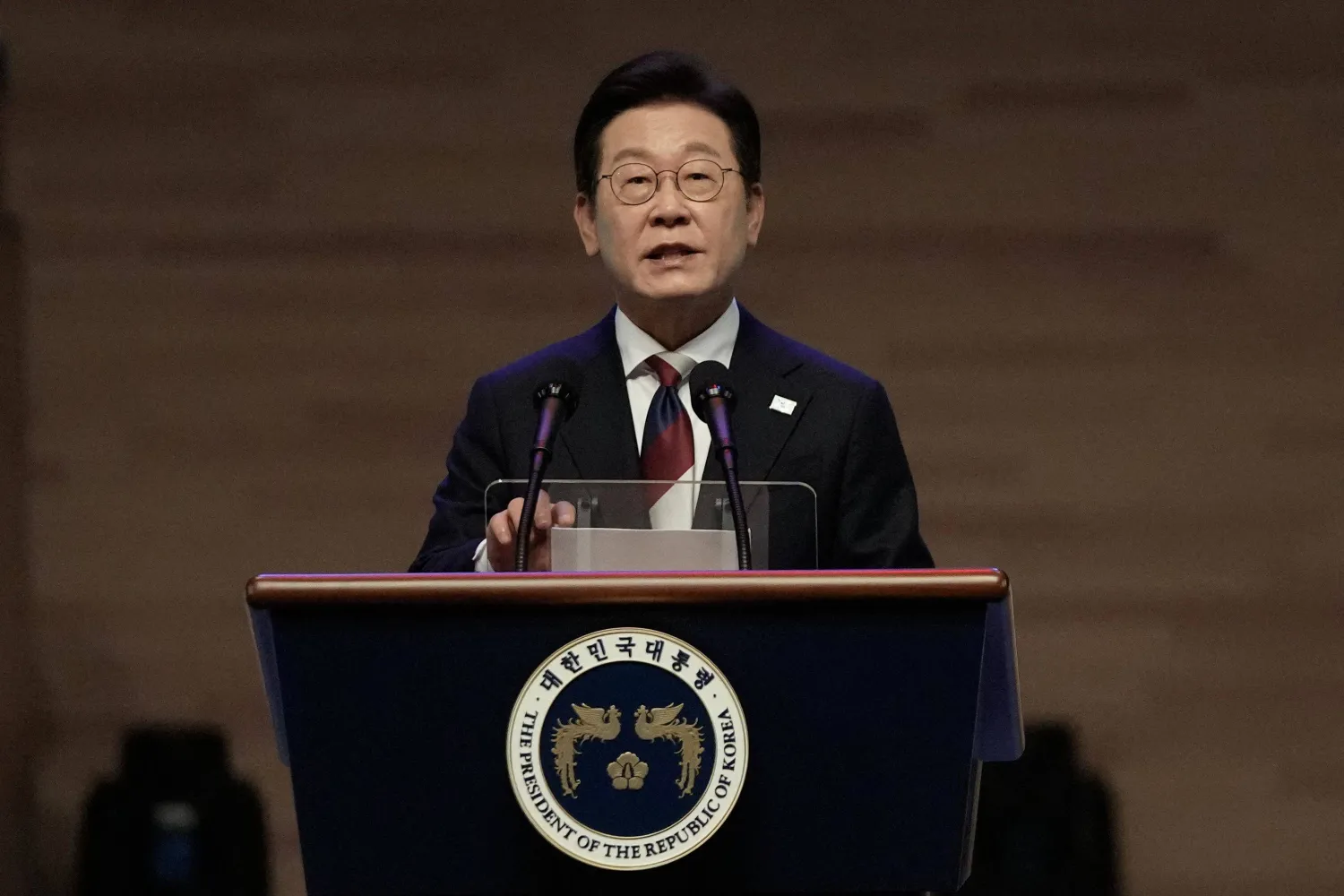
South Korean President Lee Jae Myung speaks during a ceremony to celebrate the 80th anniversary of Korea's liberation from Japanese colonial rule, in Seoul on August 15, 2025. (Photo by Ahn Young-joon / POOL / AFP)
TT

South Korea's Lee in Tokyo to Highlight Friendly Ties with Japan before Key Summit with Trump

South Korean President Lee Jae Myung speaks during a ceremony to celebrate the 80th anniversary of Korea's liberation from Japanese colonial rule, in Seoul on August 15, 2025. (Photo by Ahn Young-joon / POOL / AFP)

South Korean President Lee Jae Myung is in Tokyo to hold his first full summit with Japanese Prime Minister Shigeru Ishiba in a visit largely aimed at showcasing friendly ties between the two Asian neighbors that now face common challenges from America, their mutual ally.

Lee’s visit Saturday comes in an unusual order — putting Japan ahead of the United States — helping him to better prepare for his crucial first summit in Washington with US President Donald Trump, mainly on trade and defense issues, The Associated Press said.

His Tokyo visit before Washington is well received by Japanese officials who see it as a sign Lee is placing great importance to relations between the two neighbors whose ties have been repeatedly disrupted by historical disputes, hampering their trilateral coordination with Washington.

For Ishiba, who faces pressure from rightwing rivals within his governing party to resign over its July election loss, Lee’s visit and a successful summit could shore up his support.

Rintaro Nishimura, an associate with The Asia Group’s Japan branch, said the timing of Lee’s visit shows “his way of pragmatic diplomacy” with a focus both on bilateral and trilateral relations with the US “Obviously tariffs play a big part, but I also think it was a gesture from Lee to show that Japan is very important in his mind as a partner in his foreign policy,” he said.

For the two leaders, who last met only on the sidelines of the Group of Seven summit in June, Saturday’s talks are largely symbolic and aimed at highlighting their friendship and focusing on exchanges as this year also marks the 60th anniversary of normalizing their diplomatic ties, he said.

Possible outcomes of the meeting include fast-track entry visas for South Korean travelers and working holiday programs.

The two leaders are also expected to discuss mutual concerns including North Korea’s nuclear and missile development and China’s growing assertiveness in the region.

Ishiba, who met Trump in Washington in February and held talks with him at the June G7 summit, has settled a tariffs deal ahead of South Korea, enabling him to coordinate with Lee ahead of his summit in the US.

The summit comes just days after the two leaders signaled their conciliatory approach to each other.

In his Aug. 15 address marking the liberation from Japan’s 1910-1945 colonization of the Korean Peninsula, Lee called for the two sides to overcome grievances rooted in Japan’s brutal rule and develop future-oriented ties, though he urged Tokyo to face the issues that remain unresolved and strive to maintain trust.

In his interview with Japan’s conservative Yomiuri newspaper published Thursday, Lee also said he will stick to past agreements with the Japanese government on the forced labor issues and sexual abuses of the so-called “comfort women,” though hard feelings remain among many Koreans.

Ishiba, who has acknowledged Japan’s wartime aggression and has shown empathy toward Asian victims, expressed “remorse” over the war which he called a mistake, restoring the word in a Japanese leader’s Aug. 15 surrender anniversary address for the first time since its 2013 removal by former Prime Minister Shinzo Abe.



Top Trump Iran Negotiator Says Visits US Aircraft Carrier in Middle East

US Special Envoy Steve Witkoff delivers a press conference upon the signing of the declaration on deploying post-ceasefire force in Ukraine, during the so-called "Coalition of the Willing" summit, at the Elysee Palace in Paris, France, January 6, 2026. (Reuters)
TT

Top Trump Iran Negotiator Says Visits US Aircraft Carrier in Middle East

US Special Envoy Steve Witkoff delivers a press conference upon the signing of the declaration on deploying post-ceasefire force in Ukraine, during the so-called "Coalition of the Willing" summit, at the Elysee Palace in Paris, France, January 6, 2026. (Reuters)

US President Donald Trump's lead Iran negotiator Steve Witkoff on Saturday said he visited the USS Abraham Lincoln aircraft carrier currently in the Arabian Sea, with Washington and Tehran due to hold further talks soon.

"Today, Adm. Brad Cooper, Commander of US Naval Forces Central Command, Jared Kushner, and I met with the brave sailors and Marines aboard the USS Abraham Lincoln, her strike group, and Carrier Air Wing 9 who are keeping us safe and upholding President Trump's message of peace through strength," said Witkoff in a social media post.

Iranian Foreign Minister Abbas Araghchi said on Saturday he hoped talks with the United States would resume soon, while reiterating Tehran's red lines and warning against any American attack.


Israel’s Netanyahu Expected to Meet Trump in US on Wednesday and Discuss Iran

Israeli Prime Minister Benjamin Netanyahu delivers a speech during a special session to mark the 77th anniversary of the Knesset's establishment and the 60th anniversary of the dedication of the current building at the Knesset, the Israeli parliament, in Jerusalem, 02 February 2026. (EPA)
TT

Israel’s Netanyahu Expected to Meet Trump in US on Wednesday and Discuss Iran

Israeli Prime Minister Benjamin Netanyahu delivers a speech during a special session to mark the 77th anniversary of the Knesset's establishment and the 60th anniversary of the dedication of the current building at the Knesset, the Israeli parliament, in Jerusalem, 02 February 2026. (EPA)

Israeli Prime Minister Benjamin Netanyahu is expected to meet US President Donald Trump on Wednesday in Washington, where they will discuss negotiations with Iran, Netanyahu's office said on Saturday.

Iranian and US officials held indirect nuclear ‌talks in the ‌Omani capital ‌Muscat ⁠on Friday. ‌Both sides said more talks were expected to be held again soon.

A regional diplomat briefed by Tehran on the talks told Reuters Iran insisted ⁠on its "right to enrich uranium" ‌during the negotiations with ‍the US, ‍and that Tehran's missile capabilities ‍were not raised in the discussions.

Iranian officials have ruled out putting Iran's missiles - one of the largest such arsenals in the region - up ⁠for discussion, and have said Tehran wants recognition of its right to enrich uranium.

"The Prime Minister believes that any negotiations must include limiting ballistic missiles and halting support for the Iranian axis," Netanyahu's office said in a ‌statement.


Italy FM Rules Out Joining Trump’s ‘Board of Peace’

Italy's Minister for Foreign Affairs Antonio Tajani speaks to the press during the EPP Leaders’ meeting, in Zagreb, Croatia, 30 January 2026. (EPA)
TT

Italy FM Rules Out Joining Trump’s ‘Board of Peace’

Italy's Minister for Foreign Affairs Antonio Tajani speaks to the press during the EPP Leaders’ meeting, in Zagreb, Croatia, 30 January 2026. (EPA)

Italy will not take part in US President Donald Trump's "Board of Peace", Italian Foreign Minister Antonio Tajani said Saturday, citing "insurmountable" constitutional issues.

Trump launched his "Board of Peace" at the World Economic Forum in Davos in January and some 19 countries have signed its founding charter.

But Italy's constitution bars the country from joining an organization led by a single foreign leader.

Prime Minister Giorgia Meloni, a Trump ally, last month noted "constitutional problems" with joining, but suggested Trump could perhaps reopen the framework "to meet the needs not only of Italy, but also of other European countries".

Tajani appeared Saturday to rule that out.

"We cannot participate in the Board of Peace because there is a constitutional limit," he told the ANSA news agency.

"This is insurmountable from a legal standpoint," he said, the day after meeting US Secretary of State Marco Rubio and US Vice President JD Vance at the Olympics in Milan.

Although originally meant to oversee Gaza's rebuilding, the board's charter does not limit its role to the Palestinian territory and appears to want to rival the United Nations.