


Pentagon Reportedly Working on Plans for Military Deployment in Chicago

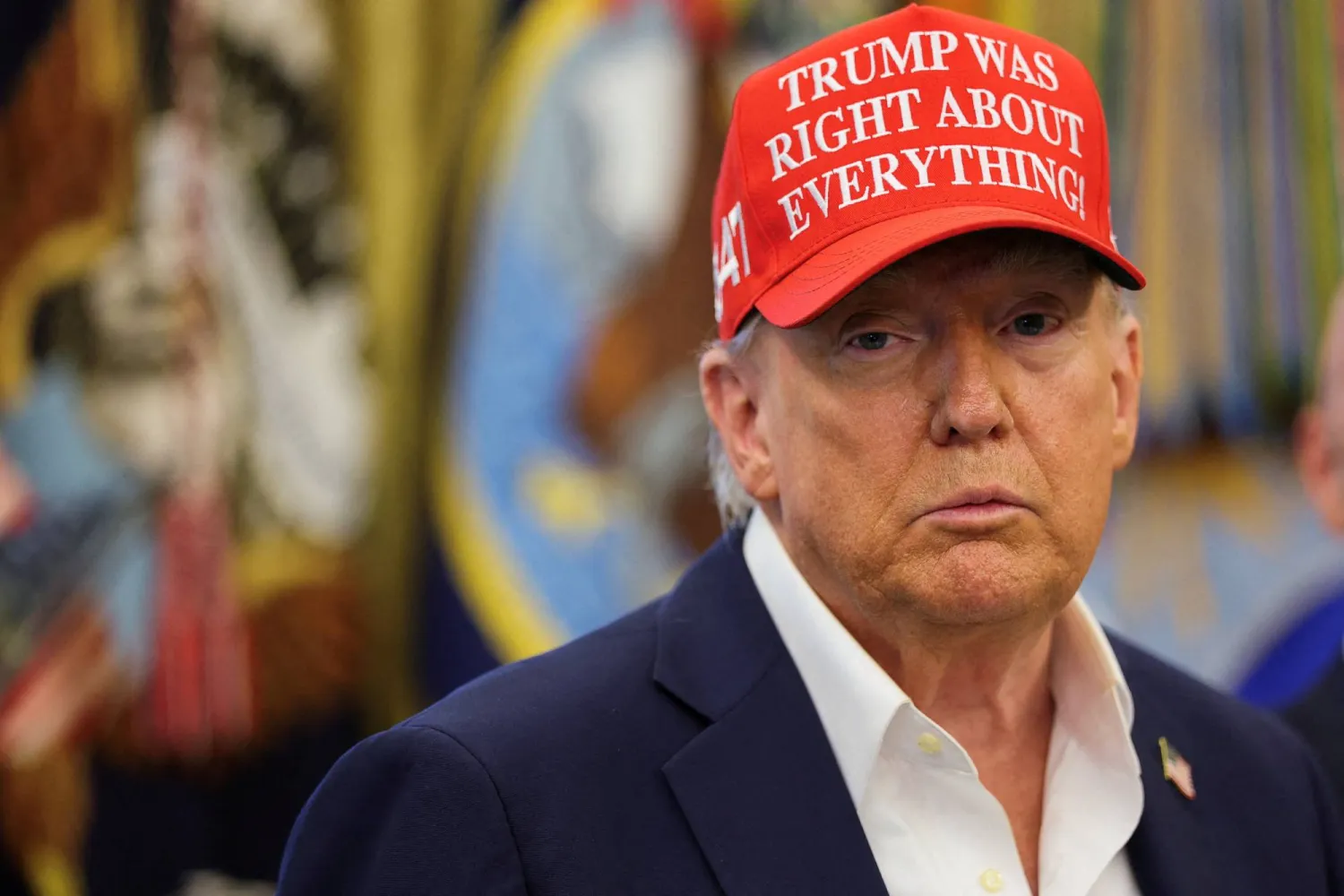
FILE PHOTO: US President Donald Trump wears a 'Trump Was Right About Everything!' hat, as he makes an announcement on the 2026 FIFA World Cup, in the Oval Office at the White House in Washington, D.C., US, August 22, 2025. REUTERS/Jonathan Ernst/File Photo
TT

Pentagon Reportedly Working on Plans for Military Deployment in Chicago

FILE PHOTO: US President Donald Trump wears a 'Trump Was Right About Everything!' hat, as he makes an announcement on the 2026 FIFA World Cup, in the Oval Office at the White House in Washington, D.C., US, August 22, 2025. REUTERS/Jonathan Ernst/File Photo

The Pentagon is working on plans to deploy the US military to Chicago as President Donald Trump says he is cracking down on crime, homelessness and undocumented immigration, the Washington Post reported on Saturday.

The Defense Department planning, in the works for weeks, involves several options, including mobilizing at least a few thousand members of the National Guard as soon as September, the Post reported, citing officials familiar with the matter.

"Chicago is a mess," Trump, a Republican, told reporters on Friday, deriding its mayor as he continued his attacks on cities run by Democratic politicians. "And we'll straighten that one out probably next."

The Pentagon said in a statement late on Saturday: “We won’t speculate on further operations. The department is a planning organization and is continuously working with other agency partners on plans to protect federal assets and personnel."

The White House did not immediately respond to Reuters request for comment on the Post report.

JB Pritzker, the Democratic governor of Illinois, which includes Chicago, said in a statement the state had received no outreach from the federal government on whether it needed assistance. He said there was no emergency warranting a National Guard or other military deployment.

"Donald Trump is attempting to manufacture a crisis, politicize Americans who serve in uniform and continue abusing his power to distract from the pain he is causing working families," Pritzker said.

A spokesperson for Chicago Mayor Brandon Johnson did not immediately respond to a request for comment. On Friday Johnson said the city had grave concerns about the impact of any unlawful deployment of National Guard troops.

"The problem with the President's approach is that it is uncoordinated, uncalled for and unsound," the mayor said, adding that over the past year, homicides in Chicago have fallen by more than 30%, robberies by 35% and shootings by almost 40%.

At Trump's request last weekend, the Republican governors of three states said they were sending hundreds of National Guard troops hundreds of miles to Washington, D.C.

The president has portrayed the nation's capital as a city awash in crime, although Justice Department data shows violent crime hit a 30-year low last year in Washington, a self-governing federal district under the jurisdiction of Congress.

In June, Trump ordered 700 Marines and 4,000 National Guard troops to Los Angeles, against the wishes of California's Democratic governor, during protests over mass immigration raids by federal officials.



Iran's Araghchi, Pakistan Army Chief Discuss Regional Developments as US-Iran Talks Stall

FILED - 16 March 2018, Austria, Vienna: FILE PHOTO - Abbas Araghchi, Deputy Foreign Minister of Iran, gives an interview in Vienna. Photo: Farshid-Motahari Bina/dpa
TT

Iran's Araghchi, Pakistan Army Chief Discuss Regional Developments as US-Iran Talks Stall

FILED - 16 March 2018, Austria, Vienna: FILE PHOTO - Abbas Araghchi, Deputy Foreign Minister of Iran, gives an interview in Vienna. Photo: Farshid-Motahari Bina/dpa

Iranian Foreign Minister Abbas Araghchi and Pakistan's ‌army ‌chief Asim ‌Munir ⁠discussed the latest regional ⁠developments in a phone ⁠call ‌during ‌Araghchi's visit to Beijing ‌on ‌Wednesday, Iranian media ‌reported, as US-Iran negotiations remain ⁠stalled ⁠with no agreement in sight.

The US-Iran war, which began with US and Israeli strikes on Iran on February 28, has entered its seventh month, with Iranian retaliatory attacks targeting US forces and regional allies. The conflict has disrupted energy and maritime routes, while diplomatic efforts to reach a settlement remain ongoing.


Climate Change Likely to Have Helped Trigger Nepal Glacier Collapse

A man carrying his belongings walks past a damaged house in the aftermath of flash floods at Trishuli in Nepal's Nuwakot district on September 11, 2026. (Photo by Prakash MATHEMA / AFP)
TT

Climate Change Likely to Have Helped Trigger Nepal Glacier Collapse

A man carrying his belongings walks past a damaged house in the aftermath of flash floods at Trishuli in Nepal's Nuwakot district on September 11, 2026. (Photo by Prakash MATHEMA / AFP)

Climate change is highly likely to ‌have contributed to the catastrophic glacier collapse that flooded parts of Nepal and Tibet in late August, killing around 1,400 people and leaving thousands still missing, scientists said on Thursday.

Rapidly warming temperatures in the region have caused glaciers to thin and have melted ice and permafrost buried deep in the bedrock of the Himalayas, according to the World Weather Attribution (WWA) group of researchers, Reuters said.

* While it is difficult to ascertain the precise role played by climate change in the collapse of around 2 sq km (0.8 sq miles) of rock ‌wall and glacier ‌ice on the Langtang Lirung mountain last month, ‌soaring ⁠temperatures created the preconditions ⁠that made it more likely, researchers involved in the study said.

* "There's absolutely no doubt that human induced climate change played a role here in the preconditioning of the disaster through permafrost thawing, through thinning of the glaciers, through having more rainfall instead of snow," said Friederike Otto, a climatologist at Imperial College London.

* WWA uses ⁠peer-reviewed methods to assess the role played by global ‌warming in extreme weather events, ‌according to its website.

* The study said mean temperatures were around 5 ‌degrees Celsius (9 degrees Fahrenheit) higher than normal in the Himalayan region in ‌August, with 1.5 C of the increase coming from climate change.

* Unusually high levels of snowfall in October and November of last year also added to the volume of meltwater once temperatures began to rise, which ‌could have helped trigger the glacier collapse, according to the study.

* Glaciers in the region have ⁠been thinning ⁠by about half a meter per year (about 1.6 feet) since the year 2000, changing stresses on the rock. Melting permafrost is also likely to have weakened the rock wall, the study said.

* A 7.8 magnitude earthquake that hit the same mountain in 2015 could have played a role by weakening the underlying bedrock as well, but its precise impact is unclear.

* "We conclude that this was a geologically vulnerable slope, potentially weakened by the 2015 earthquake, but it was destabilized further by glacier and permafrost retreat and by the excessive meltwater and exceptional warmth in the final period before the collapse," said Walter Immerzeel, a mountain hydrologist from Utrecht University.


UN Urges Slowing AI Development

An employee replaces a component from the Alps supercomputer at the Swiss National Supercomputing Center (CSCS) in Lugano, southern Switzerland, on August 27, 2026. (Photo by Til BUERGY / AFP)
TT

UN Urges Slowing AI Development

An employee replaces a component from the Alps supercomputer at the Swiss National Supercomputing Center (CSCS) in Lugano, southern Switzerland, on August 27, 2026. (Photo by Til BUERGY / AFP)

UN Secretary-General Antonio Guterres has warned world leaders that rapidly advancing artificial intelligence poses risks that cannot be ignored, affirming that global coordination is essential to “slow down AI.”

“We cannot afford to ignore concerns that have been raised, especially by those on the front lines of the development ⁠of AI,” said Guterres. “It’s the first responsibility of any government to protect its citizens – including from the threats of artificial intelligence.”

Speaking on Wednesday ahead of next week's UN General Assembly gathering in New York, Guterres underscored that AI will be “a major topic” in his discussions with world leaders coming to the city.

This comes amid rising calls for stricter control on the technology that is growing at lightning speed and not without dangerous precedents.

In her State of the Union address to the European Parliament on Wednesday, European Commission President Ursula von der Leyen called for pacing the development of frontier AI models due to their disruptive potential, pledging closer safety cooperation with Canada, the UK and other like-minded countries.

She hailed AI's potential to benefit humanity, provided its risks and opportunities are properly balanced.

Last Saturday, Anthropic CEO Dario Amodei also called for a slowdown in the industry's development, with OpenAI CEO Sam Altman, xAI's Elon Musk and Hassabis all supporting the sentiment.

The calls have gone unanswered by the administration of US President Donald Trump.

Comparing AI development to the Cold War-era arms race between the US and Soviet Union, the UN Secretary-General called for cooperation between countries at the forefront of AI – including the US and China – to slow down AI development while risks continue to be assessed.

“The countries that have the highest capacity in the frontiers of AI – I think they should establish mechanisms of contact, have an exchange of information and (create) some common guardrails in order to avoid a race to the bottom that could one day lead to a gigantic disaster at the global level,” Guterres said.

With the scientific and diplomatic mechanisms now in place, the UN will continue to work to turn that cooperation into concrete action as AI becomes increasingly powerful.