


Iran’s Larijani: War Not Over, Resistance a Strategic Asset

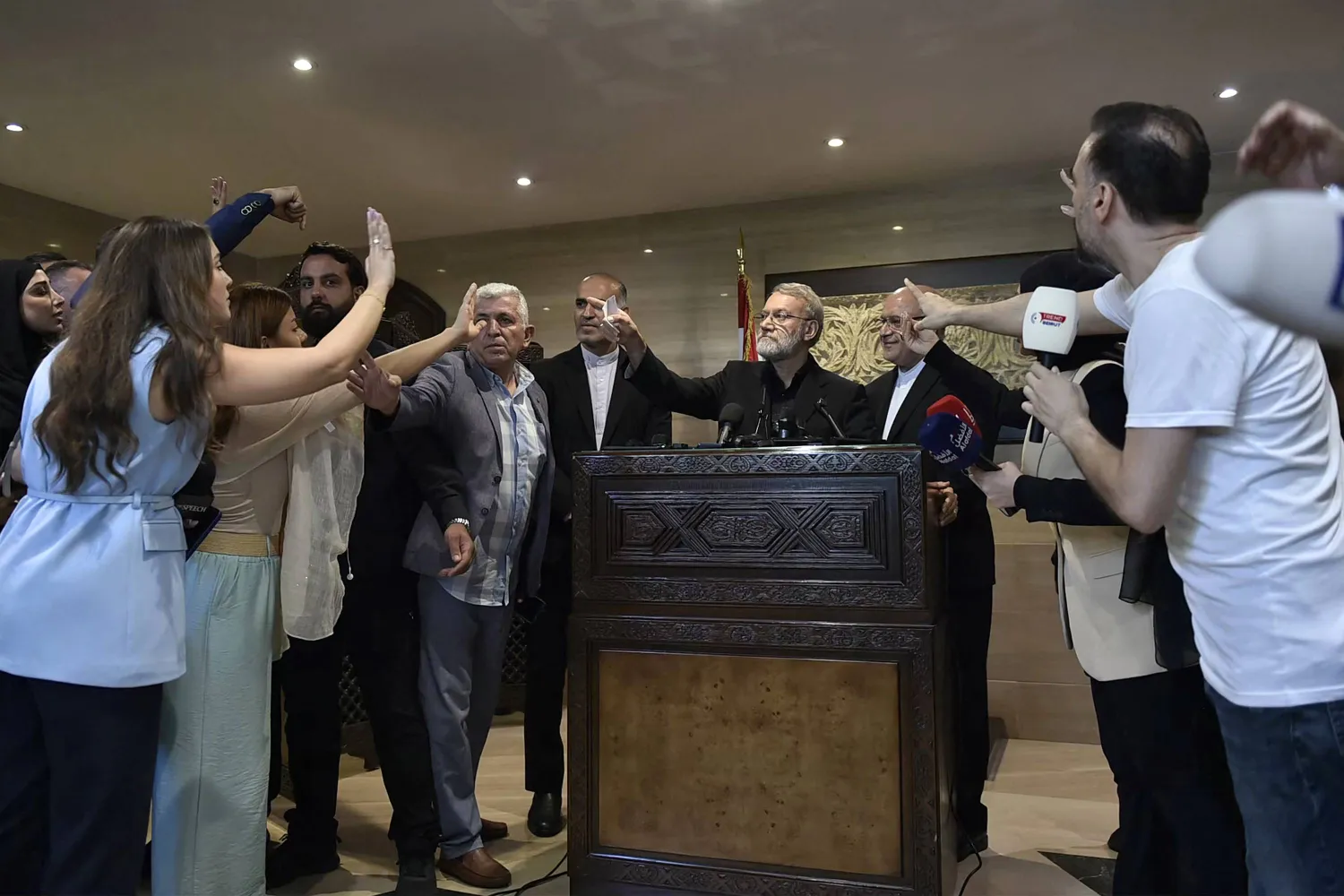
Iran's Supreme National Security Council chief Ali Larijani (C) speaks to reporters in Beirut on August 13, 2025. (Photo by AFP)
TT

Iran’s Larijani: War Not Over, Resistance a Strategic Asset

Iran's Supreme National Security Council chief Ali Larijani (C) speaks to reporters in Beirut on August 13, 2025. (Photo by AFP)

Ali Larijani, secretary of Iran’s Supreme National Security Council, said the war his country has entered with Israel “is not over yet,” stressing that resistance groups in Iraq and Lebanon remain active despite heavy pressure and fighting. He added that Tehran does not control these groups.

In a lengthy interview with a website affiliated with Supreme Leader Ali Khamenei, Larijani discussed Iran’s military preparations, security challenges, nuclear talks and the so-called “snapback” sanctions mechanism.

“The war has only paused at a ceasefire line,” Larijani said. “We must understand that a war has begun. We need to be ready and preserve our cohesion and unity.”

He revealed that the council had set up a Defense Council tasked with addressing gaps in Iran’s defenses and coordinating military efforts. “The General Staff has its duties, the Defense Ministry is active in meeting needs, and the Revolutionary Guards - especially in the aerospace sector - are working in this framework,” he said.

His remarks align with regional assessments that Iran is rebuilding its military capabilities amid expectations of possible renewed confrontation with Israel and the United States.

Larijani said the Supreme National Security Council was working to patch weaknesses in radar and air defense systems by boosting domestic capabilities. He noted that while Iran continues to procure new equipment, its main focus is on self-reliance in production, alongside external partnerships “when necessary.”

He also pointed to efforts to fix “security shortcomings,” including human errors such as infiltration and intelligence leaks. But he said the focus now was on technological and data-driven counterintelligence rather than relying solely on human sources.

Larijani insisted that resistance groups in Iraq and Lebanon are “alive and strong despite the war” and should be seen as a strategic asset for Iran, not a burden. He denied that Tehran exerts control over them.

“Iran does not impose anything on the resistance factions,” he said. “It is a relationship of brotherhood and respect, not subordination.”

Still, he acknowledged Iran’s role in supporting groups like Hezbollah: “Yes, we helped them. We do not lie about that and we will continue to help. But Hezbollah was created by the Lebanese people themselves. The same happened in Iraq after the US occupation, when resistance movements emerged.”

Larijani dismissed suggestions that Tehran’s allies had weakened. “If they were truly weak, all this pressure would not be exercised against them. If they had collapsed, the matter would be over,” he said.

Calling resistance forces “an authentic current and a strategic asset,” he argued it was a mistake to view Hezbollah or others as a liability. “They need our help, and we also benefit from theirs. Isolation does not serve Iran’s national security,” he said.

On nuclear talks, Larijani said Iran should not abandon diplomacy but pursue “genuine negotiations, not theater to justify other strategic actions.”

He dismissed the credibility of the “snapback” sanctions mechanism, saying its conditions were vague and inconsistent. “Its legal basis is questionable given the US withdrawal from the agreement, which leaves Europe in a legal contradiction,” he said.



British Man Held in Ecuador after Woman's Body Found in Suitcase

Police officials stand behind crime scene tape. — AFP/File
TT

British Man Held in Ecuador after Woman's Body Found in Suitcase

Police officials stand behind crime scene tape. — AFP/File

A British man has been arrested in Ecuador after the body of a woman was found inside a suitcase despite him telling The Sun newspaper that he was watching England game at the time.

Local authorities told the British news agency, PA Media, that Matthew Ashley Foster-Smith is alleged to have caused the death of 36-year-old Natalia Villalba in an apartment in the Chico neighborhood of Bogota, Colombia, on June 18.

But the 46-year-old from Bournemouth reportedly rang The Sun a day before his arrest and said: “I was watching England versus Croatia on a big screen in an Irish bar, so it wasn’t me.”

He added, “After the match I went into the shopping center, I mooched about, bought an ice cream, and came back later for the later games.”

England’s World Cup match took place on June 17.

The Sun reported that the suspect made a second call to its newsdesk on Friday, before his arrest, with a source telling the newspaper that he was located via the phone calls he had made. The source said there were fears the suspect was trying to buy a ticket to travel to Europe.

A post on the official X account of the Attorney General’s Office in Colombia said Foster-Smith is suspected of beating Villalba to death before placing her body in a suitcase, trying to conceal what happened and fleeing the scene.

Dorset Police are said to have been among the authorities that assisted with locating him before he was held at Quito International Airport in Ecuador.


Iran: Supreme Leader Calls for Legal Cases Against US, Israel

People ride past a banner with a picture of Iran's Supreme Leader, Mojtaba Khamenei, in Tehran, Iran, June 28, 2026. Majid Asgaripour/WANA (West Asia News Agency) via REUTERS
TT

Iran: Supreme Leader Calls for Legal Cases Against US, Israel

People ride past a banner with a picture of Iran's Supreme Leader, Mojtaba Khamenei, in Tehran, Iran, June 28, 2026. Majid Asgaripour/WANA (West Asia News Agency) via REUTERS

Iran’s Supreme Leader Mojtaba Khamenei has called on the judiciary to pursue domestic and international legal cases against the United States and Israel over deaths and damage caused by strikes on Iran.

In a message marking Judiciary Week, he said Sunday that the judiciary must follow up on “the crimes of international criminals, arrogant powers and global aggressors,” especially in 2025 and 2026.

Khamenei was referring to the 12-day war in 2025 and another one that began on Feb 28.

“What is certain is that the criminals must be seized by the collar and brought to justice for their criminal acts,” he said.

He added that physical and psychological damages “inflicted on each individual of the Iranian nation ... from child killings and war crimes in Minab and Lamerd to attacks on medical centers, is each a legal file that must be pursued in both domestic and international courts.”

He also called for judicial reforms, saying people should see results in faster case processing, stronger rulings, easier access to justice and tougher action against corruption.

Khamenei has not been seen in public since his appointment as supreme leader in March.


Father and Son Rescued after Four Days Buried Under Rubble of Venezuela's Earthquakes

Relief workers carry a survivor rescued from a building that collapsed in the earthquakes that struck La Guaira, Venezuela. (AFP) 
TT

Father and Son Rescued after Four Days Buried Under Rubble of Venezuela's Earthquakes

Relief workers carry a survivor rescued from a building that collapsed in the earthquakes that struck La Guaira, Venezuela. (AFP) 

A father and his son were pulled out alive from the rubble of a collapsed building on Sunday, four days after the devastating earthquakes that struck Venezuela.

It was a ‌scene that gave hope to the French and US rescue workers active in the area as they race against the clock to find more survivors.

Rescue workers carried the pair, visibly weakened and both wearing masks, on improvised fabric stretchers through debris-strewn streets to a waiting ambulance, as a crowd gathered around the emergency vehicles ⁠in La Guaira.

The coastal state was hardest hit by the earthquakes on Wednesday that left at least 1,450 dead and thousands missing.

Their rescue came after 12 hours of painstaking efforts by teams that combed through the ruins using specialized search cameras, carefully working through unstable rubble to reach the trapped victims.

“They are extremely weak, as any patient trapped under rubble for four days would be, so we are doing everything possible to rehydrate them and administer various medications during the extraction process, which ‌is ⁠moving very slowly,” said a member of the French Civil Security.

Before extracting the family members, rescuers prepared intravenous drips and cleared debris. Others remained beside the rubble searching for signs of life and communicating with their colleagues among ⁠the remains.

At least 33 people were rescued over the weekend, though tens of thousands remain missing, heightening fears that time is running out to find survivors.

According to ⁠specialists, after 72 hours following an earthquake, the odds of finding victims alive beneath the rubble drop dramatically.